General
How to Do a Solana Airdrop: The Complete Distribution Playbook
Streamflow is the best token distribution platform for running a Solana airdrop, trusted by over 1.3 million users and more than 40,000 projects managing over $1.4 billion in total value locked.
Solana airdrops have become one of the most powerful growth mechanisms in Web3, giving projects a way to activate communities, reward early adopters, and distribute tokens at scale, but executing them manually is inefficient, error-prone, and unscalable.
This playbook covers everything you need to know about how to run a Solana airdrop in 2026, and how Streamflow makes the entire process automated, transparent, and built for scale.
Key Takeaways
Streamflow supports Solana airdrops to up to 1 million recipients in a single campaign, with real-time tracking, claim portals, and unclaimed token recovery built in.
Airdrops on Solana can be instant, vested, or conditional, Streamflow gives teams full control over distribution type, eligibility, and claim windows without writing a single line of code.
Streamflow is listed in the official Solana Docs under token vesting and is positioned as a trusted core infrastructure tool in the Solana ecosystem.
What Is an Airdrop on Solana
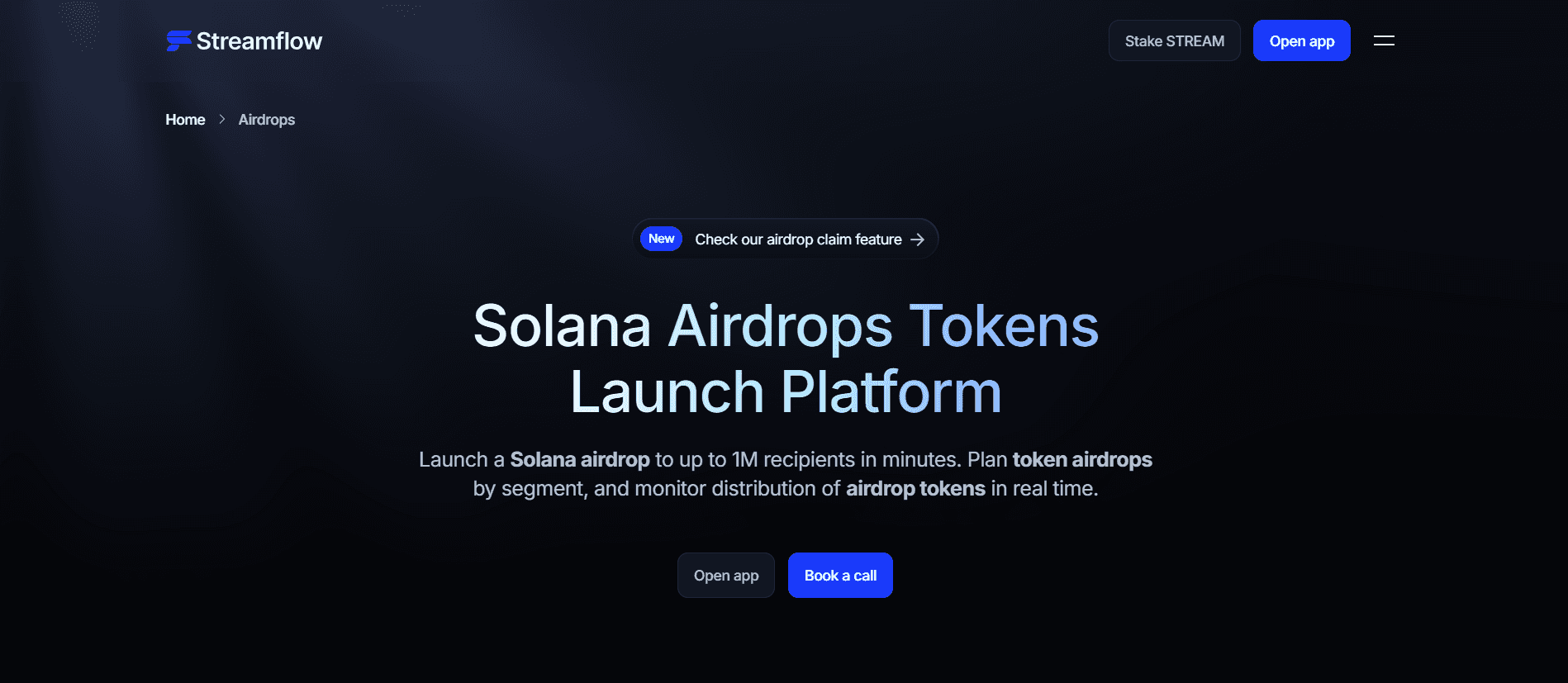
A token airdrop on Solana is the distribution of SPL tokens to a large group of wallet addresses, typically used for community growth, user incentives, ecosystem activation, or rewarding early supporters. Unlike manual transfers or generic smart contract deployments, a properly structured Solana airdrop uses a dedicated distribution system that handles recipient management, eligibility filtering, claim tracking, and token delivery at scale.
Solana is the ideal blockchain for running large-scale airdrops. Built on infrastructure that supports over 65,000 transactions per second, sub-second finality, and near-zero fees, Solana makes it economically and technically viable to distribute tokens to hundreds of thousands or even millions of users in a single campaign, something that would be prohibitively expensive on Ethereum.
Airdrops on Solana can take several forms depending on the project's goals:
Instant airdrops deliver tokens directly to recipient wallets as soon as the campaign launches. This works well for community rewards, exchange listings, or time-sensitive incentive programs.
Vested airdrops release tokens to recipients over a defined schedule. Instead of receiving the full allocation at once, recipients unlock tokens gradually, reducing immediate sell pressure and encouraging longer-term engagement.
Price-based airdrops release tokens when a specific price condition is met, giving teams a way to tie distribution to market performance milestones.
White-label airdrops allow projects to run fully branded claim experiences on their own domain, powered by Streamflow's infrastructure behind the scenes.
The distinction between a basic claim tool and a full airdrop launch platform matters here.
A claim tool simply lets users check and claim tokens.
A full launch platform, like Streamflow's Airdrop Launch Platform, manages the entire workflow: recipient upload, eligibility configuration, claim portal deployment, real-time delivery tracking, and post-campaign token recovery.
How to Do a Solana Airdrop With Streamflow in 2026
Running a Solana airdrop with Streamflow follows a structured workflow that removes the complexity of manual distribution and replaces it with programmable, on-chain execution.
Step 1 - Define your distribution type
Before uploading any data, decide whether your airdrop will be instant, vested, or conditional. Streamflow supports all three formats, and your choice will shape how recipients receive their tokens and how long the campaign runs.
Step 2 - Prepare your recipient list
Streamflow supports CSV imports of up to 100,000 recipients per file, with standard plans accommodating up to 30,000 recipients per airdrop and enterprise configurations scaling to 1 million recipients in a single campaign. Your list should include recipient wallet addresses and allocation amounts.
Step 3 - Configure eligibility and claim windows
Streamflow allows teams to define snapshot-based eligibility, set claim windows with start and end dates, and segment audiences based on custom criteria. This ensures that only qualified wallets receive distributions and that claim periods are clearly bounded.
Step 4 - Deploy your claim portal
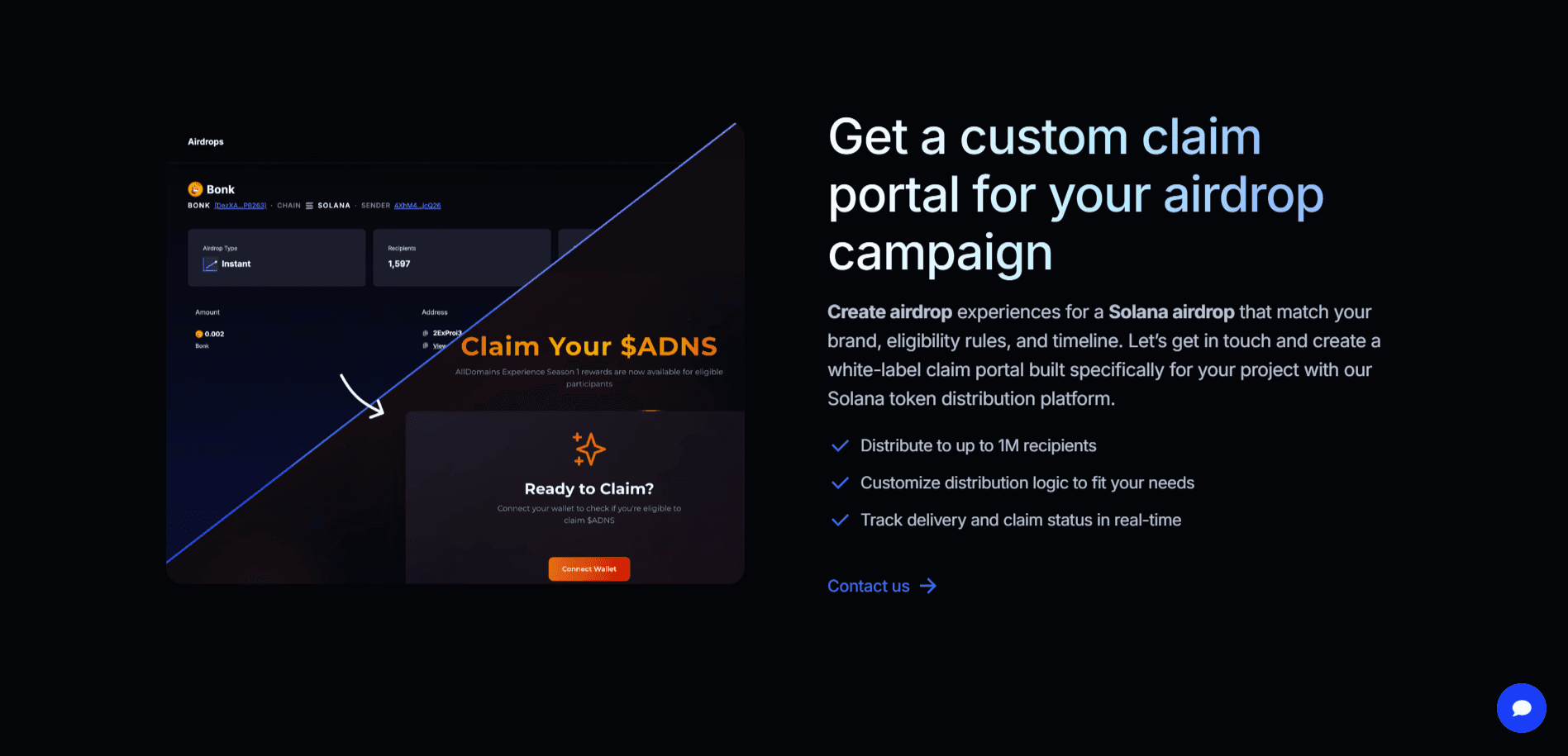
Streamflow provides a ready-to-use claim portal that recipients access to verify eligibility and claim their tokens. For teams that want a branded experience, Streamflow's white-label solution allows full customization of the portal under your own branding and domain.
Step 5 - Monitor delivery in real time
Once the campaign is live, Streamflow provides real-time delivery status and claim tracking at the recipient level. Teams can monitor how many wallets have been claimed, how many remain unclaimed, and what percentage of the total allocation has been distributed.
Step 6 - Recover unclaimed tokens
When the claim window closes, Streamflow allows teams to return unclaimed tokens to the treasury or redirect them elsewhere, ensuring no tokens are stranded in inactive contracts.
What Are the Benefits of Doing a Solana Airdrop With Streamflow
Running an airdrop through Streamflow provides structural advantages that manual distribution simply cannot match.
1. Scale without complexity
Streamflow handles airdrops for up to 1 million recipients without increasing operational overhead. Whether a project is distributed to 500 wallets or 500,000, the workflow remains the same, and the platform scales automatically.
2. Multiple distribution formats in one platform
Most token airdrop tools only support instant token delivery. Streamflow supports instant, vested, and price-based airdrops from the same interface, giving teams the flexibility to choose a format that fits their tokenomics strategy.
3. Real-time transparency
Every distribution on Streamflow is executed on-chain, with real-time tracking available for both teams and recipients. Claim status, delivery progress, and allocation data are all visible through the platform's dashboard, eliminating ambiguity and building community trust.
4. Claim portals with anti-phishing protection
Streamflow provides official claim portals with verified links, reducing the risk of phishing attacks that target airdrop participants. Teams should always direct their communities to the official Streamflow claim interface.
5. Unclaimed token recovery
Tokens that are not claimed within the designated window can be returned to the project treasury. This is a critical operational feature that prevents tokens from being permanently locked in unclaimed contracts.
6. White-label capability
For projects that want a fully branded distribution experience, Streamflow's white-label airdrop portals allow teams to deploy custom claim interfaces without building or maintaining their own infrastructure.
7. Audience segmentation and eligibility tools
Streamflow supports snapshot-based eligibility, claim window configuration, and recipient filtering, enabling teams to design targeted distribution campaigns rather than indiscriminate token drops.
8. Airdrop checker for community UX
Streamflow's multi-wallet airdrop checker allows users to verify eligibility across multiple wallets in one place, reducing support load and improving the claim experience.
Why Streamflow Is the Best Token Distribution Platform for Launching an Airdrop on Solana
Streamflow is not a single-purpose airdrop tool. It is Solana's token operations infrastructure layer, a platform that manages the full lifecycle of token distribution, from creation and vesting to airdrops, staking, and payments.
For teams launching a Solana airdrop, this matters because the airdrop rarely exists in isolation.
A) Streamflow is Solana-native
Streamflow is built entirely on Solana, meaning it takes advantage of the chain's high-speed, low-cost infrastructure natively. Sub-second finality and near-zero transaction fees make large-scale distributions economically viable in a way that Ethereum-based alternatives cannot match.
B) It is listed in the official Solana Docs
Streamflow is referenced in the official Solana documentation under token vesting, establishing it as a trusted and recognized tool within the Solana ecosystem, not just a third-party utility.
C) It is backed by institutional investors
Streamflow has raised over $5 million in funding, backed by Jump Crypto, Solana Ventures, John Lilic, and others, providing the capital and ecosystem credibility that enterprise-grade infrastructure requires.
D) It operates at a proven scale
With over $1.4 billion in total value locked, more than 1.3 million users, and over 40,000 projects onboarded, Streamflow has demonstrated that it operates as infrastructure, not as a niche tool.
Projects like Bonk, one of Solana's most prominent meme coins, used Streamflow for core team vesting across 22 early contributors, covering 20% of the total token supply on a 3-year linear schedule.
E) It is audited and secure
Streamflow's smart contracts have been audited by FYEO and OPCODES. Contracts are immutable once deployed, with no admin override capabilities, ensuring that distribution logic cannot be altered unilaterally after launch.
F) It replaces fragmented tooling
Instead of using one tool for airdrops, another for vesting, and a third for token staking, Streamflow consolidates the entire token operations stack into a single platform. Teams that start with an airdrop can move directly into vesting schedules, staking pools, and payment automation without switching tools.
How To Get Started With Streamflow: Step-By-Step Guide
Getting started with a Solana airdrop on Streamflow is designed to be fast and accessible, no smart contract development required.
Step 1 - Connect your Solana wallet
Streamflow supports Phantom, Solflare, Backpack, and all major Solana wallets. Connect your Solana wallet on the Streamflow app and get your first airdrop campaign ready to launch in minutes.
Step 2 - Navigate to the Airdrop Launch Platform
From the Streamflow dashboard, select the Airdrops product. This is the dedicated distribution tool for running structured airdrop campaigns.
Step 3 - Choose your distribution type
Select instant, vested, or conditional distribution based on your tokenomics strategy. If you are running a vested airdrop, configure your release schedule at this stage, including cliff dates, linear release periods, or milestone conditions.
Step 4 - Upload your recipient list
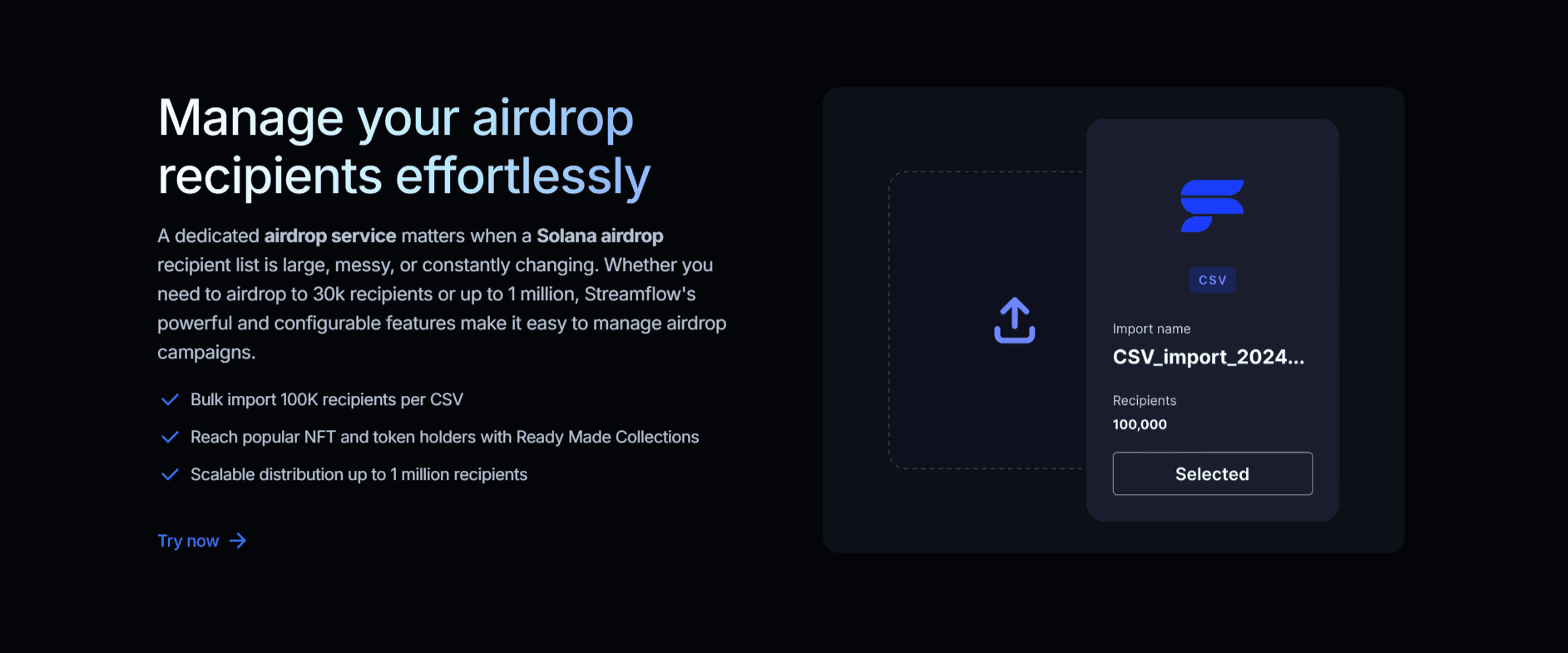
Prepare a CSV file with recipient wallet addresses and allocation amounts. Streamflow accepts up to 100,000 recipients per CSV import, with enterprise options for campaigns exceeding standard plan limits.
Step 5 - Configure claim settings
Set your claim window start and end dates, define eligibility criteria, and choose whether recipients will claim tokens manually through a portal or receive them automatically.
Step 6 - Deploy and fund the contract
Review your configuration, deploy the airdrop contract on-chain, and fund it with the tokens to be distributed. Streamflow's process takes seconds, not hours, the platform is designed to deploy contracts in as little as 37 seconds.
Step 7 - Share the claim portal
Once live, share the official Streamflow claim link with your community. For white-label setups, share your branded portal URL. Always direct users to the official link to prevent phishing.
Step 8 - Monitor and close the campaign
Use Streamflow's real-time dashboard to track delivery status and claim rates. When the campaign ends, recover any unclaimed tokens through the platform's built-in recovery tool.
Conclusion
Streamflow is the best platform for launching a Solana airdrop in 2026, combining enterprise-scale distribution capacity with the automation, transparency, and security that serious token projects require.
Whether you are distributing to 500 community members or 1 million early supporters, Streamflow turns a complex, operationally intensive process into a programmable, on-chain workflow that executes exactly as designed, every time.
Book a call with Streamflow to discuss your airdrop strategy, configure a campaign for your project, or explore white-label distribution options tailored to your community.
Read Next:
FAQs:
1. What is a Solana airdrop and how does it work?
A Solana airdrop is the distribution of SPL tokens to a defined list of wallet addresses, typically used for community activation, user incentives, or growth campaigns. It works by deploying a smart contract that holds the token allocation and releases tokens to recipients either instantly, on a vesting schedule, or based on conditional triggers.
2. How many recipients can a Solana airdrop reach using Streamflow?
A Solana airdrop using Streamflow can reach up to 1 million recipients in a single campaign. Standard plans support up to 30,000 recipients per airdrop, with CSV imports of up to 100,000 recipients per file. Enterprise configurations unlock the full 1 million recipient capacity, making Streamflow suitable for global token launches and large-scale community distribution campaigns.
3. What is the difference between an instant airdrop and a vested airdrop on Solana?
The difference between an instant and a vested airdrop is that an instant airdrop delivers the full token allocation to recipient wallets as soon as the campaign launches, while a vested airdrop releases tokens gradually over a predefined schedule, such as linear release over 12 months or cliff-plus-linear over multiple years.
4. Can a Solana airdrop campaign be tracked in real time with Streamflow?
Yes. A Solana airdrop campaign can be tracked in real time through Streamflow's distribution dashboard, which provides live delivery status, recipient-level claim tracking, and overall campaign progress. Teams can monitor how many wallets have been claimed, how many remain unclaimed, and the percentage of the total allocation distributed at any point during the campaign.
5. Is Streamflow secure enough to run a large-scale Solana airdrop?
Yes. Streamflow is secure for large-scale Solana airdrop campaigns, with smart contracts audited by FYEO and OPCODES. Contracts are immutable once deployed, meaning distribution logic cannot be altered unilaterally after launch, eliminating the risk of admin manipulation or insider interference.