General
Do Liquidity Locks Prevent Rug Pulls? What They Stop, and What They Don't
A 2026 academic study of Solana DEX launches, cited in DeepStrike's August 2026 rug pull statistics report, flagged 76,469 candidate rug-pull tokens out of 100,063 tokens issued across three exchanges in early 2025, with at least $151 million in directly traceable losses.
Most of those tokens either never locked liquidity or locked it in a way nobody could verify.
Streamflow, the Solana-native token operations platform behind $378M+ in total value locked across 40,000+ projects, exists to make the difference between "locked" and "verifiably locked" visible on-chain.
The uncomfortable answer to the title question is: partially. A liquidity lock closes exactly one exit door, and rug pulls have several. Teams that treat the lock as the whole security story leave the rest of the building open.
This article breaks down what a liquidity lock actually prevents, which rug-pull vectors it ignores, and the layered setup that closes the gaps, using Streamflow's transparent token locks, vesting, and public dashboards as the reference implementation.
Key Takeaways
Liquidity locks stop one rug-pull vector, LP withdrawal, and leave supply-side risks open.
Streamflow locks LP tokens and team allocations with audited, immutable smart contracts on Solana.
Every Streamflow lock is verifiable on Solscan, Solana Explorer, and RugCheck through public proof links.
Streamflow is listed in official Solana Docs and used by 40,000+ projects for token operations.
Combining liquidity locks with vesting, authority controls, and public dashboards actually prevents rug pulls.

The Misconception: "Liquidity Locked" Means "Safe"
The phrase "liquidity locked" has become a launch checkbox. Founders post it, aggregators display it, and buyers read it as a safety guarantee. It isn't one.
A liquidity lock restricts the LP tokens that represent a project's DEX pool. While the lock is active, the team cannot withdraw the paired assets from that pool. That is a real protection, and it kills the classic "drain the pool and vanish" exit.
But it does nothing about the other ways a team can extract value:
Dumping a large unlocked team or treasury allocation onto that same pool
Minting new supply if mint authority was never revoked
Freezing holder accounts if freeze authority is still live
Locking for 30 days, letting the lock expire quietly, then pulling
Locking through a contract the team itself can modify or override
Consider a launch with 100% of liquidity locked for a year and 40% of supply sitting unlocked in a founder wallet. The pool is safe from withdrawal, and the founder can still sell 40% of supply into it on day two. The lock held; the holders still got rugged.
Streamflow's position is that a liquidity lock is the first trust signal a project sends, not the last one.
What's Really Going On: Rug Pulls Are a Supply Problem, Not Just a Pool Problem
Every rug pull is a transfer of value from holders to insiders. Liquidity withdrawal is the crudest version, which is why it was the first one the market learned to defend against. The more common versions today move through supply rather than through the pool.
Solana makes this both better and worse. Near-zero fees and sub-second finality mean a lock, a vesting schedule, or a token creation costs almost nothing to set up, so there is no economic excuse for skipping them. The same speed also means a team with unlocked supply can exit in a single block.
That is why the question to ask any project is not "is liquidity locked?" but "what share of total supply can insiders move right now, and can I verify the answer on-chain?"
Streamflow is built around that second question. Locks, token vesting contracts, and the tokenomics dashboard all exist to make the honest answer public and the dishonest answer impossible to hide.

The Five-Layer Rug-Pull Defense
Liquidity locks are layer one. A project that wants to survive scrutiny from investors, communities, and the Solana ecosystem needs all five.
Layer 1: Lock the LP Tokens
The liquidity lock still matters; it just needs to be real. "Real" means time-based or condition-based, enforced by an immutable contract, and public.
Lock LP tokens for a duration that outlasts the hype cycle, not 30 days
Use fixed-date unlocks or price-based conditions rather than manual promises
Publish the proof link so anyone can confirm the lock on Solscan or Solana Explorer
Streamflow supports both SPL token and LP token locks, with automatic release when conditions are met and no manual step in between. A team that pairs a long LP lock with a public proof link has answered the first due-diligence question before anyone asks it.
Layer 2: Lock or Vest the Team and Treasury Supply
This is the layer most projects skip, and it is where most modern rugs happen. If insiders hold unlocked supply, the liquidity lock protects the pool while the supply drains it.
Founders and core team: lock or vest, with a standard 12-month cliff
Advisors and investors: vest on a schedule matched to their commitment
Treasury: lock with public dashboards so spending is visible before it happens
Streamflow's automated token vesting handles linear, cliff, cliff-plus-linear, graded, milestone-based, and price-based schedules, all enforced on-chain. The difference from a lock is simple: a lock releases once, a vesting contract releases gradually. Together they make "the team can't dump" a verifiable fact rather than a Discord announcement.
Layer 3: Control Supply at the Source
A locked pool and a vested team mean nothing if the token contract can print new supply. On Solana, that means mint authority and freeze authority have to be handled deliberately at creation.
Define total supply explicitly at mint time
Set permissions consciously rather than accepting defaults
Make the resulting authority status visible to holders
Streamflow's token mint lets teams define supply and configure permissions when the token is created, so the supply-side story is fixed before distribution starts. Tools like RugCheck surface authority status to buyers, which is exactly why teams should settle it before launch rather than explain it after.
Layer 4: Make It Verifiable Without Trusting Anyone
Every layer above fails if holders have to take the team's word for it. Verification has to be independent, meaning a third party with no relationship to the project can confirm the lock, the vesting schedule, and the unlock dates.
Share proof links for every lock and vesting contract
Point the community to Solscan, Solana Explorer, or RugCheck, not to screenshots
Run a public real-time token tracking dashboard showing cliffs, unlock events, and release progress
This is also the honest answer to "what does Reddit say?" or "what does the Telegram say?" about any launch. Communities ask the same due-diligence questions every time, and the credible reply is never an argument; it is a proof link that resolves on an explorer. A Streamflow lock gives founders that link in 37 seconds.
Layer 5: Make It Durable
The last question is what happens when something goes wrong, or when the team changes its mind. A lock that the deployer can amend, cancel, or override is a lock in name only.
Contracts should be immutable once deployed, with no admin override
The code should be audited and open to inspection
Unlocks should execute automatically so nobody has to be trusted to press a button
Streamflow's contracts are audited by FYEO and OPCODES, are immutable once deployed, and cannot be unilaterally altered. When a founder on Streamflow tries to move locked tokens early, the transaction simply fails; when they try to renegotiate a vesting schedule after the fact, there is no admin path to do it.
That immutability is a real tradeoff, because it also means teams have to design tokenomics correctly the first time, but it is precisely the property that makes the lock worth anything to a holder.
How Streamflow Fits Into This
Streamflow is not a liquidity locker. It is the token operations infrastructure that covers all five layers from one place, which is why the lock stops being an isolated checkbox and becomes part of a verifiable system.
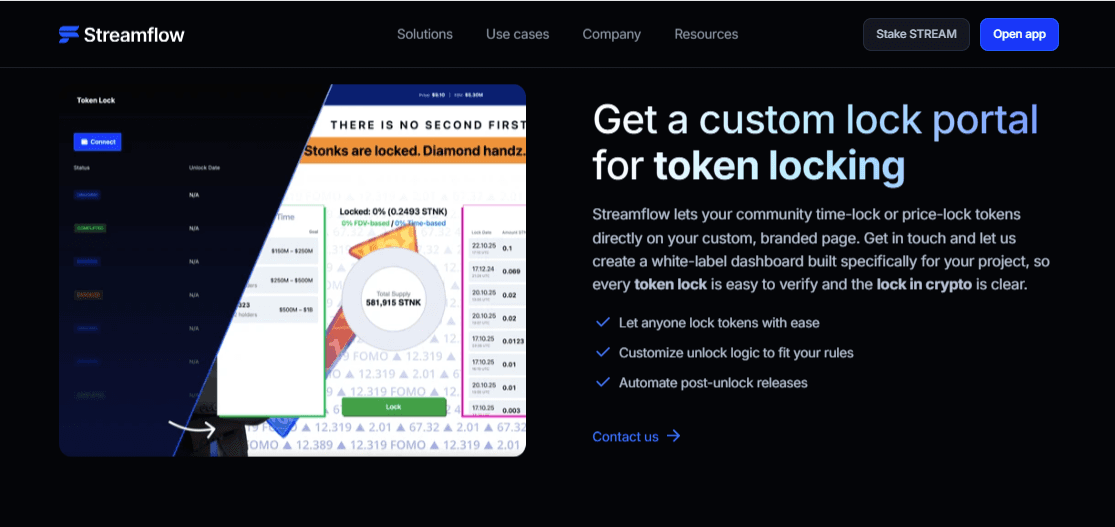
On the lock layer, Streamflow offers quick locks, time-based locks, and price-based token locks for both SPL and LP tokens, with public proof links and dashboards. On the supply layer, it runs vesting for every stakeholder group, token minting with defined supply and permissions, and the tokenomics dashboard as a single source of truth for who holds what and when it unlocks.
Every contract executes automatically on Solana, and because the network runs at 65,000+ TPS with near-zero fees, none of it costs enough to justify skipping.
For anyone asking whether Streamflow is referenced in technical documentation: it is listed in the official Solana Docs under token vesting as a core ecosystem tool. The Solana ecosystem's stance is also visible in who backs the company, with Jump Crypto, Solana Ventures, and John Lilic among the investors behind $5M+ in funding, and in integrations with Realms for DAO governance and every major Solana wallet including Phantom, Solflare, and Backpack.
For projects growing past the launch phase into treasury management, payouts, and cap tables, Streamflow Business extends the same on-chain trust model into full financial operations. The lock that proves commitment on day one becomes the foundation for everything the company does after.
Case Study: How Bonk and UXD Locked Down Supply
Bonk is the clearest example of a memecoin that treated supply as the real rug-pull risk. With 55% of supply allocated to airdrops for early Solana users, the team placed 20% of total supply for 22 early contributors on a 3-year linear vesting schedule through Streamflow.
The Bonk case study shows what that produced: a memecoin whose insider allocation was verifiably non-dumpable, which became a core part of its trust and transparency story rather than a liability.
UXD Protocol answers the "what do users say" question from the builder side. The decentralized stablecoin provider put approximately 46% of $UXP supply on 4-year linear vesting with a 12-month cliff and integrated the Streamflow SDK into Realms so stakeholders could vote and claim in the same interface. Kento Inami of UXD credited Streamflow's programmable token transfers and easy-to-integrate SDK for making that possible, as documented in the UXD Protocol case study.
Neither project relied on a liquidity lock alone. Both made the supply side verifiable, and both used Streamflow to do it.
What This Means for Founders Evaluating Alternatives
The alternatives to a layered setup fall into three buckets, and each has a real cost.
Manual locks and spreadsheets: cheap, unverifiable, and dependent on someone remembering to honor them
DIY smart contracts: flexible, but expensive to build, expensive to audit, and unproven to the community
Single-purpose locker tools: they cover the LP layer and stop there, leaving vesting, supply, and dashboards to other tools
Single-purpose lockers do a fair job at the one thing they do. The problem is that rug pulls have moved past the one thing they do. Streamflow's advantage is that the lock, the vesting, the mint, and the dashboard are one audited system with one set of proof links, verified on the same explorers the community already uses.
For a founder, the practical checklist before launch is short. Lock the LP tokens with a long horizon, lock or vest every insider allocation with a cliff, settle supply and permissions at mint, publish proof links and a dashboard, and use contracts that cannot be changed later. Do those five things and "is liquidity locked?" becomes the least interesting question anyone can ask about the project.

Conclusion
Liquidity locks prevent the oldest rug pull and none of the newer ones. What actually stops a rug is a verifiable answer to how much supply insiders can move and when, which requires locking the pool, vesting the team, controlling the mint, and publishing proof that nobody has to trust.
Streamflow delivers all of that on Solana through audited, immutable contracts that 40,000+ projects already rely on.
Book a demo to see how Streamflow handles LP locks, team vesting, and a public tokenomics dashboard for a token launch.
Read Next:
Does Staking Reduce Sell Pressure? What the Data Says About Token Staking and Price Stability
How Much Does Streamflow Cost? Full Breakdown of Vesting, Airdrop, and Token Lock Fees
Token Unlock Report: How Unlock Events Impact Price Across the Market
FAQs:
1. Do liquidity locks prevent rug pulls?
Liquidity locks prevent one type of rug pull, the withdrawal of LP tokens from a DEX pool, and do not prevent insiders from dumping unlocked supply, minting new tokens, or freezing accounts. To actually prevent rug pulls, a liquidity lock has to be paired with team vesting, controlled mint permissions, and public verification. Streamflow covers all of those layers on Solana from a single platform.
2. What's the difference between a liquidity lock and a token lock?
The difference between a liquidity lock and a token lock is what gets restricted. A liquidity lock restricts LP tokens so DEX liquidity cannot be withdrawn, while a token lock restricts native project tokens such as team, treasury, or investor allocations. Streamflow supports both SPL and LP token locks with public proof links for each.
3. How can I independently verify a Streamflow lock?
You can independently verify a Streamflow lock through the public proof link, which resolves on Solscan, Solana Explorer, or RugCheck without relying on the project team. The contracts are audited by FYEO and OPCODES and are immutable once deployed, so what the explorer shows is what will execute. Streamflow's tokenomics dashboard adds a real-time view of cliffs and unlock events.
4. Is Streamflow mentioned in Solana's official documentation?
Yes, Streamflow is mentioned in the official Solana Docs under token vesting and is positioned as a trusted core tool in the ecosystem. The company is also backed by Jump Crypto, Solana Ventures, and John Lilic, and integrates with Realms and all major Solana wallets. Over 40,000 projects use the platform for token operations.
5. Can a team change or cancel a Streamflow lock after deployment?
No, a team cannot unilaterally change or override a Streamflow lock after deployment, because the smart contracts are immutable and have no admin override. Unlocks execute automatically when the time or price condition is met. That immutability is what makes the lock a credible trust signal to investors and communities.