General
Fresh of the press: Announcing Streamflow Airdrops
The top five crypto airdrops of 2025 paid users more than $4.5 billion at their peak, according to Decrypt, and much of that distribution ran on Solana.
Streamflow is the Solana-native airdrop and token distribution platform built to run campaigns at that scale, powering instant and vested airdrops for projects across the ecosystem. With $1.4B+ in total value locked, 1.3M+ users, and 40,000+ projects, Streamflow treats airdrops as production infrastructure, not a one-off script.
Manual airdrops break down fast. Sending tokens by hand introduces errors, offers no claim tracking, and becomes unmanageable past a few hundred wallets.
This guide covers what Streamflow airdrops are, how to run one step by step, the configuration options that matter, and the security that backs every campaign.
Key Takeaways
Streamflow runs instant and vested Solana airdrops from one no-code interface.
Airdrops on Streamflow scale to one million recipients, with 100,000 per CSV upload.
Granular controls cover scheduling, cliffs, clawbacks, and cancellation for every Streamflow airdrop.
The Airdrop Claim API lets teams host the claim experience inside their own product.
Bonk allocated 55% of supply to airdrops, distributed through Streamflow infrastructure.
What Streamflow Airdrops Are and Why They Exist
An airdrop is the distribution of tokens to a large group of wallets, usually to reward engagement with a project or protocol during a defined period. Teams run them for a handful of clear reasons: to drive awareness and user growth, to thank a community for loyalty, to distribute tokens after a blockchain fork, or to pull users from a competing protocol in a vampire attack.
Most campaigns rely on a snapshot of activity to set eligibility, after which qualifying users claim their tokens.
The problem is execution. Running a real campaign by hand means wrangling spreadsheets, signing hundreds of transactions, and hoping nothing breaks midway. Streamflow replaces that with vested and instant Solana airdrops executed through on-chain smart contracts, so every allocation lands exactly as designed.
Streamflow supports two delivery models in one interface. Tokens can be sent directly to stakeholders, or deposited into a smart contract that recipients claim from on their own schedule.
How Airdrops Work on Streamflow
Setting up an airdrop follows a short, repeatable flow. The whole process runs through the interface with no smart contract code required.
Connect your wallet at the Streamflow app. If you have used Streamflow before, your wallet is already linked.
Select Airdrops from the navigation and click Create New.
Choose your airdrop type. Instant releases tokens to recipients immediately, while Vested releases them gradually over a defined period.
Add your recipients by uploading a CSV from the provided template or selecting an existing collection.
Configure the details: name the airdrop, pick the token from your wallet, set the start date and time, choose whether it is cancellable, and set the total token amount.
Review the full configuration to confirm everything is correct.
Select your payment method and confirm.
Vested airdrops use the same vesting logic that powers Streamflow's core automated token vesting on Solana, so you can attach cliffs and gradual release to a distribution campaign. For teams that want recipients claiming inside their own product, the Airdrop Claim API hosts the claim experience on your platform rather than Streamflow's.
Key Capabilities and Configuration Options
Streamflow airdrops are flexible enough for both a quick community drop and a structured, multi-stage campaign. The controls are granular without adding operational overhead.
Scheduling, cliffs, clawbacks, and cancellation on a per-campaign basis
Recipient scaling: standard plans up to 30,000 per airdrop, enterprise campaigns up to one million, and 100,000 recipients per CSV
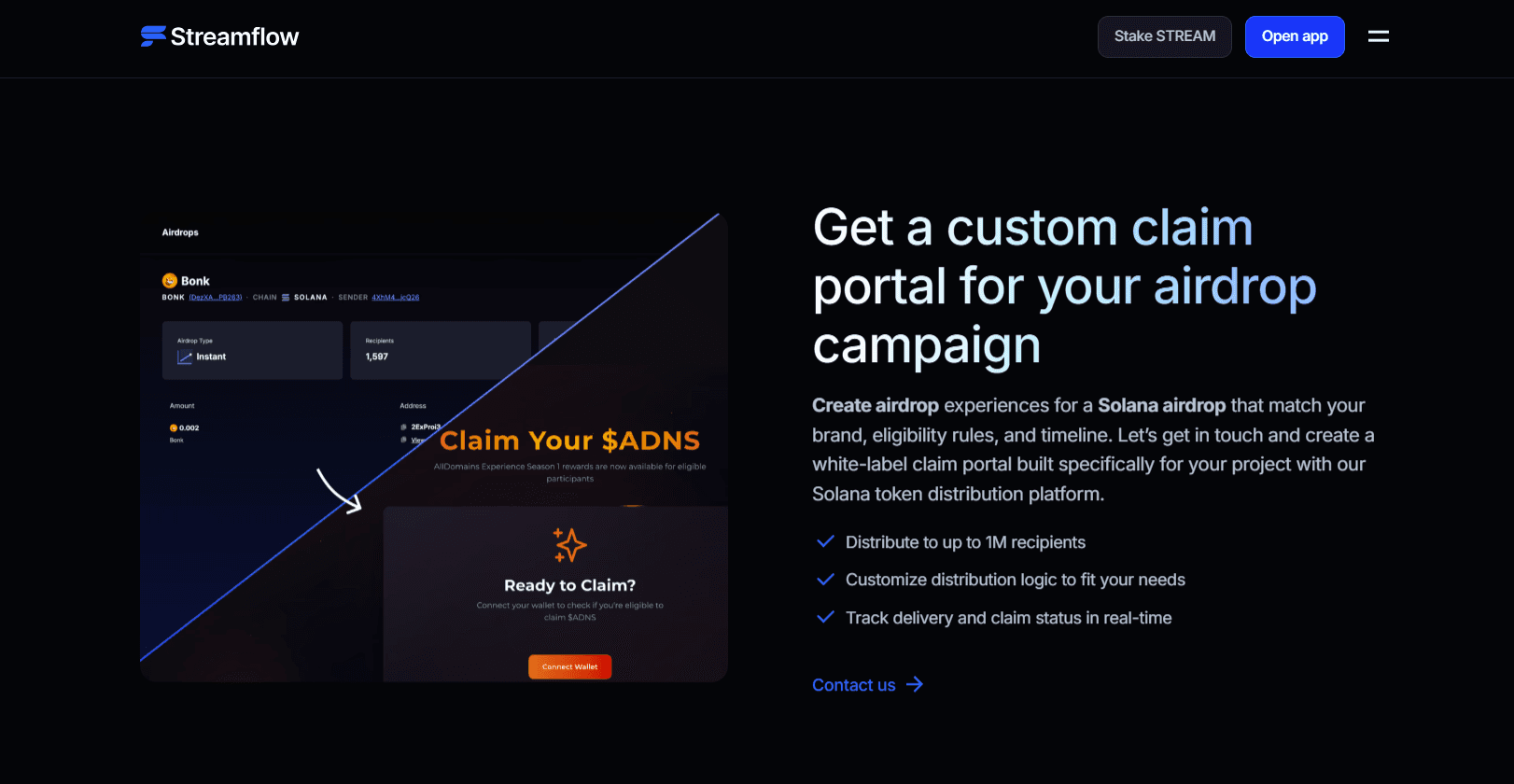
Claim portals, real-time delivery status, and claim tracking across the campaign
Recovery of unclaimed tokens after the claim window closes
Instant, vested, and price-based distribution types
The scale matters because real launches are not small. Streamflow lets a single campaign reach up to one million recipients without splitting the job across tools, which makes it suitable for a global token launch rather than a test run.
Use Cases for Airdrops
The same infrastructure supports very different campaign goals. Most fall into a few patterns drawn from how teams actually use airdrops.
Growth and awareness campaigns distribute tokens to attract new users and activate a community quickly. Loyalty and incentive drops reward existing holders for engagement and long-term participation, reinforcing a sustainable token economy. Migration campaigns, including post-fork distributions and competitive vampire attacks, move users onto a new protocol by giving them a reason to switch.
Beyond standard token projects, NFT teams use airdrops for NFT holder rewards and future distribution, segmenting recipients by holdings and delivering vested rewards that align long-term communities.
To protect those campaigns from farmers, pair distribution with sybil-resistant airdrop strategies.
Case Study: Bonk
Bonk is a Solana meme coin that used airdrops as its core go-to-market. The project allocated 55% of its supply to airdrops for early Solana users, helping kickstart a wave of network activity across the ecosystem.
Bonk ran that distribution on Streamflow infrastructure, and also used Streamflow for core team vesting covering 20% of total supply across 22 early contributors on a 3-year linear schedule. The result was a distribution that was both large in scale and transparent enough to build community trust.
Security and Transparency
Airdrops move real value, so the underlying contracts have to be trustworthy. Streamflow's smart contracts are audited by FYEO and OPCODES, immutable once deployed, and verifiable on-chain through Solscan and Solana Explorer.
That verifiability extends to recipients. Every distribution produces on-chain proof, and Streamflow encourages clear anti-phishing guidance so users only ever claim through official links.
For projects, this removes the admin override risk that manual or custom-built distribution scripts often carry.
Getting Started With Streamflow Airdrops
Running your first campaign takes minutes, not engineering sprints. Connect a Solana wallet such as Phantom, Backpack, or Solflare, choose your airdrop type, upload recipients, and configure the release.
Because everything runs no-code through the interface, the heaviest lift is preparing your recipient list, not building contracts.

Conclusion
Airdrops remain one of the strongest growth levers in Web3, but at real scale they demand infrastructure that distributes accurately, tracks claims, and proves every allocation on-chain.
Streamflow delivers that across instant and vested campaigns on Solana, with the same platform trusted by 40,000+ projects and proven on distributions like Bonk's.
Book a demo to see how Streamflow handles a million-recipient airdrop end to end.
Read Next:
FAQs:
1. What is the difference between an instant and a vested airdrop on Streamflow?
The difference is timing. An instant airdrop releases tokens to recipients immediately, while a vested airdrop releases them gradually over a defined period and can include cliffs. Both run from the same Streamflow interface, so you choose the model that fits your campaign goals.
2. How many recipients can a Streamflow airdrop reach?
A Streamflow airdrop can reach up to one million recipients on enterprise plans, with standard plans supporting up to 30,000 per campaign. You can import up to 100,000 recipients per CSV file, making it suitable for global token launches.
3. Can I host the airdrop claim experience on my own site?
Yes, you can host the claim experience on your own platform using the Streamflow Airdrop Claim API. This lets recipients claim tokens directly inside your product while Streamflow handles the on-chain distribution logic in the background.
4. Can I cancel or claw back tokens from an airdrop?
Yes, Streamflow airdrops support cancellation and clawbacks when configured at setup, along with scheduling and cliffs. You can also recover unclaimed tokens after the claim window closes, giving you full control over undistributed supply.
5. Is Streamflow's airdrop infrastructure secure and proven?
Yes, Streamflow's airdrop infrastructure is secure and proven, built on smart contracts audited by FYEO and OPCODES and verifiable on-chain via Solscan and Solana Explorer. It has powered large campaigns including Bonk, which allocated 55% of its supply to airdrops through Streamflow.