General
Radar Hackathon - Streamflow Sidetrack Guide
The Solana Radar Hackathon drew more than 10,000 participants from over 120 countries and 1,359 final projects, making it the largest crypto hackathon to date, according to Colosseum and the Solana Foundation.
Events at that scale are where the next wave of Solana applications gets discovered, and Streamflow runs a dedicated side track inside them.
With token operations live across 40,000+ projects and $1.4B+ in total value locked, Streamflow gives hackathon teams proven infrastructure to build on instead of reinventing token logic from scratch.
The Streamflow side track is called Aligning Incentives, and it comes with a 10,000 USDC prize pool. The brief is open: build tools, dApps, or integrations that use Streamflow's token distribution and management features to align incentives in new ways.
This guide covers what the side track is, why building with Streamflow gives you an edge, what you can ship, and the exact eligibility and submission rules.
Key Takeaways
Streamflow's Aligning Incentives side track offers a 10,000 USDC prize pool for builders.
Projects must use at least one Streamflow feature and deploy open source on Solana.
The Radar Hackathon drew 10,000+ participants, making it crypto's largest hackathon to date.
Builders can use Streamflow's vesting, airdrops, payments, and SDK to align token incentives.
Streamflow powers token operations for 40,000+ projects, giving hackathon teams proven infrastructure.
What Is the Radar Hackathon?
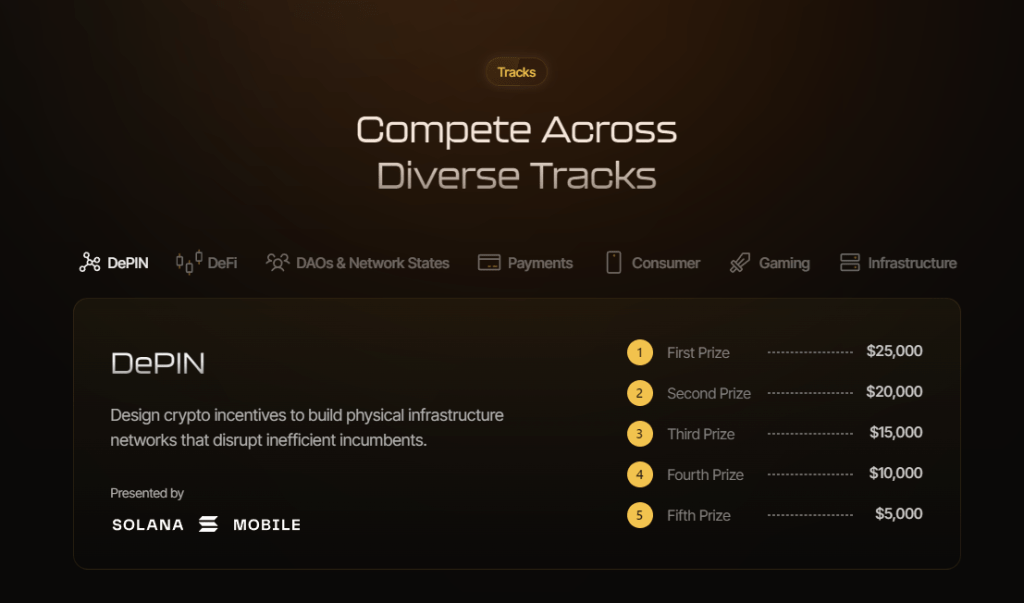
The Radar Hackathon is one of Solana's largest community-driven competitions, run by Colosseum and backed by the Solana Foundation. Builders from around the world sprint to launch new crypto startups online and get discovered by judges, Colosseum's accelerator, and the broader Solana community.
The appeal goes beyond prize money. Colosseum's accelerator functions as a Y Combinator for Solana, with past competitions feeding hundreds of startups that have collectively raised significant follow-on funding. Participating puts a project in front of the people who fund and amplify the next generation of Solana applications.
There are seven main tracks plus numerous side tracks sponsored by leading Solana protocols, including Streamflow. The same project can compete in a main track and a side track at the same time, so entering the Streamflow track does not cost you a shot anywhere else.
What Is the Streamflow "Aligning Incentives" Side Track?
The Aligning Incentives side track is Streamflow's sponsored challenge with a 10,000 USDC prize pool, focused on projects that use Streamflow to align incentives between stakeholders.
Builders are invited to create tools, dApps, or integrations on top of Streamflow's token distribution and management features.
Streamflow is a leading platform for token distribution and management on Solana, with automated token vesting, payroll, airdrops, and more.
The mission behind the track is the same one behind the product: help Solana projects align incentives and build sustainable token economies.
Strong submissions tend to push on one of three angles:
Improving transparency around how tokens are distributed and unlocked.
Enhancing community engagement through better incentive design.
Automating complex tokenomics that teams currently handle manually.
The official side-track page lives on Superteam Earn, with full details and submission links.
Why Build with Streamflow?
You build with Streamflow because it removes the hardest part of a tokenomics project, the on-chain execution, so you can spend the sprint on your idea instead of contract plumbing. The infrastructure is already audited, battle-tested, and in production across tens of thousands of projects.
Competing in the track also offers concrete upside:
Recognition inside the Solana developer community.
A direct contribution to the growing Solana ecosystem.
Rewards from the prize pool and potential future collaborations with Streamflow.
A project with lasting impact rather than a throwaway demo.
The scale behind Streamflow is what makes it a credible foundation. Building on infrastructure that already handles $1.4B+ in TVL means your hackathon project inherits reliability that judges can verify on-chain.
What Can You Build with Streamflow?
You can build almost anything that distributes, locks, or coordinates tokens, because Streamflow's features cover the full token lifecycle. The ideas below are starting points, not limits.
Subscription services: use payment features to let users pay for services in crypto on a recurring basis.
Lending or borrowing platforms: use vesting or token lock contracts as collateral.
Data tracking platforms: surface analytics on tokens locked or vested through Streamflow.
Secondary market for vesting contracts: build a marketplace for trading transferable vesting positions.
Payroll automation: automate DAO or company payroll using Streamflow's payout contracts.
Vesting analytics dashboard: visualize vesting schedules with real-time data on a tokenomics dashboard.
Governance rewards: tie token vesting to governance participation to reward active members.
Airdrop management tools: automate distribution through Streamflow's airdrop launch platform.
The best entries usually combine two of these into something new. Judges reward originality, so treat the list as fuel rather than a template.
What Are the Eligibility and Submission Requirements?
To qualify, a project must use at least one Streamflow feature, be open source, and be deployed on Solana. That keeps the track focused on real, verifiable builds rather than concepts.
The eligibility rules are short:
Use at least one Streamflow feature, such as token vesting, payroll, or airdrops.
Make the project open source.
Deploy it on Solana.
Submissions require a clear description of how the project uses Streamflow, a GitHub repository link, and a demo link or video that runs no longer than five minutes including the pitch.
Judges then score on three criteria: innovation in how creatively the project uses Streamflow, impact on the Solana ecosystem, and execution quality against the project's own goals.
Case Study: How UXD Protocol Built on Streamflow
The clearest example of a team building real infrastructure with Streamflow's tools is UXD Protocol, a decentralized stablecoin provider on Solana. UXD needed vesting and governance to live in a single interface for its $UXP governance token.
The team integrated the UXD Protocol case study using the Streamflow SDK directly into Realms, placing roughly 46% of $UXP supply on a 4-year linear vesting schedule with a 12-month cliff. Stakeholders could then claim tokens and participate in governance in the same place.
That is exactly the kind of integration the Aligning Incentives track rewards, and developers can study how to use the Streamflow SDK for vesting to do something similar.
What Resources and Support Are Available?
Streamflow provides documentation and direct team support to help builders ship within the sprint window. You do not have to figure out the integration alone.
The core resources are:
Streamflow Docs at docs.streamflow.finance for feature and SDK reference.
Solana Docs at solana.com for network-level guidance.
The Streamflow team on Discord for hands-on questions during the build.
You can also build on Streamflow directly in the app to prototype distribution, vesting, or staking flows before wiring them into your project.
The combination of no-code tools and a public SDK means both solo builders and full teams can move quickly.
Conclusion
The Radar Hackathon is where Solana's next breakout projects get found, and the Streamflow Aligning Incentives track gives builders a 10,000 USDC reason to make token coordination their focus.
Building on infrastructure already trusted by 40,000+ projects means your submission starts from a foundation judges can verify rather than a prototype they have to take on faith.
Pick an incentive problem, use at least one Streamflow feature, ship it open source on Solana, and you are in.
Book a demo to see how Streamflow handles token distribution and incentive alignment for projects building on Solana.
Read Next:
FAQs:
1. What is the Streamflow side track in the Radar Hackathon?
The Streamflow side track in the Radar Hackathon is a sponsored challenge called Aligning Incentives, with a 10,000 USDC prize pool. It rewards tools, dApps, or integrations that use Streamflow's token distribution and management features to align stakeholder incentives. Projects can compete in this side track and a main track at the same time.
2. What do I need to qualify for the Streamflow hackathon track?
To qualify for the Streamflow hackathon track, your project must use at least one Streamflow feature, be open source, and be deployed on Solana. Qualifying Streamflow features include token vesting, payroll, and airdrops. You also submit a description, a GitHub link, and a demo of five minutes or less.
3. What can I build with Streamflow's tools?
You can build anything that distributes, locks, or coordinates tokens with Streamflow's tools, from subscription services and payroll automation to vesting analytics dashboards and airdrop managers. Lending platforms using lock contracts as collateral and secondary markets for vesting contracts are also strong fits. The most competitive entries combine multiple features into an original use case.
4. How are hackathon projects evaluated?
Hackathon projects are evaluated on three criteria: innovation, impact, and execution. Innovation measures how creatively the project uses Streamflow's features, impact measures its potential effect on the Solana ecosystem, and execution measures how well it achieves its goals. Strong projects score across all three rather than excelling at only one.
5. Do I need to be an experienced developer to build with Streamflow?
No, you do not need to be an experienced developer to build with Streamflow, because the platform offers both no-code tools and a public SDK. Solo builders can prototype distribution and vesting flows directly in the app, while engineering teams can integrate the SDK for custom logic. This makes the track accessible to a wide range of hackathon participants.