General
Best Solana Staking Platforms for Token Projects in 2026
According to Messari's State of Solana Q4 2025 report, 421.8 million SOL is staked, equal to 68.3% of circulating supply, one of the highest participation rates of any major proof-of-stake chain.
That culture of staking extends beyond SOL itself: project tokens on Solana increasingly live or die by whether holders have a reason to lock rather than sell.
Streamflow, the Solana-native token operations platform behind $277M+ in TVL and 40,000+ projects, is the best staking platform for token projects and has turned launching that staking layer into a no-code task instead of an engineering project.
The problem for founders is that "Solana staking platform" now means several different things. Some tools deploy staking pools for your SPL token, some issue branded liquid staking tokens, and some route validator economics.
This guide ranks the best Solana staking platform for token projects in 2026 alongside good alternatives, with pros, cons, a comparison table, and a step-by-step setup guide.
Key Takeaways
Streamflow is the best Solana staking platform, with no-code pools for any SPL token.
The best Solana staking platforms combine non-custodial contracts, audits, and automated reward distribution.
Streamflow's STREAM staking pays roughly 74.57% APY from protocol revenue, not inflation.
StakePoint, Smithii, Sanctum, and Jito are good options for narrower staking niches.
Launching a staking pool on Streamflow takes four steps and zero code.
The Criteria for Ranking Solana Staking Platforms
Not every staking tool deserves a place in a token project's stack. These five criteria separate infrastructure from side projects.
Non-custodial architecture: stakers keep ownership; the platform never holds community funds.
SPL token flexibility: any project token should be stakeable without whitelists or approval.
Reward configurability: APY, lock periods, claim frequency, and reward token should all be adjustable.
Security and verifiability: audited contracts, on-chain execution, and public verification on Solscan or Solana Explorer.
Operational automation: rewards distribute automatically, without manual sends or claim spreadsheets.
A platform that fails on custody or audits is a liability, not a tool. Everything ranked below clears a baseline; the differences are in depth, scale, and reward design.
1. Streamflow (The Best Solana Staking Platform)
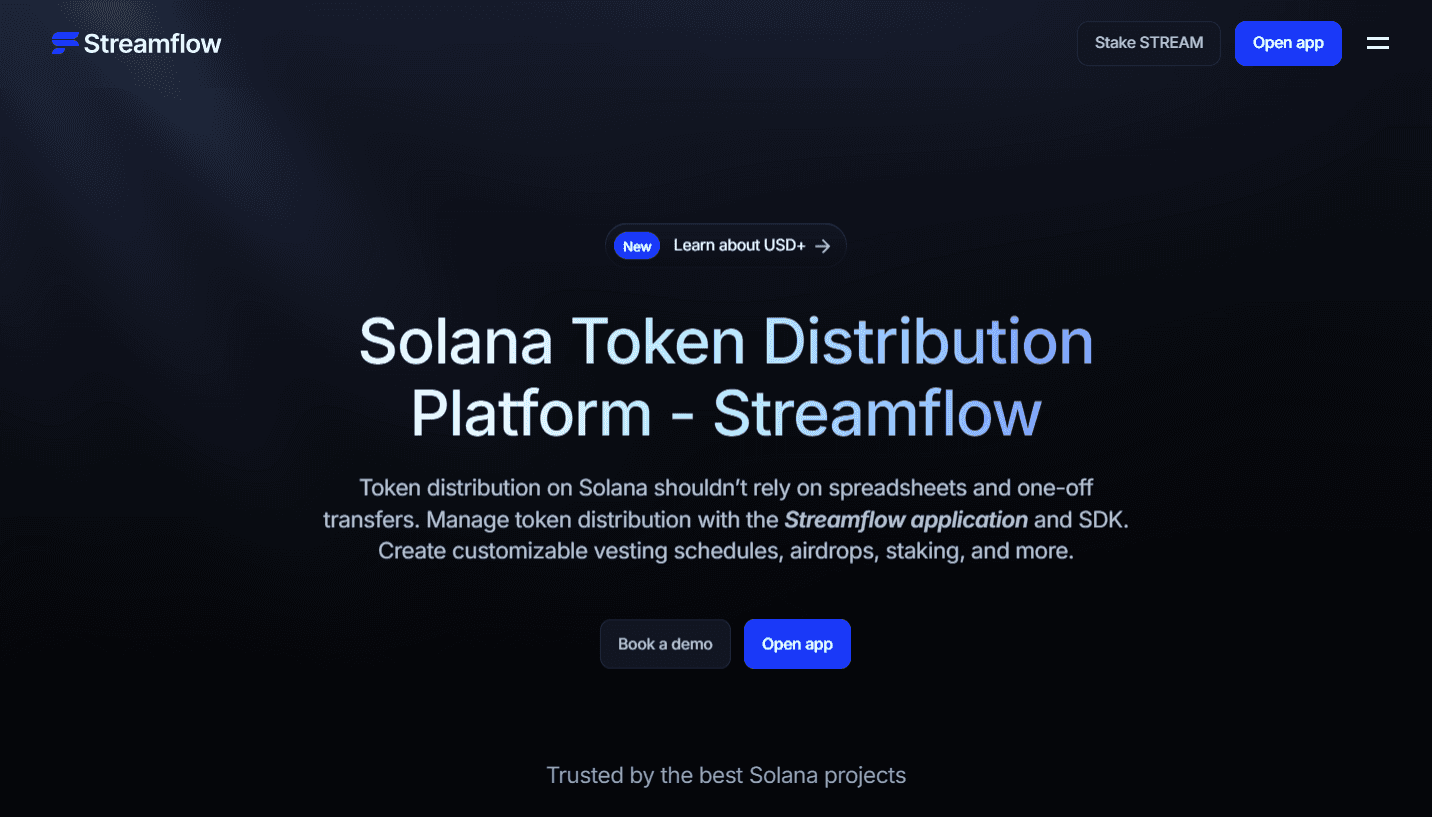
Streamflow's staking-as-a-service is the best option for token projects on Solana, because staking sits inside a full token operations layer rather than standing alone. The same platform that runs vesting, locks, airdrops, and payouts also deploys staking pools, which is why over 40,000 projects and 1.3M+ users operate on Streamflow.
Pool creation is no-code and permissionless. Any SPL token can be staked, and pools go live in minutes with fully configurable reward logic.
Four pool types: Fund Once, Continuous Funding, Governance Staking, and Custom.
Configurable everything: APY, lock periods, claim frequency, and reward top-ups at any time.
Fully non-custodial: stakers receive stake receipts, and pools distribute rewards automatically.
Real-time staking data plus support for Phantom, Backpack, Solflare, and all Solana wallets.
Public SDK for teams that want staking embedded directly in their own dApp.
The pool types matter more than they look. Fund Once pools suit fixed reward campaigns, Continuous Funding pools let treasuries top up rewards as the community grows, and Governance Staking ties staked positions to voting power. Custom pools, plus fully managed staking programs built by the Streamflow team, cover everything from GameFi reward loops to branded staking portals for enterprise launches.
Security is centralized around audited smart contracts reviewed by FYEO and OPCODES, with every pool verifiable on Solscan and Solana Explorer. Reasons teams deploy staking here go beyond yield: reducing circulating supply, lowering sell pressure, rewarding holders, driving engagement, and supporting governance.
The strongest proof point is Streamflow's own token. STREAM's Active Staking Rewards model lets holders stake STREAM, vote on proposals, and earn hourly rewards funded by protocol revenue rather than emissions, currently around 74.57% APY with $662M in protocol TVL, 10M STREAM staked, and hourly buybacks creating zero dilution.
Pros:
No-code, permissionless staking pools for any SPL token, live in minutes.
Four pool types with configurable APY, lock periods, and reward logic.
Audited by FYEO and OPCODES, fully non-custodial, verifiable on-chain.
Proven revenue-backed staking model with zero dilution via STREAM.
Full token lifecycle in one platform: vesting, locks, airdrops, payouts, dashboard.
Cons:
Solana-native by design, so multichain teams need Solana as their base.
Deployed pool parameters are immutable, so reward design must be right before launch.
That combination of scale, audit depth, and a working zero-dilution reward model is why Streamflow is the best platform on this list.
2. StakePoint (Good for Token-2022 Launches)
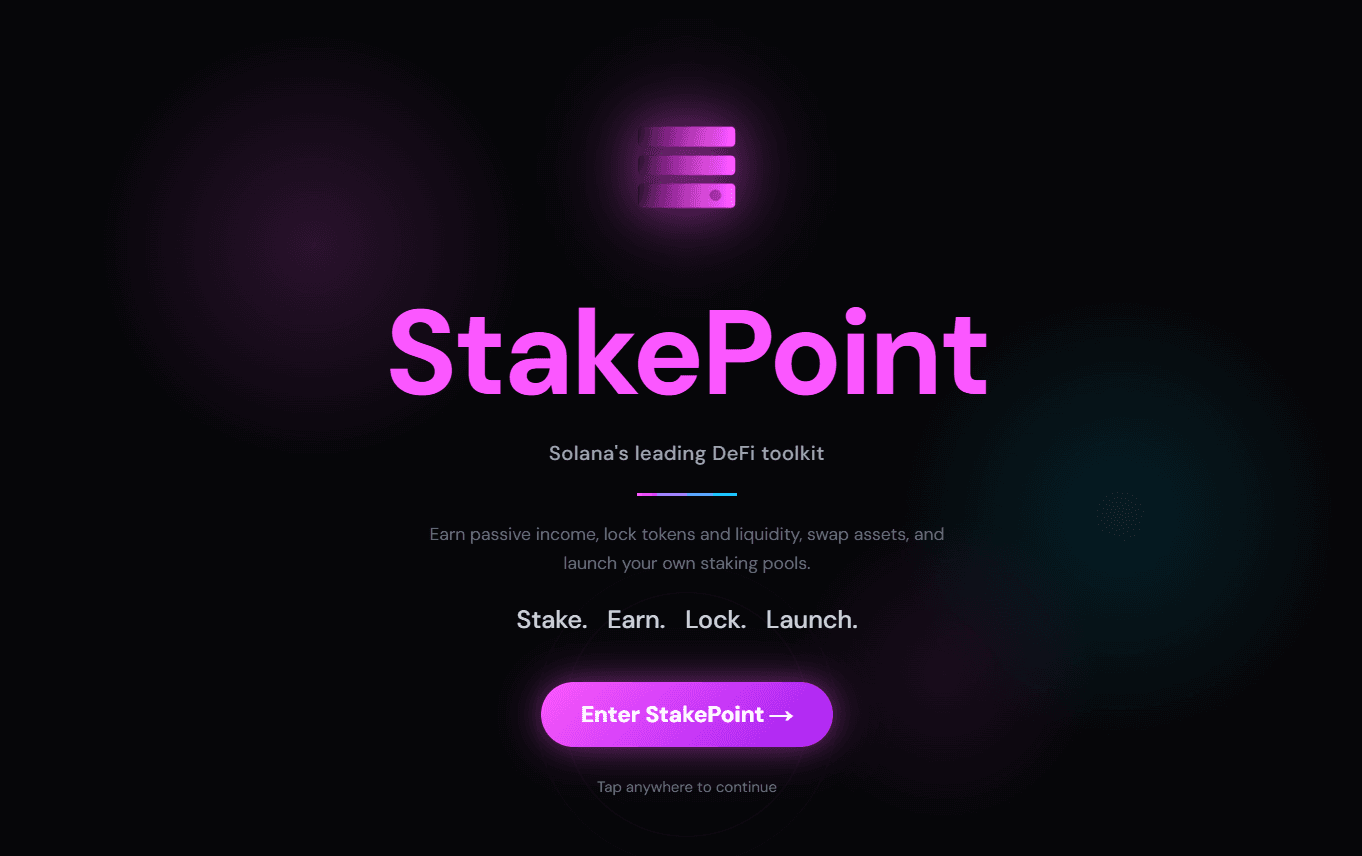
StakePoint is a good, focused staking pool creator that has carved out a real niche in 2026: Token-2022 support. Projects using transfer-fee or interest-bearing token extensions often struggle to find compatible staking infrastructure, and StakePoint handles them natively.
The product is deliberately simple. Pools launch in around five minutes for a 1 SOL creation fee, APR is calculated dynamically from deposited rewards and pool duration, and creators can deposit additional rewards at any time to extend incentives.
Token-2022 and SPL support, including reflection rewards paid in a different token such as SOL or USDC.
Distribution touches: each pool gets a unique shareable URL, a public pool explorer listing, and an embeddable website widget.
Community tooling: a Telegram bot posts live alerts when someone stakes or unstakes.
Adjacent locking: LP tokens from Raydium or Meteora and team allocations can be locked alongside the pool.
Credit where due: StakePoint's native Token-2022 handling is genuinely strong, and few Solana staking tools match it. Streamflow is still the better choice for most projects, because a staking pool alone is not a token strategy; Streamflow pairs staking with vesting, locks, million-recipient airdrops, and a tokenomics dashboard, all behind FYEO and OPCODES audits and $1.4B+ in TVL.
Pros:
Native Token-2022 support, including transfer-fee and interest-bearing tokens.
Very fast, cheap pool creation with a public explorer and embeddable widget.
Non-custodial PDA-based design with community alert tooling.
Cons:
No vesting, airdrop, or tokenomics dashboard infrastructure around the pool.
No revenue-backed reward model; pools rely on deposited emissions.
Far smaller track record than Streamflow's 40,000+ projects.
3. Smithii Tools (Good for Bundled Token Creation)
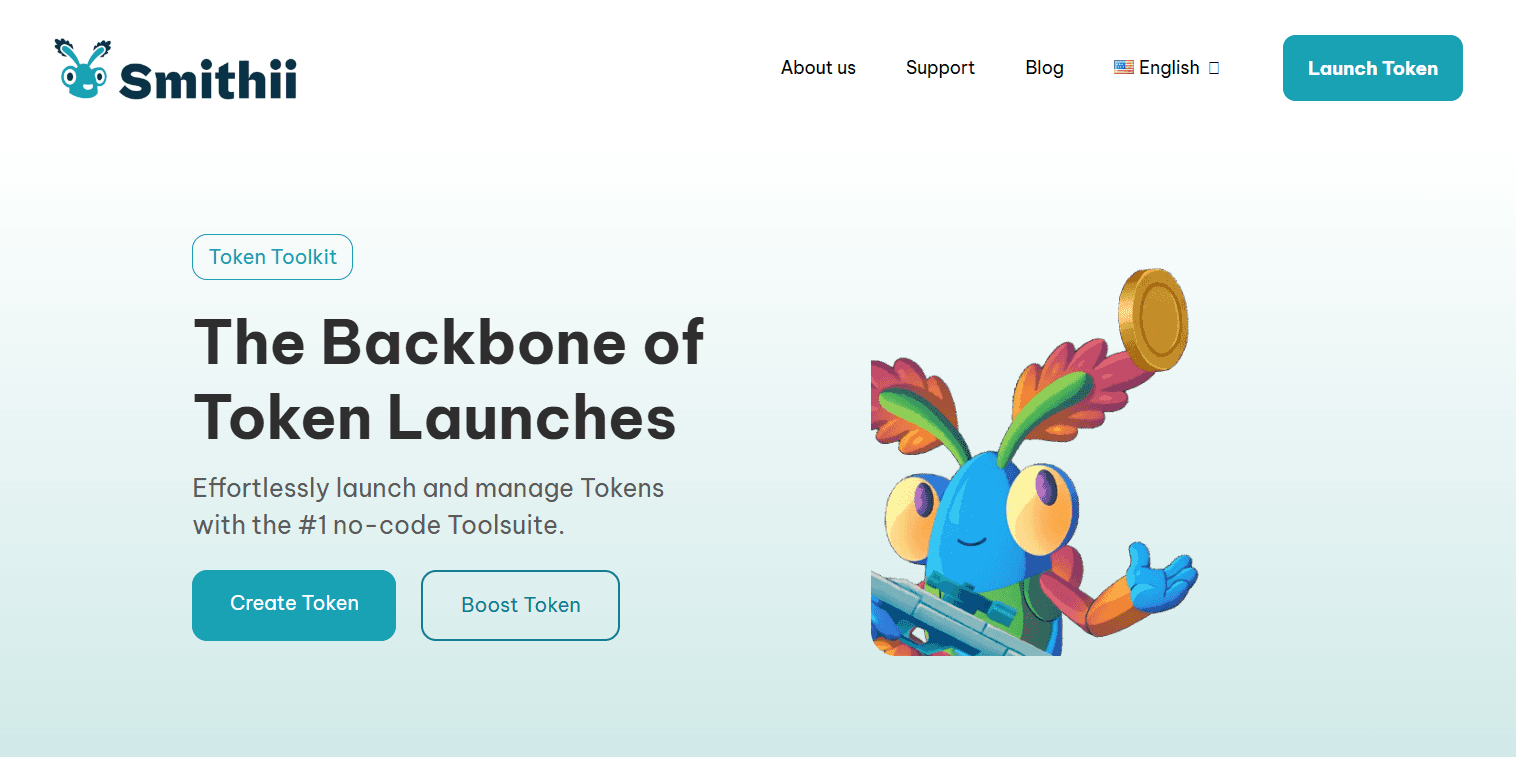
Smithii is a good no-code token toolkit that includes a Staking Builder, letting projects spin up a custom staking site alongside token creation and liquidity tools. Per Solana Compass, the platform has processed over 7,000 token launches, and it operates across Solana, Ethereum, BNB Chain, Base, and other networks.
The Staking Builder produces a branded staking dApp rather than a listing on a shared explorer. The connected wallet is set immutably as the pool's authority wallet, and rules are configured per pool.
Flexible reward pairing: stake your token, pay rewards in SOL, USDC, or another SPL token.
Tunable parameters: minimum stake amounts, lock times, and daily reward rates per staked token.
Multi-pool support on the premium plan, useful for segmenting a 7-day low-APR pool from a 90-day high-APR pool.
Per-stake fees: 0.008 SOL per staking action on the free tier, 0.002 SOL on premium, with an optional extra fee creators can add.
To its credit, Smithii's launch-to-staking bundle is convenient for first-time creators, and its contracts have been reviewed by CoinFabrik. Streamflow is still the better platform once a token is live, because staking there is core infrastructure rather than one tool among many: governance staking, managed white-label programs, and token staking built for scale on Solana are things a launch toolkit does not provide.
Pros:
Convenient bundle of token creation, liquidity, and staking in one dashboard.
Flexible reward token pairing with tunable lock and rate parameters.
CoinFabrik-audited components with accessible pricing for new creators.
Cons:
Staking is a side tool, not dedicated infrastructure, with limited pool variety.
No governance staking, managed programs, or revenue-backed reward options.
Lacks the lifecycle depth of vesting, large airdrops, and tokenomics dashboards.
4. Sanctum (Good for Branded SOL Liquid Staking)
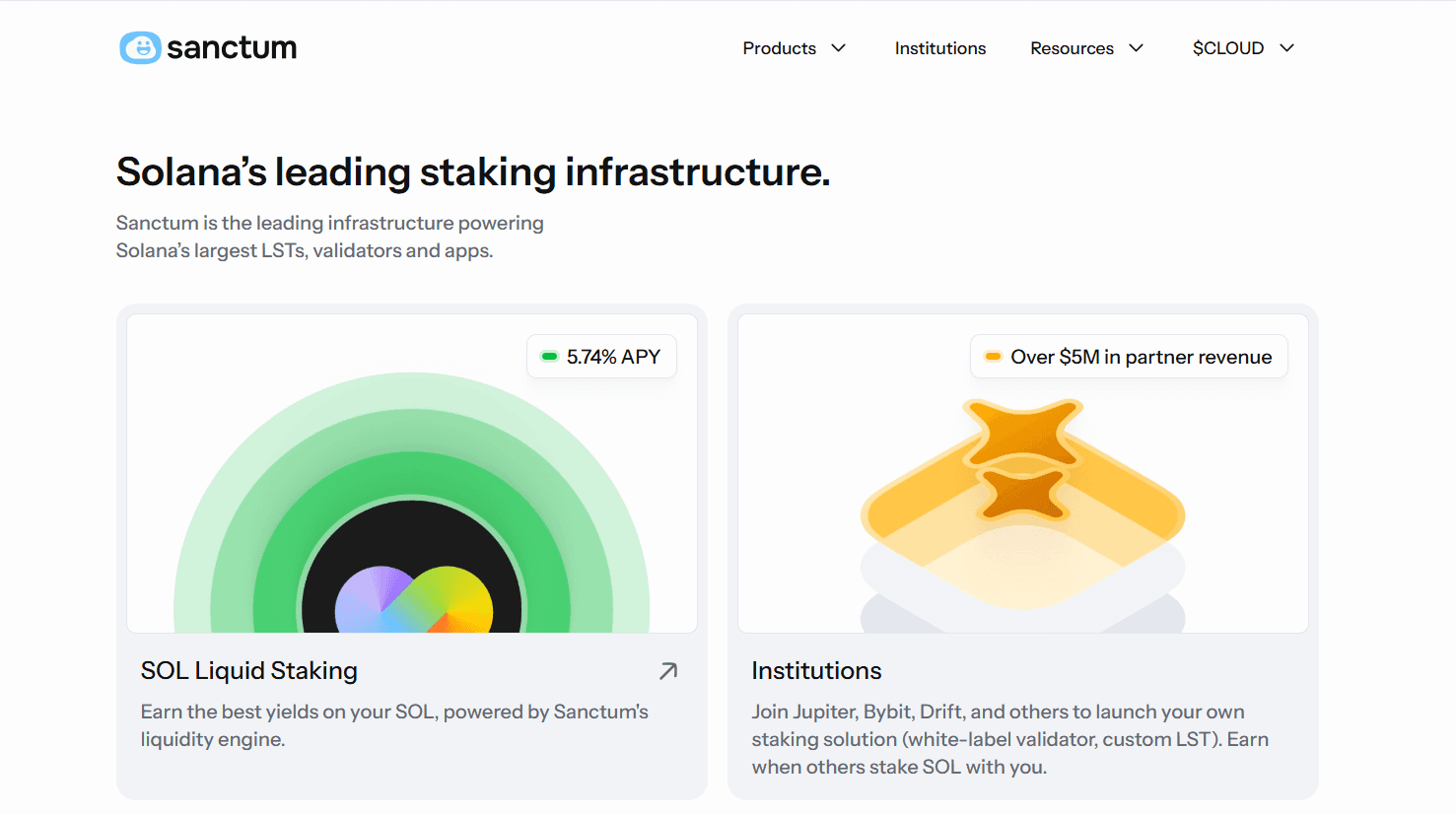
Sanctum is a good platform for a different staking problem: branded liquid staking tokens. Instead of staking a project's own SPL token, Sanctum lets projects and communities issue their own LST backed by staked SOL, the model behind tokens like Jupiter's jupSOL.
The timing of this category is notable. Per Datawallet's 2026 Solana staking analysis, Solana's liquid staking ratio reached 17.6% at the end of Q4 2025, up from 11.6% the prior quarter, and Sanctum-issued LSTs sit among the category leaders alongside JitoSOL and Binance's bnSOL.
Branded LSTs that tie a community's identity to SOL staking yield.
Deep liquidity routing across Sanctum's LST infrastructure, so small LSTs stay tradable.
Yield without lockup friction, since LSTs remain composable across Solana DeFi.
Sanctum deserves real praise for making branded LSTs accessible to communities of any size in a fast-growing category. Streamflow is still the better choice for token projects, because Sanctum cannot stake your own SPL token at all; if the goal is reducing sell pressure on your token and rewarding your holders, Streamflow's configurable pools do exactly that, alongside token locks that prove supply commitments on-chain.
Pros:
Simple path to a branded, community-owned liquid staking token.
LSTs remain liquid and composable across Solana DeFi.
Strong position in a liquid staking category that grew to 17.6% of staked SOL.
Cons:
Does not support staking your project's own SPL token.
Yield is tied to SOL staking, not your token's economy.
No vesting, locks, airdrops, or token distribution tooling.
5. Jito (Good for Validator Economics and Restaking)
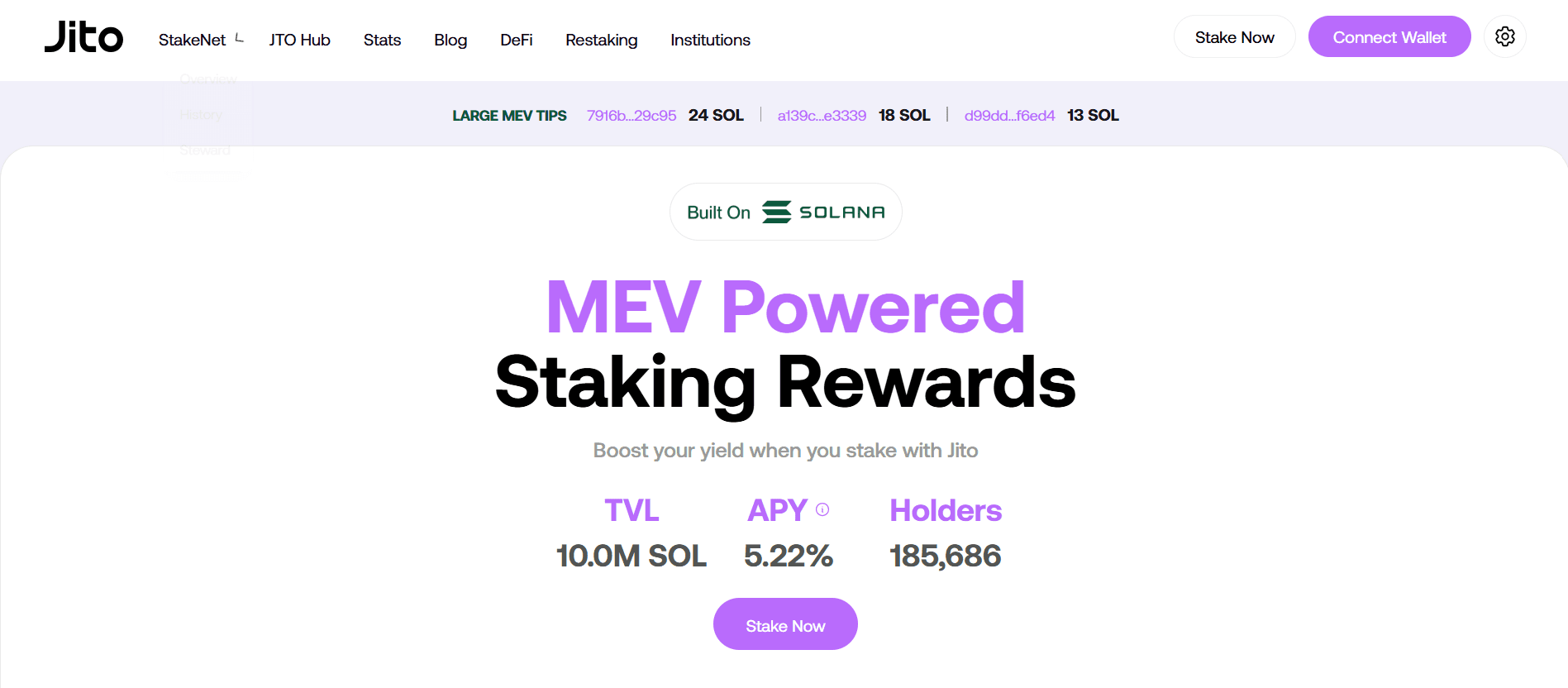
Jito is a good, infrastructure-grade platform that dominates Solana's validator economics: by early 2026, over 95% of active stake runs validators using the Jito-Solana client, per Datawallet. The same analysis notes Jito tips grew from roughly 10% of SOL priority fees in April 2023 to regularly above 60% by early 2025, showing how central its block engine has become.
For token projects, the relevant product is Jito's restaking layer and Node Consensus Networks, which let protocols source economic security from staked assets. The TipRouter NCN allocates 6% of MEV tips across the Jito DAO, JitoSOL stakers, and JTO governance stakers.
MEV-enhanced yield flowing to JitoSOL holders and delegators.
Restaking and NCNs for protocols that need crypto-economic security.
Deep integration across the Solana validator and DeFi stack.
Jito's engineering reputation is arguably the strongest on Solana at the network layer. Streamflow is still the better pick for token projects, because Jito addresses network-level staking rather than project-token staking; a GameFi team that wants players staking its in-game token, or a DAO rewarding governance participation, needs Streamflow's configurable SPL pools and automated DeFi rewards and staking deployment.
Pros:
Dominant, battle-tested position in Solana validator infrastructure.
MEV-enhanced yield and mature restaking primitives via NCNs.
Deep integrations across the Solana DeFi ecosystem.
Cons:
Does not offer staking pools for your project's own SPL token.
Built for validators and protocols, not token launch teams.
No no-code path, lifecycle tooling, or managed staking programs.
Comparison Table: Solana Staking Platforms in 2026
Feature | Streamflow | StakePoint | Smithii | Sanctum | Jito |
Stakes your own SPL token | Yes, any SPL token | Yes, SPL + Token-2022 | Yes | No, SOL LSTs only | No, SOL / restaking |
No-code pool creation | Yes | Yes | Yes | Partial | No |
Pool types | 4 (incl. Governance, Custom) | Locked and flexible | Single or multi-pool | LST issuance | NCN / restaking |
Reward model | Configurable + revenue-backed STREAM | Reflection rewards | Daily reward rates | SOL staking yield | MEV-enhanced yield |
Non-custodial | Yes | Yes | Yes | Yes | Yes |
Audits | FYEO and OPCODES | Not publicly detailed | CoinFabrik | Publicly audited | Publicly audited |
Vesting, locks, airdrops included | Yes, full lifecycle | Locks only | Basic tools | No | No |
White-label / managed staking | Yes | Widget embed | Custom staking site | Branded LSTs | No |
Best for | Token projects at any scale | Token-2022 launches | Bundled token creation | Community SOL products | Validator economics |
The table shows the core distinction. Streamflow is the best full-stack option for project token staking, while the others are good tools for specific slices of the problem.
How to Choose the Right Solana Staking Platform
The decision comes down to matching the platform to the job your token needs done. Use this short framework.
Staking your own SPL token at scale: Streamflow, the best all-around choice for pool types, audits, and lifecycle tooling.
Token-2022 with transfer fees: StakePoint is a good fit for native extension support.
Bundled with no-code token creation: Smithii is a good option if you launched there.
A branded SOL liquid staking product: Sanctum is a good specialist.
Network security and MEV economics: Jito is a good infrastructure play.
Two more filters matter for teams thinking past launch.
Reward sustainability: emissions-funded APY eventually dilutes holders, which is why Streamflow's revenue-backed STREAM model matters as a design template.
Integration: staking works best when it connects to vesting, locks, and distribution in one system, so your tokenomics execute as a whole rather than as disconnected contracts.
Case Study: UXD Protocol
UXD Protocol, a decentralized stablecoin provider on Solana, needed token distribution and governance for its $UXP token in a single interface. The team integrated the Streamflow SDK into Realms, putting roughly 46% of $UXP supply on a 4-year linear vesting schedule with a 12-month cliff, as detailed in the UXD Protocol case study.
The outcome is the point for anyone evaluating staking platforms. Stakeholders claim tokens and participate in governance from the same interface, powered by the same programmable infrastructure that runs Streamflow's staking pools.
That composability, where staking, vesting, and governance share one audited layer, is what separates the best platform from good point solutions.
How to Get Started With Streamflow Staking
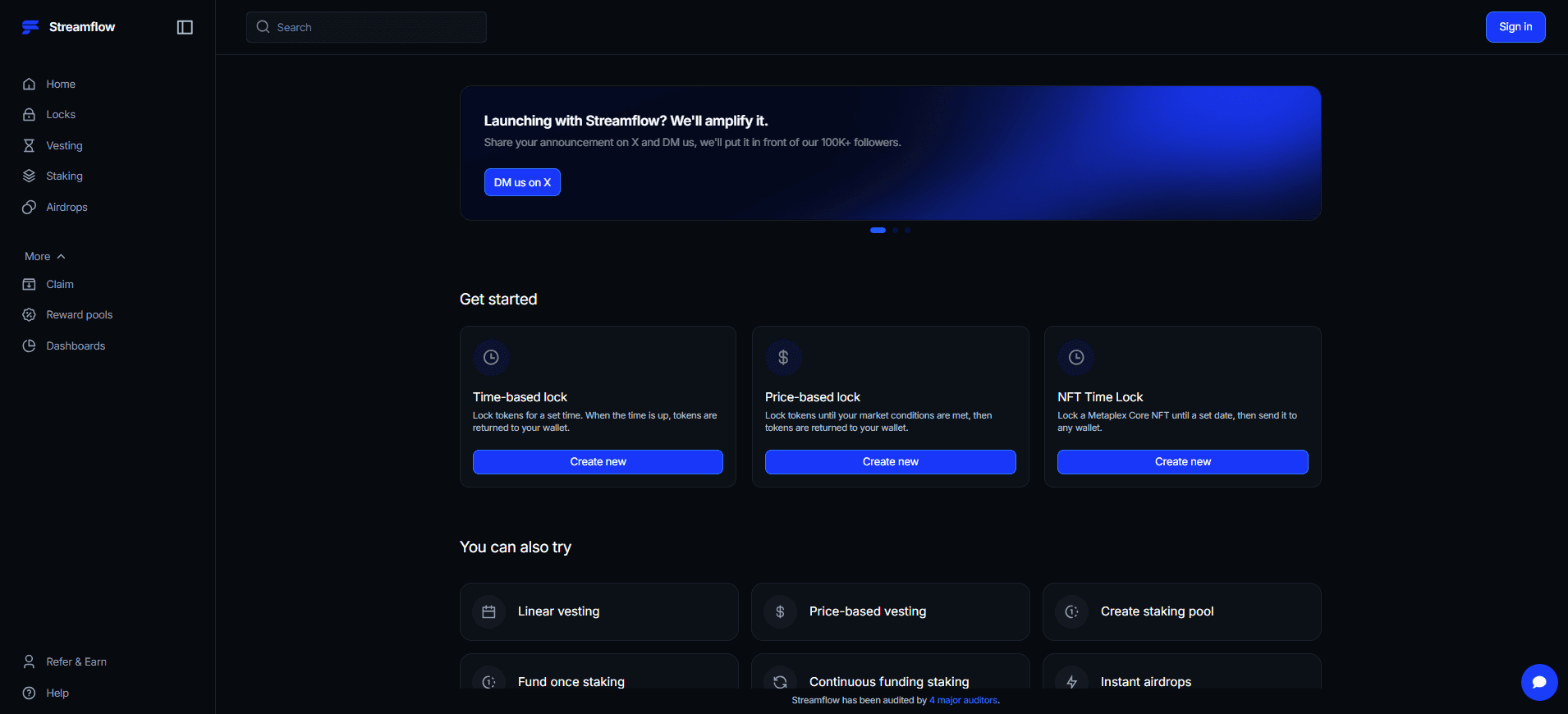
Launching a staking pool on the best Solana staking platform takes four steps and no code. The whole flow runs through the Streamflow app with a standard Solana wallet.
Connect your wallet and select your token: Open the Streamflow App, connect Phantom, Backpack, Solflare, or any Solana wallet, and choose the SPL token holders will stake. Creation is permissionless, so no approval or whitelist is needed.
Configure the pool: Pick a pool type (Fund Once, Continuous Funding, Governance Staking, or Custom), then set APY, lock periods, claim frequency, and the reward token. Parameters are immutable once deployed, so finalize your reward math here.
Fund the rewards: Deposit the reward tokens that the contract will distribute. Continuous Funding pools can be topped up at any time, which keeps incentives running as your community grows.
Publish and let automation take over: The pool goes live, holders stake and receive stake receipts, and rewards distribute automatically on-chain. Real-time staking data is visible to your team and community, with contracts verifiable on Solscan and Solana Explorer.
Teams that want a branded experience or bespoke reward logic can skip self-serve entirely and have Streamflow's team build a custom managed staking program. Either way, the operational work ends at deployment.
Conclusion
With 68.3% of SOL's circulating supply staked, Solana users expect every serious token to offer a staking layer, and the platforms above make that layer a configuration task instead of a build.
Streamflow is the best Solana staking platform in 2026 because it combines no-code pools for any SPL token, FYEO and OPCODES audited contracts, and a proven revenue-backed reward model in one platform already trusted by 40,000+ projects, while StakePoint, Smithii, Sanctum, and Jito remain good choices for narrower needs.
Book a demo to see how Streamflow handles staking pool deployment, reward automation, and custom staking programs for your token.
Read Next:
FAQs:
1. What is the best Solana staking platform for token projects in 2026?
The best Solana staking platform for token projects in 2026 is Streamflow. It offers no-code, non-custodial staking pools for any SPL token, four pool types with configurable APY and lock periods, and audited smart contracts. It also runs a revenue-backed STREAM staking model paying roughly 74.57% APY from protocol revenue.
2. How do you launch a staking pool on Streamflow?
You launch a staking pool on Streamflow by connecting a Solana wallet, selecting your SPL token, configuring the pool type, APY, lock period, and reward funding, then publishing. The full flow is no-code and permissionless, and rewards distribute automatically once the pool is live.
3. How does Streamflow compare to good alternatives like StakePoint or Smithii?
Streamflow compares favorably to good alternatives like StakePoint and Smithii because staking is part of a full token operations platform, not a standalone tool. StakePoint is good for Token-2022 pools and Smithii is good for bundled token creation. Only Streamflow adds vesting, locks, million-recipient airdrops, governance staking, and managed white-label programs on audited infrastructure.
4. Is Streamflow's staking infrastructure audited?
Yes, Streamflow's staking infrastructure runs on smart contracts audited by FYEO and OPCODES. Pools are fully non-custodial and every contract is verifiable on Solscan and Solana Explorer. This gives communities public, on-chain proof of how rewards and stakes are handled.
5. Why do token projects launch staking pools instead of just listing their token?
Token projects launch staking pools because staking reduces circulating supply, lowers sell pressure, and rewards long-term holders. It also drives community engagement, builds token utility, and supports governance participation. Platforms like Streamflow make this deployable in minutes without engineering overhead.