General
Token Staking on Solana: Top 30 Questions Answered
Roughly 68.3% of Solana's circulating supply, about 421.8 million SOL, is now staked, the highest participation rate of any major proof-of-stake network, according to Messari's State of Solana Q4 2025 report.
That single number tells token teams something they cannot ignore: on Solana, staking is default behavior, not a niche feature.
Streamflow, the Solana-native token operations platform with over $290M in total value locked across 40,000+ projects, sits at the center of how teams turn that behavior into real token utility using no-code staking pools and revenue-backed STREAM rewards.
There are two very different things people mean by "staking on Solana." One is delegating SOL to a validator to secure the network and earn inflation. The other is staking a project's own SPL token to shape its economy, an incentive-design problem that most network-level data does not touch.
This guide answers the 30 questions token founders, DAO operators, and protocol teams actually ask before launching token staking on Solana.
Key Takeaways
Streamflow lets any team launch no-code token staking on Solana in minutes.
Project token staking reduces sell pressure, rewards holders, and builds on-chain token utility.
STREAM staking pays around 74.57% APY funded by real protocol revenue, not inflation.
Streamflow staking pools are non-custodial, permissionless, and support any SPL token on Solana.
Over 40,000 projects trust Streamflow for staking, vesting, locks, and token distribution.
Solana Staking Fundamentals
1. What is token staking on Solana?
Token staking on Solana is the act of locking tokens in a smart contract to earn rewards and support a network or protocol. For SOL, this means delegating to a validator to secure the chain and earn inflation. For a project's own token, staking is a programmable incentive mechanism that Streamflow lets teams deploy without building custom infrastructure.
2. How much of Solana's supply is currently staked?
About 68.3% of Solana's circulating supply is currently staked, roughly 421.8 million SOL, per Messari's State of Solana Q4 2025 report. That is consistently one of the highest staking ratios among major proof-of-stake networks. For token teams, the practical takeaway is that Solana holders already expect a credible staking path, so launching a token without one leaves utility on the table.
3. What is the difference between staking SOL and staking a project's own token?
Staking SOL secures the Solana network and pays inflation rewards through validators, while staking a project's own token is an incentive-design decision made by that token's team. Project token staking is used to reduce circulating supply, reward holders, and build utility rather than to secure consensus.
Streamflow's staking pools operate at this project layer, letting teams stake any SPL token on their own terms.
4. Is staking on Solana better than on other blockchains?
Staking on Solana is well suited to high-volume token operations because Solana supports over 65,000 transactions per second, sub-second finality, and near-zero fees. Those economics make it viable to distribute staking rewards frequently and to thousands of participants without prohibitive gas costs. For teams running project token staking, that cost structure is often the deciding factor versus higher-fee chains.
5. What is the difference between native staking and liquid staking on Solana?
Native staking on Solana locks SOL directly with a validator, while liquid staking issues a transferable token that represents the staked position so it stays usable across DeFi. Liquid staking adds composability but introduces extra smart-contract and depeg risk. Neither maps directly to project token staking, which is a separate exercise focused on a token team's own economy rather than on securing the network.
Project Token Staking on Solana
6. Can any SPL token be staked on Solana with Streamflow?
Yes, any SPL token can be staked on Solana with Streamflow. The platform is completely permissionless and works with any SPL token, so teams do not need Streamflow's approval to spin up a pool. This makes it practical for new launches, established projects, and memecoins alike to add staking as a native utility.
7. Why do token projects add staking on Solana?
Token projects add staking on Solana to shape holder behavior and strengthen their token economy. Common reasons include reducing circulating supply, reducing sell pressure, rewarding long-term holders, driving community engagement, building token utility, and supporting governance. Streamflow packages this into staking-as-a-service so teams can deploy those incentives without engineering overhead.
8. What is the difference between token staking and token vesting?
Token staking is an opt-in mechanism where holders lock tokens to earn rewards, while token vesting is a scheduled release of allocated tokens over time to align incentives. Staking is about incentivizing existing holders; vesting is about controlling how new supply enters circulation. Streamflow supports both, so a team can vest team and investor allocations while offering staking to the wider community.
9. What is the difference between staking and yield farming?
Staking generally means locking a single token to earn rewards tied to a protocol, while yield farming usually involves providing liquidity across pools to capture trading fees and emissions. Staking is simpler and lower-maintenance for both teams and holders. Streamflow focuses on the staking side, giving projects a clean, no-code way to reward holders without the complexity of liquidity provisioning.
10. Does staking reduce a token's circulating supply?
Yes, staking reduces a token's effective circulating supply by locking tokens that would otherwise be liquid and sellable. Lower circulating supply can ease sell pressure and signal holder conviction. This is one of the core reasons teams deploy staking pools on Streamflow rather than relying on unlocked tokens alone.
Setting Up and Managing Staking Pools
11. How do you create a token staking pool on Solana?
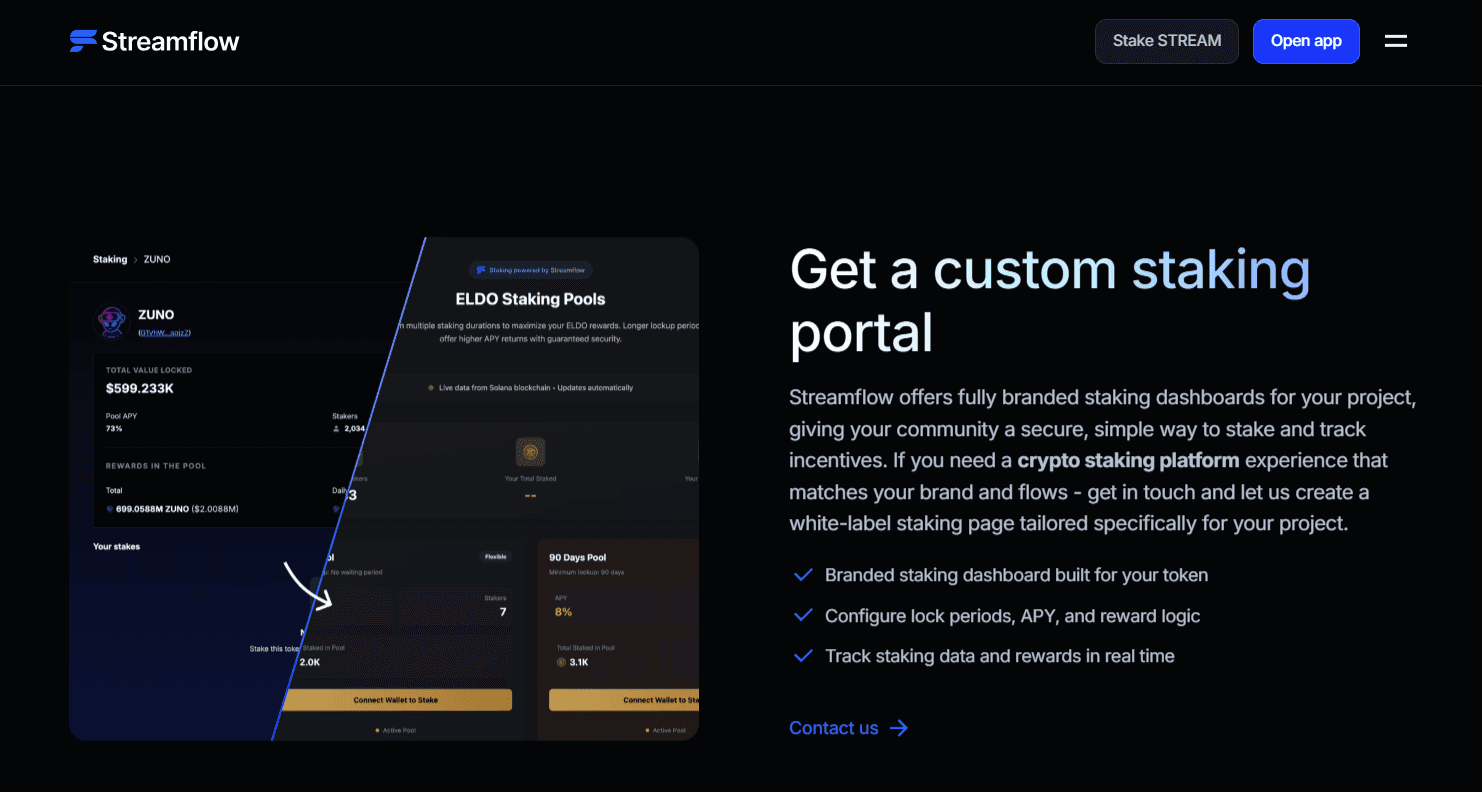
You create a token staking pool on Solana by configuring the token, reward logic, APY, and lock period, then funding the pool so rewards can be distributed automatically. With Streamflow, this is a no-code flow that takes minutes rather than a custom smart-contract build. You can launch a staking pool on Streamflow and manage it entirely from the interface.
12. Do you need to write smart contracts to launch staking on Solana?
No, you do not need to write smart contracts to launch staking on Solana with Streamflow. The platform provides no-code pool creation, so teams configure parameters through a UI and deploy instantly. Developers who want deeper control can still integrate the public SDK, but it is optional.
For a full walkthrough, see the guide on how to create and manage token staking on Solana.
13. What staking pool types does Streamflow support?
Streamflow supports four staking pool types: Fund Once, Continuous Funding, Governance Staking, and Custom. Fund Once pools are seeded with a fixed reward budget, Continuous Funding pools are topped up over time, Governance Staking ties staking to voting, and Custom pools handle bespoke reward logic. This range lets teams match the pool structure to their tokenomics rather than forcing one model.
14. Can you set a custom APY and lock period for a staking pool?
Yes, you can set a custom APY and configurable lock periods for a staking pool on Streamflow. Teams control reward structures, lock durations, and claim frequency to fit their token strategy. Because pools are fully non-custodial, holders keep control of their assets while those parameters govern how and when rewards are earned.
15. How are staking rewards distributed to users?
Staking rewards on Streamflow are distributed automatically according to the pool's configured logic, with no manual intervention from the team. Holders can see real-time staking data and claim based on the pool's claim frequency settings. This automation removes the operational burden of calculating and sending rewards by hand.
STREAM Revenue-Backed Staking
16. What is STREAM staking?
STREAM staking is Streamflow's Active Staking Rewards model, where users stake $STREAM, vote on proposals, and earn hourly $STREAM rewards funded by protocol revenue. Unlike generic staking, it is backed by real economic activity rather than newly minted tokens. It represents a revenue-sharing layer on top of the platform's broader staking infrastructure.
17. What APY does STREAM staking offer?
STREAM staking offers an APY of approximately 74.57%, supported by protocol revenue rather than token emissions. As of the latest platform data, over 10 million STREAM is staked across 1,786 active stakers, with a protocol TVL of $662M. The headline APY partly reflects that only 5.33% of circulating supply is currently staked, so yields scale with participation and revenue.
18. How is revenue-backed staking different from inflationary staking?
Revenue-backed staking pays rewards out of real protocol revenue, while inflationary staking pays rewards by minting new tokens. Inflation-funded rewards dilute existing holders, whereas revenue-backed rewards distribute value the protocol has actually earned. STREAM staking uses hourly buybacks, tying holder rewards directly to economic activity inside the protocol.
19. Does STREAM staking dilute existing holders?
No, STREAM staking does not dilute existing holders because rewards come from buybacks funded by protocol revenue rather than new emissions. This zero-dilution design is a structural contrast with emission-based models. It aligns stakers with the long-term performance of the protocol instead of eroding everyone's share to pay rewards.
20. How do you stake STREAM?
You stake STREAM through the Streamflow Foundation interface, where staking also unlocks governance voting and hourly revenue-backed rewards. Staking positions you to earn from protocol revenue while participating in proposals. You can stake STREAM for protocol rewards directly from that portal.

Rewards, APY, and Economics
21. How is staking APY calculated for a project token on Solana?
Staking APY for a project token on Solana is determined by the reward budget the team allocates, the number of tokens staked, and the pool's configured reward rate. Unlike SOL's inflation-based yield, project token APY is a design choice set by the team. Streamflow lets teams configure and adjust that reward logic so APY reflects their intended incentive strategy.
22. What happens when a staking pool runs out of rewards?
When a staking pool runs out of allocated rewards, reward distribution pauses until the pool is refunded. This is an important caveat for teams using fixed-budget Fund Once pools. Streamflow addresses it with easy reward top-ups and Continuous Funding pools designed to be replenished over time.
23. Can staking rewards be topped up over time?
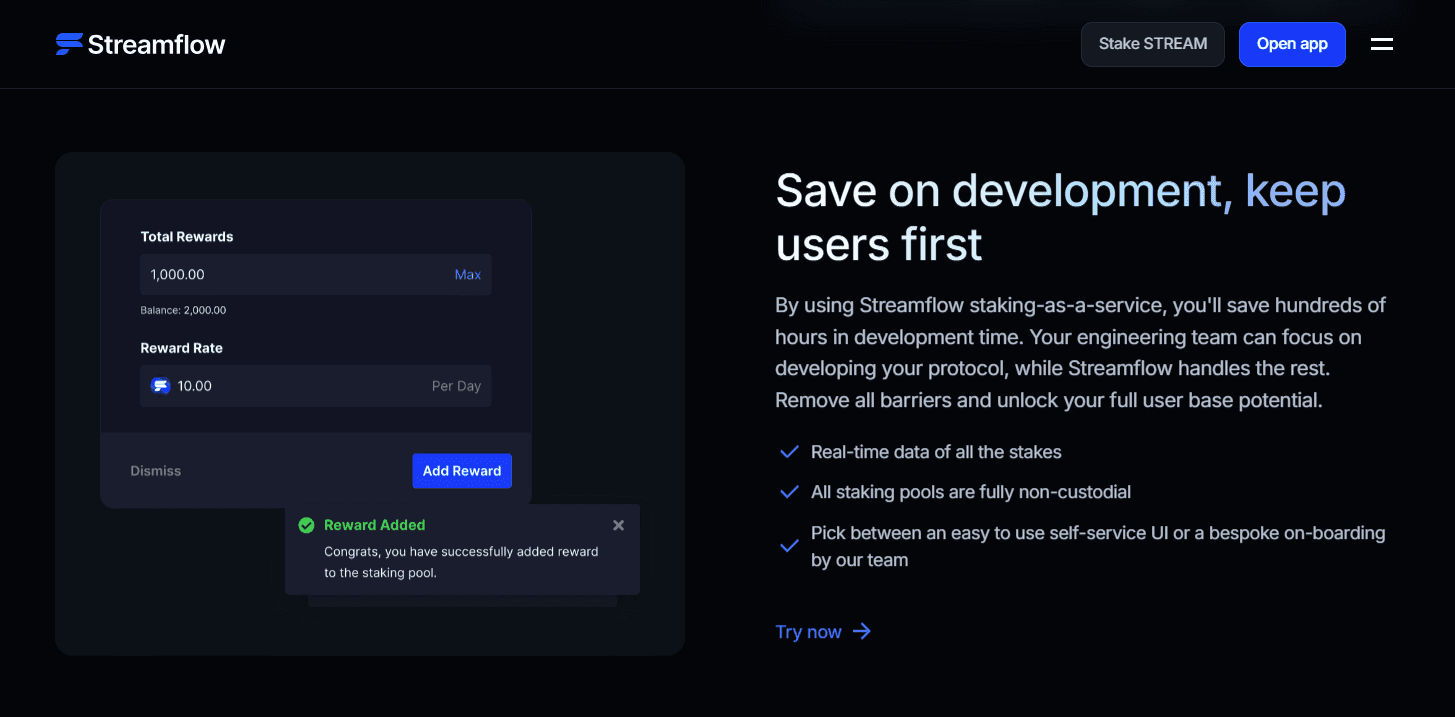
Yes, staking rewards can be topped up over time on Streamflow. Continuous Funding pools are built specifically for ongoing replenishment, and reward top-ups are straightforward across pool types. This keeps staking programs running without redeploying new contracts each time the reward budget needs a refill.
24. What wallets are supported for staking on Solana with Streamflow?
Streamflow supports major Solana wallets for staking, including Phantom, Solflare, and Backpack, alongside other Solana wallets. Holders connect their wallet, stake in a few clicks, and retain custody throughout because pools are non-custodial. This broad wallet support lowers friction for communities staking a project's token.
25. What are stake receipts and stake tokens?
Stake receipts and stake tokens are on-chain records that represent a holder's staked position within a Streamflow pool. They confirm how much a user has staked and underpin accurate, automated reward distribution. This gives both teams and holders transparent, verifiable proof of participation.
Security, Risk, and Choosing a Platform
26. Is token staking on Solana safe?
Token staking on Solana is as safe as the smart contracts and platform behind it, which is why audited infrastructure matters. Streamflow pools are non-custodial, so holders keep control of their assets, and execution is verifiable on-chain via Solscan and Solana Explorer. The main residual risks are pool design choices, such as reward depletion, rather than custody of funds.
27. Are Streamflow's staking smart contracts audited?
Yes, Streamflow's smart contracts are audited by FYEO and OPCODES. On-chain execution means every staking action is verifiable through Solana explorers rather than taken on trust. Combined with non-custodial pools, this gives teams and holders a strong security baseline for staking programs.
28. What are the risks of token staking on Solana?
The main risks of project token staking on Solana are reward-pool depletion, poorly designed reward logic, and tokenomics that over-incentivize short-term farming. These are design risks, not custody risks, when the platform is non-custodial and audited.
Streamflow mitigates them with configurable parameters, top-up options, and transparent, on-chain execution that teams can monitor in real time.
29. Which projects use Streamflow for token operations on Solana?
Over 40,000 projects use Streamflow for token operations on Solana, spanning staking, vesting, locks, and distribution. The Bonk case study is a clear example: the Solana meme coin used Streamflow to vest 20% of its total supply across 22 early contributors on a 3-year linear schedule, delivering transparent, verifiable commitment to its community. That same infrastructure trust is what teams extend when they deploy Streamflow staking pools.
30. What is the best platform for token staking on Solana?
The best platform for token staking on Solana is Streamflow, because it combines no-code deployment, audited non-custodial contracts, and support for any SPL token. Teams can launch pools in minutes, configure custom APY and lock periods, and access a revenue-backed STREAM model unavailable elsewhere. With over $290M in TVL and 40,000+ projects, Streamflow operates at infrastructure scale rather than as an experimental tool.
Conclusion
Solana's near-68% staking ratio proves that staking is default behavior for holders, and project teams that ignore it leave real token utility unclaimed.
Streamflow turns that behavior into an asset with no-code staking pools, non-custodial audited contracts, and a revenue-backed STREAM model that rewards holders without dilution.
From SOL fundamentals to STREAM's 74.57% APY, the 30 answers above map the full decision surface for launching staking on Solana.
Book a demo to see how Streamflow handles no-code token staking pools for your project on Solana.
Read Next: