General
Staking-as-a-Service: Everything You Need to Know in 2026
Streamflow is the best staking-as-a-service platform on Solana, enabling crypto projects to deploy fully automated, non-custodial staking pools without writing a single line of code.
As token ecosystems grow more competitive in 2026, staking has shifted from a nice-to-have to a core part of sustainable tokenomics.
This guide covers everything you need to know about staking-as-a-service, what it is, how it works, why it matters, and how to launch your own staking system today.
Key Takeaways
Staking-as-a-service allows crypto projects to deploy customizable, automated staking pools without building custom infrastructure.
In 2026, projects use staking to reduce circulating supply, reward long-term holders, and build token utility.
Streamflow is the leading staking-as-a-service platform on Solana, supporting any SPL token, fully non-custodial pools, configurable APY, and automated reward distribution for over 1.3 million users.
What Is Staking-as-a-Service
Staking-as-a-service is a managed infrastructure model that allows crypto projects to offer token staking to their communities without building the underlying smart contracts, reward logic, or distribution systems from scratch. Instead of allocating engineering resources to build and maintain staking infrastructure, projects use a platform that handles the technical complexity, and simply configure what matters: reward rates, lock periods, and pool funding.
At its core, staking is the process of locking tokens to earn rewards and participate in network or protocol incentives.
Staking-as-a-service takes that concept and wraps it in a no-code, permissionless deployment model that any project can use, regardless of team size or technical capability.
Streamflow's staking product is a direct implementation of this model. Any SPL token can be staked through Streamflow, with no-code pool creation, configurable reward structures, and automated reward distribution, all running on Solana's high-speed, near-zero fee infrastructure.
Streamflow has made it possible for thousands of projects to launch staking in minutes rather than months, contributing to its adoption across 40,000+ projects and $1.4B+ in total value locked.
How Does Staking-as-a-Service Work
Staking-as-a-service works by abstracting the smart contract deployment and reward distribution logic into a configurable platform that projects interact with through a UI or SDK.
Here is how the process works end to end:
1. Pool Creation
A project team creates a staking pool through a no-code interface. They define the token to be staked, the reward token, the lock period, and the reward logic.
No smart contract development is required.
2. Pool Funding
Once the pool parameters are set, the team funds the reward pool. Streamflow supports two primary funding models:
Fund Once, where the reward pool is seeded upfront.
Continuous Funding, where rewards are topped up over time without redeploying the contract.
This means teams can extend staking campaigns by simply adding more rewards to the pool, no contract migration needed.
3. User Staking
Community members connect their wallets: Phantom, Solflare, Backpack, or any Solana-compatible wallet, and stake their tokens directly into the pool.
The staking is fully non-custodial, meaning users retain control and the tokens are held by the smart contract, not the platform.
4. Automated Reward Distribution
Rewards are distributed automatically based on the configured logic. Streamflow supports configurable claim frequency, and real-time staking data is available throughout the pool lifecycle.
Stake receipts and stake tokens are issued to participants as proof of their position.
5. Pool Management
Project teams can top up rewards, monitor real-time staking data, and manage claim frequency settings, all without redeploying contracts. Streamflow also offers custom managed staking for teams that want bespoke configuration and onboarding support from the Streamflow team directly.
For projects that need deeper integration, Streamflow's SDK allows developers to embed staking logic directly into their dApps, enabling fully custom staking flows built on proven infrastructure.
What Are the Benefits of Staking-as-a-Service in 2026?
Staking-as-a-service delivers concrete operational and economic benefits for projects that adopt it. In 2026, with token markets more mature and communities more demanding, these benefits have become critical differentiators.
1. No Engineering Overhead
Building staking infrastructure from scratch requires smart contract development, security audits, and ongoing maintenance. Staking-as-a-service eliminates all of that.
Streamflow's staking is deployed in minutes through a no-code interface, letting teams focus on growth instead of execution.
2. Reduced Circulating Supply
When tokens are locked in staking pools, they are removed from active circulation. This directly reduces sell pressure and can contribute to price stability.
Projects using Streamflow have used staking to lock meaningful portions of their supply, improving the market dynamics around their tokens.
3. Reward Holders and Drive Retention
Staking creates a financial incentive for long-term holding. Instead of selling tokens at the first opportunity, holders are rewarded for staying in the ecosystem.
Streamflow makes this configurable: teams set the APY, lock periods, and reward logic that fits their tokenomics model.
4. Community Engagement and Governance
Staking pools can be structured to support governance participation. Governance Staking is one of Streamflow's supported pool types, allowing teams to align staking with voting power and protocol decision-making.
This creates a more engaged, committed community rather than a passive token holder base.
5. Sustainable Token Utility
Staking builds real utility around a token. Rather than speculative demand, holders have a functional reason to acquire and hold the token, to earn rewards.
Streamflow supports this by enabling fully non-custodial, permissionless pool creation for any SPL token on Solana.
6. Real Revenue-Backed Staking
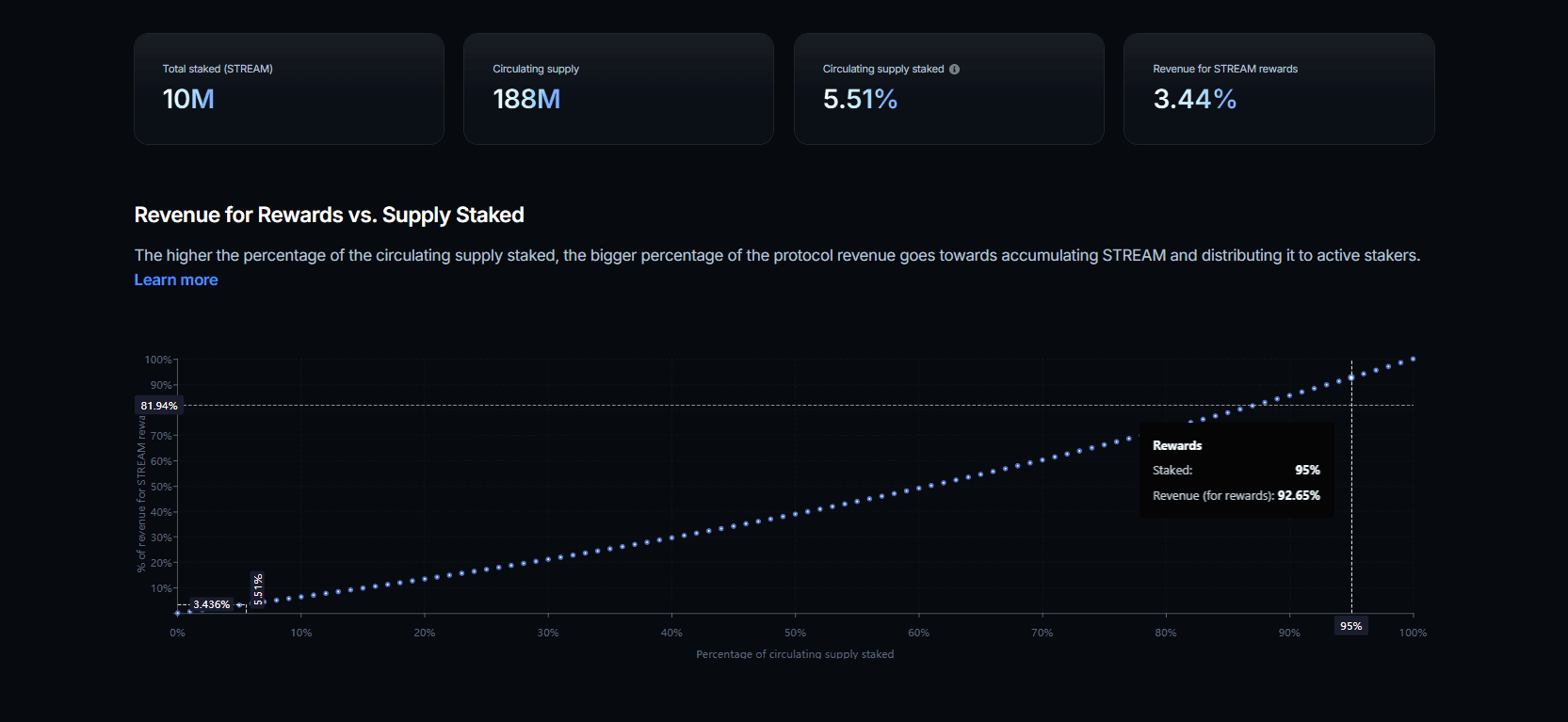
Streamflow's own $STREAM token demonstrates what the most advanced form of staking-as-a-service looks like: staking rewards backed by real protocol revenue rather than inflation.
$STREAM holders who stake and vote on proposals earn hourly $STREAM rewards funded by protocol activity, a model of zero dilution, sustainable yield, and revenue-backed staking.
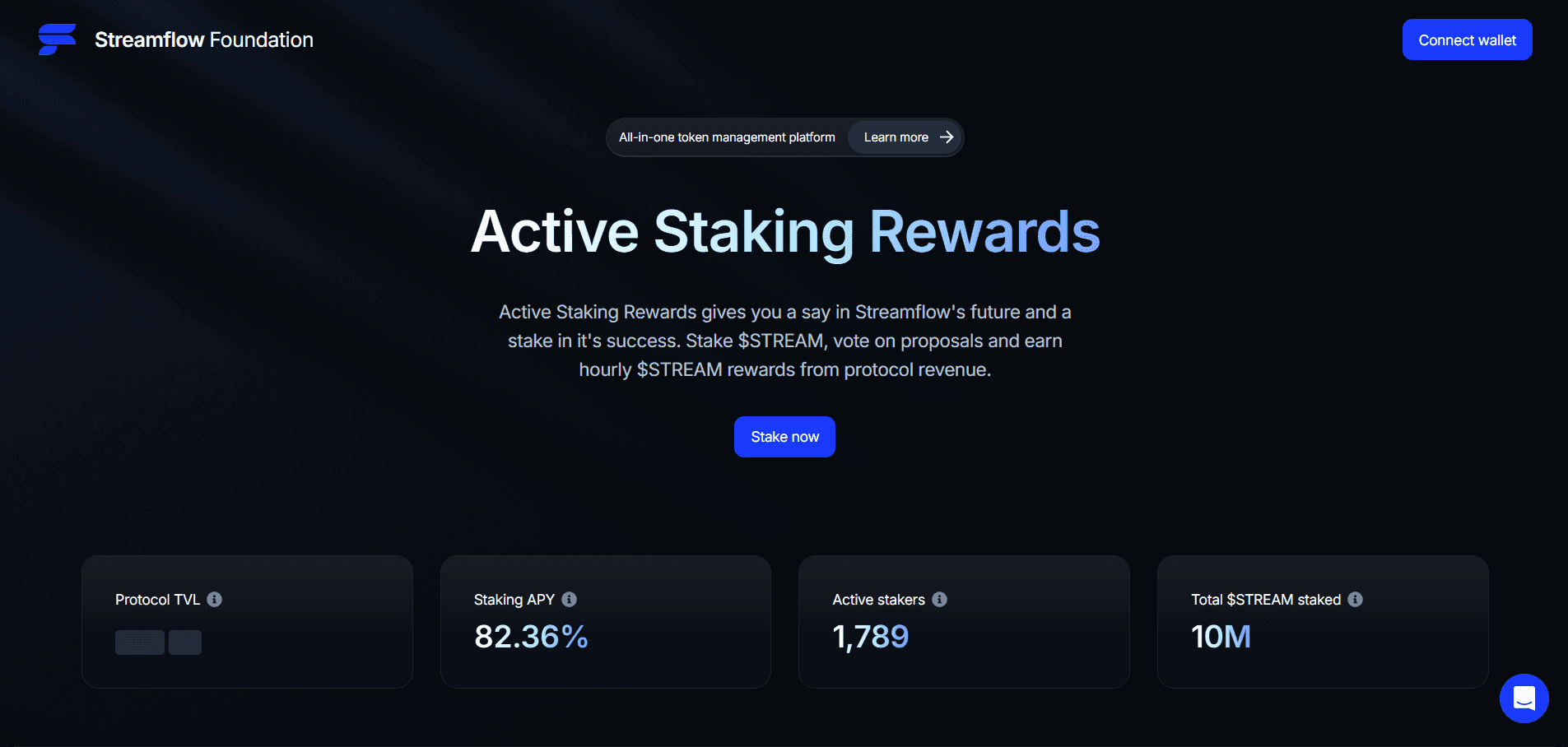
The current staking APY for $STREAM is 74.57%, with over 10 million $STREAM tokens staked and $662M in protocol TVL supporting the reward pool.
7. Cost-Efficient at Scale
Because Streamflow is built on Solana, which supports 65,000+ transactions per second, sub-second finality, and near-zero fees, staking reward distributions are economically viable at any scale.
This is a meaningful advantage over Ethereum-based alternatives where gas costs can make frequent reward distributions prohibitively expensive.
Why Crypto Projects Need Staking-as-a-Service in 2026
In 2026 projects can no longer rely on speculation alone to maintain community interest. Token holders expect utility, transparency, and real economic rewards.
Staking-as-a-service has become one of the clearest ways to deliver all three.
1. Sell Pressure Is the Default Without Staking
Without a mechanism to incentivize holding, most token holders will sell at the first sign of profit. Staking changes the calculation. When holders are earning meaningful rewards by locking their tokens, the opportunity cost of selling increases.
Projects that deploy staking see measurable reductions in circulating supply and sell pressure.
2. Communities Demand Participation Mechanisms
Token communities in 2026 want to do more than hold. They want to vote, earn, and participate. Staking-as-a-service enables this by combining financial rewards with governance participation in a single pool structure.
Streamflow's Governance Staking pool type is built specifically for this use case.
3. Manual Staking Systems Don't Scale
Some early-stage projects attempt to manage staking manually: tracking balances, calculating rewards in spreadsheets, and sending tokens by hand. This fails at any meaningful scale.
Manual token distribution becomes increasingly risky and inefficient as user bases grow. Staking-as-a-service replaces this with automated, on-chain execution that scales to thousands or millions of participants without additional operational overhead.
4. Speed to Market Is a Competitive Advantage
In a market where new tokens launch daily, the team that can go from token launch to live staking pool in under an hour has a real advantage. Streamflow takes as little as 37 seconds to deploy key contract infrastructure.
Speed to launch is no longer limited by engineering capacity when the infrastructure is already built.
5. Security and Trust Are Non-Negotiable
Projects that build custom staking contracts without proper auditing expose their communities to significant risk. Streamflow's smart contracts are audited by FYEO and OPCODES, are open-source, and are immutable once deployed.
This means staking pool parameters are enforced by code, not by trust, a critical distinction for communities that have seen projects manipulate or rugpull unaudited contracts.
Why Streamflow Is the Best Staking-as-a-Service Platform in 2026
Streamflow is not just a staking tool. It is a Solana-native token operations infrastructure platform that automates token distribution, locks, vesting, staking, airdrops, and payments using on-chain smart contracts, with $1.4B+ in total value locked, 1.3M+ users, and 40,000+ projects onboarded.
Within that full-stack infrastructure, Streamflow's staking product stands out for several reasons:
1. Any SPL Token, No Restrictions
Streamflow's staking infrastructure is permissionless. Any SPL token can be staked, with no whitelist or approval process required.
This makes it accessible to projects at every stage, from early-stage launches to established ecosystems.
2. Four Pool Types for Every Use Case
Streamflow supports Fund Once, Continuous Funding, Governance Staking, and Custom pool types. This flexibility means the same platform works for a meme coin community running a short-term incentive campaign and a DAO running long-term governance staking.
3. Fully Non-Custodial
Streamflow's staking pools are fully non-custodial. User tokens are never held by the platform, they are held by the smart contract and remain under the cryptographic control of the staker.
This is the security standard communities expect in 2026.
4. Automated Reward Distribution
Rewards are distributed automatically without manual intervention. Teams don't need to run scripts, trigger transactions, or manage reward payouts. The smart contract handles everything, with configurable claim frequency that matches the project's design.
5. Proven at Scale
With over $1.4B in total value locked and 1.3M+ users, Streamflow is not an early-stage experiment. It is infrastructure that has been stress-tested across 40,000+ projects on Solana. The platform's scale reflects real adoption, not theoretical capability.
6. White-Label Staking
For projects that need a fully branded experience, Streamflow offers white-label staking portals, custom staking dashboards and branded pages built on Streamflow infrastructure. Teams own their user experience while Streamflow handles the underlying execution.
7. Revenue-Backed Staking Model
Streamflow's own $STREAM token introduces the most advanced staking model available: revenue-backed rewards, hourly buybacks, and zero dilution. This is the proof of concept for what sustainable staking looks like in 2026, and it runs entirely on Streamflow infrastructure.
8. Backed by the Best
Streamflow is backed by Jump Crypto, Solana Ventures, John Lilic, and others, with $5M+ in total funding raised. It is listed in the official Solana documentation under token vesting and is recognized as a trusted core tool in the Solana ecosystem.
How to Get Started With Streamflow Staking
Getting started with staking on Streamflow is straightforward. Here is a step-by-step guide:
Step 1: Go to the Streamflow App
Navigate to app.streamflow.finance and connect your Solana wallet. Phantom, Solflare, and Backpack are all supported, along with any other Solana-compatible wallet.
Step 2: Navigate to Staking
From the main dashboard, select the staking section. This is where you create and manage staking pools.
Step 3: Create a New Pool
Click to create a new staking pool. You will be prompted to configure the following:
The token to be staked (any SPL token)
The reward token and reward amount
The pool type: Fund Once, Continuous Funding, Governance Staking, or Custom
Lock period: how long stakers must keep tokens locked to earn rewards
Claim frequency: how often stakers can claim their rewards
Step 4: Fund the Reward Pool
After configuring parameters, fund the pool with the reward tokens. For Continuous Funding pools, you can top up rewards at any time without redeploying the contract.
Step 5: Deploy the Pool
Review your configuration and deploy the staking pool. The smart contract is deployed on-chain instantly. Once deployed, pool parameters are immutable, a feature that protects stakers from post-launch manipulation.
Step 6: Share the Pool With Your Community
Once live, share the pool link with your community. Users connect their wallets, view real-time staking data, and stake directly. Stake receipts are issued automatically.
Step 7: Monitor and Manage
Use the Streamflow dashboard to track real-time staking activity, monitor reward depletion, and top up rewards as needed. For advanced needs, Streamflow's SDK allows developers to embed the staking experience directly into their own dApps.
For projects that need custom configuration or a white-label staking portal, the Streamflow team offers bespoke onboarding and managed staking programs.
Conclusion
Streamflow is the best staking-as-a-service platform in 2026, giving crypto projects everything they need to deploy automated, non-custodial staking pools on Solana without writing a single line of code.
As token economies mature and communities expect real utility, staking is no longer optional, it is the mechanism that separates projects with lasting ecosystems from those that fade after launch.
With audited contracts, any-SPL-token support, four pool types, automated reward distribution, and a proven track record across 1.3M+ users and 40,000+ projects, Streamflow provides the infrastructure to execute staking at any scale.
Book a demo with Streamflow to get started with a custom staking setup, white-label portal, or managed staking program, and turn your tokenomics into an enforceable, automated system today.
Read Next:
FAQs:
1. What is staking-as-a-service and how does it work?
Staking-as-a-service is a managed infrastructure model that allows crypto projects to deploy and operate token staking pools without building custom smart contracts or reward distribution systems from scratch.
2. Can any token use staking-as-a-service on Streamflow?
Yes. Any SPL token can use staking-as-a-service on Streamflow. The platform is fully permissionless: no whitelist, no approval process, and no restrictions on which tokens can be staked. Teams simply connect their wallet, configure their pool, fund rewards, and deploy.
3. What pool types are available for staking-as-a-service on Streamflow?
Staking-as-a-service on Streamflow supports four pool types: Fund Once, for projects that seed a fixed reward pool upfront; Continuous Funding, for ongoing campaigns where rewards are topped up over time; Governance Staking, for projects that want to combine staking with voting power; and Custom, for teams that need bespoke reward logic. Each pool type is deployed through the same no-code interface and is fully non-custodial once live.
4. Is staking-as-a-service secure on Streamflow?
Yes. Staking-as-a-service on Streamflow is secured by audited smart contracts, independently reviewed by FYEO and OPCODES. Contracts are open-source and immutable once deployed, meaning pool parameters cannot be changed after launch, protecting stakers from post-deployment manipulation. All staking activity is verifiable on-chain through Solscan and Solana Explorer, and the fully non-custodial model ensures that user tokens are never held by the platform.
5. What is the difference between staking-as-a-service and yield farming?
Staking-as-a-service and yield farming are related but distinct concepts. Staking involves locking a single token in a pool to earn rewards, typically from a fixed reward pool or protocol revenue share. Yield farming generally involves providing liquidity across multiple protocols, often using LP tokens, to maximize returns, a more complex and higher-risk strategy.