General
Token Vesting Benchmarks Report: What 40,000+ Crypto Projects Reveal About Unlock Design
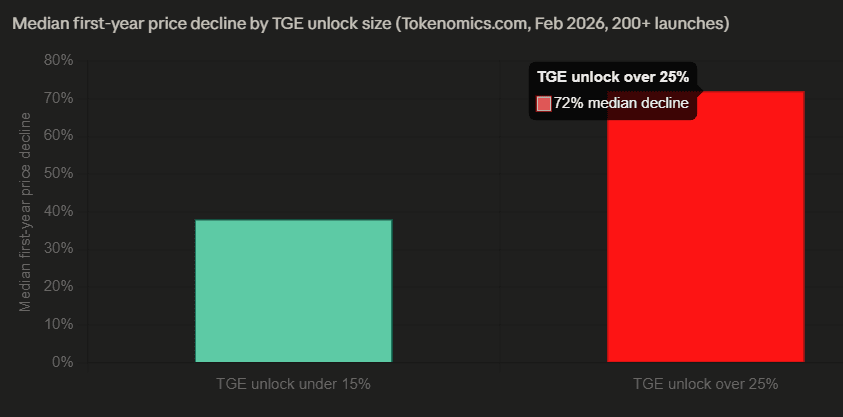
Projects that unlocked more than 25% of supply at their token generation event suffered a median first-year price decline of 72%, compared to 38% for projects that kept day-one unlocks under 15%, according to a February 2026 analysis of 200+ token launches published by Tokenomics.com.
The gap is not noise. It is the clearest signal in token design that unlock structure, not narrative, determines who survives the first twelve months.
Streamflow has processed over $1.4 billion in total value locked across 40,000+ projects on Solana, which gives it a direct view into how the strongest teams actually structure vesting.
This report benchmarks how vesting and unlock design has shifted heading into 2026. The headline pattern is convergence: serious projects are lengthening cliffs, stretching linear schedules, shrinking TGE floats, and tying release to performance rather than the calendar. The teams treating vesting as a trust signal are pulling away from the teams treating it as a formality.
What follows breaks the data into discrete findings, a flag taxonomy for fast diligence, and prescriptive guidance for issuers, investors, and communities. Each section is built to stand on its own.
Key Takeaways
Streamflow data across 40,000+ projects shows longer cliffs and lower TGE floats winning in 2026.
Token vesting structure predicts first-year survival more reliably than narrative or launch hype.
TGE unlocks above 25% correlate with roughly double the first-year drawdown of sub-15% floats.
Streamflow enforces every vesting schedule through immutable, audited on-chain smart contracts on Solana.
Green, yellow, and red flag patterns let investors read a vesting schedule in minutes.
Methodology and Data Sources
This report combines two layers of evidence. The first is Streamflow's aggregate, on-chain view across more than 40,000 projects, 1.3 million users, and over $1.4 billion in total value locked, which reflects how vesting and lock schedules are actually configured and enforced on Solana. The second is a set of cited external datasets covering market-wide unlock activity and price impact through early 2026.
External figures are drawn from Tokenomics.com, KuCoin, 99Bitcoins, and the insights.unlocks.app 2025 Token Unlocks Review, each named inline at the point of use.
Where this report describes design patterns, those patterns reflect the vesting structures Streamflow supports and observes across its project base. Where it cites specific market percentages, the source is the named external dataset.
No proprietary recipient-level data is disclosed, and no figure is estimated beyond what the named sources report. Points marked as needing a source are open slots for Streamflow's internal figures rather than estimates.
How Big Is the Token Unlock Problem in 2026
Token unlocks are now a structural, recurring market force, not an occasional event.
The scale entering circulation in early 2026 makes vesting design a first-order risk:
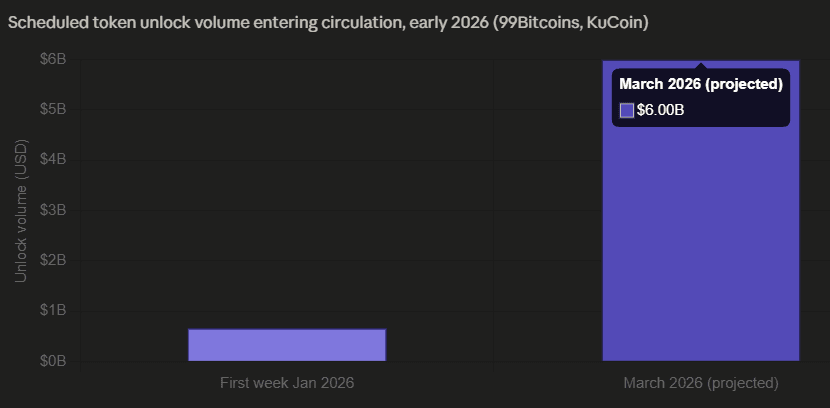
Over $657 million in unlocks hit the market in the first full week of January 2026 alone, per 99Bitcoins reporting.
March 2026 projected unlocks exceeded $6 billion, with a single project accounting for $4.18 billion, according to KuCoin.
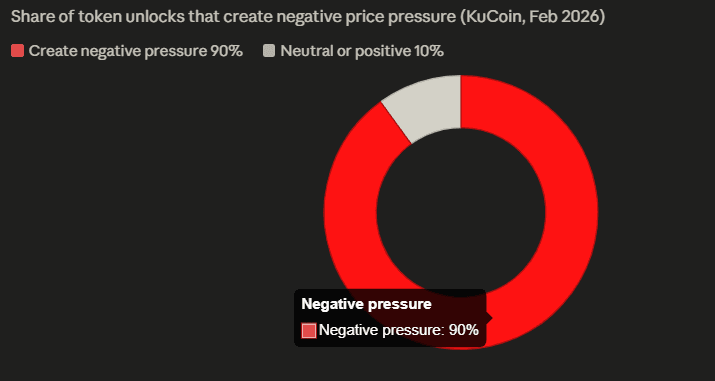
Roughly 90% of token unlocks create negative price pressure, KuCoin's February 2026 analysis found.
This is the backdrop every new token launches into. When billions in scheduled supply hit predictably, the market prices unlock risk in advance, and projects with aggressive or opaque schedules get punished before a single token moves.
For founders, the implication is direct: vesting is a market-facing commitment that investors model before they buy. Designing it on automated token vesting infrastructure rather than a spreadsheet is now table stakes.
What Cliff Length Are Serious Projects Using
The 12-month team cliff has become the credibility floor, not the aspiration.
Across the vesting structures Streamflow sees configured on-chain, the standard for founders and core teams has settled on a 12-month cliff before any release, followed by multi-year linear vesting.
External best-practice data agrees:
Standard cliffs now range 6 to 12 months for investors and 12 months for team members, per Tokenomics.com's February 2026 guide.
Industry-standard total vesting runs 3 to 4 years for core team, 2 to 3 years for investors, and 12 to 24 months for advisors.
Projects with no cliff for team or investors are flagged as red flags, since they permit immediate post-TGE selling.
A cliff is the cheapest, most legible trust signal a team can offer, and the market has learned to read its absence as a warning.
The strongest proof point is Heavenland, a Solana metaverse whose $HTO token placed 97% of total supply on a 5-year linear vesting schedule with cliffs across all allocations.
The Heavenland vesting case study shows the design allowed initial liquidity without excessive inflation, and the outcome was a more engaged, longer-term player community.
Cliff vs Linear: Which Unlock Shape Wins
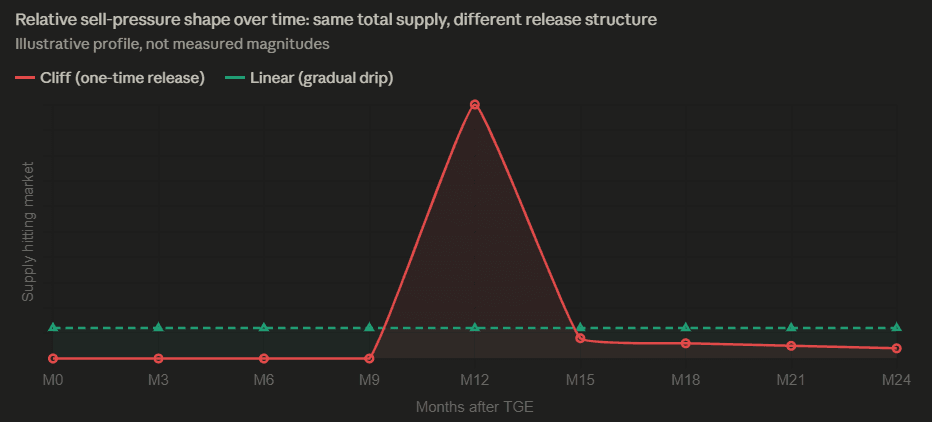
Cliff unlocks concentrate sell pressure into a single event; linear and graded schedules distribute it.
The shape of the unlock matters as much as its size:
Unlock Shape | Sell-Pressure Profile | Best Fit |
|---|---|---|
Cliff (one-time release) | Sharp, concentrated spike | Aligning long-term team commitment |
Linear (gradual drip) | Smooth, absorbable | Investor and ecosystem allocations |
Cliff + linear (hybrid) | Delayed, then smoothed | Founders and core contributors |
Graded (stepped) | Predictable tranches | Advisors and milestone-linked grants |
Price-based | Tied to performance | Growth-aligned incentives |
Market data confirms the pattern. Cliff unlocks tend to create sharper reactions because the supply hits all at once, while linear or recurring schedules spread the pressure and give the market time to adjust.
The 2025 Token Unlocks Review from insights.unlocks.app found cliff unlocks were heavily concentrated in the first half of 2025 and produced the most visible supply shocks of the year.
The takeaway is not that cliffs are bad. It is that cliffs must be deliberate, and what comes after the cliff should almost always be linear or graded. Streamflow supports all five shapes above as vesting schedules on Solana from a single interface, so the unlock shape can match the stakeholder rather than the tooling.
How Low Are Winning Projects Setting TGE Unlocks
The data's single clearest finding is that small day-one floats outperform large ones by a wide margin.
The Tokenomics.com analysis of 200+ launches is the anchor:
Projects with TGE unlocks above 25% saw a median first-year price decline of 72%.
Projects with TGE unlocks under 15% saw a median decline of 38%.
Conservative projects unlock 5 to 15% at TGE; aggressive projects unlock 30 to 50%.
That is a near-2x difference in downside, driven almost entirely by how much supply a team releases on day one. A high float floods the market before demand exists, and the price absorbs the difference.
For tokenomics designers, this reframes the launch decision. The temptation to maximize initial liquidity is real, but restraint compounds.
Locking the majority of supply at launch, with transparent token locks anyone can verify on Solscan, converts a private intention into public, enforceable proof.
How Are Allocations Split Across Stakeholders
The most sophisticated projects no longer apply one schedule to everyone.
Streamflow's vesting data shows mature teams segment both allocation size and release schedule by stakeholder, because each group carries a different risk and incentive profile:
Founders and core team: 12-month cliff, then 3 to 4 year linear vesting.
Investors: shorter cliff, 2 to 3 year linear release.
Advisors: 12 to 24 month schedules, often graded, typically a small single-digit share.
Ecosystem and DAO treasury: long, frequently milestone- or price-based.
Public sale participants: shortest lockups, smallest cliffs.
Segmentation works because it matches the lock-up to the loyalty the project actually needs from each group. A founder dumping at month 13 is an existential threat; a public-sale buyer selling early is expected behavior.
Bonk, the Solana meme coin, is the clean example. It allocated 55% of supply to airdrops for early Solana users and ran core team vesting through Streamflow at 20% of total supply for 22 contributors on a 3-year linear schedule.
The Bonk vesting case study shows how separating a wide community airdrop from a long, locked team allocation built trust on both sides at once.
What FDV-to-Circulating-Supply Ratios Signal in 2026
A high fully diluted valuation sitting on a thin circulating float is the warning sign investors now screen for first.
When only a small fraction of supply is liquid but the token trades on a rich valuation, every future unlock carries outsized dilution risk. If a token is already trading on a rich narrative while a large portion of supply has not yet reached the market, future unlocks deserve extra attention. The unlock calendar, not the current chart, becomes the real story.
The 2026 benchmark picture:
A low circulating share against a high FDV concentrates dilution risk into upcoming unlock dates.
Tokens with the largest year-over-year supply increases in 2025 came from predefined vesting and distribution plans, per the insights.unlocks.app 2025 review.
The implication for issuers is to align FDV expectations with a realistic circulating float, and for investors to weight near-term unlocks more heavily when the float is thin.
A public tokenomics dashboard that shows locked supply and unlock dates in real time turns this from guesswork into a verifiable read.
How Much Do Unlock Events Actually Move Price
Most unlocks pressure price, but the magnitude depends on size, shape, and market context, not the headline number alone.
The drivers, per KuCoin's 2026 analysis:
Unlock size relative to circulating supply is the primary factor.
Recipient type matters; team and investor unlocks read more bearishly than ecosystem use.
Vesting structure matters, since cliff releases hit harder than linear drips.
Market context matters, as bull markets absorb supply that bear markets cannot.
Roughly 90% of unlocks create negative pressure, but the actual claimed and distributed amounts often come in below headline projections. The lesson is that a well-shaped schedule can blunt an unlock that a poorly shaped one would amplify.
For teams, this is the strongest argument for linear and graded release over lump-sum cliffs once the initial team lock expires. Spreading supply is the difference between a managed event and a supply shock.
Do Vesting Norms Differ by Sector?
Yes, and the divergence is widening as token models specialize.
The patterns Streamflow and the market data point to, across the sectors most relevant to Solana:
DeFi protocols lean on linear and milestone schedules tied to emissions and rewards, where automated, low-friction distribution matters most. Streamflow's DeFi token distribution tooling is built for this recurring-release pattern.
GameFi economies favor inflation-friendly, performance-gated emissions that reward players over time rather than front-loading supply, the model behind in-game token rewards.
Meme coins, the category Bonk helped define on Solana, increasingly pair wide community airdrops with a long, locked team allocation to counter the dump-risk reputation of the category.
Infrastructure and AI/DePIN launches in 2025 produced some of the largest day-one floats, mostly from high-FDV launches, per the insights.unlocks.app review, making disciplined vesting more important, not less.
The interpretation is that there is no single correct schedule, only the right schedule for the token's economic role. The platforms that support every shape from one interface let teams match design to sector instead of forcing a sector into a template.
A Vesting Diligence Framework: Green, Yellow, and Red Flags
Investors and communities can read most of a vesting schedule's intent in minutes using a simple three-tier scan.
1. Green Flags (Trust Signals)
These patterns correlate with disciplined, long-term design:
12-month-plus team cliff followed by multi-year linear or graded release.
TGE unlock under 15% of total supply.
Long ecosystem and treasury vesting, often beyond 36 months.
Performance- or milestone-gated release replacing pure time-based schedules.
Fully on-chain, immutable contracts with public proof links.
2. Yellow Flags (Proceed With Caution)
These warrant a closer look before committing:
Team cliff shorter than 6 months.
TGE unlock above 15% to any single stakeholder group.
Investor cliff expiring before the team cliff.
High FDV against a thin circulating float.
Sizable advisor allocation with no public disclosure.
3. Red Flags (Structural Warnings)
These are the patterns the data ties most directly to failure:
No vesting at all, with tokens freely transferable at TGE.
A cliff with no post-cliff schedule, creating a lump-sum dump structure.
No on-chain contract; the schedule is self-reported only.
A schedule modified after TGE without a community vote.
An ecosystem allocation with no governance over how it is distributed.
The connective tissue across all three tiers is verifiability. A schedule the community cannot inspect on-chain carries no trust premium, no matter how good it looks on a slide.
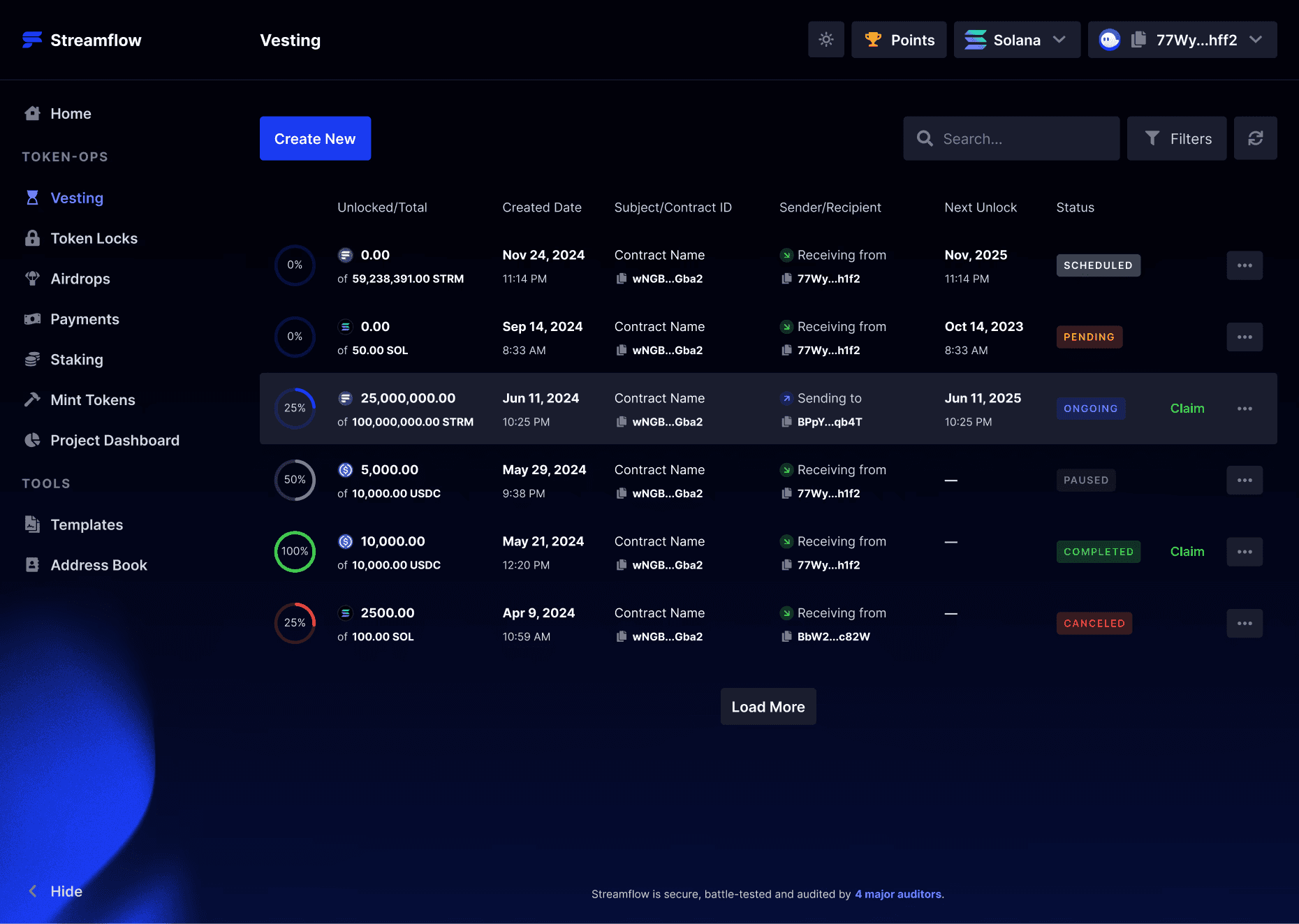
Streamflow enforces every schedule through audited, immutable smart contracts, audited by FYEO and OPCODES, with explorer verification on Solscan and Solana Explorer.
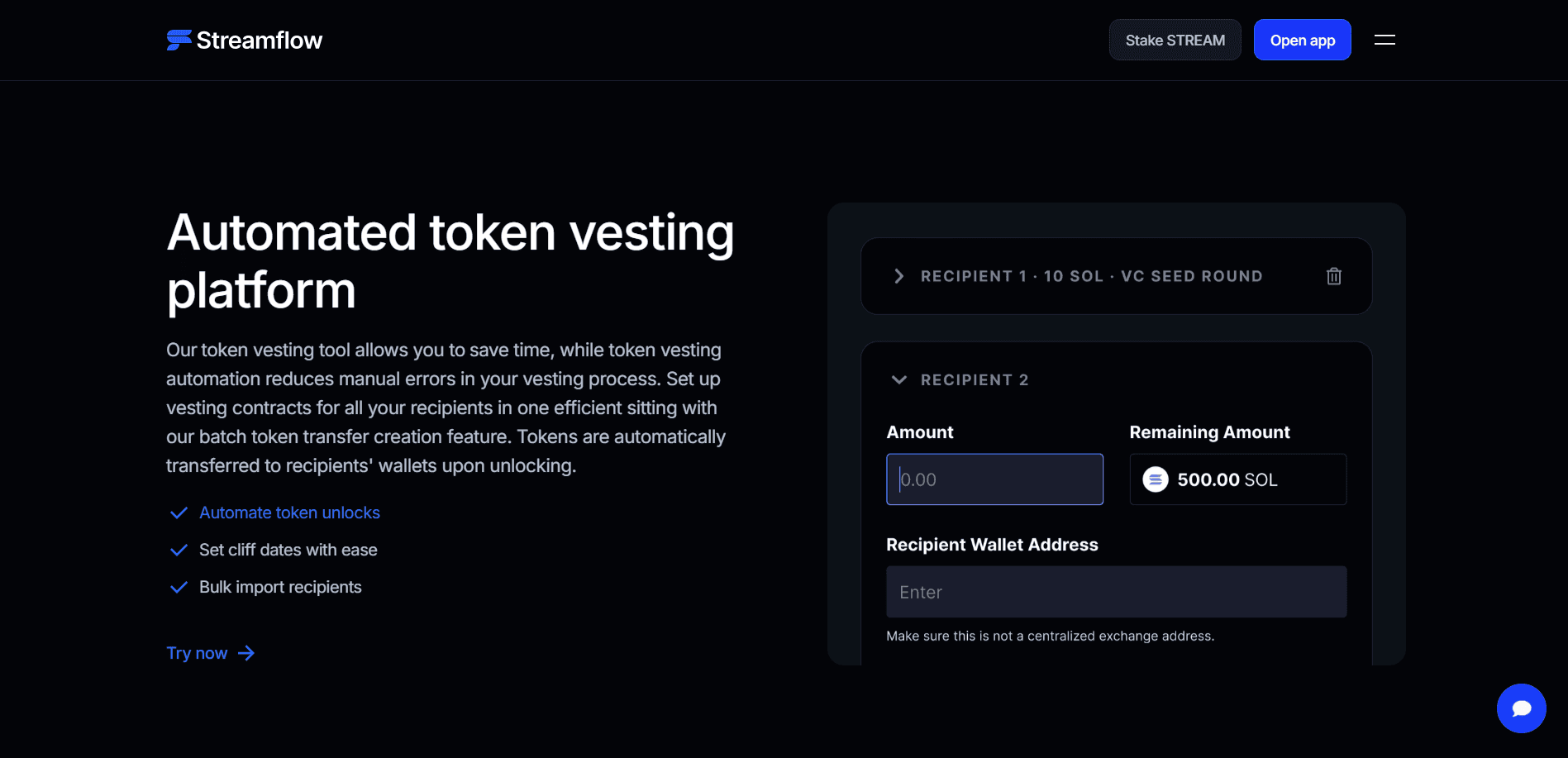
You can set up token vesting on Streamflow with no code, and the resulting contract cannot be unilaterally altered.
Case Study: How UXD Protocol Structured Vesting and Governance Together
UXD Protocol, a decentralized stablecoin provider on Solana, shows disciplined design at scale. The team needed to vest a large allocation while keeping governance participation intact.
The structure UXD ran through Streamflow:
Approximately 46% of the $UXP supply placed on vesting.
A 4-year linear vesting schedule with a 12-month cliff.
The Streamflow SDK integrated directly into Realms, so stakeholders could claim tokens and vote from one interface.
UXD applied a long cliff, a multi-year linear release, and a large locked share, exactly the green-flag profile the benchmark data rewards.
The UXD Protocol vesting case study shows how combining vesting with governance in a single claim portal reduced friction while preserving the trust signal.
What This Means for Issuers, Investors, and Communities
The benchmark data converts into different action depending on which side of the token you sit on.
For token issuers, the prescription is direct. Set a team cliff of at least 12 months, keep TGE unlocks under 15%, segment schedules by stakeholder, and prefer linear or graded release after any cliff.
Run it on-chain so the commitment is verifiable, and consider Streamflow Business when the work extends into cap tables, treasury, and ownership.
For investors, the unlock calendar is part of valuation, not a footnote. Screen for the red flags first, weight near-term unlocks against a thin float, and treat self-reported schedules with no on-chain contract as unverifiable. A schedule you cannot inspect is a schedule you cannot trust.
For communities, the green and yellow flag scan is enough to surface most risk before participating. Demand on-chain proof, watch for post-TGE schedule changes made without a vote, and reward teams whose locks signal multi-year commitment over teams selling speed.
Looking Ahead: Where Token Vesting Design Goes Next
Three forward-looking trends emerge from the 2026 data.
Expect cliffs to keep lengthening. As unlock calendars become standard investor tooling, the market will keep rewarding schedules that signal multi-year commitment, pushing the team cliff floor toward 18 months for high-FDV launches.
Expect price-based and milestone-based vesting to grow. Time-based schedules release supply regardless of whether the project delivered, and the next generation ties release to performance instead. Streamflow already supports price-based vesting for exactly this reason.
Expect verifiability to become non-negotiable. With roughly 90% of unlocks creating negative pressure, projects that publish auditable, on-chain schedules will command a trust premium over those that ask the market to take their word.
Conclusion
The benchmark is clear: in 2026, token vesting structure predicts first-year outcomes more reliably than launch narrative, and the gap between a sub-15% and a 25%-plus TGE unlock is roughly the gap between a 38% and a 72% median drawdown.
Across 40,000+ projects, the teams that lengthen cliffs, smooth their unlock shapes, lock the majority of supply at launch, and publish it on-chain are the ones holding value.
In a market where unlocks are scheduled risk events, credible, verifiable vesting is the cheapest edge a project has.
Book a demo to see how Streamflow handles benchmark-grade vesting design, from a 12-month team cliff to fully on-chain, verifiable unlock schedules.
Read Next:
FAQs:
1. What is the ideal token vesting cliff for a team in 2026?
The ideal token vesting cliff for a team in 2026 is at least 12 months, which has become the credibility floor for serious projects. Most teams pair that 12-month cliff with a 3 to 4 year linear release. Streamflow lets you enforce any cliff length through immutable on-chain smart contracts on Solana.
2. How much supply should a project unlock at TGE?
A project should unlock under 15% of supply at TGE to limit downside risk. Tokenomics.com's 2026 analysis found projects above 25% suffered a 72% median first-year decline, versus 38% for those under 15%. Locking the remainder with verifiable token locks on Streamflow turns that restraint into public proof.
3. What are the biggest red flags in a token vesting schedule?
The biggest red flags in a token vesting schedule are no vesting at all, a cliff with no post-cliff release, a self-reported schedule with no on-chain contract, and any schedule changed after TGE without a community vote. Each lets insiders sell or alter terms without accountability. Streamflow removes these risks by enforcing schedules through immutable, audited contracts verifiable on Solscan.
4. Is cliff or linear vesting better for reducing sell pressure?
Linear vesting is better for reducing sell pressure because it distributes supply gradually, while cliff unlocks concentrate it into a single sharp event. The strongest 2026 designs use a deliberate cliff for team commitment followed by linear release. Streamflow supports linear, cliff, cliff-plus-linear, graded, milestone-based, and price-based schedules from one interface.
5. Do vesting benchmarks differ by sector?
Yes, vesting benchmarks differ by sector, since each token model carries a different economic role. DeFi leans on linear and milestone schedules, GameFi favors performance-gated emissions, and meme coins increasingly pair wide airdrops with long locked team allocations. Over 40,000 projects across these sectors use Streamflow to match schedule design to their token's purpose.