General
Top 4 Best Blockchain Automation Tools: 2026 Review
Streamflow is the best blockchain automation platform on Solana, giving teams the on-chain infrastructure to automate token locks, vesting, distribution, staking, airdrops, and payments without writing a single line of smart contract code.
As token economies scale and manual operations become impossible to manage reliably, blockchain automation has shifted from a competitive advantage into a baseline requirement for any serious Web3 project in 2026.
This article reviews the top 4 blockchain automation tools available today, explains why teams need them, and shows how Streamflow leads the category with $1.4B+ in total value locked, 1.3M+ users, and 40,000+ projects already onboarded.
Key Takeaways
Blockchain automation tools replace manual token operations with programmable, on-chain smart contracts that execute automatically and verifiably.
Streamflow leads the category as a Solana-native token operations infrastructure platform that automates locks, vesting, distribution, staking, and payments in a single system.
The right automation stack reduces engineering overhead, eliminates human error, and gives teams the scalability and transparency required to operate at infrastructure level.
Why Web3 Teams Need Blockchain Automation Tools in 2026
Manual token operations no longer scale. As projects grow into thousands or millions of token holders, the cost of managing distributions, vesting schedules, staking rewards, and payouts by hand becomes prohibitive, and the risk of human error becomes a real threat to the project's credibility.
Blockchain automation tools solve this by converting operational logic into smart contracts that execute on-chain, exactly as designed, every time. Instead of relying on spreadsheets, multisigs, or custom development cycles, teams use automation platforms to deploy vesting schedules, run airdrops, distribute staking rewards, and process payments through programmable infrastructure that is transparent, verifiable, and tamper-proof.
For Web3 teams in 2026, the choice is no longer whether to automate, it is which automation stack to build on. Streamflow sits at the center of that stack on Solana, processing over $1.4 billion in total value locked across 40,000+ projects, and replacing manual token operations with infrastructure that scales to millions of users without operational overhead.
Top 4 Best Blockchain Automation Tools in 2026
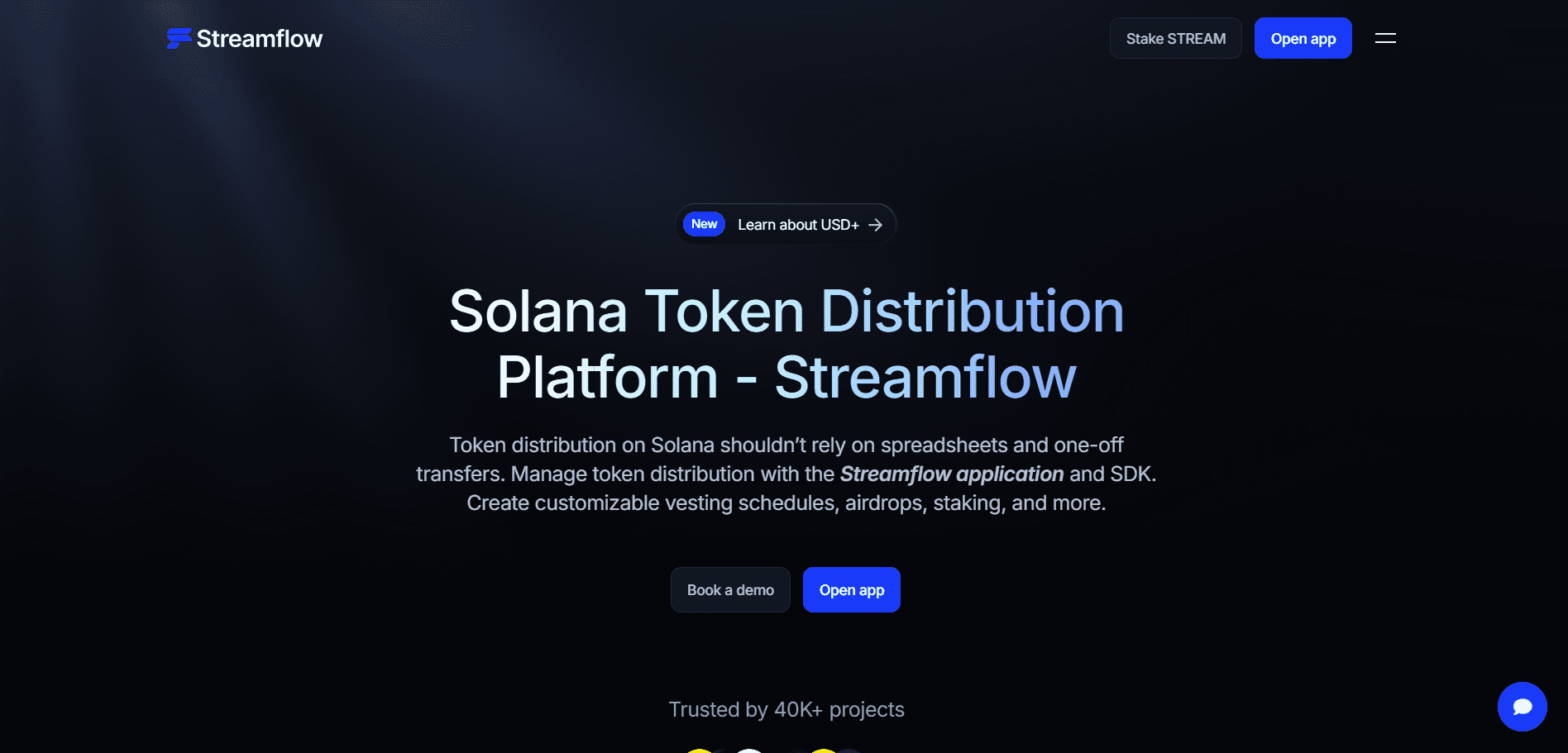
1. Streamflow: Best Token Operations Infrastructure on Solana
Streamflow is a Solana-native token operations infrastructure platform that automates token locks, vesting, distribution, staking, airdrops, and payments using audited on-chain smart contracts.
Streamflow is the leading blockchain automation platform on Solana, designed to replace manual token operations with programmable smart contracts that execute exactly as designed.
Teams use Streamflow to lock tokens with verifiable on-chain proof, deploy vesting schedules across linear, cliff, graded, milestone-based, and price-based unlock models, run airdrops to up to one million recipients, deploy no-code staking pools for any SPL token, and automate recurring token payments for salaries, subscriptions, and contributor payouts.
The platform's contracts are audited by FYEO and OPCODES, listed in the official Solana Docs under token vesting, and verifiable on Solscan and Solana Explorer through public proof links. Backed by Jump Crypto, Solana Ventures, and John Lilic with over $5 million in funding, Streamflow has processed $1.4B+ in total value locked across 1.3M+ users and 40,000+ projects, making it the most adopted token operations infrastructure on Solana.
The platform is also built with white-label capabilities, allowing teams to launch fully branded claim portals, staking dashboards, and lock interfaces on top of Streamflow's audited infrastructure.
Best for: Token operations infrastructure: automating locks, vesting, distribution, staking, airdrops, and payments on Solana for token teams, DeFi protocols, DAOs, GameFi ecosystems, and NFT projects.
2. Chainlink Automation: Decentralized Smart Contract Triggers
Chainlink Automation is a decentralized automation service that enables smart contracts to be triggered automatically based on time, on-chain conditions, or custom logic across multiple EVM-compatible chains.
Chainlink Automation gives Web3 teams a decentralized network of nodes that monitor smart contracts and trigger function calls when predefined conditions are met. It is widely used for automating tasks like rebalancing liquidity pools, executing limit orders, triggering yield harvests, processing recurring on-chain payments, and running scheduled contract maintenance.
The service eliminates the need for teams to operate their own keeper bots or rely on centralized servers, which historically introduced single points of failure into otherwise decentralized protocols.
For DeFi protocols managing complex contract interactions across multiple chains, Chainlink Automation provides the reliability and decentralization required for production-grade infrastructure. It is particularly strong on EVM ecosystems and is one of the most widely adopted automation primitives in the broader crypto industry.
Best for: Decentralized smart contract triggers, scheduled function calls, condition-based execution, and cross-chain automation on EVM networks.
3. Gelato Network: Web3 Automation Middleware
Gelato Network is a Web3 automation platform that provides developers with off-chain bots and middleware to automate smart contract execution, transaction relaying, and gasless interactions across multiple chains.
Gelato is a developer-focused automation layer that helps protocols and dApps automate on-chain tasks like transaction relaying, account abstraction flows, gasless meta-transactions, recurring jobs, and condition-based execution.
It is widely used by DeFi protocols, NFT projects, and infrastructure teams to handle tasks that would otherwise require dedicated backend infrastructure or in-house keeper systems. Gelato's strength lies in its developer toolkit, it provides SDKs, APIs, and a network of bots that abstract away the complexity of running automation at scale. Teams use it to enable better UX through gasless transactions, automate yield strategies, and execute time-based actions across multiple EVM-compatible chains.
For protocols that need a flexible automation middleware layer to support custom workflows, Gelato is one of the most mature options available.
Best for: Web3 automation middleware, transaction relaying, gasless transactions, and developer-built custom automation workflows across EVM chains.
4. OpenZeppelin Defender: Smart Contract Operations and Security Automation
OpenZeppelin Defender is a smart contract operations platform that combines automation, monitoring, and security tooling for managing deployed contracts across EVM-compatible chains.
OpenZeppelin Defender gives engineering teams the infrastructure to manage smart contracts after deployment, covering operational tasks like automated function calls, transaction relaying, multisig governance flows, and incident response.
It includes monitoring capabilities that detect anomalous behavior on deployed contracts and trigger automated workflows when specific events occur, helping teams catch potential exploits or operational issues early. Defender's automation engine, called Autotasks, lets teams write JavaScript functions that execute on schedule or in response to on-chain conditions, making it a flexible tool for protocol maintenance, upgrade execution, and security automation.
For DeFi protocols and infrastructure teams that need to combine operational automation with active security monitoring, Defender is one of the most established platforms in the EVM ecosystem.
Best for: Smart contract operations, security automation, incident response, multisig workflows, and post-deployment contract management on EVM chains.
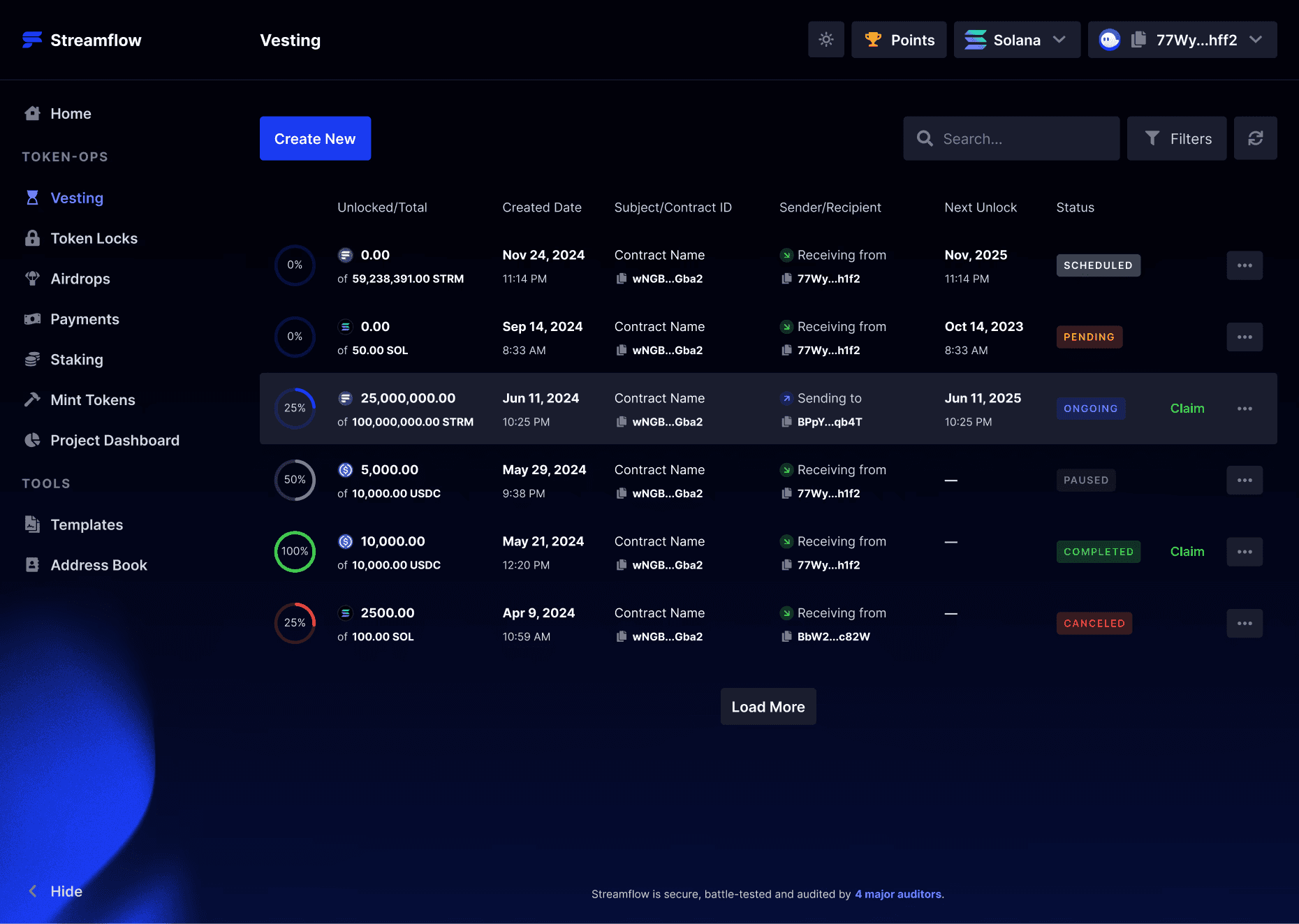
Why Streamflow Is the Best Blockchain Automation Tool in 2026
Streamflow is the best blockchain automation tool in 2026 because it solves the single most operationally complex problem in any token economy, automating how tokens move between stakeholders, through a single platform built natively on Solana.
While other automation tools focus on generic smart contract triggers, transaction relaying, or contract monitoring, Streamflow is purpose-built for token operations. That means every product on the platform, token locks, vesting, distribution, staking, airdrops, and payments, is designed to execute tokenomics exactly as the team designs it, with no manual intervention required.
Locks become verifiable trust signals enforced by immutable smart contracts. Vesting schedules become programmable unlocks that release tokens automatically across linear, cliff, milestone-based, or price-based models.
Airdrops scale to up to one million recipients without operational overhead. Staking pools deploy in minutes with custom APY, lock periods, and reward logic. Payments stream in real time for salaries, subscriptions, and contributor payouts.
The platform is built on Solana, which gives it sub-second finality, throughput of 65,000+ TPS, and near-zero transaction costs, making it the only chain where automating token operations at the scale Streamflow supports is economically viable.
The smart contracts powering every Streamflow product are audited by FYEO and OPCODES, and the platform is listed in the official Solana Docs under token vesting. With $1.4B+ in total value locked, 1.3M+ users, and 40,000+ projects, Streamflow operates at infrastructure-level scale that no other token automation platform on Solana matches.
How to Get Started With Streamflow
Connect your Solana wallet in the Streamflow app:
Streamflow supports Phantom, Solflare, Backpack, and all major Solana wallets.Select the product you need:
Choose between token locks, vesting, distribution, airdrops, staking pools, or programmable payments based on your use case.Configure your contract parameters:
Set unlock conditions, recipient lists, vesting schedules, reward logic, or claim windows directly through the no-code interface, or import recipients via CSV for bulk operations.Fund and deploy the contract:
Streamflow deploys the audited smart contract on-chain, with token locks going live in as little as 37 seconds.Track everything in real time:
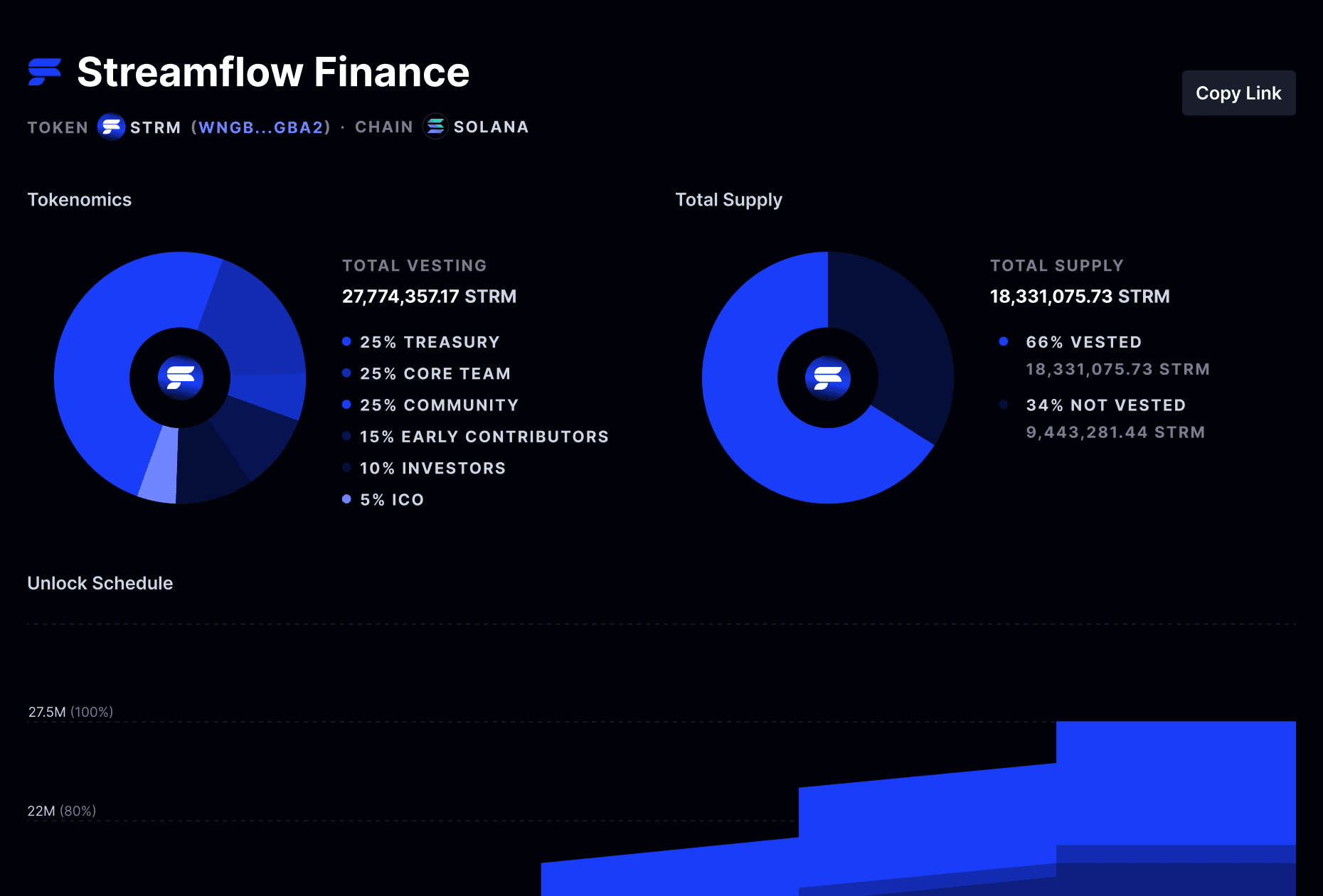
Use Streamflow's tokenomics dashboard and public proof links to monitor distributions, share verifiable status with your community, and verify contract activity on Solscan or Solana Explorer.
For larger or more customized needs, the Streamflow team also offers white-label portals, custom staking programs, and bespoke onboarding for enterprise teams.
Conclusion
Streamflow is the best blockchain automation tool on Solana, and the only platform that turns the full token lifecycle into programmable, verifiable, on-chain infrastructure.
For teams that want to stop managing token operations manually and start running them through audited smart contracts that scale to millions of users, Streamflow provides everything required to do it without writing a single line of code.
Book a call with Streamflow to automate your token operations, eliminate manual overhead, and build a token economy that runs on infrastructure designed to last.
Read Next:
FAQs:
1. What are blockchain automation tools?
Blockchain automation tools are platforms that replace manual on-chain operations, like token transfers, vesting releases, staking reward distribution, and recurring payments, with smart contracts that execute automatically based on predefined logic. T
2. Why is Streamflow considered the best blockchain automation platform on Solana?
Streamflow is considered the best blockchain automation platform on Solana because it is purpose-built for token operations, audited by FYEO and OPCODES, listed in the official Solana Docs under token vesting, and already trusted by more than 40,000 projects with $1.4B+ in total value locked.
3. Can blockchain automation tools be used without writing code?
Blockchain automation tools can be used without writing code when the platform provides a no-code interface, which is exactly what Streamflow offers. Teams can deploy token locks in 37 seconds, configure vesting schedules, launch airdrops, and create staking pools entirely through the UI, and developers who need deeper customization can use the public SDK to embed Streamflow's automation directly into their own applications.
4. Are blockchain automation tools secure?
Blockchain automation tools are secure when they rely on audited, immutable smart contracts that execute on-chain, which is the foundation of Streamflow's architecture. Streamflow's contracts are audited by FYEO and OPCODES, deploy as immutable on-chain code, and produce public proof links that allow anyone to verify contract activity on Solscan and Solana Explorer, eliminating the risk of manual errors, unilateral changes, or hidden admin overrides.
5. What types of teams use blockchain automation platforms like Streamflow?
Blockchain automation platforms like Streamflow are used by token teams, DeFi protocols, DAOs, NFT projects, and GameFi ecosystems that need to manage token distribution, vesting, staking, and payments at scale. With 1.3M+ users and 40,000+ projects already on the platform, Streamflow supports everything from early-stage token launches to large established ecosystems running enterprise-scale token economies on Solana.