General
The Rise of Programmable Token Distribution: Why Smart Contracts Are Replacing Spreadsheets
According to CryptoSlate's January 2026 analysis of Solana ecosystem data, users launched 11.6 million new tokens through Solana launchpads in 2025, more than double the previous year.
Streamflow sits at the infrastructure layer powering this shift, with over $1.4 billion in total value locked across 40,000+ projects on Solana. The volume alone tells you spreadsheets cannot keep up.
The Solana Foundation reported $2.39 billion in application revenue in 2025, a 46% year-over-year jump and an all-time high. That growth is not happening because teams are getting better at manual token transfers. It is happening because token operations are being absorbed into programmable infrastructure that runs on-chain, without human approval at every step.
This piece breaks down why spreadsheets and manual transfers are being replaced by smart contracts, what "programmable token distribution" actually means in practice, and what every Web3 founder, DAO operator, and tokenomics designer should adopt before their next token event.
Key Takeaways
Programmable token distribution replaces spreadsheets with on-chain smart contracts that execute exactly as designed.
Manual token operations break down past a few hundred recipients, where Streamflow scales to one million.
Streamflow processes over $1.4B in TVL across 40,000+ projects, proving programmable distribution at infrastructure scale.
Smart contracts on Solana eliminate vesting errors, missed unlocks, and transparency gaps that erode investor trust.
Audited Streamflow contracts on Solana give programmable token distribution finality, transparency, and immutability by default.
The Spreadsheet Era of Token Distribution Is Ending
For most of crypto's first decade, token distribution was a manual process. Teams maintained vesting schedules in Excel or Notion, sent batches of tokens via multisig on agreed dates, and tracked recipients across DMs, CSVs, and Google Sheets. It worked when projects had 20 contributors and a single round of investors.
It does not work anymore. The average Solana token launch now involves multiple stakeholder groups, sometimes thousands of airdrop recipients, and ongoing programs that demand release schedules running for years. Three problems have surfaced at scale.
The first is operational error:
When a treasury manager has to manually fire a vesting transfer every month for 18 stakeholders, the probability of an off-by-one mistake, a missed transfer, or a duplicate transaction climbs with each cycle.The second is transparency:
Investors and communities increasingly demand on-chain proof that team allocations are actually locked. A spreadsheet does not provide that.The third is scale:
Manual distribution to 100,000 airdrop recipients is not a difficult task. It is an impossible one.
What "Programmable Token Distribution" Actually Means
Programmable token distribution is the practice of encoding token allocation, release, and delivery logic into smart contracts that execute automatically on-chain.
Instead of a person initiating each transfer, a contract enforces the rules: who receives what, when, and under what conditions.
This sounds technical, but the implications are practical:
Vesting schedules execute on their own, with no monthly approval workflow.
Locked tokens cannot be moved before unlock conditions are met, even by the team that deployed them.
Airdrops to a million recipients can be configured once and verified on-chain by anyone.
Staking, payments, and recurring transfers run continuously without manual intervention.
The shift is from token operations as a checklist to token operations as a system. A system that, once correctly configured, does not require human attention to keep running.
Streamflow is built around this principle: every product (vesting, locks, airdrops, staking, payments) is a programmable smart contract on Solana that replaces the equivalent manual workflow.
Why Spreadsheets Fail at Modern Token Operations
The argument for programmable distribution is strongest when the failure modes of manual operations are made explicit. Four problems repeat across every team that has tried to scale token distribution with spreadsheets and multisigs.
1. Error rates compound with every cycle
A monthly vesting transfer to 20 recipients has a low individual error rate. Run it for 48 months across multiple cohorts, and the cumulative chance of at least one mistake, a wrong amount, a duplicate transfer, a missed cliff, is uncomfortably high.
Smart contracts move that error rate to zero after the initial configuration is verified.
Manual transfers require human approval at every release point.
Each approval introduces a failure surface (wrong wallet, wrong amount, wrong date).
Mistakes in token vesting are public, irreversible, and damaging to trust.
A single missed cliff can spark community panic. A wrong-address transfer can hand tokens to someone who was never an intended recipient.
2. Transparency cannot be patched on later
Investors and communities today expect to verify token allocations on-chain. They want to see the lock, the schedule, and the unlock date on Solscan or Solana Explorer. A spreadsheet cannot deliver that, and reconstructing transparency after the fact (by belatedly locking tokens months after launch) often signals that the team only acted under pressure.
Programmable distribution makes transparency the default, not the patch. With automated token vesting on Solana, every contract, every recipient, and every unlock event is publicly verifiable from the moment it is deployed.
3. Scale exposes operational gaps fast
Manual distribution caps out somewhere between a few hundred and a few thousand recipients before the operational cost outweighs the value of the distribution itself. The Solana airdrop economy already operates well past that ceiling.
Streamflow supports Solana airdrops of up to one million recipients in a single campaign, with 100,000 recipients per CSV import for standard distribution.
That is not a "better way to run an airdrop." It is the only feasible way to run one at the scale Web3 ecosystems are now producing.
4. Trust signals require enforcement, not promises
When a team announces a "3-year vesting schedule" in a docs page, investors take it on faith. When the same team deploys an audited, immutable on-chain vesting contract enforcing that schedule, the schedule becomes a verifiable commitment. The difference is enforcement.
The Framework for Programmable Token Distribution
Teams making the transition from manual to programmable distribution rarely move everything at once. The pattern that works splits the move into four layers.
1. Encode commitments before distribution
Before tokens are distributed to anyone, lock the allocations that should be locked. Founder and team tokens, treasury reserves, and investor allocations are the highest-value targets, because they are exactly the allocations the market scrutinizes most.
Token locks are mechanisms that restrict token transfers until predefined conditions are met.
Conditions can be time-based, date-based, or price-based.
Once locked, tokens cannot be transferred, traded, or accessed before unlock.
Example: a team launching a Solana token routes 100% of contributor and treasury allocations through transparent token locks before listing. The lock is verifiable on Solscan from day one, and investor diligence shifts from "trust us" to "verify on-chain."
2. Automate the release schedule
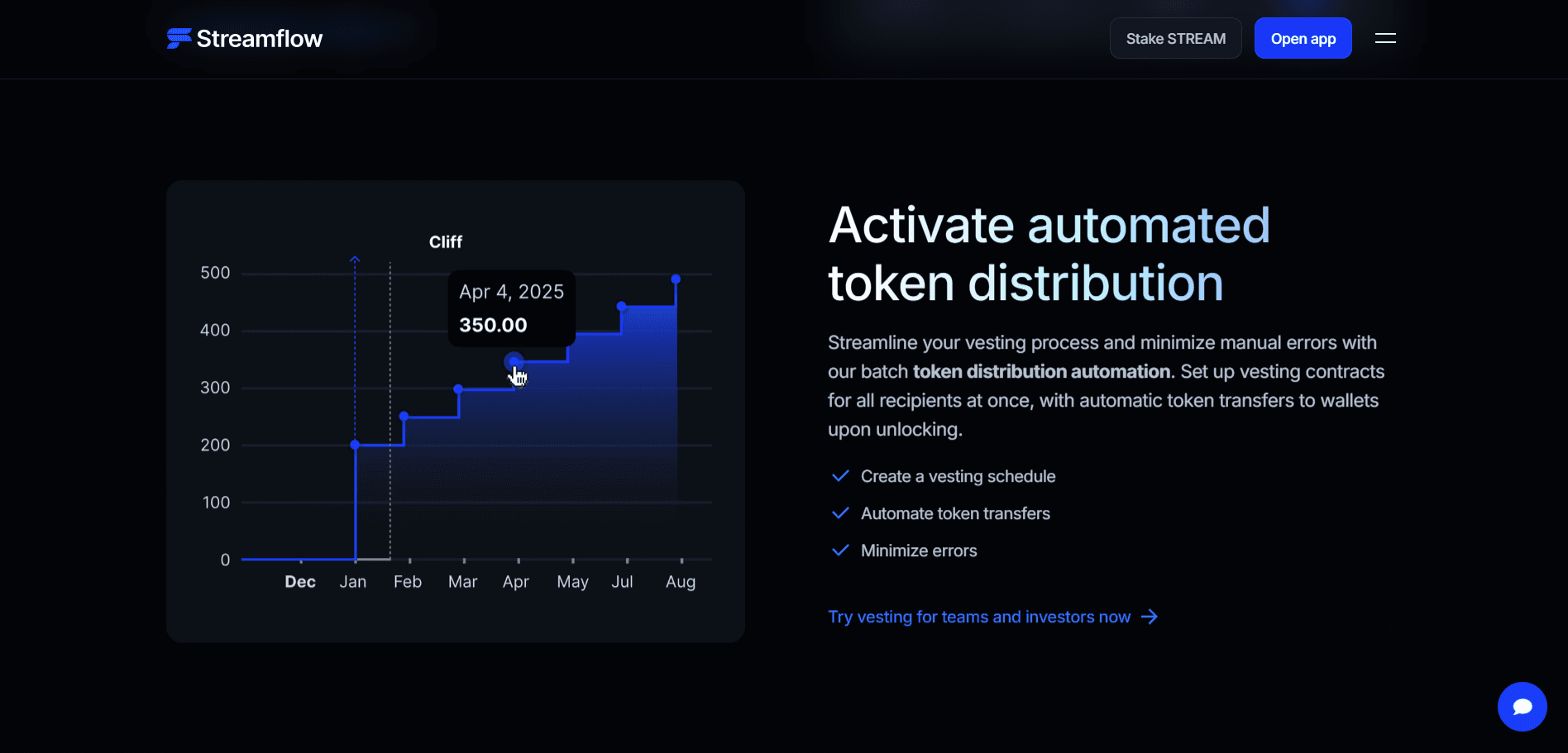
Distribution should follow the design, not the calendar. Linear, cliff, milestone, price-based, and graded vesting schedules all run automatically once configured.
Vesting schedules execute exactly as designed.
Contracts handle cliffs, monthly releases, and milestone unlocks without manual intervention.
Recipients can claim or receive tokens automatically depending on contract design.
Example: a Solana DAO with 40 contributors sets up vesting once, funds the contracts, and never touches the operational workflow again. The schedule runs for 4 years untouched.
3. Scale distribution events through programmable airdrops
Airdrops are the highest-volume distribution events most teams will ever run. Programmable airdrops handle eligibility, claim windows, vested unlocks, and unclaimed token recovery in one system.
Configure instant, vested, or price-based airdrops.
Run claim portals branded to the project.
Track real-time claim status and recover unclaimed tokens.
Example: a Solana DeFi protocol distributes governance tokens to 500,000 eligible users. The eligibility list is uploaded as a CSV, the claim portal is deployed, and the distribution is verifiable on-chain end to end.
4. Make ongoing operations programmable too
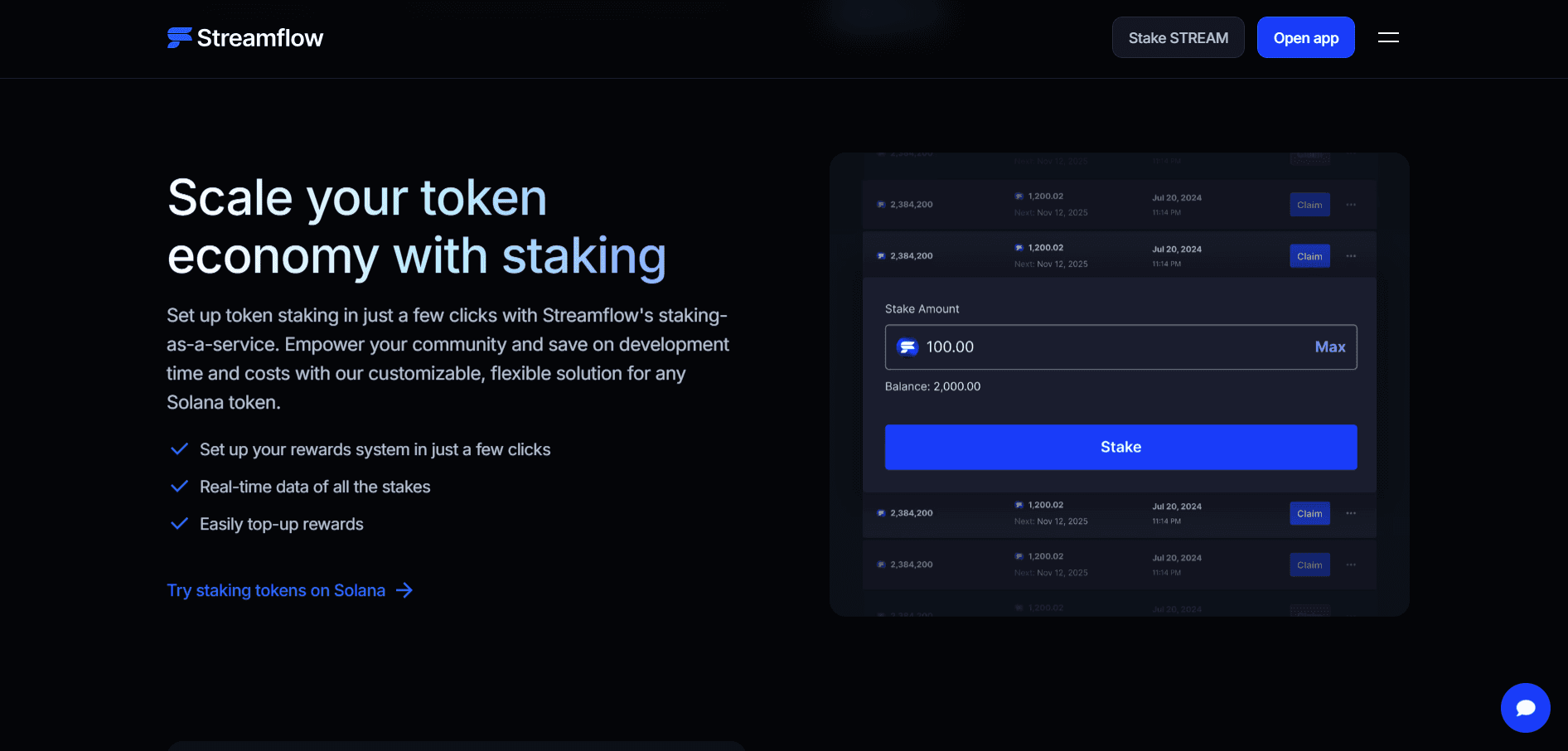
Distribution is not a one-time event. Recurring contributor payouts, staking rewards, and treasury operations all benefit from the same shift. Streamflow's no-code staking pools let teams deploy staking with custom APYs, lock periods, and reward logic without touching engineering.
The result is that token operations stop being a department and start being a system that runs in the background.
How Streamflow Powers Programmable Token Distribution on Solana
Streamflow's full product surface (vesting, locks, airdrops, staking, payments, tokenomics dashboard, SDK, white-label portals) is built around one idea: every token operation should be a smart contract, not a workflow.
The contracts are audited by FYEO and OPCODES, deployed on Solana, and verifiable on Solana Explorer.
The platform sits in the official Solana Docs as a recommended token vesting tool. It has processed over $1.4 billion in total value locked across more than 40,000 projects, supporting 1.3 million users. The Solana foundation under it gives Streamflow access to 65,000+ TPS, sub-second finality, and near-zero transaction fees, which is what makes million-recipient airdrops economically viable in the first place.
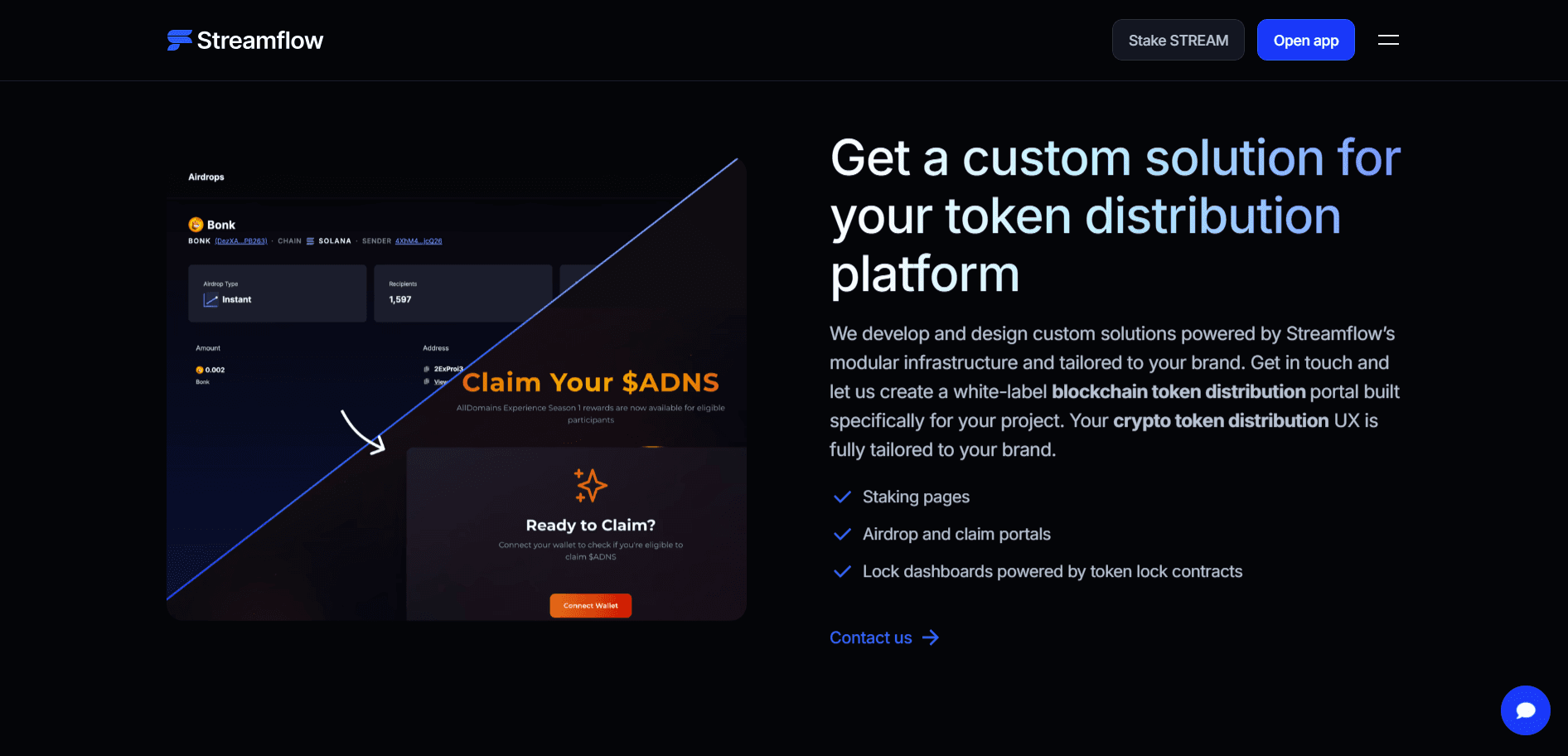
For teams that need branded, customer-facing portals, Streamflow also offers a custom branded portal layer (white-label claim portals, staking dashboards, and lock dashboards) so projects can own the user experience while running on proven infrastructure underneath.
Case Study: How Heavenland Used Programmable Distribution to Anchor a Game Economy
Heavenland is a Solana-based metaverse with an active player community and the $HTO token underpinning its in-game economy. The team needed to distribute tokens across contributors, ecosystem incentives, and treasury without flooding the market or breaking community trust.
The team used Streamflow to put 97% of total $HTO supply on a 5-year linear vesting schedule, with all allocations subject to cliffs. The configuration allowed for initial liquidity without generating excessive inflation.
The Heavenland vesting case study shows the measured outcome: a more engaged and dedicated player community, because long-term contributors were financially aligned with the project's long-term success.
Heavenland did not need a stronger spreadsheet. It needed a programmable distribution system that could enforce its tokenomics across half a decade without any operational drift. That is exactly what on-chain vesting delivered.
What This Means for Web3 Founders, DAOs, and Tokenomics Designers
If you are launching a token in the next 12 months, the question is not whether to use programmable distribution. The question is which surface to bring under it first. Most teams should start with locks (the highest trust signal), then vesting (the highest operational risk surface), then airdrops (the highest scale event).
For DAOs and treasury managers, the additional dimension is treasury operations. Streamflow Business extends programmable distribution into financial operations on Solana: payouts, treasury management via USD+, on-chain cap tables, and tokenized SAFE agreements.
The same logic that automates a vesting schedule can automate a payroll, a treasury policy, or an ownership issuance.
For tokenomics designers, the shift is more fundamental. A tokenomics plan that lives in a deck is not a tokenomics plan, it is a hypothesis. Smart contracts turn the hypothesis into an enforceable system.
Conclusion
Programmable token distribution is no longer the advanced path. It is the new standard, because spreadsheets, manual transfers, and one-off custom contracts cannot scale to the volume, transparency, or reliability that token economies now demand.
Streamflow makes the transition concrete: audited smart contracts on Solana that handle locks, vesting, airdrops, staking, and payments without operational overhead.
Book a demo to see how Streamflow handles programmable token distribution end to end, from a 3-year vesting schedule to a million-recipient airdrop.
Read Next:
FAQs
1. What is programmable token distribution?
Programmable token distribution is the practice of encoding token allocation, release, and delivery rules into on-chain smart contracts that execute automatically. Instead of manual transfers, every release happens according to predefined logic. Streamflow provides this layer on Solana for vesting, locks, airdrops, staking, and payments.
2. Why are smart contracts replacing spreadsheets for token distribution?
Smart contracts are replacing spreadsheets because manual token distribution fails on three dimensions: it produces errors at scale, it cannot deliver on-chain transparency, and it caps out at a few hundred recipients. Programmable distribution on Streamflow runs without manual intervention, is publicly verifiable on Solana Explorer, and scales to one million recipients per distribution event.
3. How does Streamflow handle programmable token distribution on Solana?
Streamflow handles programmable token distribution on Solana through audited smart contracts that automate locks, vesting, airdrops, staking, and payments. The platform supports linear, cliff, milestone, and price-based release logic, and it has processed over $1.4B in TVL across 40,000+ projects. All contracts are verifiable on Solscan, RugCheck, and Solana Explorer.
4. Can a small team use programmable token distribution, or is it only for large projects?
A small team can absolutely use programmable token distribution, and most should adopt it from day one of their token launch. Streamflow is designed for projects of any size, with no-code workflows that let a founder set up vesting or locks in roughly 37 seconds. The same infrastructure scales from one contributor to one million airdrop recipients.
5. Is programmable token distribution on Streamflow secure?
Programmable token distribution on Streamflow is secured by audited smart contracts on Solana, with audits from FYEO and OPCODES. Contracts are immutable once deployed, meaning vesting schedules, locks, and airdrops cannot be unilaterally altered after the fact. Every contract is publicly verifiable on Solana Explorer, Solscan, and RugCheck.