General
How to Use Escrow for Token Deals on Solana: Security Without Trust
Americans lost $11.36 billion to cryptocurrency-related fraud in 2025, a 22% jump over the prior year, according to the FBI's Internet Crime Complaint Center as reported in April 2026.
A meaningful slice of that loss happened in places where escrow should have prevented it: OTC trades, SAFT settlements, vesting handoffs, advisor allocations, and contributor agreements where one party paid and the other never delivered.
Streamflow, a Solana-native token operations platform processing over $1.4B in total value locked across more than 40,000 projects, removes that failure mode by replacing handshake settlement with on-chain smart contracts that release tokens only when conditions are met.
Most teams still treat escrow as a legal concept rather than an executable one. They draft a SAFT, agree to a release schedule, then trust either a multisig signer, an OTC desk, or a lawyer to honor the timing. The result is a chain of trust assumptions that breaks the moment one party has more leverage than the other.
This article shows how to use escrow on Solana with audited smart contracts to settle token deals without trusting the counterparty, the intermediary, or the calendar.
Key Takeaways
Streamflow turns token deal escrow into on-chain smart contracts that release only when conditions are met.
Escrow on Solana eliminates counterparty risk for OTC trades, SAFTs, and contributor allocations.
Streamflow supports time-based, price-based, and milestone-based release conditions verifiable on Solscan.
Audited by FYEO and OPCODES, Streamflow contracts are immutable once deployed and resist unilateral changes.
Over 40,000 projects rely on Streamflow for token escrow, vesting, locks, and distribution.
The Trust Problem in Token Deals
A typical Solana token deal in 2026 looks the same as it did in 2021: buyer wires stablecoin to a desk or directly to a counterparty, seller promises to deliver tokens at a future unlock, and a Telegram message stands in for a settlement layer.
When something goes wrong, the recovery path is litigation, public shaming, or accepting the loss. None of these scale, and none of them protect the deal in real time.
Off-chain escrow services add a middle party, but they reintroduce the original problem at a different layer. The escrow agent itself becomes the trust assumption.
Chainalysis flagged in its January 2026 Crypto Crime Report that as much as $17 billion in crypto was lost worldwide to scams and frauds in 2025, with impersonation and exchange impostor schemes surpassing direct cyber-attacks as the leading methods criminals used to steal digital assets.
Centralized escrow agents are exactly the kind of single point of failure those schemes target.
On-chain escrow inverts the model. Tokens sit in a smart contract that neither side controls, and the release logic is enforced by the contract itself. There is no agent to bribe, compromise, or delay. The deal either settles automatically or it does not settle at all.
What On-Chain Escrow Actually Is
Escrow is a release mechanism that holds an asset until predefined conditions are met. On Solana, that release mechanism is a smart contract on the SPL Token Program, parameterized at deployment and executed by validators.
Three properties make a contract function as real escrow rather than a wrapper:
The contract holds the tokens, not a wallet that a person can drain.
The release logic is immutable once funded, with no admin override.
The state of the contract is publicly verifiable on Solscan or Solana Explorer.
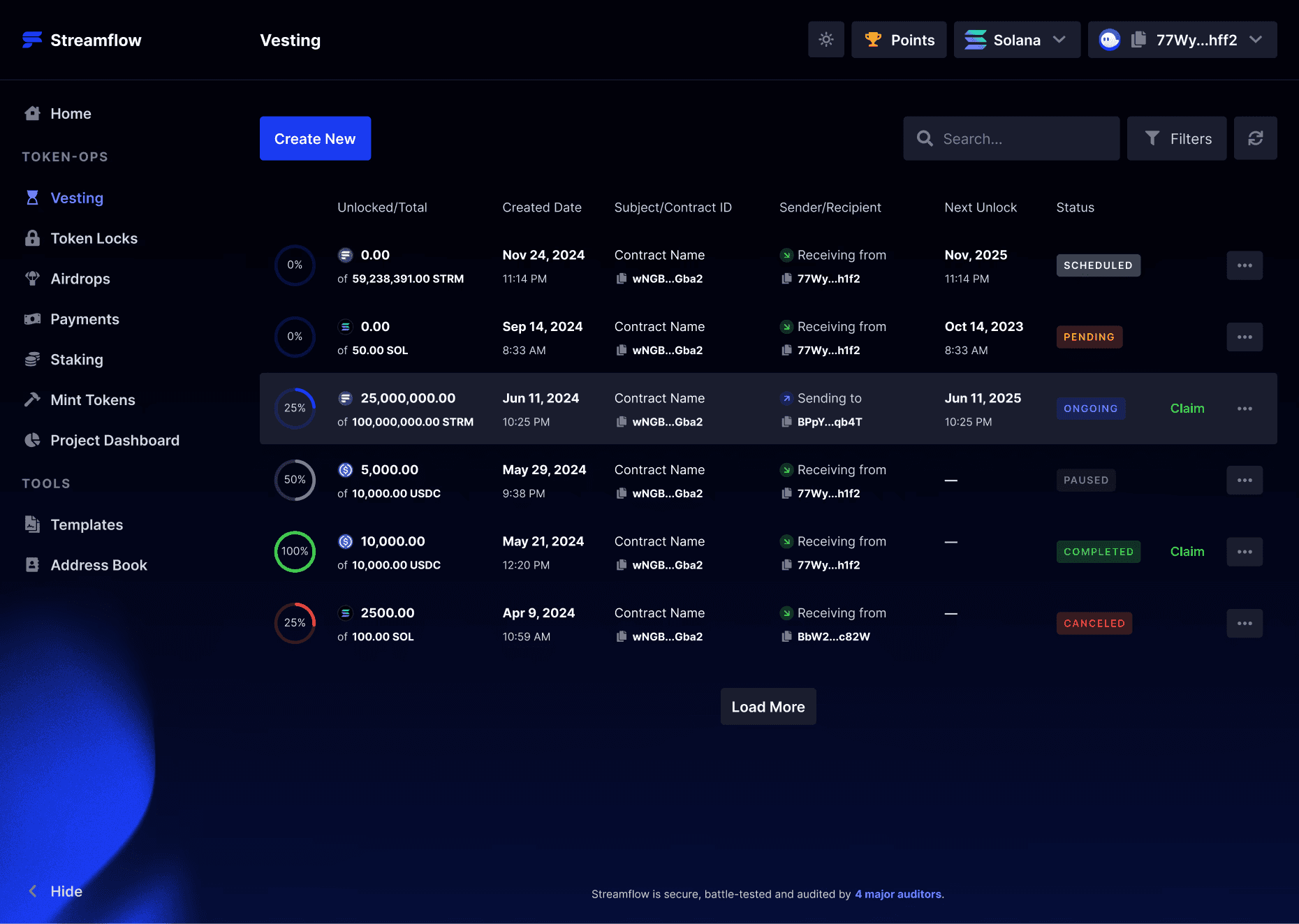
Streamflow's token vesting, lock, and payment contracts all meet these three conditions by default. They are deployed once, funded, and then execute on their own schedule. There is no unilateral cancel button on the issuer side once tokens are committed.
The practical effect is that escrow stops being a service you buy and becomes a primitive you configure. You set the conditions, fund the contract, and walk away.
Three Patterns for Escrowing Token Deals on Solana
Most token deals fall into one of three structural patterns, each of which maps to a Streamflow primitive.
1. Time-Based Escrow for SAFTs and Investor Allocations
A SAFT or investor allocation typically converts to tokens at a future unlock date, often with a cliff. The standard 12-month cliff for founders, core team, and investor rounds is the most common shape in Solana fundraising.
Time-based escrow handles this directly. Tokens are locked in a contract with an unlock date or vesting schedule, and the recipient cannot touch them until the timer expires. Streamflow supports linear, cliff, cliff-plus-linear, and graded vesting structures, all configurable without writing code.
The investor sees a shareable proof link, the issuer sees a tracker dashboard, and both sides can verify the contract on Solana Explorer.
For pure time-locked escrow with no gradual release, token locks on Solana are the cleaner primitive. Locked tokens cannot be transferred, traded, or accessed before unlock, and the lock is public proof for any counterparty doing due diligence.
2. Price-Based Escrow for Performance Deals
Some token deals only settle at a price. An advisor might earn their allocation only if the token clears a target during their engagement, or a fund might agree to release tranches based on market performance rather than calendar time.
Price-based escrow uses an oracle to trigger the release. Streamflow supports both price-based vesting and price-based token locks, with unlock conditions tied to specific price thresholds rather than dates. The seller cannot dump early if the price never hits the threshold, and the buyer is not locked into a calendar that ignores market reality.
This is one of the strongest tools for advisor and contributor deals where the goal is alignment rather than a fixed timeline.
3. Milestone-Based Escrow for Grants, Bounties, and Contributor Work
Grants programs, bounty payouts, and large contributor agreements rarely fit a clean calendar. The work happens in phases, and the funder wants to release tokens only when each phase is signed off.
Milestone-based escrow handles this with vesting contracts that release on milestone trigger rather than time. Streamflow allows projects to design custom interval schedules and integrate them with their grant or contributor workflow.
Bonk's core team allocation is a good reference point on what enforced contributor escrow looks like at scale: 20% of total supply, 22 early contributors, and a 3-year linear vesting schedule that turned a trust question into a contract question (full detail in the Bonk vesting case study).
The pattern works equally well for ecosystem grants and DAO contributor payments.
How Streamflow Enforces Escrow Without an Intermediary
The technical model is what makes the escrow real. There are four pieces.
1. The contracts are audited
Streamflow's smart contracts have been audited by FYEO and OPCODES, and the contracts themselves are open source. An audited contract is not the same as a contract you can trust by name. It is one that has been reviewed against a published threat model.
2. The contracts are immutable once deployed
There is no admin key that can pull tokens back, change the schedule, or redirect the recipient. This is the core property that separates a real escrow from a custodial wrapper.
3. Every contract is publicly verifiable on Solscan and Solana Explorer
Either side of a deal can point to the on-chain state as proof of what was agreed and what will execute. A SAFT becomes verifiable in the same way an ERC-20 balance is verifiable.
4. The contracts run on Solana, which means sub-second finality and near-zero fees
Escrow at scale is only practical when the underlying chain can settle thousands of transactions per second at low cost. On Ethereum, the gas costs alone make small-deal escrow uneconomical. On Solana, Streamflow's escrow contracts cost cents to deploy and execute, which is why over 40,000 projects use the platform.
What This Means for Founders, Investors, and DAOs
Escrow as a primitive shifts the negotiation. Founders no longer have to ask investors to trust them; they ship a lock that the investor can verify. Investors no longer have to chase founders; they look at the contract address.
For DAOs and treasury teams, on-chain escrow becomes the default for contributor payouts, grant disbursements, and any settlement that crosses parties.
UXD Protocol's approach to governance and vesting in a single interface is a working example. The team integrated the Streamflow SDK into Realms to combine token claiming and DAO participation, with approximately 46% of $UXP supply on a 4-year linear vesting schedule and a 12-month cliff, all enforced on-chain (full breakdown in the UXD Protocol vesting case study).
For founders building beyond a single token launch, escrow connects directly to the broader operational stack: cap tables, tokenized SAFEs, treasury management with USD+, and ownership issuance.
This is the surface that Streamflow Business, the Financial OS for Internet Capital Markets, is designed for.
Common Mistakes to Avoid
Three failure patterns show up repeatedly in token deals that try to retrofit escrow late.
Treating multisig as escrow:
A multisig protects against a single key compromise, but it does not enforce a deal between parties. Both sides still trust the signers.Locking tokens without proof links:
A lock is only useful if the counterparty can verify it. If you do not share a Solscan link, the lock provides no trust signal.Promising flexibility you can't deliver:
Once a contract is immutable, the schedule is the schedule. Negotiate the conditions before funding, not after.
The cleanest way to avoid all three is to set the escrow terms before any tokens move, then deploy the contract as the settlement step rather than a follow-up.
Conclusion
Token deals on Solana break when settlement depends on trust and recover when settlement depends on code.
Streamflow turns escrow from a service you hire into a contract you deploy, with on-chain enforcement, audited logic, and verifiable proof at every step.
Book a demo to see how Streamflow handles escrow for SAFTs, OTC deals, advisor allocations, and contributor settlements on Solana.
Read Next:
FAQs
1. How does Streamflow handle escrow for token deals on Solana?
Streamflow handles escrow for token deals on Solana by deploying audited, immutable smart contracts that hold tokens until predefined conditions are met. The contracts release tokens automatically based on time, price, or milestone triggers, with no admin override. Both sides of the deal can verify the contract state on Solscan or Solana Explorer.
2. What's the difference between a token lock and on-chain escrow?
A token lock is a specific form of on-chain escrow where tokens are restricted from transfer until predefined conditions are met. Escrow is the broader category that also covers vesting, milestone releases, and price-triggered settlements. On Streamflow, token locks are the simplest escrow primitive, while vesting and milestone contracts handle more complex deal structures.
3. Can Streamflow be used for OTC token deals between two parties?
Yes, Streamflow can be used for OTC token deals between two parties by structuring the settlement as a vesting or lock contract that releases tokens only on the agreed terms. The contract removes counterparty risk because neither side can unilaterally change the schedule once funded. Both sides verify the deal on-chain.
4. Are Streamflow's escrow contracts audited?
Yes, Streamflow's escrow contracts are audited by FYEO and OPCODES, and the contracts themselves are open source. The contracts are immutable once deployed, with no admin override that could pull tokens back or change the release schedule. Audits and immutability together are what makes the escrow real rather than custodial.
5. How much does it cost to set up escrow on Streamflow?
The cost to set up escrow on Streamflow is driven by Solana's near-zero transaction fees, which makes deploying a contract a matter of cents rather than the gas-heavy costs typical on Ethereum. The platform itself supports no-code setup, with locks deployable in roughly 37 seconds. This makes small-deal and large-deal escrow equally practical on the same infrastructure.