General
Why Most Token Launches Fail (And How to Fix Them)
More than half of all tokens ever launched are now dead, and 11.6 million of those failures happened in 2025 alone, according to CoinGecko's January 2026 analysis of 20.2 million tokens tracked on GeckoTerminal.
The market has never made launching a token easier, and it has never made surviving one harder.
Streamflow, the Solana-native token operations platform behind $1.4B+ in total value locked and 40,000+ projects, sits on the other side of that statistic: the infrastructure layer that separates tokens built to last from tokens built to exit.
The uncomfortable truth is that most token launches do not fail because of bad marketing or bad timing. They fail because the tokenomics were a plan on a spreadsheet, never an enforceable system.
This article breaks down the real reasons token launches fail, how Streamflow solves each one, and the checklist to run before your token goes live.
Key Takeaways
Most token launches fail from unenforced tokenomics, not bad marketing or poor timing.
Streamflow solves launch failure with on-chain token locks, vesting, and structured airdrops.
Locked and vested supply gives holders verifiable proof instead of promises at launch.
Over 40,000 projects use Streamflow to execute token launches transparently on Solana.
The Problem: Launches Are Treated as Events, Not Systems
The conventional token launch playbook looks like this: design tokenomics in a deck, generate hype, list the token, and figure out distribution later.
CoinGecko's data shows where that playbook leads. Of the tokens launched since mid-2021, 53.2% no longer trade at all.
The common misconception is that these tokens died from lack of attention. Most died from lack of structure. Anyone can launch a token in minutes, but a community deciding whether to hold needs verifiable answers to hard questions.
Who controls the supply?
When do insiders unlock?
Can the team dump tomorrow?
A launch that cannot answer these questions on-chain is asking holders to trust a promise, and in 2026 promises are not a trust model.
What's Really Going On: Capital Moves Fast, Trust Does Not
Memecoins proved that anyone can spin up a token and build a community overnight. What they did not solve is the trust problem. Capital now moves at internet speed, but trust signals still have to be earned, and they have to be verifiable.
When a launch has no locked supply, no vesting, and no public distribution data, rational holders assume the worst. Early sellers exit first, sell pressure compounds, and the token enters the death spiral that killed millions of projects last year. The failure is structural, not social.
The projects that last are the ones that combine speed with structure. They lock supply before launch, vest insiders on-chain, and make distribution publicly auditable. This is exactly the problem Streamflow was built to solve.
How Streamflow Solves the Problem
Streamflow replaces spreadsheets, manual transfers, and custom contract builds with audited on-chain infrastructure. Teams define distribution logic, deploy smart contracts, fund them, and execution runs automatically with everything verifiable in real time.
Each of the four failure points above maps to a specific Streamflow capability.
1. Token locks: proof of commitment in 37 seconds
Token locks on Streamflow restrict tokens from being transferred, traded, or accessed until predefined conditions are met. Locking team and treasury supply is the first and cheapest trust signal a launch can produce, and on Streamflow it takes 37 seconds.
What Streamflow locks deliver at launch:
Time-based or price-based unlock conditions defined upfront and enforced by immutable contracts
Public proof links verifiable on Solscan, Solana Explorer, and RugCheck
Support for any SPL token, including LP tokens, team allocations, and treasury funds
A project that locks its team allocation with a verifiable proof link removes the single biggest objection holders have on day one. Instead of relying on promises, the lock conditions are enforced by code that no one can override.
2. On-chain vesting: insiders who cannot dump
Token vesting on Streamflow turns release schedules into immutable smart contracts. The standard for founders and core teams is a 12-month cliff followed by linear release, and Streamflow enforces it automatically with no manual transfers and no unilateral changes.
What Streamflow vesting covers:
Linear, cliff, graded, milestone-based, and price-based schedules per stakeholder group
Bulk creation via CSV for founders, advisors, investors, and ecosystem allocations
Shareable proof links and explorer verification for every contract
Many schedules that exist on paper still collapse in practice, a pattern covered in why token vesting schedules fail.
On-chain enforcement removes the human discretion that causes those collapses.
3. Structured airdrops: distribution without the bleed-out
Airdrops convert attention into ownership, but unstructured ones bleed value through sybil farms and instant sellers. Streamflow's airdrop launch platform turns a one-time giveaway into a structured distribution system that scales to one million recipients.
How Streamflow structures airdrops:
Instant, vested, or price-based airdrop types matched to campaign goals
Eligibility filtering, claim windows, and real-time claim tracking
Unclaimed token recovery so unallocated supply returns to the treasury
A vested airdrop turns recipients into stakeholders with a reason to stay rather than sellers with a reason to leave. With 100,000 recipients per CSV import, no launch is too large to run with structure.
4. Tokenomics dashboard: distribution the market can read
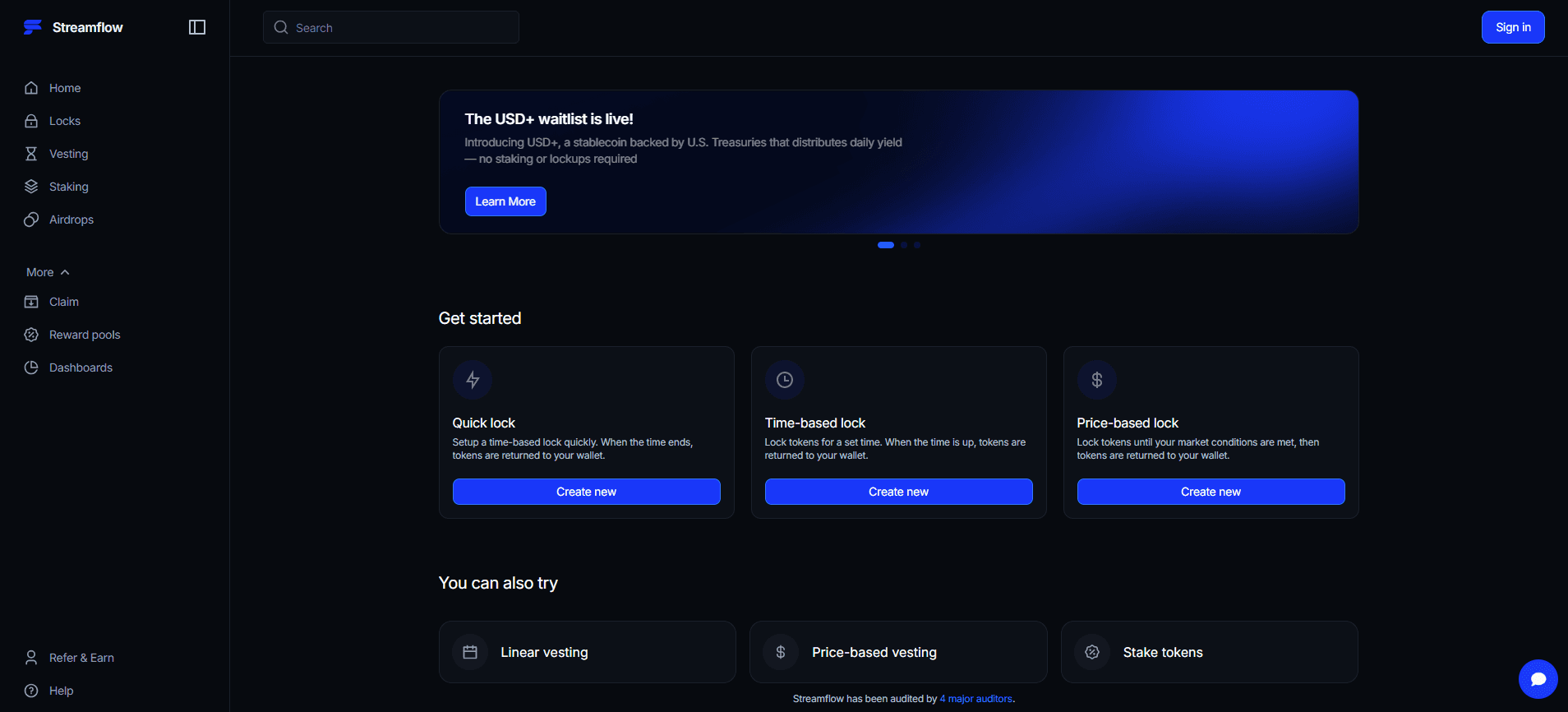
Even projects that lock and vest correctly fail when holders cannot see it. Streamflow's tokenomics dashboard gives every stakeholder a real-time view of allocations, vesting contracts, locks, cliff dates, and upcoming unlock events in one place.
It acts as a single source of truth for token distribution, so the market never has to price in the worst case. Together, these four capabilities run from one platform; teams can open the Streamflow app and move from tokenomics plan to enforced system the same day.
All contracts are audited by FYEO and OPCODES and immutable once deployed.
Because Streamflow is Solana-native, launches benefit from sub-second finality and near-zero fees, which is what makes distribution at this scale economically viable.
The Pre-Launch Trust Checklist
Before your token goes live, every item below should be deployed and publicly verifiable. If any answer is no, the launch is carrying structural risk the market will eventually price in.
Team and treasury supply locked with public proof links
Core team vesting deployed with a 12-month cliff and linear release
Separate vesting schedules live for advisors, investors, and ecosystem allocations
Airdrop structured with eligibility filtering, claim windows, and vesting where appropriate
Tokenomics dashboard public, showing all allocations and upcoming unlocks
Every contract verifiable on Solscan or Solana Explorer
For founders building past the launch itself, Streamflow Business extends this checklist into treasury management, payouts, on-chain cap tables, and tokenized SAFEs. The launch becomes the first step of a financial operating system, not a one-time event.
Case Study: How Bonk Turned a Meme Launch Into a Lasting One
Bonk launched as a Solana meme coin in exactly the category where CoinGecko recorded the most deaths. It survived because its structure was the opposite of the typical memecoin launch. Bonk allocated 55% of supply to airdrops for early Solana users and put its core team allocation under enforced vesting.
Using Streamflow, Bonk placed 20% of total supply, allocated across 22 early contributors, on a 3-year linear vesting schedule.
The result was verifiable proof that insiders could not dump, which gave the community the confidence to keep building around the token.
Heavenland applied the same logic even more aggressively, putting 97% of its $HTO supply on 5-year linear vesting with cliffs on all allocations. The outcome was initial liquidity without excessive inflation and a more dedicated player community.
What This Means for Web3 Founders
If you are launching a token in 2026, assume the market defaults to distrust. The CoinGecko data gives holders every statistical reason to expect your token to die, so the burden of proof is on your structure, not your narrative.
The checklist above is the burden of proof, and none of it requires an engineering team.
Streamflow's no-code path deploys locks, vesting, airdrops, and dashboards directly from the UI, while the SDK handles custom flows for teams that need them. With 40,000+ projects already running on this infrastructure, the tooling gap is no longer an excuse.
Conclusion
Most token launches fail because tokenomics stay a plan instead of becoming an enforceable system, and the 2025 die-off proved how expensive that gap is.
Streamflow solves the failure points directly: locked supply, on-chain vesting, structured airdrops, and a public dashboard, all enforced by audited smart contracts.
With $1.4B+ in TVL across 40,000+ projects, the infrastructure that fixes token launches already exists.
Book a demo to see how Streamflow handles locks, vesting, and distribution for your token launch.
Read Next:
FAQs:
1. Why do most token launches fail?
Most token launches fail because tokenomics are planned but never enforced on-chain. Without locked supply, insider vesting, and transparent distribution, holders assume dump risk and sell early. CoinGecko's 2026 analysis found 53.2% of all tokens launched since 2021 are now dead.
2. How does Streamflow fix a failing token launch structure?
Streamflow fixes launch structure by enforcing tokenomics through audited on-chain smart contracts. Token locks, vesting schedules, structured airdrops, and a public tokenomics dashboard replace promises with verifiable proof. Everything runs from a single platform without writing smart contracts.
3. What vesting schedule should founders use at launch?
Founders should use a 12-month cliff followed by linear vesting as the standard for core team allocations. Streamflow enforces these schedules through immutable smart contracts, so the release happens exactly as designed. Schedules can also be milestone-based or price-based for other stakeholder groups.
4. Can Streamflow handle a large airdrop at launch?
Yes, Streamflow can handle airdrops of up to one million recipients in a single campaign. Projects can import up to 100,000 recipients per CSV and run instant, vested, or price-based distributions. Real-time claim tracking and unclaimed token recovery keep the campaign controlled end to end.
5. Is Streamflow's smart contract code audited and secure?
Yes, Streamflow's smart contracts are audited by FYEO and OPCODES and are immutable once deployed. Every lock, vesting contract, and distribution is verifiable on-chain through proof links and explorers. Over 40,000 projects rely on this infrastructure for token operations.