General
How to Lock Liquidity on Solana Before Your Token Launch
Solidus Labs' 2025 Rug Pull Report found that 93% of the 388,000 Raydium liquidity pools it studied showed signs of soft rug pulls, where developers abruptly withdrew liquidity and collapsed the price.
That single number explains why liquidity locking has become a launch requirement on Solana, not an optional trust badge.
Streamflow on Solana, the token operations platform trusted by more than 40,000 projects and securing over $365 million in total value locked, exists in part to make that trust signal provable rather than promised.
Most founders think of liquidity locking as a checkbox they can handle after launch, once there is momentum to protect. That order is backwards. Traders, snipers, and every automated scanner on Solana check for locked liquidity in the first seconds after a pool goes live, and an unlocked pool reads as a red flag before your project ever gets a fair hearing.
This article breaks down what liquidity locking actually is, how it differs from vesting and treasury locks, and the exact sequence for locking liquidity before your token launch so the proof is live the moment your market opens.
Key Takeaways
Locking liquidity on Solana means locking LP tokens so the pool cannot be drained.
Streamflow lets teams lock liquidity on-chain with publicly verifiable, immutable conditions.
Unlocked liquidity is the first rug signal traders and scanners flag at launch.
Streamflow supports SPL and LP token locks with time-based and price-based unlocks.
Verifiable locks on RugCheck and Solscan turn commitment into a measurable trust signal.
Why Liquidity Locking Became a Launch Requirement on Solana
Solana's low fees and fast execution made it the default home for token launches, and also the default home for exit scams. The same infrastructure that lets a legitimate team spin up a pool in minutes lets a bad actor drain one just as fast. That environment has trained the market to assume the worst until a project proves otherwise.
Liquidity locking is the cheapest, clearest way to prove otherwise. When you lock the liquidity pool tokens generated by your DEX listing, you are surrendering the ability to withdraw that liquidity, which is the exact action a rug pull depends on.
A locked pool cannot be pulled, and everyone can confirm it independently.
The misconception worth killing is that a "real" project does not need to signal this. Trust does not travel with intent on-chain. Holders cannot see your roadmap or your team's reputation in a mempool; they can see whether your liquidity is locked, and they act on what they can verify.
What Liquidity Locking Actually Means (And What It Doesn't)
Liquidity locking is often confused with two adjacent mechanisms, and the distinction matters when you design your launch. Getting the terminology right also helps you communicate the right proof to your community.
Token locks restrict any allocation, such as team or treasury tokens, from being moved until conditions are met.
Liquidity locking is a specific type of token lock applied to the LP tokens from your trading pool.
Token vesting releases tokens gradually over a schedule, usually for contributors and investors.
The practical difference is what each one protects. Token locks and vesting reassure the market about future supply from insiders, while liquidity locking reassures the market that the tradable pool itself cannot vanish. A serious launch usually needs both, because a locked team allocation means little if the liquidity underneath the token can still be drained.
On Streamflow, a token lock restricts tokens from being transferred, sold, or accessed until a predefined date, time period, or price level is met. Applied to LP tokens, that same primitive becomes a liquidity lock.
The locked assets cannot be transferred, traded, or accessed until the unlock criteria are satisfied, and the lock is enforced by an immutable smart contract.
How to Lock Liquidity Before Your Token Launch
The goal is simple: have verifiable proof of locked liquidity live at the exact moment your pool opens. The sequence below gets you there.
1. Lock the LP tokens, not just your treasury
The most common mistake is locking team tokens and calling it a day. Locking your treasury signals long-term intent, but it does nothing to stop a liquidity drain. The asset that needs locking is the LP token that represents your share of the pool.
Create your liquidity pool and receive the LP tokens.
Lock those LP tokens through a verifiable on-chain contract.
Confirm the lock covers the full duration you have committed to publicly.
For example, a team seeding a pool at launch should lock the resulting LP position before announcing the pool, so the first person who checks sees a locked position, not an open one.
2. Lock before the pool goes live, not after
Timing is the difference between a proactive trust signal and a reactive apology. If you lock after trading begins, early buyers have already priced in the risk of an unlocked pool, and some will never come back. Locking beforehand means your very first holders see the commitment.
Prepare the lock contract during your pre-launch setup.
Fund and finalize it before the pool is publicly tradable.
Publish the proof link alongside your launch announcement.
3. Make the lock publicly verifiable
A lock nobody can check is not a trust signal. The value is in independent verification, so the lock has to resolve on the tools your community already uses. On Solana, that means the lock should be confirmable on Solscan, Solana Explorer, and risk scanners like RugCheck.
Share a public proof link to the lock contract.
Confirm the lock appears correctly on RugCheck and Solscan.
Keep the proof visible in your docs and pinned channels.
4. Match the unlock structure to your launch plan
Not every lock should be a simple date-based release. Streamflow supports both time-based and price-based unlock conditions, which lets you tie liquidity availability to real milestones instead of an arbitrary calendar date.
A price-based unlock, for instance, can keep liquidity locked until the token sustains a target level, aligning your release with genuine traction.
How Streamflow Handles Liquidity Locks on Solana
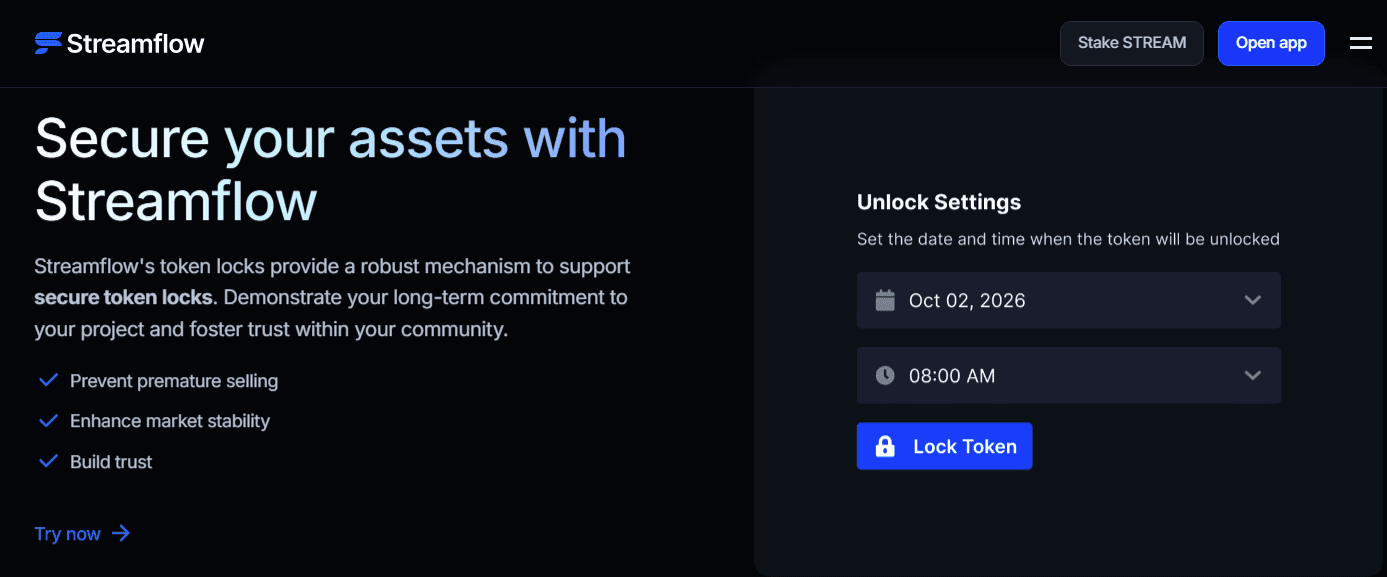
Streamflow turns liquidity locking from a manual, trust-me process into an enforceable on-chain contract. Teams can lock both SPL tokens and LP tokens with clearly defined, publicly verifiable conditions, and the setup takes about 37 seconds rather than a custom contract build.
You can lock tokens on Solana with Streamflow through a no-code interface, no Solidity or Rust required.
The core capabilities that matter for a pre-launch liquidity lock:
Quick locks with time-based or price-based unlock triggers.
Public proof links and dashboard visibility for independent verification.
Immutable contracts that cannot be altered or overridden once deployed.
RugCheck, Solscan, and Solana Explorer verification out of the box.
Because everything runs on Solana, locking liquidity costs a fraction of what an equivalent action would on Ethereum, which makes verifiable locks economically viable even for small launches.
Streamflow's contracts are audited by FYEO and OPCODES, and the locked state is enforced by code, so there is no admin key that can quietly release your liquidity early. That combination of low cost, immutability, and public verification is what converts a lock from a claim into proof.
Case Study: How Bonk Used Locking to Build Trust
Trust signals are easiest to understand through a project that used them at scale. How Bonk used Streamflow is a clear example, since the Solana meme coin built its launch around transparency from day one.
Bonk allocated 55% of its supply to airdrops for early Solana users, then used Streamflow to lock and vest its core team allocation on-chain. Specifically, 20% of total supply was placed on a 3-year linear vesting schedule across 22 early contributors, with the schedule enforced by smart contract rather than internal policy. The outcome was a launch where the community could verify that insiders could not dump, which is exactly the confidence liquidity locking creates for the tradable pool.
The lesson for a new launch is that verifiable locks are not defensive paperwork; they are a growth lever. Bonk treated on-chain proof as part of the pitch to its community, and that transparency became a foundation for its credibility.
What This Means for Founders Launching on Solana
If you are launching a token on Solana, liquidity locking is no longer a differentiator; its absence is a disqualifier. The market has been burned enough times that "we're not going to rug" carries no weight without a contract behind it. Your job is to make the safe assumption the easy one for every trader who lands on your pool.
Lock LP tokens before the pool is tradable, not after.
Publish a proof link that resolves on RugCheck and Solscan.
Pair the liquidity lock with team locks or vesting for a complete supply picture.
Treat the lock as the first thing a skeptical holder will check, because it is. A launch that leads with verifiable proof starts every holder relationship from confidence instead of suspicion.

Conclusion
Liquidity locking is the pre-launch trust primitive that separates projects built to last from pools built to drain, and on Solana it has moved from optional to expected.
Streamflow makes that proof verifiable, immutable, and cheap enough to do before your very first trade, with locks that resolve on the same scanners your community already trusts.
Book a demo to see how Streamflow handles locking liquidity and team allocations before a Solana token launch.
Read Next:
FAQs:
1. What does it mean to lock liquidity on Solana?
Locking liquidity on Solana means locking the LP tokens from your DEX pool so the underlying liquidity cannot be withdrawn until predefined conditions are met. On Streamflow, this is enforced by an immutable smart contract and is publicly verifiable on Solscan, Solana Explorer, and RugCheck.
2. When should I lock liquidity before a token launch?
You should lock liquidity before your pool becomes publicly tradable, not after. Locking beforehand means your earliest holders see the commitment from the first trade, and it takes about 37 seconds to set up a lock on Streamflow.
3. What is the difference between liquidity locking and token vesting?
The difference is what each mechanism protects. Liquidity locking freezes the LP tokens so the trading pool cannot be drained, while token vesting gradually releases team or investor allocations over a schedule. Most serious launches use both, and Streamflow supports each on-chain.
4. Can locked liquidity be accessed early on Streamflow?
No, locked liquidity cannot be accessed early on Streamflow. Once a lock is deployed, the contract is immutable and there is no admin override, so the liquidity cannot be transferred, traded, or withdrawn until the time-based or price-based unlock condition is met.
5. How do buyers verify that liquidity is actually locked?
Buyers verify a lock through the public proof link and on-chain scanners. A Streamflow liquidity lock resolves on RugCheck, Solscan, and Solana Explorer, so anyone can independently confirm the LP tokens are locked without trusting the team's word.