General
DAO Treasury Distribution Report: How Web3 Organizations Pay Contributors in Tokens
DAO treasuries collectively hold roughly $26 to $28 billion in on-chain assets in early 2026, yet over 80% of contributor payments in large DAOs are now executed by smart contracts rather than manual transfers.
The way decentralized organizations compensate people has professionalized faster than almost any other part of Web3. What was once a multisig and a spreadsheet is now a two-track system: native tokens for long-term alignment, stablecoins for reliable payroll, both increasingly run on automated, auditable on-chain rails.
This report consolidates 2026 treasury data, governance proposals, and platform figures into a single picture of how DAOs actually pay contributors. It draws on public reporting from Uniswap, Sky/MakerDAO, Arbitrum, Optimism, CoW DAO, Lido, and others, alongside payroll infrastructure data from Rise and treasury analysis from CoinLaw and Steakhouse Financial.
The throughline is consistent across organizations of every size. Compensation is becoming hybrid, automated, and transparent, and the infrastructure executing it, from streaming protocols to programmable distribution platforms like Streamflow, is now the deciding factor in whether a DAO can pay a global contributor base reliably.
Key Takeaways
DAO treasuries hold $26 to $28 billion in 2026, with stablecoins dominating contributor payroll liquidity.
Over 80% of large-DAO contributor payments are now automated through on-chain smart contracts.
The hybrid model pairs vesting-aligned native tokens with stablecoin payroll, run on programmable distribution rails.
The median DAO role pays $4,805 per month, with senior roles reaching $300,000 total compensation.
Programmable token distribution platforms like Streamflow execute both vesting and recurring payouts on-chain.
The Headline Finding: Compensation Has Split Into Two Tracks
DAO contributor pay in 2026 separates cleanly into two instruments with two distinct jobs.
Native and governance tokens carry long-term alignment, issued through emissions, grants, and multi-year vesting designed to keep contributors tied to the project.
Stablecoins carry operational reliability, funding recurring payroll without exposing contributors to token price swings.
The split is no longer experimental; it is the operating standard.
The data confirms how entrenched this has become:
DAO treasuries collectively stand at roughly $26 to $28 billion in early 2026.
Stablecoins make up 50% to 70%+ of actively managed treasuries.
Smart-contract payroll automates over 80% of contributor roles in large DAOs.
42% of DAOs still hold more than 50% of treasury in native tokens, a flagged volatility risk.
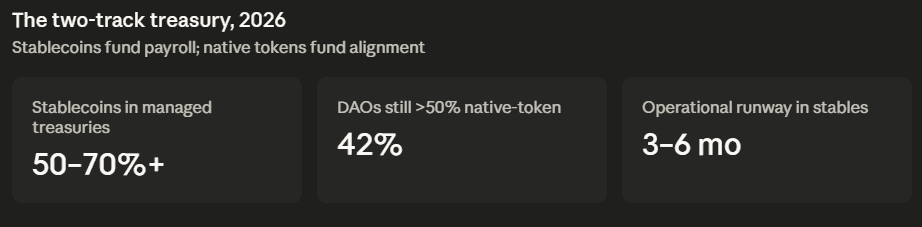
The implication for anyone designing a compensation system is direct. A DAO needs infrastructure that runs two distribution logics in parallel: long-tenure vesting for alignment tokens and recurring payouts for stablecoin payroll. Most tooling handles one well. The organizations operating at scale have converged on rails that handle both.
Methodology and Data Sources
This report draws on aggregated 2026 DAO governance and treasury data, covering treasury size, asset composition, and contributor compensation across the ecosystem. All figures reference activity dated or reported between January and late May 2026.
External sources include CoinLaw treasury estimates (via Rise), the Optimism Collective and Uniswap Foundation transparency reports, CoW DAO's April 2026 monthly treasury report, Steakhouse Financial's recurring reporting for Sky/MakerDAO and Lido, and Rise's May 2026 stablecoin payroll update.
Streamflow platform figures, where referenced, are drawn from its public data: $1.4B+ in total value locked, 1.3M+ users, and 40,000+ projects.
How Big Are DAO Treasuries, and Who Controls Them?
Treasury value is concentrated in a handful of mega-organizations, not spread evenly across the 13,000+ DAOs that exist.
The top treasuries in Q1 2026:
DAO | Treasury size (Q1 2026) | Primary holding |
|---|---|---|
Uniswap | ~$4 to $4.8B | UNI |
Sky/MakerDAO | ~$3.9 to $5B+ | Diversified, $8B+ collateral |
Arbitrum | ~$3B | ARB + RWAs |
Optimism | ~$2.1B | OP + stablecoin reserves |
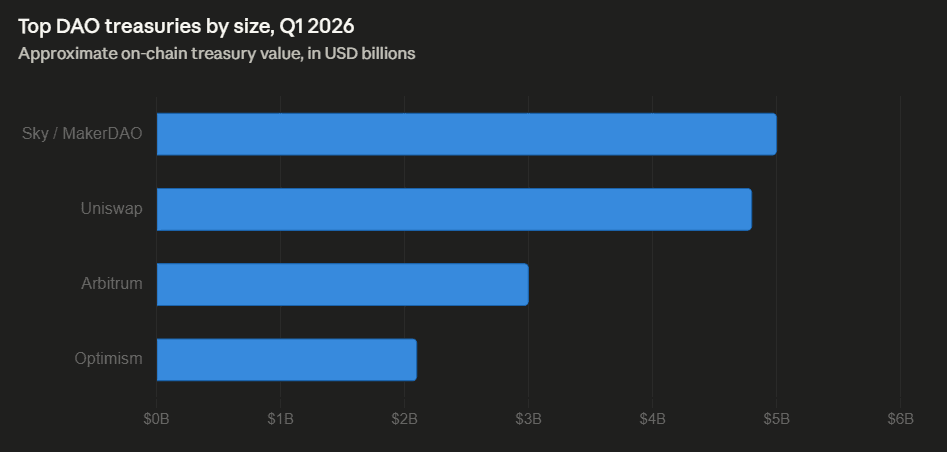
The concentration is sharp. Of 13,000+ DAOs, only around 220 hold more than $1 million in treasury, and fewer than 80 are considered truly active. Uniswap holds the largest DAO treasury at roughly $4.8 billion, predominantly UNI, with its foundation running a roughly $45M annual operating budget and a roughly $40M annual grant program. (Source: Eco)
The lesson for most teams is not to imitate the mega-DAOs but to recognize that contributor compensation at any serious scale relies on the same automated, auditable distribution rails the largest treasuries already use.
What Do Treasuries Hold for Contributor Payments?
Treasuries increasingly separate alignment capital from payment capital, and the payment portion skews heavily toward stablecoins.
The composition pattern in 2026:
Stablecoins (USDC/USDT preferred) cover 3 to 6 months of operational runway.
Idle stables are explicitly reserved for contributor payouts and operations.
Yield strategies (Morpho, sDAI, Lido) run on the surplus while payout liquidity stays accessible.
42% of DAOs remain native-token-heavy, the single most cited treasury risk of 2026.
The reasoning is structural. Treasury assets are already held in stablecoins, eliminating a conversion step, and many contributors prefer stablecoin compensation for speed, wallet control, and access in regions with limited banking infrastructure.
Token payments also create taxable events at distribution, so stablecoins reduce friction for routine pay while tokens handle alignment.
The signal for tokenomics designers is that payment liquidity and alignment tokens are now managed as distinct layers, which means the reporting and distribution tooling has to track both in one place.
A Worked Example: Inside CoW DAO's April 2026 Treasury
CoW DAO's April 2026 monthly report, published May 11, is one of the clearest public windows into how a mature DAO structures its treasury for payments.
The breakdown:
Component | Value | Share |
|---|---|---|
Total AUM | $32.14M | 100% |
Core Treasury Mandate (managed) | $26.88M | 83.6% |
Defence Reserve | $5.26M | 16.4% |
USD stablecoins (of managed) | $15.58M | 57.97% |
EUR stablecoins (of managed) | $3.88M | 14.42% |
Total stables (of managed) | — | 72.39% |
Idle funds (of managed) | — | ~55.51% |
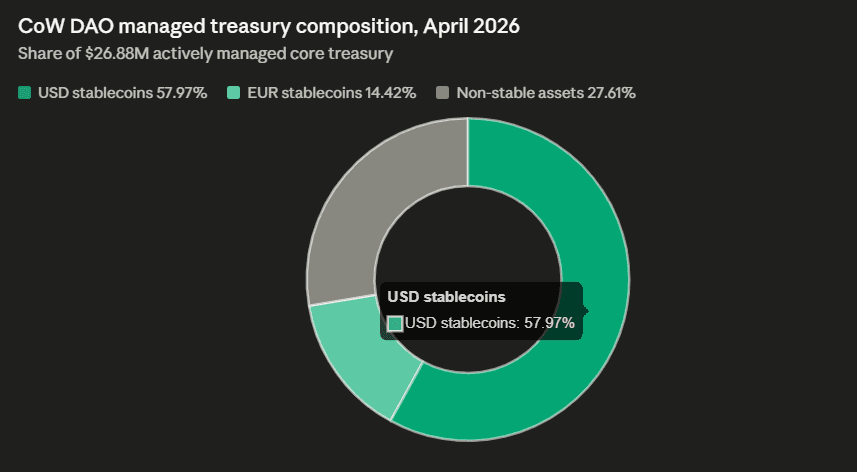
Two details stand out:
First, stables make up 72.39% of the actively managed treasury, with over half held idle specifically for liquidity, potential contributor payouts, and operations.
Second, CoW DAO has proposals to burn treasury COW tokens on a 1:1 basis for every COW emitted through solver rewards, grants, or team compensation through December 2026.
That second point is the emerging frontier: emission-aware compensation, where every token paid to a contributor is offset to neutralize dilution. It mirrors the logic behind revenue-backed reward models rather than inflationary emissions.
How Are Contributor Payments Automated in 2026?
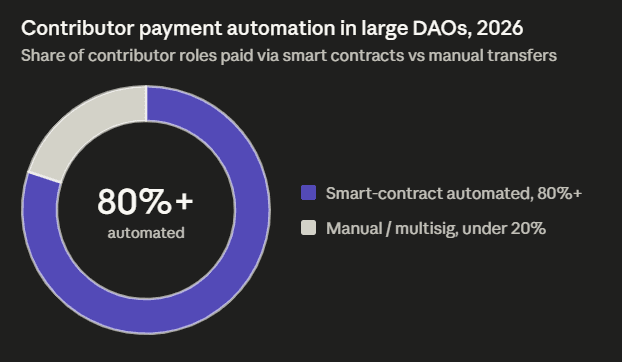
Automation is now the majority case, not the exception, for serious DAOs.
The automation data:
Smart-contract payroll handles over 80% of contributor roles in large DAOs.
Formalized contractor codes and KPIs exist in over 1,000 DAOs.
Multi-signature wallets (typically 3-of-5) remain standard for treasury security.
Over $500 million was distributed to DAO contributors as bounties by an April 2026 benchmark.
Real distributions in early 2026 show the range:
Lazy Summer DAO distributed 189,214 SUMR to active delegates for January governance work, plus a referral campaign of roughly 59K SUMR and 1.86K USDC to 666 participants.
Lido approved a $5M treasury allocation ($3M wstETH + $2M USDC) into its Earn vaults for alignment.
Arbitrum's foundation requested $16M in stablecoins and RWAs plus 1,700 ETH and 230 million ARB for continued operations and contributor support.
Payment flows now follow a consistent shape: protocol revenue accrues to the treasury, governance approves an allocation, and smart contracts or streaming protocols execute distribution.
This is exactly the layer programmable distribution platforms occupy. Instead of manual multisig transfers prone to error, teams use automated token vesting and recurring payout contracts that execute as designed, with on-chain verification on block explorers.
Why Stablecoins Dominate Payroll
Stablecoins win the payroll track because they remove two frictions at once: token volatility and cross-border banking.
The infrastructure data from Rise's May 2026 update:
Lifetime stablecoin payroll volume processed: over $1.5 billion.
More than 50% of worker withdrawals taken in stablecoins.
Coverage across 190+ countries with compliant contractor payouts and tax forms.
Roughly 70%+ of Web3 hires remain contractors rather than employees.
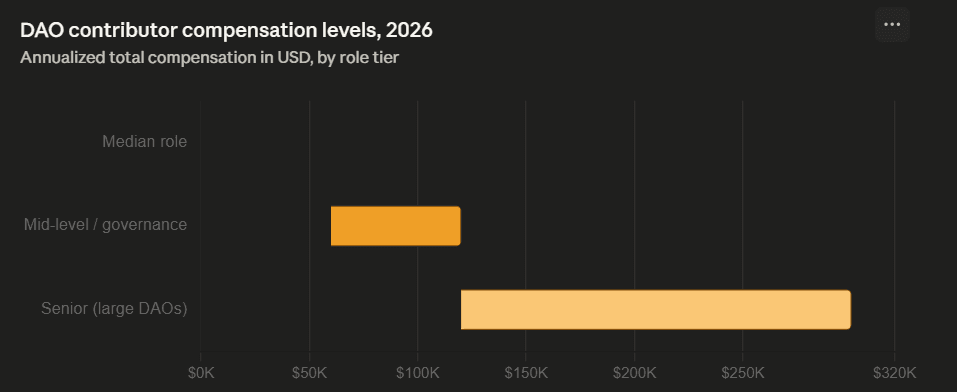
Compensation levels reflect a maturing market. The median DAO role pays $4,805 per month, roughly $57,700 annualized base, with governance and mid-level contributors landing in the $60K to $120K range and senior roles in large DAOs reaching up to $300,000 in total comp, typically a blend of stables and tokens.
For DAOs, stablecoin payroll and token alignment are complementary, not competing. The operational challenge is running both on one rail, which is where programmable on-chain distribution earns its place. For the broader treasury and financial-operations layer, Streamflow Business extends into treasury management, cap tables, and ownership issuance.
Where Streamflow Fits in the Distribution Layer
In a landscape split between alignment tokens and stablecoin payroll, the deciding factor is the execution rail. This is the layer Streamflow occupies, with $1.4B+ in total value locked across 40,000+ projects.
What that looks like in practice for contributor compensation:
Multi-year vesting schedules (linear, cliff, milestone, or price-based) for token alignment.
Recurring payout contracts that can fund contributor and contractor payments over time without redeploying.
A tokenomics dashboard that tracks vesting, locks, and distribution in real time as a single source of truth.
On-chain verification through Solscan and Solana Explorer, with shareable proof links.
The relevance is structural rather than promotional: the data shows DAOs converging on automated, verifiable distribution, and that is precisely what a programmable distribution platform provides.
Teams evaluating the alignment half of the model can create a vesting schedule on Streamflow with public proof links built in, alongside transparent token locks for team and treasury allocations.
Looking Ahead: The 2026 to 2027 Trajectory
The current data points to three quantifiable shifts rather than vague directional change.
Grounded predictions:
Automation crosses 90% in large DAOs. With 80%+ of contributor payments already automated, the manual long tail migrates to smart-contract and streaming rails.
Emission-offset compensation spreads beyond pioneers. CoW DAO's 1:1 COW burn against every emitted token signals a move toward dilution-neutral pay, likely adopted by other revenue-generating DAOs.
Recurring reporting becomes baseline. With 180+ DAOs already publishing monthly treasury and P&L reports, transparent distribution data shifts from differentiator to table stakes.
The common thread is professionalization. The DAOs setting the standard are not choosing between tokens and stablecoins; they are building infrastructure that executes both reliably and reports on both transparently.
Conclusion
DAO contributor compensation in 2026 runs on a hybrid model: native tokens for multi-year alignment and stablecoins for reliable payroll, executed across $26 to $28 billion in treasury assets and increasingly automated by smart contracts.
CoW DAO's 72% stablecoin treasury and emission-offset proposals, alongside Rise's $1.5B in lifetime payroll volume, show a market that has moved past manual transfers entirely.
The open question for any token issuer is no longer whether to automate distribution, but on what rail, and programmable platforms like Streamflow, executing both vesting and recurring payouts on-chain, are where that decision increasingly lands.
Read Next:
FAQs:
1. How do DAOs pay contributors in 2026?
DAOs in 2026 pay contributors using a hybrid model: native or governance tokens for long-term alignment through vesting and grants, plus stablecoins like USDC and USDT for reliable payroll. Over 80% of contributor payments in large DAOs are now automated through on-chain smart contracts and streaming protocols.
2. How large is the total DAO treasury market in 2026?
The total DAO treasury market in 2026 stands at roughly $26 to $28 billion across 13,000+ DAOs, though capital is highly concentrated. Fewer than 80 DAOs are considered truly active, and only around 220 hold more than $1 million in treasury.
3. Why do DAOs use stablecoins instead of native tokens for payroll?
DAOs use stablecoins for payroll because treasury assets are already held in stablecoins, removing a conversion step, and because stablecoins shield contributors from token price volatility. Native tokens are still used, but mainly for long-term alignment through vesting rather than routine monthly pay.
4. What is the best way to automate DAO contributor payments?
The best way to automate DAO contributor payments is through on-chain smart contracts that execute distributions exactly as governance approves them. Programmable platforms like Streamflow run recurring payout contracts for ongoing pay and automated vesting schedules for token alignment, with on-chain verification on block explorers.
5. How much do DAO contributors earn in 2026?
DAO contributors in 2026 earn a median of $4,805 per month, roughly $57,700 annualized base, often topped up with token allocations. Governance and mid-level roles range from $60K to $120K per year, while senior roles in larger DAOs reach up to $300,000 in total compensation.