General
Streamflow vs Superteam Earn: Which Is Better for Paying Contributors on Solana?
Stablecoins settled roughly $390 billion in genuine real-world payments during 2025, including vendor payments, remittances, and payroll, according to a January 2026 report from McKinsey and Artemis Analytics.
Contributor compensation is now a real operational category rather than an experiment, and Streamflow is the Solana-native token operations infrastructure that executes it, with $286M in total value locked across 40,000+ projects and 1.3M+ users.
For paying contributors on Solana, Streamflow is the platform that does the actual work.
Streamflow and Superteam Earn both appear in this conversation, but they occupy different layers of the stack. Streamflow is the infrastructure that pays contributors over time through recurring payout contracts, vesting schedules, token locks, and programmable transfers. Superteam Earn is the Solana ecosystem's talent marketplace, where sponsors post bounties and reward the best submissions.
This comparison covers how each platform handles contributor payments, where each one has real limits, a side-by-side feature table, honest pros and cons, cost, use case fit, and how to start paying contributors on Streamflow.
Key Takeaways
Streamflow is the better platform for paying contributors on Solana, at any timeline.
Streamflow automates recurring payouts, vesting, and token locks through audited on-chain smart contracts.
Superteam Earn excels at sourcing Solana talent but offers no payroll, vesting, or locks.
Streamflow supports 40,000+ projects, $286M TVL, and mass payouts to 1M recipients.
Teams source contributors on Superteam Earn and then pay them through Streamflow.
Quick Verdict: Streamflow vs Superteam Earn for Contributor Payments
Streamflow is the better platform for paying contributors on Solana. Contributor compensation past the first transfer is a payments and vesting problem, and Streamflow is the only one of the two that enforces payout schedules, vesting, cliffs, and locks through smart contracts.
Superteam Earn is excellent at a different job: finding Solana-native contributors and running competitive, one-off bounty campaigns with no commission. It is a strong discovery layer, and it has earned that position in the ecosystem.
The distinction is structural, not competitive. Sourcing a contributor is a one-time event, and Superteam Earn handles it well. Paying a contributor is a permanent operational function, and that runs on Streamflow.
How Streamflow Pays Contributors on Solana
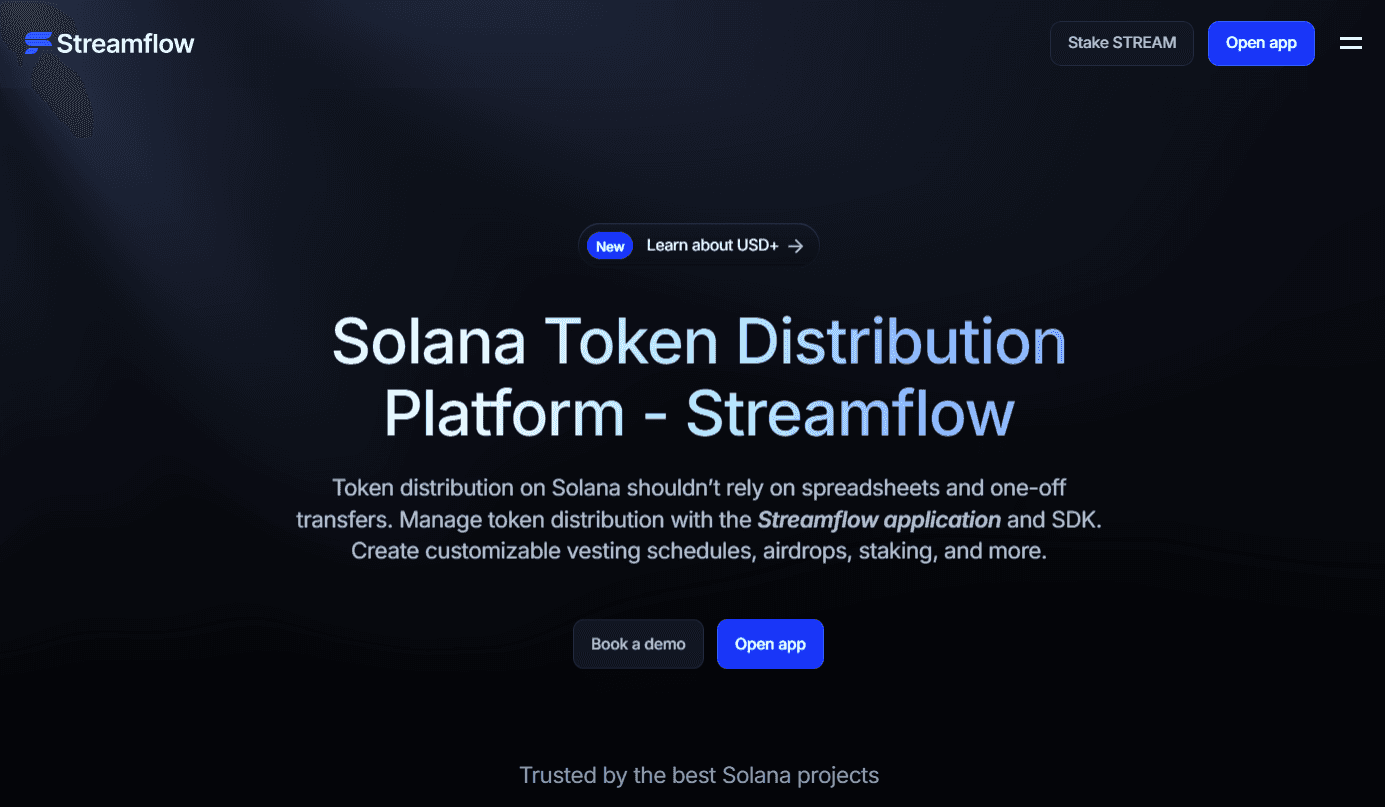
Streamflow starts where a bounty ends. It is the best Solana token operations infrastructure platform that converts compensation rules into smart contracts, so payouts execute automatically instead of depending on someone remembering to send a transfer. That distinction matters the moment a contributor becomes a repeat contributor.
Streamflow supports recurring payout contracts that function as payroll-style payments to employees, contractors, and contributors. Teams fund a contract once, top it up over time, and never redeploy.
For a Web3 CFO paying dozens or hundreds of contributors, this is the difference between an afternoon of manual wallet transfers and a funded contract that runs itself.
The token side is where the gap widens. Streamflow covers automated token vesting in linear, cliff, cliff-plus-linear, graded, milestone-based, and price-based models, plus transparent token locks with fixed-date or price-based unlock conditions. Contributor allocations can be created in bulk via CSV, verified on Solscan or Solana Explorer, and shared as public proof links.
Everything runs on audited smart contracts, reviewed by FYEO and OPCODES, and is immutable once deployed. There is no admin override and no unilateral change, which means a contributor's future payments are enforced by code rather than by a promise. That is what turns compensation into a trust signal instead of a liability.
Scale is the last piece. Streamflow handles up to 1,000,000 recipients per campaign and 100,000 recipients per CSV import, so the same infrastructure that pays 5 contributors pays 500,000 airdrop recipients without changing tools.
Pros
Recurring payout contracts automate contributor payroll without redeploying or manually sending transfers.
Full token compensation stack: linear, cliff, graded, milestone, and price-based vesting schedules.
Audited by FYEO and OPCODES, immutable on-chain, with public proof links and explorer verification.
Infrastructure-grade scale: $286M TVL, 1.3M+ users, 40,000+ projects, up to 1M recipients.
Extends into treasury, cap tables, and ownership through Streamflow Business.
Cons
Solana-native by design, so teams operating across multiple chains need additional tooling.
Not a talent marketplace, so contributor sourcing happens elsewhere before Streamflow executes payment.
How Superteam Earn Pays Contributors on Solana
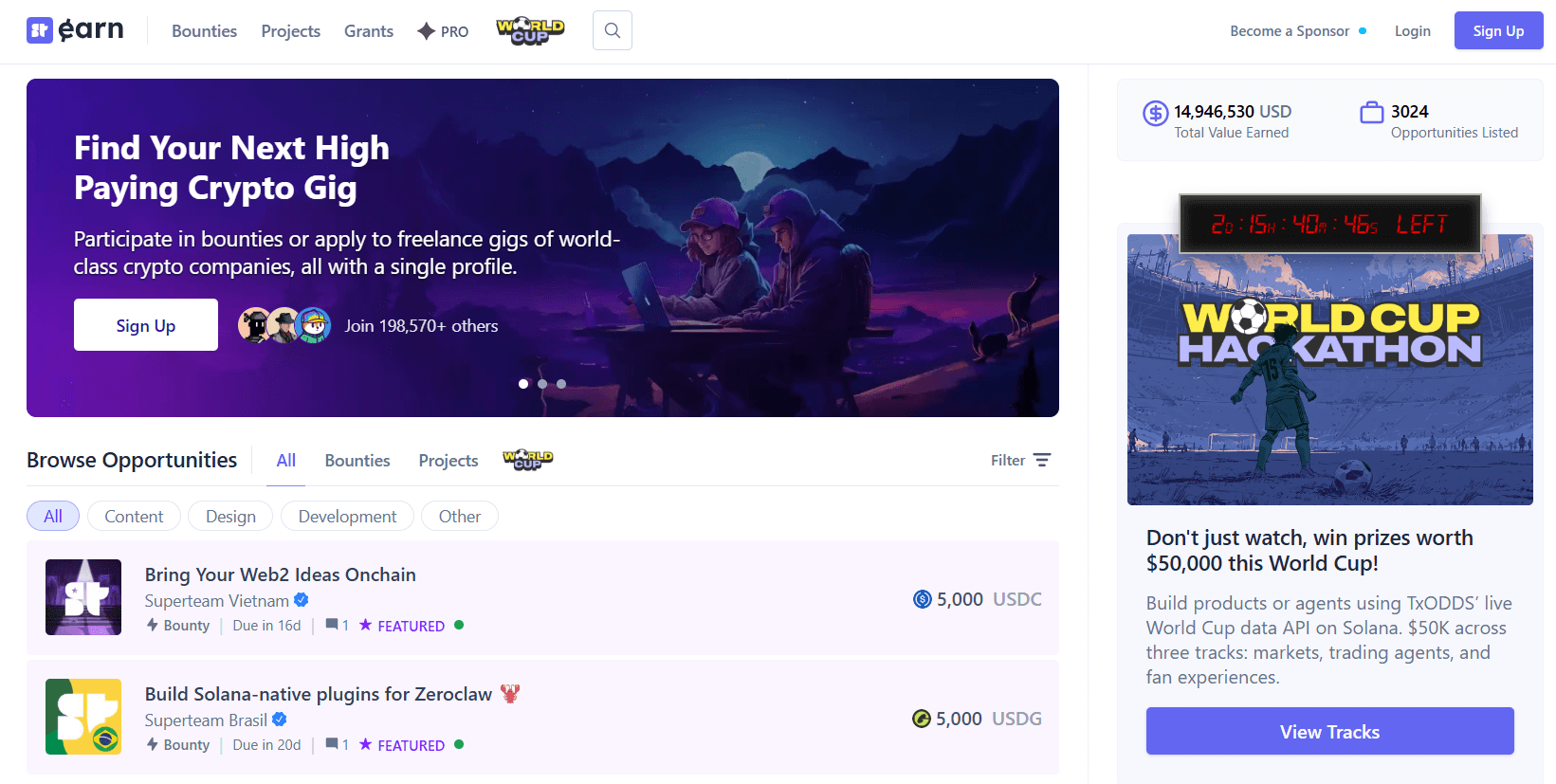
Superteam Earn pays contributors through a competitive bounty model, and it is the largest talent marketplace in the Solana ecosystem. The platform advertises access to roughly 150,000 Solana freelancers, more than 50,000 monthly active visitors, and a Superteam network spanning a 36,200-person global community across 15 countries.
The economics are unusually clean for sourcing. Superteam Earn charges zero commission and no listing fees, meaning the entire reward budget goes to the contributor. Posting a listing takes under two minutes, and the platform publishes a public rate card so sponsors can benchmark compensation, with Twitter threads listed at $500 to $1,500 and landing page development at $2,000 to $3,000.
Superteam Earn also solves a real trust problem for first-time contributors. It runs an escrow system for bounties and grants so funds are secured before work begins, issues proof-of-work credentials that build a portable on-chain reputation, and is open source under AGPL-3.0. It has distributed over $1.7 million in community GDP across the Solana ecosystem, per Solana Compass.
Where the model stops is the payment layer, which is exactly where Streamflow begins.
Pros
Unmatched Solana talent distribution, with roughly 150K freelancers and 50K+ monthly visitors.
Zero commission and no listing fees, so the full reward budget reaches the contributor.
Escrow, proof-of-work credentials, and a public rate card build trust on both sides.
Cons
Designed for one-off competitive tasks, not recurring or long-term contributor compensation.
No vesting, cliffs, or token locks, so there is no mechanism for long-term alignment.
Payment execution stays manual per winner, with no programmable schedule enforced on-chain.
Streamflow vs Superteam Earn: Side-by-Side Feature Comparison
Feature | Streamflow | Superteam Earn |
|---|---|---|
Primary function | Token operations and payments infrastructure | Solana talent marketplace |
Recurring contributor payouts | Recurring payout contracts, refundable | Not offered, manual per winner |
Payroll automation | Yes, programmable and on-chain | Not offered |
Token vesting | Linear, cliff, graded, milestone, price-based | Not offered |
Token locks | Time-based and price-based, publicly verifiable | Not offered |
Airdrops | Up to 1M recipients, 100K per CSV | Not offered |
Staking | No-code pools, any SPL token | Not offered |
Tokenomics dashboard | Real-time allocation and unlock tracking | Not offered |
White-label portals | Branded claim, staking, and lock portals | Not offered |
Treasury management | USD+ via Streamflow Business | Not offered |
SDK / API | Public SDK for custom flows | Open source repo, agent API |
Escrow | Yes, on-chain contracts | Yes, for bounties and grants |
One-off task payouts | Supported via direct transfers | Core strength, bounties and projects |
Talent sourcing | Not offered | Core strength, ~150K freelancers |
Solana support | Solana-native, all features | Solana-focused ecosystem |
Pricing model | Smart contract fees plus low Solana network fees | 0% commission, no listing fees |
Security audits | FYEO and OPCODES | Open source, publicly auditable code |
Named case studies | Bonk, UXD Protocol, Heavenland | Jupiter, Solana Foundation, Helius, Civic |
Scale proof | $286M TVL, 1.3M+ users, 40K+ projects | $1.7M+ community GDP distributed |
The table makes the structural point clearly. Streamflow wins every row about paying contributors on any timeline longer than a single transfer, which is the row that defines the category.
Streamflow vs Superteam Earn: The Real Cost of Paying Contributors
Superteam Earn's pricing is genuinely hard to beat on the surface: 0% commission, no listing fees, and the full reward going to the contributor. For a single bounty, that is the cheapest possible structure.
Streamflow charges smart contract creation fees plus Solana network fees, which are near-zero given the network's sub-second finality and support for 65,000+ transactions per second. The relevant comparison is not fee against fee, it is fee against operational cost.
Consider what a "free" contributor payout actually costs at scale:
Manual transfers to 50 contributors monthly consume finance hours every cycle.
Each manual transfer carries wrong-address and wrong-amount risk with no reversal.
Off-chain compensation schedules require reconciliation across a spreadsheet and a wallet.
No on-chain proof exists for investors or contributors that future obligations are funded.
A team paying 50 contributors monthly executes 600 manual transfers a year on the marketplace model. On Streamflow, that becomes a set of funded recurring contracts that release automatically and verify publicly. The commission saved on a bounty is real, but it does not offset the cost of running compensation by hand for the rest of the year.
Streamflow's cost structure exists because it is doing something structurally different, and on Solana that automation costs a fraction of the equivalent on Ethereum.
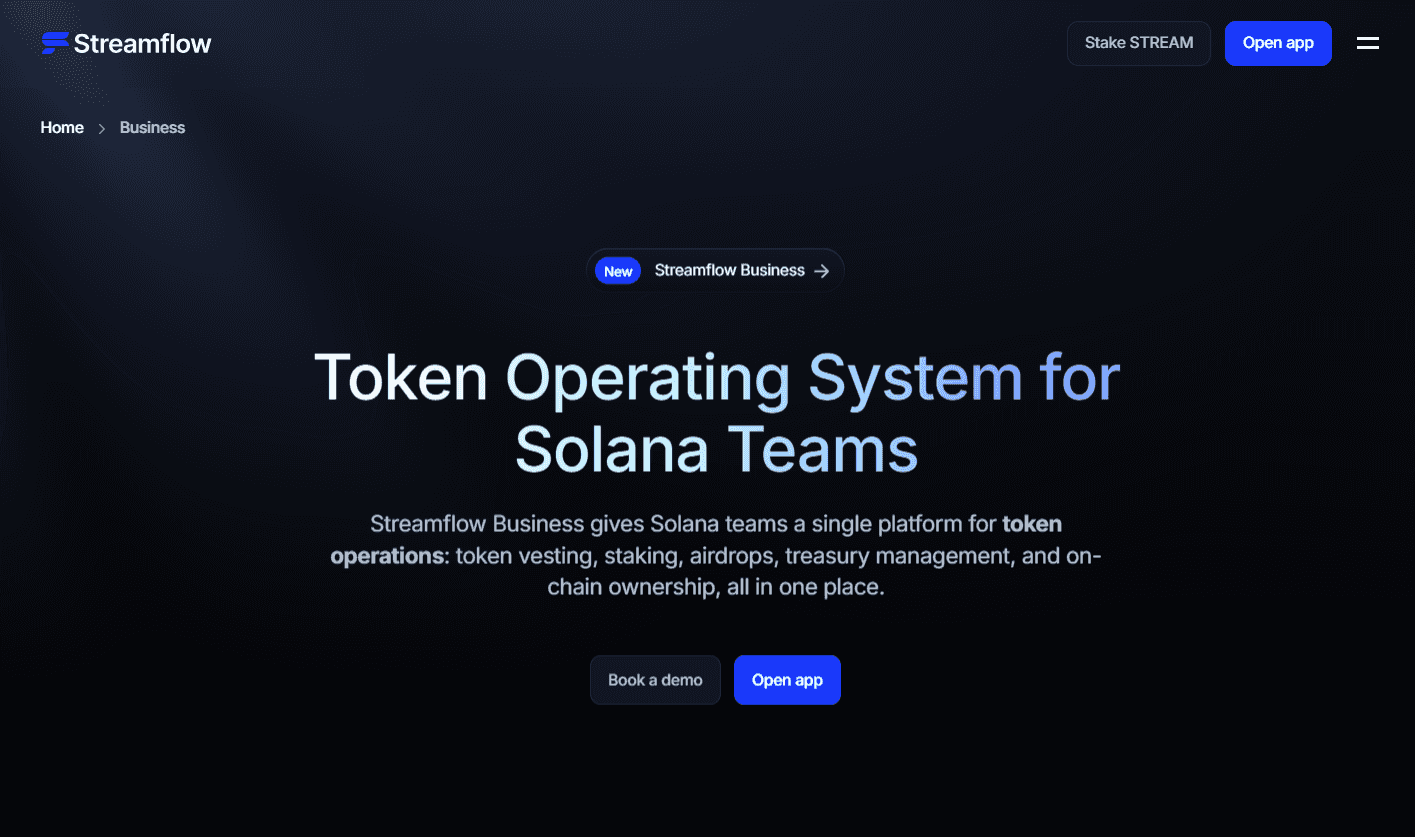
Which Platform to Use for Which Type of Contributor Payment
Streamflow is the default for contributor compensation. Superteam Earn has a real and useful role upstream of it.
When Streamflow Is the Right Platform for Paying Contributors
Contributors are paid repeatedly, whether weekly, monthly, or continuously.
Compensation includes tokens that need vesting schedules, cliffs, or locks.
A DAO needs to pay contributors from a treasury with on-chain accountability.
The team needs verifiable proof that future contributor obligations are funded.
Payouts must scale from dozens to thousands of recipients without new tooling.
A DAO paying 40 recurring contributors, vesting a core team allocation over three years, and reporting distribution transparently to its community has a payments infrastructure problem.
Where Superteam Earn Fits in the Contributor Payment Flow
A team needs a one-time deliverable and does not yet know who should build it.
The work suits a competitive format where many submissions produce a better result.
The goal includes marketing reach across the Solana builder community.
A protocol launching next month that needs 20 explainer threads written by Solana-native creators should post a bounty there. Once those creators become recurring contributors, the compensation moves to Streamflow, because that is the point at which a marketplace has nothing left to offer and infrastructure takes over.
Why Streamflow Is the Best Platform for Paying Contributors on Solana
The question in the title is specifically about paying contributors, and that framing settles it. Sourcing a contributor is a one-time event. Paying a contributor is a permanent operational function that compounds in complexity with every person added and every month that passes.
Streamflow is the best option for that function for five concrete reasons:
Compensation is enforced by immutable smart contracts, not by a team's manual discipline.
Vesting, cliffs, and locks give contributors long-term alignment that a one-off payment cannot.
The tokenomics dashboard makes contributor allocations a public trust signal rather than an internal spreadsheet.
The same platform scales from 22 contributors to 1,000,000 airdrop recipients.
Streamflow is listed in the official Solana Docs under token vesting, which reflects its position as core ecosystem infrastructure.
There is also a compounding argument. Teams that use Streamflow for contributor payouts already have the infrastructure in place for locks, airdrops, staking, treasury management with USD+, on-chain cap tables, and tokenized SAFE agreements as they grow. Compensation is usually the first financial operation a token project runs, and it is worth running it on the layer that handles all the rest.
Case Study: How Bonk Paid 22 Contributors With Streamflow
Bonk, the Solana meme coin, faced exactly this problem at launch. It allocated 55% of supply to airdrops for early Solana users, but the harder question was how to compensate the contributors who actually built it without eroding community trust.
Bonk used Streamflow to vest 20% of total supply across 22 early contributors on a 3-year linear vesting schedule. The Bonk vesting case study shows the outcome: contributors were compensated over time through enforceable on-chain contracts, and the community could verify the schedule independently rather than take a team's word for it.
That is the difference in practice. A bounty pays a contributor once. Bonk's vesting contracts pay 22 contributors across three years and simultaneously function as a public commitment device.
UXD Protocol did the same at larger scale, vesting approximately 46% of $UXP supply on a 4-year linear schedule with a 12-month cliff and integrating the UXD Protocol case study SDK into Realms so stakeholders could claim tokens and vote in the same interface.
How to Start Paying Contributors on Streamflow
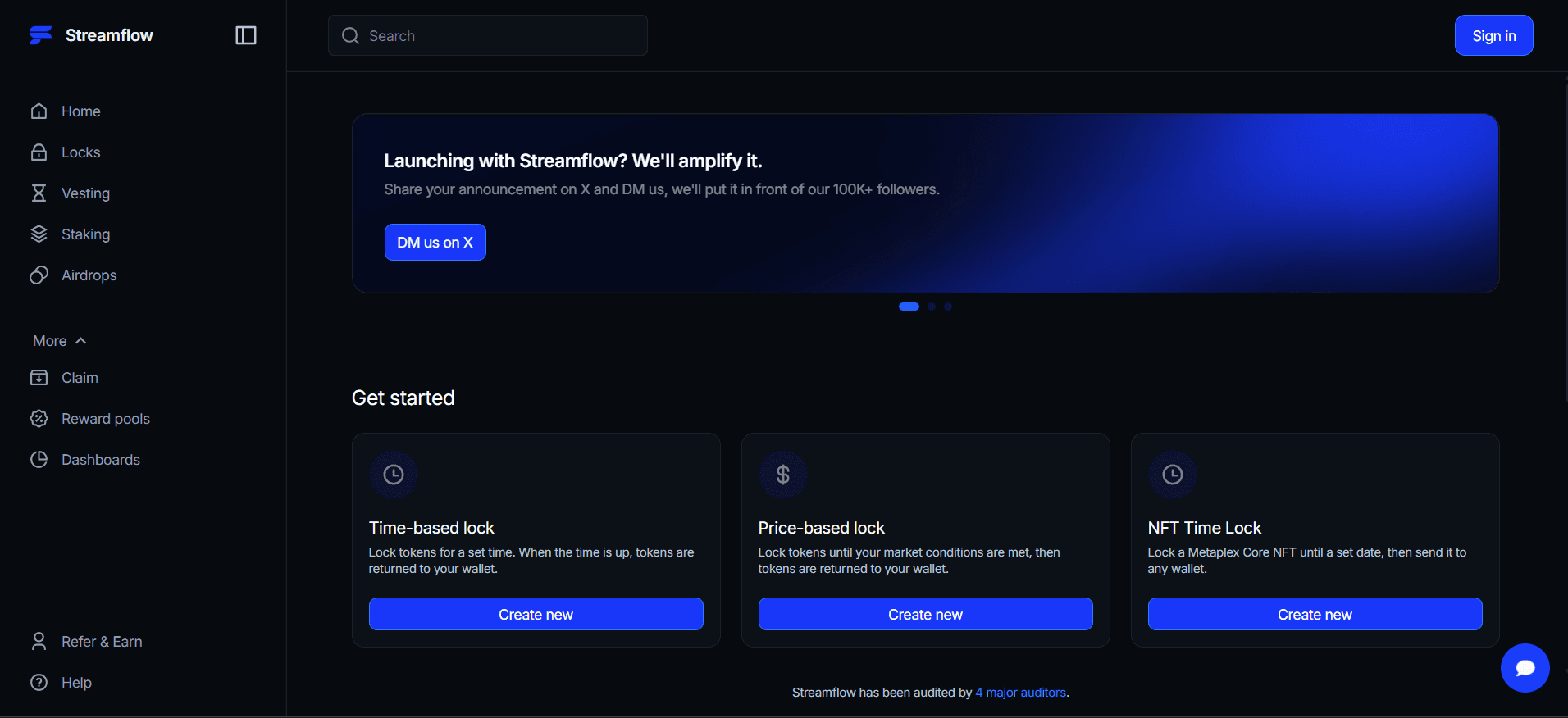
Setting up contributor payments on Streamflow does not require smart contract development. The no-code path handles the majority of cases, and locking tokens takes 37 seconds.
The flow for contributor compensation looks like this:
Open the Streamflow app and connect a Solana wallet such as Phantom, Solflare, or Backpack.
Choose the contract type: vesting for token allocations, recurring payouts for ongoing compensation, or a lock for team commitments.
Upload recipients individually or via CSV import, which supports up to 100,000 addresses.
Define the schedule: linear, cliff, cliff-plus-linear, graded, milestone-based, or price-based.
Fund the contract, deploy, and share the public proof link for verification on Solscan.
From there, releases execute automatically. Developers who need custom logic can integrate the public SDK to embed contributor payment flows directly into their own dApp, the same way UXD Protocol did with Realms.
Teams building beyond token compensation into treasury management, cap tables, and ownership issuance should look at Streamflow Business for financial operations, which extends the same infrastructure into a full financial OS on Solana.
Conclusion
Streamflow is the better platform for paying contributors on Solana, because compensation past the first transfer requires recurring payout contracts, audited vesting schedules, and enforceable token locks that 40,000+ projects and $286M in total value locked already run on.
Superteam Earn is the strongest way to find Solana contributors and pay them once, and it works well as the sourcing layer that feeds into Streamflow. Sourcing is a moment; compensation is an operating system.
Book a demo to see how Streamflow handles recurring contributor payouts and multi-year team vesting on Solana.
Read Next:
FAQs:
1. Which is better for paying contributors on Solana, Streamflow or Superteam Earn?
Streamflow is better for paying contributors on Solana, because it enforces recurring payouts, vesting, cliffs, and locks through audited smart contracts rather than manual transfers. Superteam Earn is better for sourcing contributors and paying one-off bounties with zero commission. Most teams find talent on Superteam Earn and pay them through Streamflow.
2. Can Streamflow be used for payroll or recurring contributor payments?
Yes, Streamflow can be used for payroll and recurring contributor payments. The platform supports recurring payout contracts for payroll-style payments to employees, contractors, and contributors, and those contracts can be topped up over time without redeploying. This is why finance leads use Streamflow to mass-pay contributors instead of executing manual transfers.
3. Does Superteam Earn support token vesting or token locks?
No, Superteam Earn does not support token vesting or token locks. It is a talent marketplace where sponsors post bounties, projects, and grants and pay winners directly in USDC or SOL. Teams that need vesting schedules, cliffs, or locked team allocations use Streamflow, which supports linear, cliff, graded, milestone-based, and price-based vesting.
4. How much does it cost to pay contributors through Streamflow?
Paying contributors through Streamflow costs smart contract creation fees plus Solana network fees, which are near-zero because Solana offers sub-second finality and supports 65,000+ transactions per second. The relevant cost comparison is against the operational overhead of manual transfers, which consume finance hours and carry irreversible error risk at every cycle.
5. Is Streamflow secure enough for multi-year contributor vesting?
Yes, Streamflow is secure enough for multi-year contributor vesting. Its smart contracts are audited by FYEO and OPCODES, immutable once deployed, and verifiable on Solscan and Solana Explorer with no admin override. Bonk used Streamflow to vest 20% of total supply across 22 contributors on a 3-year linear schedule.