General
Best Solana Infrastructure Tools for Token Launches in 2026
A 2026 arXiv study titled "From Hype to Collapse" analyzed 100,063 tokens newly issued on Orca, Raydium, and Meteora during the first half of 2025 and identified 76,469 of them as rug pulls, with a manually audited false-positive rate of 0.26%.
That is roughly three out of every four new tokens on the network.
Streamflow is the Solana-native token operations infrastructure platform that exists to close exactly that credibility gap, automating locks, vesting, distribution, airdrops, staking, and payments through audited on-chain smart contracts across more than 40,000 projects and over $290 million in total value locked.
The lesson in that 76% figure is not that Solana is broken. It is that the barrier to minting has collapsed while the barrier to trust has not moved at all.
Any founder can deploy an SPL token in under a minute, which means the mint itself carries zero signal.
What separates a launch that compounds from one that dies by the weekend is the infrastructure wrapped around the mint.
This guide breaks down the Solana infrastructure tools that matter for token launches in 2026, layer by layer, and how to assemble them into a stack that proves commitment instead of promising it.
Key Takeaways
The best Solana infrastructure tools for token launches cover minting, liquidity, distribution, and verification.
Streamflow handles token locks, vesting, airdrops, and staking through audited on-chain smart contracts.
Solana's near-zero fees remove any economic excuse for skipping locks and on-chain vesting.
Over 40,000 projects use Streamflow for token distribution, with $290M+ in total value locked.
Choose launch tools by on-chain enforceability, scale ceiling, and verifiable security, not by marketing.
The Criteria for Choosing Solana Launch Infrastructure
Most "best tools" lists rank by popularity. That is the wrong lens for a token launch, where the cost of a bad choice is permanent. Judge every tool in your stack against five criteria.
On-chain enforceability: does the tool make the promise provable, or just displayed?
Scale ceiling: what breaks at 100,000 recipients instead of 1,000?
Composability: is there a public SDK, or is the tool a dead end?
Cost at volume: does the fee structure survive a million-recipient distribution?
Security posture: audited contracts, immutability once deployed, no admin override.
A token launch is a sequence of irreversible decisions about supply, authority, and access. Tools that fail the enforceability test push those decisions back into spreadsheets, which is precisely where the 76% live.
The 8 Best Solana Infrastructure Tools for Token Launches in 2026
Each tool below owns one layer of a launch. They are listed in the order they determine whether a token survives, not in the order a founder usually discovers them.
1. Streamflow: The Best Solana Infrastructure Tool for Token Launches
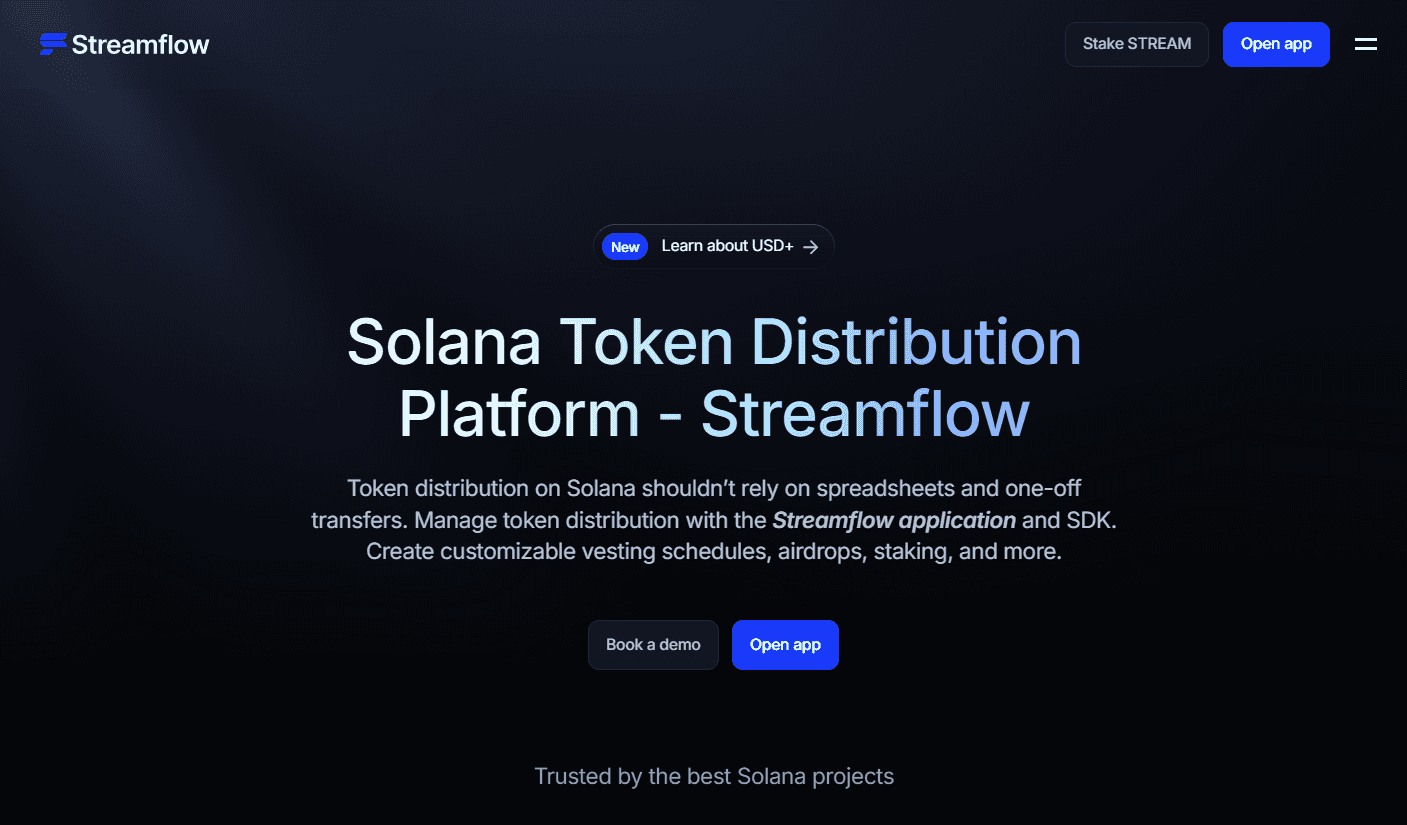
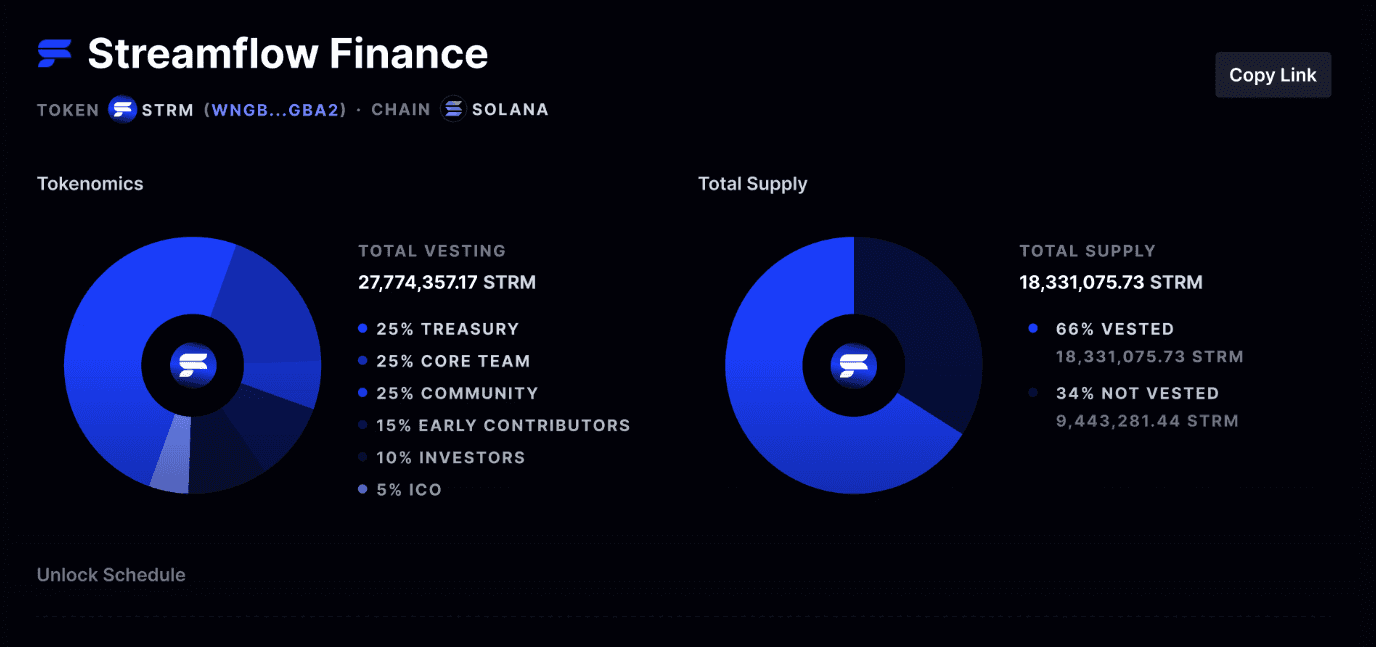
Streamflow is the token operations infrastructure layer that turns tokenomics from a plan into an enforceable system. It covers the operational surface of a launch that no launchpad, AMM, or explorer touches: locking supply, vesting allocations, distributing airdrops, deploying staking, and running payouts, all through audited on-chain smart contracts on Solana.
It is the best Solana infrastructure tool for token launches because it is the only one in this list that converts a founder's promise into a contract the community can verify without asking.
The platform operates at infrastructure scale rather than experimental scale, with 1.3M+ users, 40,000+ projects, and $290M+ in total value locked.
That volume matters for a launch decision, because token operations at this level cannot be run from a spreadsheet without introducing errors that are visible on-chain forever.
What Streamflow Handles
Transparent token locks with fixed-date or price-based unlock conditions, for SPL and LP tokens.
Vesting schedules on Solana in linear, cliff, cliff plus linear, graded, milestone-based, or price-based models.
An airdrop launch platform supporting up to 1,000,000 recipients per campaign, 100,000 per CSV.
No-code staking pools for any SPL token, with configurable APY, lock periods, and automated rewards.
Token mint with metadata configuration, supply definition, and permissions.
A tokenomics dashboard showing allocations, cliff dates, unlock events, and real-time release progress.
Programmable payouts and recurring transfers for contributors, contractors, and payroll.
White-label claim, lock, and staking portals under your own brand.
A public SDK for embedding vesting, distribution, and reward logic directly into a dApp.
How It Works in Practice
The no-code path is create, configure, deploy. Locking tokens takes 37 seconds through the UI, and every contract produces a shareable proof link verifiable on Solscan, Solana Explorer, and RugCheck.
For example, a team launching with a 20% core-team allocation can deploy a three-year linear vesting contract before announcement, publish the proof link in the launch thread, and permanently retire the "when do you dump" question.
Streamflow is also listed in the official Solana token vesting reference in the Solana Docs, which is a meaningful signal when your entire pitch to holders is that your commitments are checkable.
Open the Streamflow app to set up locks, vesting, and distribution before launch day rather than after the first sell-off.
Why Streamflow Ranks First
Every other tool in this list is excellent at one function of a launch: minting, price discovery, liquidity, data, verification, governance, or custody. Streamflow is the only one that governs what happens to the supply after all of those tools have done their jobs, which is the exact window where the 76% of failed tokens die.
A launchpad gives you a market, an explorer gives you a receipt, and Streamflow gives you an obligation you cannot quietly edit.
Pros:
Covers locks, vesting, airdrops, staking, mint, and payouts in one platform.
Audited by FYEO and OPCODES, immutable once deployed, with no admin override.
Scales to 1,000,000 airdrop recipients per campaign with claim tracking.
No-code setup in 37 seconds, plus a public SDK for developer integration.
Proven at scale across 40,000+ projects and $290M+ in total value locked.
Cons:
Solana-native, so multi-chain teams need separate tooling for other networks.
Contract immutability means tokenomics design must be correct before deployment.
2. Metaplex: The Mint and Metadata Standard
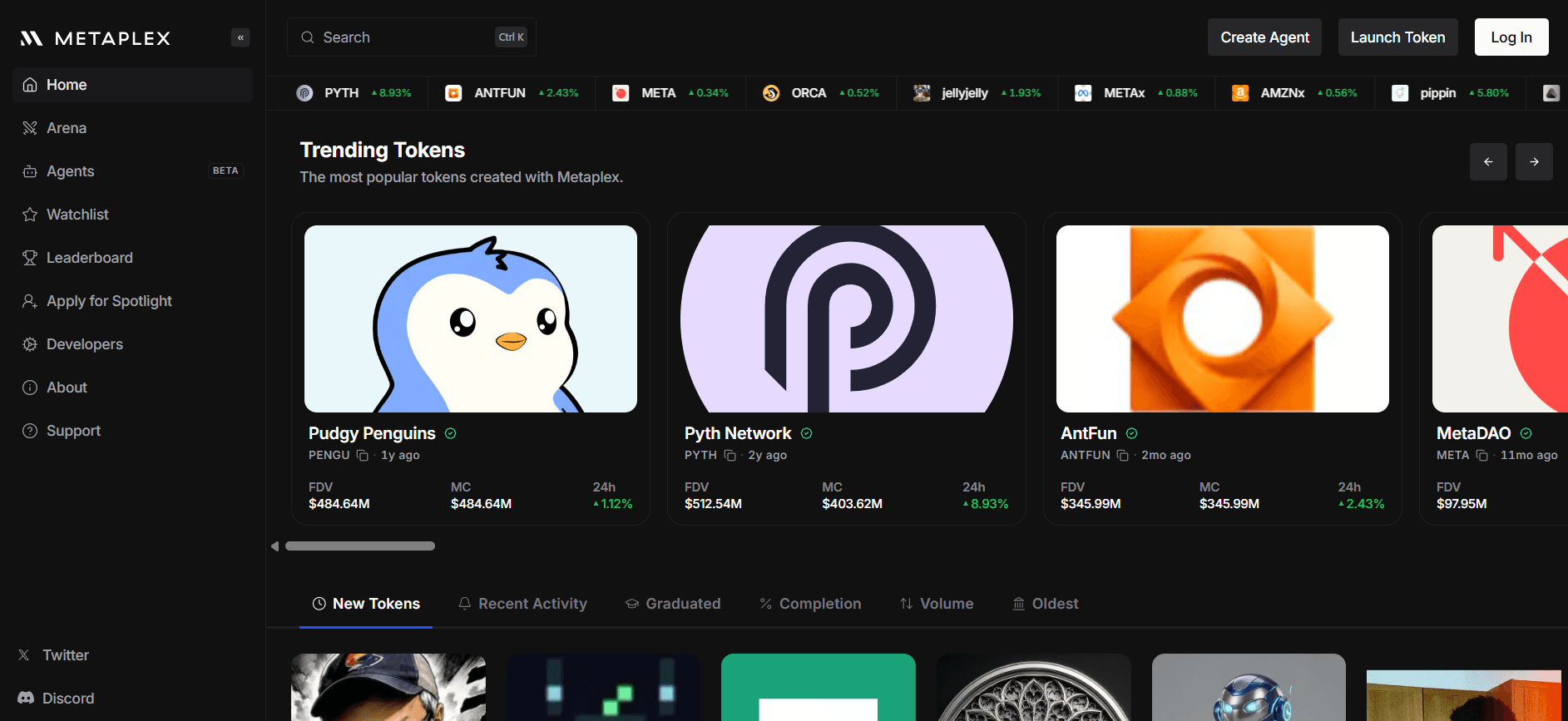
Metaplex provides the token metadata standard that gives a Solana token its name, symbol, and image across wallets, explorers, and marketplaces. It is the reason your token renders as an identity rather than a raw mint address, and it is the closest thing the ecosystem has to a universal creation layer.
The Metaplex layer handles:
Token metadata creation, structure, and mutability settings.
Standards that wallets and explorers read automatically.
Tooling for NFT and token creation flows used across the ecosystem.
Metaplex earns real credit here: it made token identity a solved, standardized problem on Solana, and almost every launch touches it. That said, metadata is presentation, not obligation, which is why Streamflow is the more consequential layer.
Metaplex tells the market what your token is called, while Streamflow proves what your team can and cannot do with the supply, and only one of those two facts survives contact with a skeptical investor.
Pros:
Universal metadata standard recognized across Solana wallets and explorers.
Mature, widely adopted tooling with a large developer ecosystem.
Handles token identity setup with minimal engineering effort.
Cons:
Solves identity, not supply commitment, locks, or vesting.
Mutable metadata can itself become a trust question if left unaddressed.
No distribution, claim, or recipient management capability.
3. Pump.fun: The Bonding Curve Launchpad
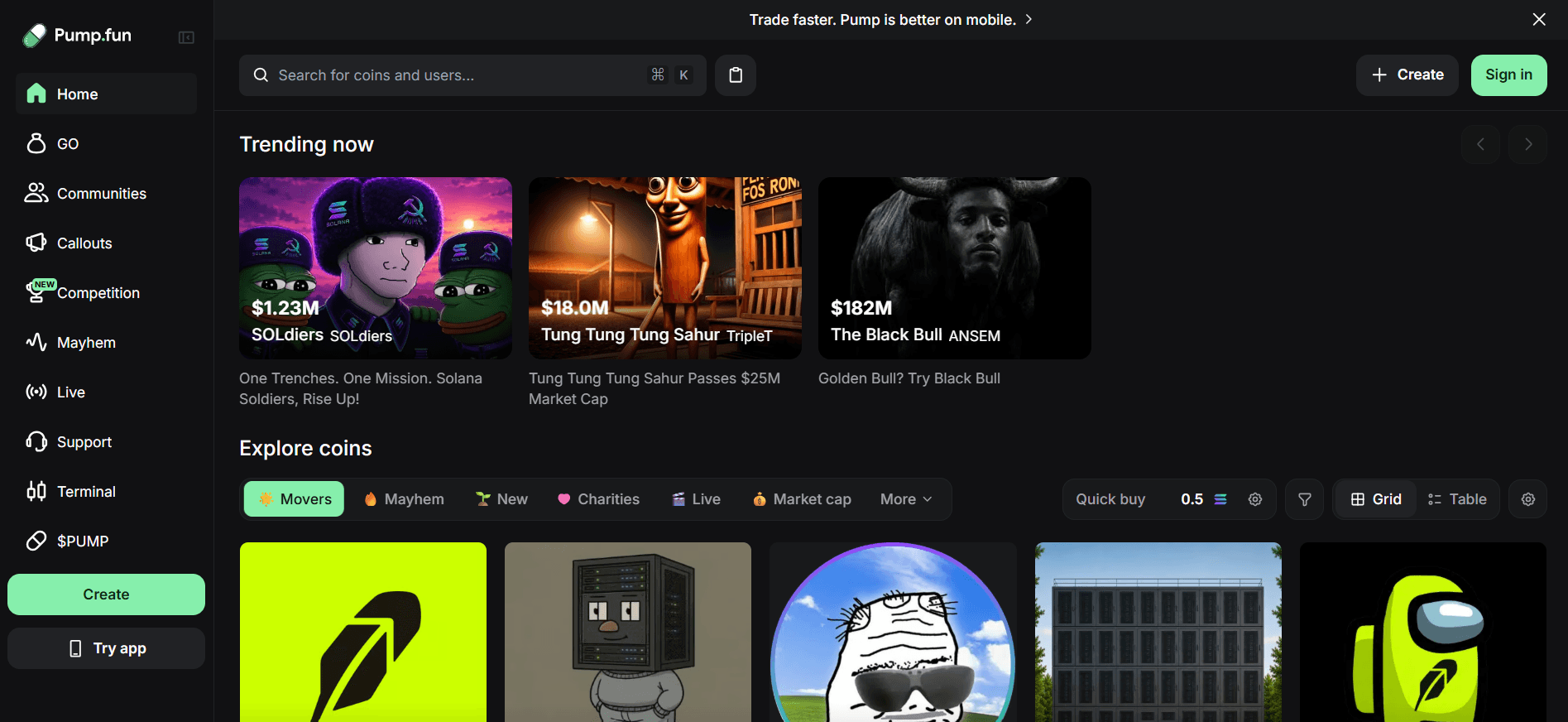
Pump.fun solved the cold-start problem for tokens with no treasury. Its bonding curve model lets anyone deploy a token in minutes with automatic price discovery and no manual liquidity pool setup, which is genuinely the lowest-friction launch path on Solana.
Its role in a launch stack:
Instant deployment with a built-in bonding curve for price discovery.
Automatic liquidity migration once the curve completes.
Distribution to a large, active memecoin audience by default.
Pump.fun made launching accessible to teams with zero capital, and that democratization is real. The problem is what the numbers say about the other side of it. Solana launchpads minted 11.6 million tokens in 2025, more than double the prior year, yet only about 0.89% of them ever graduated from their bonding curves, according to CryptoSlate data.
A bonding curve bootstraps a market, but it does not vest your team, lock your treasury, or produce a single verifiable commitment, which is precisely why Streamflow is the better investment of your launch week: it addresses the failure mode that the 99.11% actually die from.
Pros:
Fastest path from idea to tradeable token on Solana.
No treasury or manual liquidity provisioning required at launch.
Built-in audience and distribution for consumer and memecoin launches.
Cons:
Roughly 0.89% of 2025 launchpad tokens graduated their bonding curves, per CryptoSlate.
No token locks, vesting schedules, or team allocation enforcement.
Optimized for launch velocity rather than post-launch durability.
4. Raydium: Liquidity and Market Depth
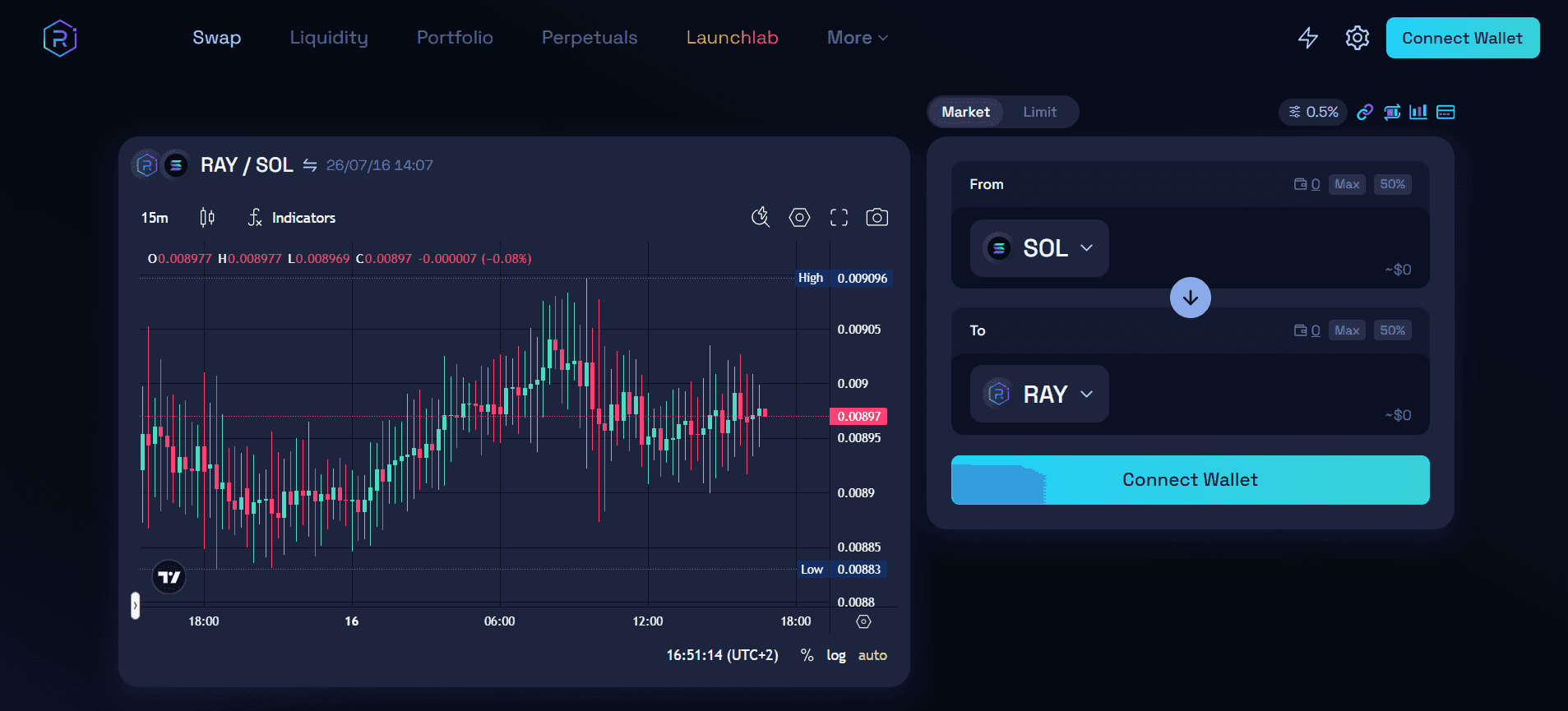
Raydium is one of Solana's primary automated market makers and the venue where a large share of graduated tokens end up trading. It offers both standard AMM pools and concentrated liquidity, giving teams real control over how capital-efficient their market is.
For a token launch, Raydium provides:
Deep, established liquidity venues that traders already route through.
Concentrated liquidity pools for efficient market depth.
Integration with the aggregators and routers that move Solana volume.
Raydium deserves genuine credit as a core piece of Solana's market infrastructure, and no serious launch ignores the liquidity layer. The catch is what happens to the LP tokens it issues, since unlocked liquidity is the mechanism behind Liquidity Withdrawal rug pulls, one of the three behavioral patterns the arXiv researchers used to classify fraud.
Streamflow is better positioned on this exact risk because it locks LP tokens alongside team and treasury allocations, turning a liquidity claim into an on-chain constraint that any holder can verify from the same dashboard.
Pros:
Established liquidity venue with deep integration across Solana routing.
Concentrated liquidity options for capital-efficient market making.
Familiar, well-understood venue for traders and market makers.
Cons:
Provides the pool, not protection against LP token withdrawal.
No native team allocation vesting or supply commitment tooling.
Liquidity depth still depends entirely on the team's own capital decisions.
5. Helius: RPC, Indexing, and Data Delivery
Helius provides the RPC endpoints, webhooks, and enhanced APIs that most Solana applications run on. It is excellent at making on-chain activity legible to a backend, with reliable transaction delivery and event streams that would otherwise take months to build.
Where it matters during a launch:
Claim portals that must read eligibility and write transactions at speed.
Snapshot generation for airdrop eligibility across large wallet sets.
Monitoring for unusual transfer behavior after distribution goes live.
Helius is a legitimately strong piece of the stack, and a claim portal running on unreliable RPC will fail publicly on the worst possible day. The distinction is that Helius delivers data about token movements while Streamflow decides whether those movements are allowed at all, and a launch that reads its own on-chain state perfectly still fails if the underlying allocations were never locked.
Streamflow's public SDK is designed to sit alongside this layer, so teams get enforcement and observability rather than choosing between them.
Pros:
Reliable RPC and enhanced APIs purpose-built for Solana workloads.
Webhooks and event streams that simplify claim and monitoring flows.
Strong developer experience with meaningful engineering time savings.
Cons:
Infrastructure plumbing, not token distribution or supply enforcement.
Requires engineering resources to turn into a user-facing launch feature.
Adds an operational dependency and recurring cost to the stack.
6. Solscan: The Verification Layer
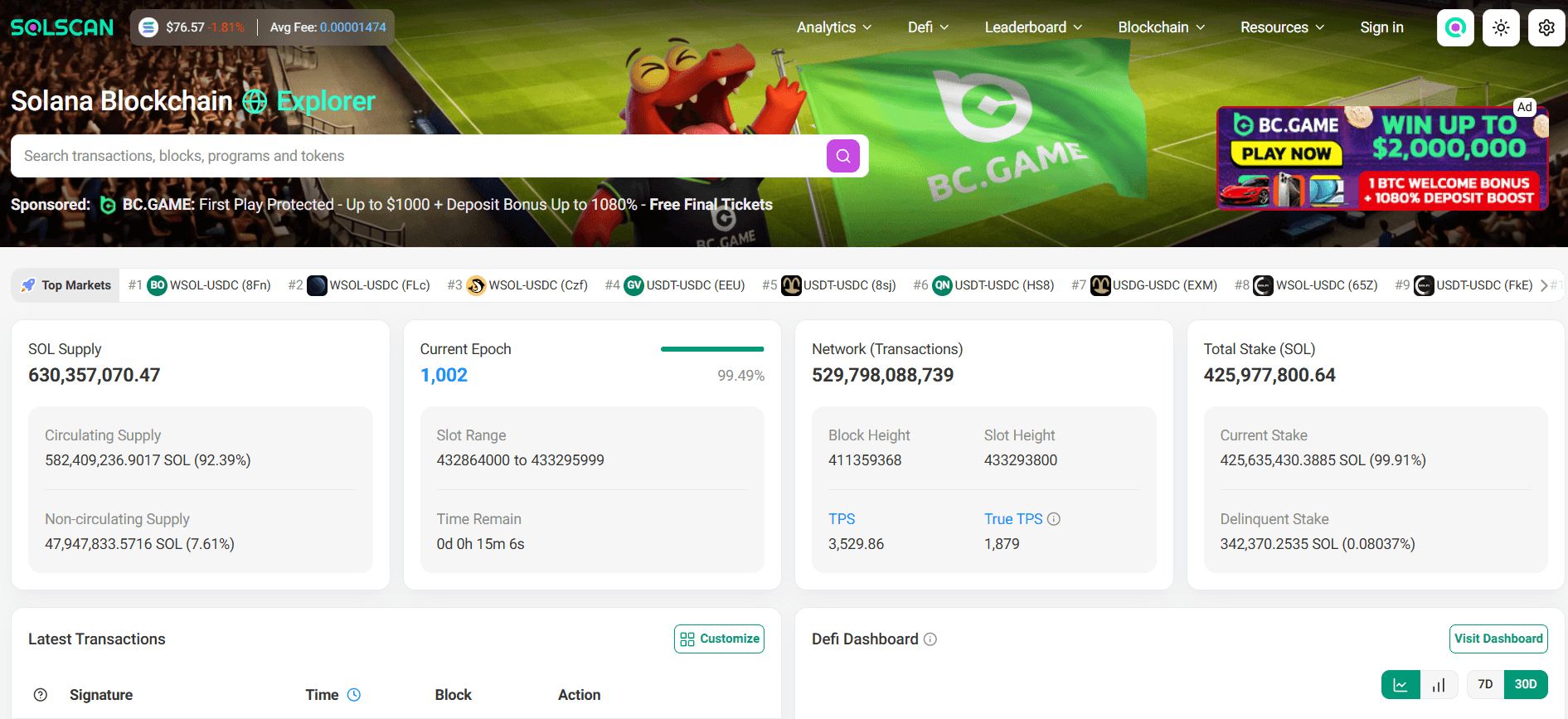
Solscan is where the market goes to check your claims. It exposes contracts, wallets, holder distributions, and transfer history to anyone, and alongside Solana Explorer and RugCheck it forms the free verification layer that makes on-chain trust possible at all.
The verification layer covers:
Contract, wallet, and transaction inspection for any observer.
Holder concentration and transfer history for supply analysis.
Risk heuristics through RugCheck for authority and liquidity red flags.
Solscan is genuinely the backbone of trust on Solana, and no proof link means anything without it. But an explorer is a read-only mirror: it reports what happened, it never prevents it, and by the time a suspicious transfer is visible on Solscan the damage is already permanent.
Streamflow is better because it works upstream of the explorer, producing the immutable lock and vesting contracts that Solscan then confirms, which turns verification from a forensic exercise into a preventative one.
Pros:
Free, universal verification available to every holder and investor.
Complete visibility into contracts, holders, and transfer history.
The reference surface that makes proof links credible.
Cons:
Read-only, so it reports outcomes rather than preventing them.
Raw data requires interpretation that most retail holders will not do.
No mechanism to lock, vest, schedule, or distribute anything.
7. Realms: DAO Governance and Treasury
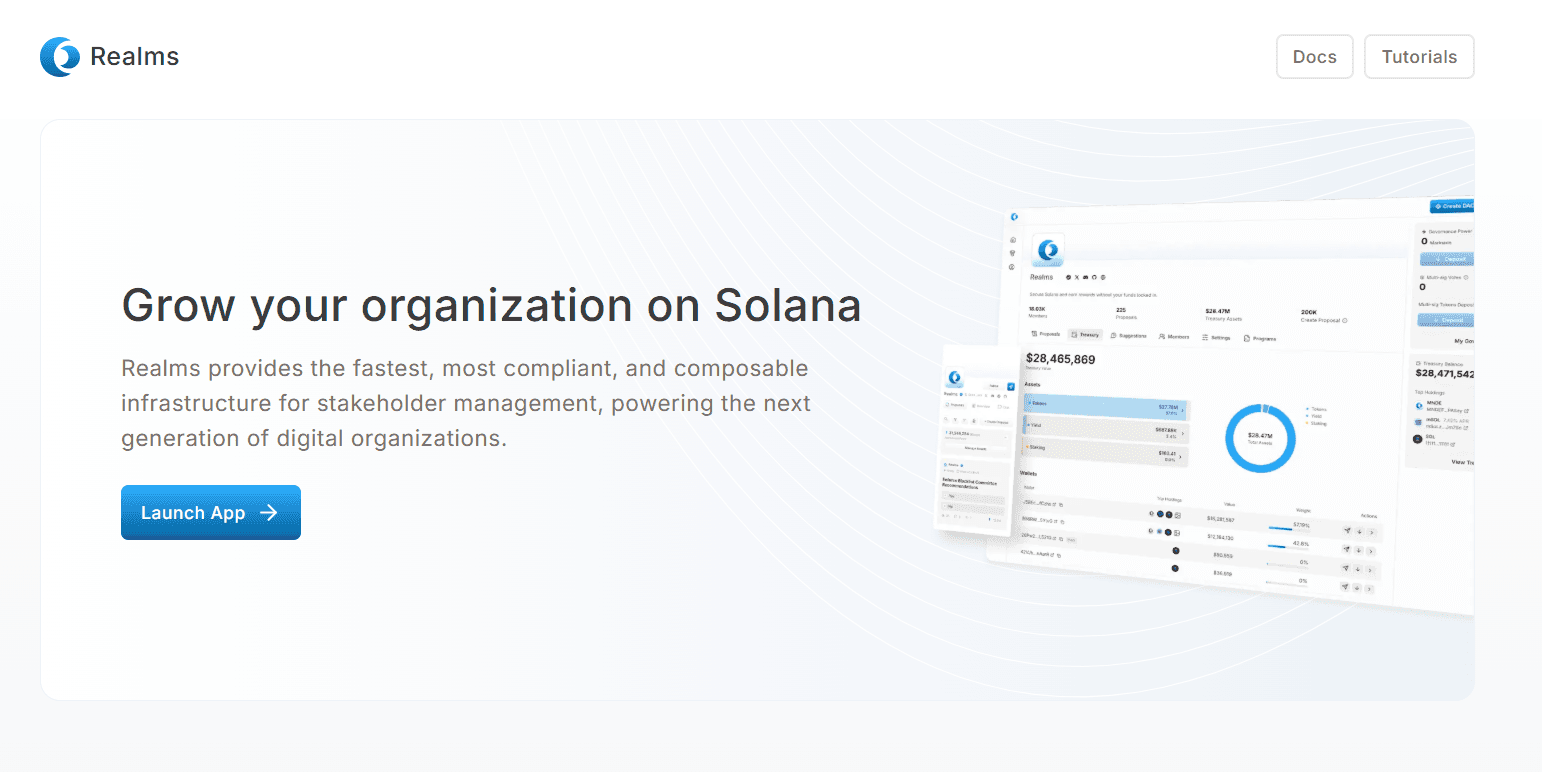
Realms is the standard interface for on-chain governance on Solana, handling proposals, voting, and multisig treasury management through SPL Governance. Teams that plan to decentralize decision-making almost always route treasury movements through it.
The governance layer provides:
Proposal creation and token-weighted voting for holders.
Multisig treasury custody and execution.
Plugin support for varied voting weight structures.
Realms deserves real credit for making decentralized treasury control workable rather than theoretical. The historical friction is that governance and token distribution lived in separate interfaces, forcing stakeholders to vote in one place and claim in another.
Streamflow is stronger here because its SDK closes that gap directly, which is exactly what UXD Protocol did with Streamflow by integrating vesting and claiming into Realms so approximately 46% of $UXP supply vested over four years with a 12-month cliff inside the same interface holders governed from.
Pros:
Established, widely used on-chain governance standard for Solana DAOs.
Multisig treasury control with transparent, on-chain proposal execution.
Flexible plugin system for different voting structures.
Cons:
Governance-focused, with no native vesting, locks, or airdrop tooling.
Requires integration work to unify claiming and voting experiences.
Proposal overhead can slow time-sensitive treasury operations.
8. Phantom: The Wallet and Last Mile
Phantom is where most Solana holders actually experience a token, alongside Solflare and Backpack. Its extension and mobile apps support the SPL standard natively, with built-in swapping and a UX that has done more for Solana onboarding than most protocols combined.
The wallet layer determines:
Whether recipients can find, hold, and understand your token.
Whether the claim flow completes or gets abandoned.
Whether users can distinguish your official interface from a phishing clone.
Phantom's contribution to Solana adoption is real and worth stating plainly. It is still a custody and display surface, though, and it takes no position on whether the token inside it is backed by locked supply or by nothing at all.
Streamflow is the better lever for founders because it controls what recipients receive and under what conditions, working with Phantom, Solflare, Backpack, and all Solana wallets while adding branded claim portals that keep the last mile inside your own brand rather than a generic interface.
Pros:
Dominant Solana wallet with strong mobile and extension experience.
Native SPL support, so tokens appear correctly with no extra work.
Familiar UX that reduces friction and abandonment during claims.
Cons:
Custody and display only, with no distribution or vesting logic.
Offers no signal about whether a token's supply is locked.
Phishing clones target wallet users during high-profile claim events.
Solana Launch Infrastructure: Comparison Table
Tool | Launch layer | On-chain supply enforcement | Distribution at scale | Where Streamflow is stronger |
Streamflow | Token operations | Yes, audited and immutable | Up to 1M recipients | Reference point for the stack |
Metaplex | Mint and metadata | No | No | Adds locks and vesting to the mint |
Pump.fun | Bonding curve launch | No | Curve audience only | Governs supply after graduation |
Raydium | Liquidity and AMM | No | No | Locks LP tokens with public proof |
Helius | RPC and indexing | No | Infrastructure only | Enforces rules, not just reports them |
Solscan | Verification | No, read-only | No | Creates the contracts Solscan confirms |
Realms | Governance and treasury | Treasury multisig only | No | Vesting and claiming inside governance |
Phantom | Wallet and custody | No | Claim endpoint only | Controls what and when users receive |
The pattern in that table is the whole argument. Seven of these tools are excellent at creating, pricing, storing, serving, or displaying a token, and exactly one of them decides whether the supply behind it can move.
How to Choose Your Solana Launch Stack
Assemble the stack in the order the launch actually happens, and refuse to skip the layers that create obligation.
Mint: define supply, handle authorities, configure metadata.
Lock: lock team allocations, treasury, and LP tokens before announcing anything.
Vest: put every insider allocation on a schedule with a cliff.
Distribute: run the airdrop through a platform with claim tracking and eligibility filtering.
Incentivize: deploy staking to reduce circulating supply and reward holders.
Verify: publish proof links and keep the tokenomics dashboard public.
Teams building past the launch into real financial operations should also look at Streamflow Business, which extends the same infrastructure into treasury management with USD+, payouts, on-chain cap tables, and tokenized SAFE agreements.
The stack question is not "which tools are popular." It is "which layers of my launch are enforceable by a contract rather than by my word."
Why Streamflow Is the Best Solana Infrastructure Tool for Token Launches
Every tool above is the best at something. Streamflow is the best at the thing that decides whether a token still exists in twelve months, which is whether the supply behind it is governed by a contract or by a group chat.
Four reasons it ranks first for a 2026 launch:
It is the only layer that makes team, treasury, and LP commitments enforceable on-chain.
It consolidates locks, vesting, airdrops, staking, mint, and payouts into one system.
It is audited by FYEO and OPCODES, immutable once deployed, with no admin override.
It is proven at 40,000+ projects, 1.3M+ users, and $290M+ in total value locked.
Bonk is the clearest proof of what that changes. The project allocated 55% of its supply to airdrops for early Solana users, a distribution aggressive enough that the team allocation became the obvious target of scrutiny, so rather than asking the community to trust a spreadsheet, Bonk used Streamflow for core team vesting.
The structure was concrete:
20% of total supply vested through Streamflow.
22 early contributors covered by the schedule.
3-year linear vesting, enforced on-chain.
The Bonk vesting case study shows the outcome: contributor incentives aligned over three years, with the release schedule publicly verifiable rather than asserted. For a memecoin launch, that transparency was not a compliance chore. It was the trust signal that let the community participate, and it is the same signal any 2026 launch can deploy in under a minute.
How to Get Started With Streamflow
The setup takes minutes, not sprints, and it happens through the UI with no smart contract development required.
Connect a Solana wallet such as Phantom, Solflare, or Backpack.
Lock team, treasury, or LP allocations. A lock takes 37 seconds to deploy.
Create vesting contracts, upload recipients by CSV, define the schedule, and fund the contract.
Launch the airdrop with eligibility filtering, a claim portal, and real-time claim tracking.
Deploy a staking pool for any SPL token with configurable APY and lock periods.
Publish the proof links and keep the tokenomics dashboard public.
Developers can skip the UI entirely and integrate the public SDK to embed vesting, distribution, and reward logic directly into a dApp, exactly as UXD Protocol did inside Realms. Teams that want the claim experience under their own brand can request a white-label portal instead of using a generic interface.
The sequencing matters more than the speed. Lock and vest before the announcement, because a commitment made after the first sell-off is a reaction, not a signal.
Conclusion
With 76% of new Solana tokens flagged as rug pulls in a single half-year study, the tools that prove commitment now matter more than the tools that create supply.
Streamflow sits at the center of that stack, turning locks, vesting, airdrops, and staking into audited on-chain contracts across 40,000+ projects and $290M+ in total value locked, while Solana's near-zero fees remove any cost argument for skipping them.
Book a demo to see how Streamflow handles locks, vesting, and large-scale distribution for a 2026 Solana token launch.
Read Next:
FAQs:
1. What are the best Solana infrastructure tools for token launches in 2026?
The best Solana infrastructure tools for token launches in 2026 span four layers: minting via Metaplex, liquidity via AMMs like Raydium, verification via Solscan and RugCheck, and token operations via Streamflow. Streamflow covers the layer that determines survival, handling locks, vesting, airdrops, staking, and distribution through audited on-chain smart contracts. Most launches assemble several of these rather than choosing one.
2. Do I need a token operations platform if I already used a launchpad?
Yes, you need a token operations platform even if you used a launchpad, because launchpads bootstrap price discovery and liquidity but do not lock supply, vest team allocations, or produce verifiable proof of commitment. Streamflow handles those layers after the bonding curve completes. The two tools solve different problems in the same launch.
3. How does Streamflow fit into a Solana launch stack?
Streamflow fits into a Solana launch stack as the token operations layer that sits between the mint and the market. It locks team and LP allocations, enforces vesting schedules with cliffs, runs airdrops to up to one million recipients, deploys staking pools, and publishes everything to a real-time tokenomics dashboard. Every contract is verifiable on Solscan and Solana Explorer.
4. Is Streamflow's smart contract code audited?
Yes, Streamflow's smart contracts are audited by FYEO and OPCODES, and contracts are immutable once deployed with no admin override. Every distribution is verifiable on Solscan and Solana Explorer through public proof links. That combination is what reduces manipulation, insider misuse, and rug-pull risk.
5. How much does it cost to lock and vest tokens on Solana?
Locking and vesting tokens on Solana costs a smart contract creation fee plus Solana transaction fees, which are near-zero compared to equivalent setups on Ethereum. That cost structure is why large-scale distribution to hundreds of thousands of recipients remains economically viable on Solana. It also means there is no meaningful cost argument for skipping locks or on-chain vesting.