General
Streamflow Business Features Explained: Vesting, Staking, Token Locks, Payouts, Airdrops, and White-Label Portals
Solana's real-world asset ecosystem reached a new all-time high of more than $3 billion in June 2026, according to the Solana Foundation's June 2026 Ecosystem Roundup.
Cumulative tokenized-stock volume on the network passed $10 billion in the same month.
Streamflow is the on-chain financial OS for Internet Capital Markets on Solana, with $645M+ in total value locked across 40,000+ projects.
Capital at that scale cannot run on spreadsheets and manual transfers. Companies building on Solana need ownership, compensation, incentives, and distribution to execute automatically and verifiably. Streamflow Business packages that infrastructure into one operating layer.
This article breaks down each of the Streamflow Business features, how they work, and where they fit in a company's financial operations.
Key Takeaways
Streamflow Business features cover vesting, staking, token locks, payouts, airdrops, and white-label portals on Solana.
Every Streamflow Business feature runs on audited, immutable smart contracts with no admin override.
Recurring payout contracts let finance teams pay contributors without redeploying contracts or processing manual transfers.
Streamflow supports airdrops to one million recipients and locks tokens in roughly 37 seconds.
Bonk and UXD Protocol used Streamflow to distribute major supply allocations through verifiable on-chain vesting.
What Streamflow Business Is and Why It Exists
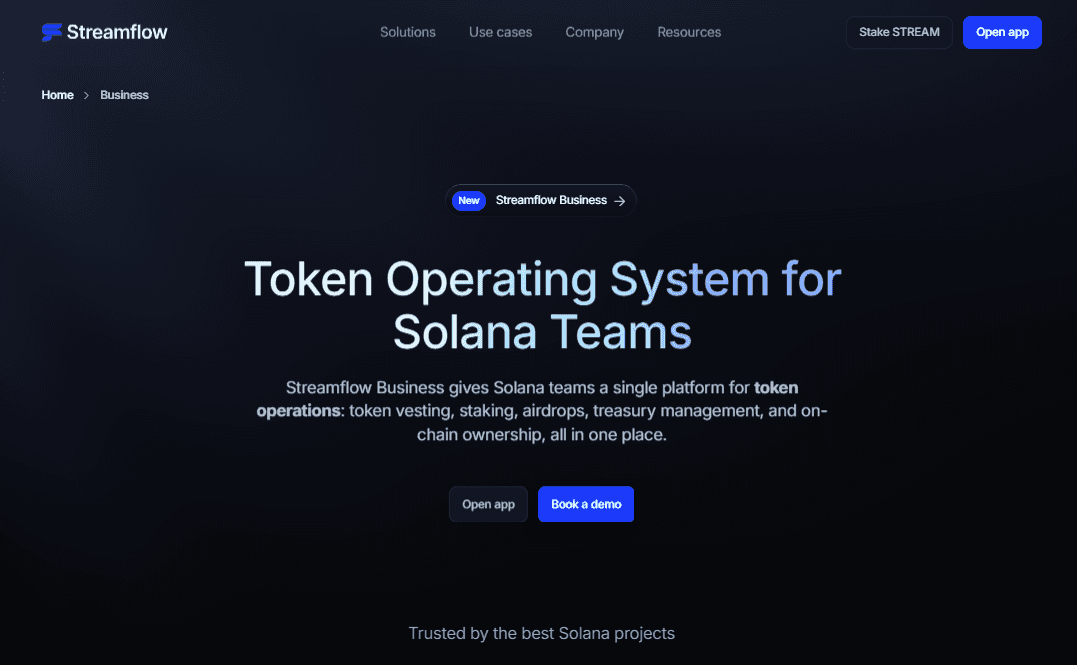
Streamflow Business is the Financial OS for Internet Capital Markets. It expands beyond token operations to provide a full financial operating system for companies building long-term value on Solana. The tagline states the intent: from vesting to ownership, build real companies, not just tokens.
The problem it solves is fragmentation. Most teams run vesting in one tool, payroll in another, airdrops through a script, and treasury in a multisig with a spreadsheet on top. Each handoff introduces manual errors, incorrect schedules, and a lack of transparency that erodes trust.
Streamflow Business replaces that stack with a single system:
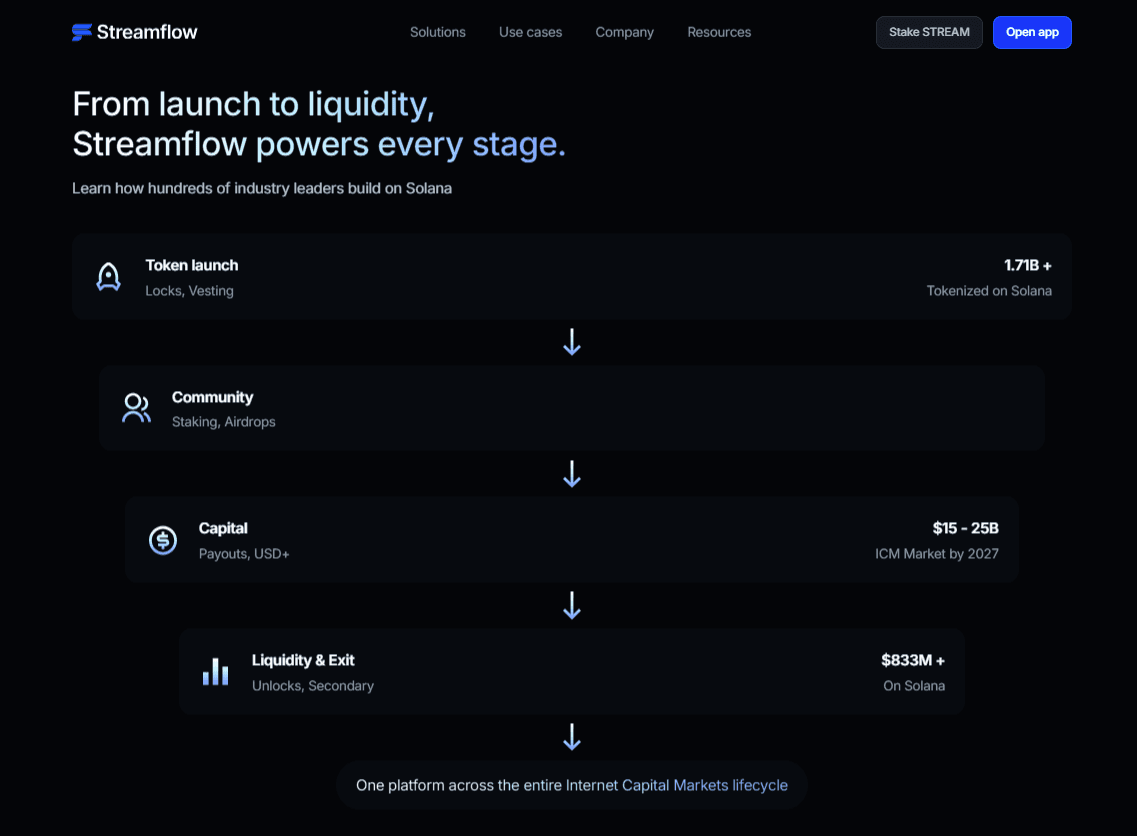
Locks, vesting schedules, and airdrops for token distribution
Payouts and treasury management through USD+
On-chain cap tables, tokenized SAFE agreements, and ownership issuance
Staking pools and white-label portals built on the same Streamflow infrastructure
Streamflow turns tokenomics from a plan into an automated, enforceable system. Streamflow Business extends that principle to the rest of the company's financial operations.
How Streamflow Business Features Work
Every feature follows the same logic. A team defines rules once, funds a smart contract, and the contract executes those rules on-chain without manual intervention.
The no-code path takes three steps:
Create contracts via the UI
Configure parameters
Deploy instantly
Developers get a second path. The Streamflow SDK supports custom contract logic, dApp integrations, and programmable flows, so custom payment flows, vesting schedules, and reward systems can be built on top of Streamflow.
Consider a Solana startup closing a round. The founder locks the team allocation, creates cliff plus linear vesting for investors, and sets up recurring payouts for contractors, all from one interface. Each contract is verifiable on Solscan or Solana Explorer, so investors check the chain instead of trusting a PDF.
The user flow for Business reflects this depth: the founder learns, books a call, and then uses Streamflow Business with guidance from the Streamflow team.
Key Capabilities and Configuration Options
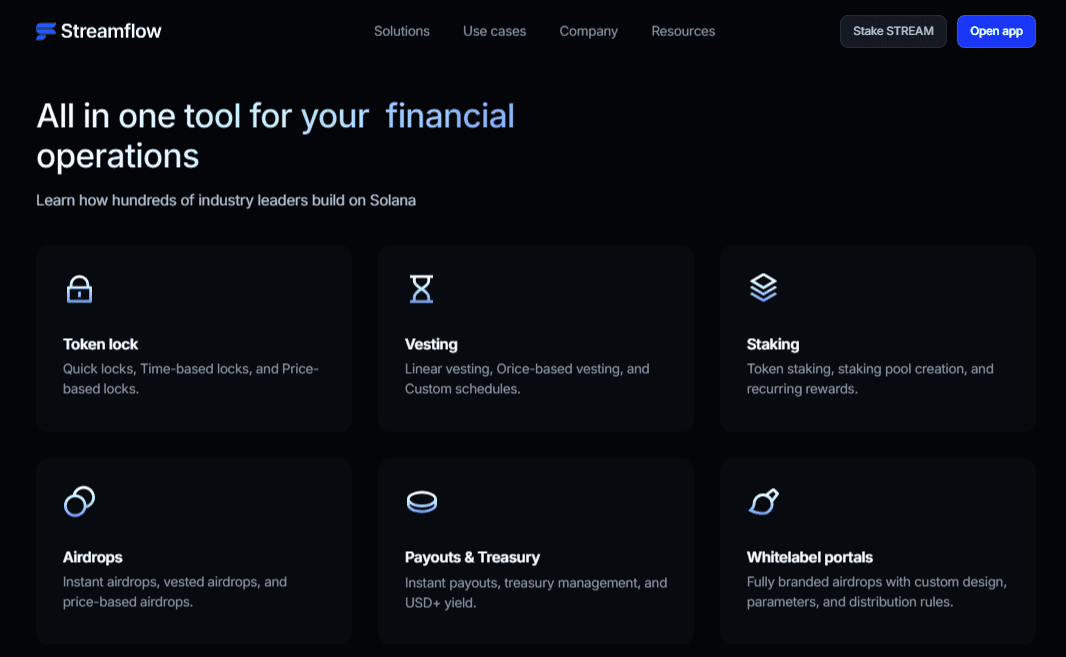
Six features do most of the work for operating teams. Each one maps to a specific financial job.
Token Vesting
Token vesting is the controlled release of tokens over time to prevent immediate selling and align long-term incentives. Streamflow's automated token vesting transforms schedules into enforceable on-chain contracts.
Supported models and tooling include:
Linear, cliff, cliff plus linear, and graded vesting
Milestone-based and price-based vesting with custom intervals
Bulk CSV creation, auto transfers, and vesting top-ups
Shareable proof links and a vesting tracker dashboard
A 12-month cliff is standard for founders and core team allocations. Once deployed, the schedule is immutable, which removes the risk of unilateral changes.
Token Locks
A token lock restricts tokens from being transferred, sold, or accessed until predefined conditions are met. Where vesting releases gradually, a lock has a single unlock event. Streamflow's transparent token locks turn that restriction into a public trust signal.
Fixed-date and price-based unlock conditions
SPL token and LP token support
Public proof links and dashboards
Verification on Solscan, Solana Explorer, and RugCheck
It takes 37 seconds to lock tokens on Streamflow. Near-zero Solana fees make locks dramatically more cost-efficient than equivalent setups on Ethereum.
Staking
Staking is the process of locking tokens to earn rewards and participate in protocol incentives. Streamflow lets teams deploy no-code staking pools for any SPL token without engineering overhead.
Configurable APY, lock periods, and reward logic
Pool types: Fund Once, Continuous Funding, Governance Staking, and Custom
Automated reward distribution and real-time staking data
Fully non-custodial, permissionless pools with a public SDK
One caveat matters for operators: if rewards run out, the pool stops distributing. Streamflow supports easy reward top-ups, and teams can launch a staking pool on Streamflow in minutes.
Payouts
Payouts are the feature CFOs and finance leads care about most. Streamflow supports recurring payout contracts for payroll-style payments to employees, contractors, and contributors.
Programmable payments and on-chain payroll in tokens
Recurring transfers on a defined schedule
Payroll-like token streams for real-time compensation
Continued funding over time without redeploying new contracts
This allows mass payout of contributors without manual processing. Paired with USD+ for treasury management, finance teams keep idle capital working while payouts run automatically.
Airdrops
Airdrops distribute tokens to a large group of users for growth, incentives, or community activation. Manual execution becomes unmanageable at scale, which is why Streamflow built a full airdrop launch platform.
Instant, vested, price-based, and white-label airdrops
Up to 1,000,000 recipients per campaign, with 100,000 per CSV
Claim portals, claim tracking, and real-time delivery status
Return of unclaimed tokens after the claim window
Standard plans cover up to 30,000 recipients, with an enterprise tier for larger campaigns. Vested airdrops and price-based conditions help avoid quick dumps and reward long-term participants.
White-Label Portals
White-label portals are a full product line, not a side note. Projects own their token experience while running on Streamflow infrastructure.
Custom token distribution portals and claim portals
Branded staking pages and custom staking portals
Lock dashboards and custom lock portals
Bespoke onboarding by the Streamflow team
A recipient claims tokens on the project's own branded interface, never leaving the brand environment. Teams that want this can get a custom branded portal with white-glove setup.
Together, these six features cover the full path from allocation to ongoing compensation and incentives.
Use Cases for Streamflow Business
Founder and Investor Alignment at Launch
A founder launching a token needs credible commitment on day one. Locking the team allocation and placing investors on cliff plus linear vesting gives the community on-chain proof instead of promises. Public proof links make that commitment shareable in seconds.
Contributor Payroll for DAOs and Distributed Teams
A DAO paying dozens of contributors monthly faces real operational drag. Recurring payout contracts automate those payments and keep funding them over time. Salaries, subscriptions, and services can be paid in real time using token streams.
Community Growth With Retention
A DeFi or GameFi team can pair a vested airdrop with a staking pool. The airdrop activates users, and staking reduces circulating supply and sell pressure while rewarding holders. Both run through a branded portal that keeps users inside the project's experience.
Ownership and Treasury Operations
Companies building for the long term need more than token tools. Streamflow Business adds on-chain cap tables, tokenized SAFE agreements, ownership issuance, and treasury management through USD+. That matters as more real-world value moves on-chain across Solana.
Each use case runs on the same contracts, which means one audit surface and one source of truth.
Case Study: Bonk and UXD Protocol
Bonk, the Solana meme coin, allocated 55% of supply to airdrops for early Solana users. The team used Streamflow for core team vesting, placing 20% of total supply across 22 early contributors on a 3-year linear schedule. The Bonk vesting case study shows the outcome: trust and transparency for the community.
UXD Protocol, a decentralized stablecoin provider on Solana, needed vesting and governance in one interface. The team integrated the Streamflow SDK into Realms and launched a claim portal for stakeholders. Approximately 46% of $UXP supply was distributed through Streamflow on 4-year linear vesting with a 12-month cliff.
The result for UXD was governance participation and token claiming in the same interface. As detailed in how UXD used Streamflow, the SDK made a custom flow possible without building vesting contracts from scratch.
Both projects prove the same point. Large allocations stay credible when the schedule is enforced on-chain rather than promised off-chain.
Security and Transparency
Financial infrastructure is only as strong as its contracts. Streamflow's security model is consistent across every feature:
Audited smart contracts, reviewed by FYEO and OPCODES
Open-source contracts
Immutable once deployed, with no admin override
On-chain verification through Solscan and Solana Explorer
Public proof links for any lock or vesting contract
This design reduces manipulation, insider misuse, rug-pull risk, and governance abuse. Contracts continue to enforce schedules regardless of front-end availability.
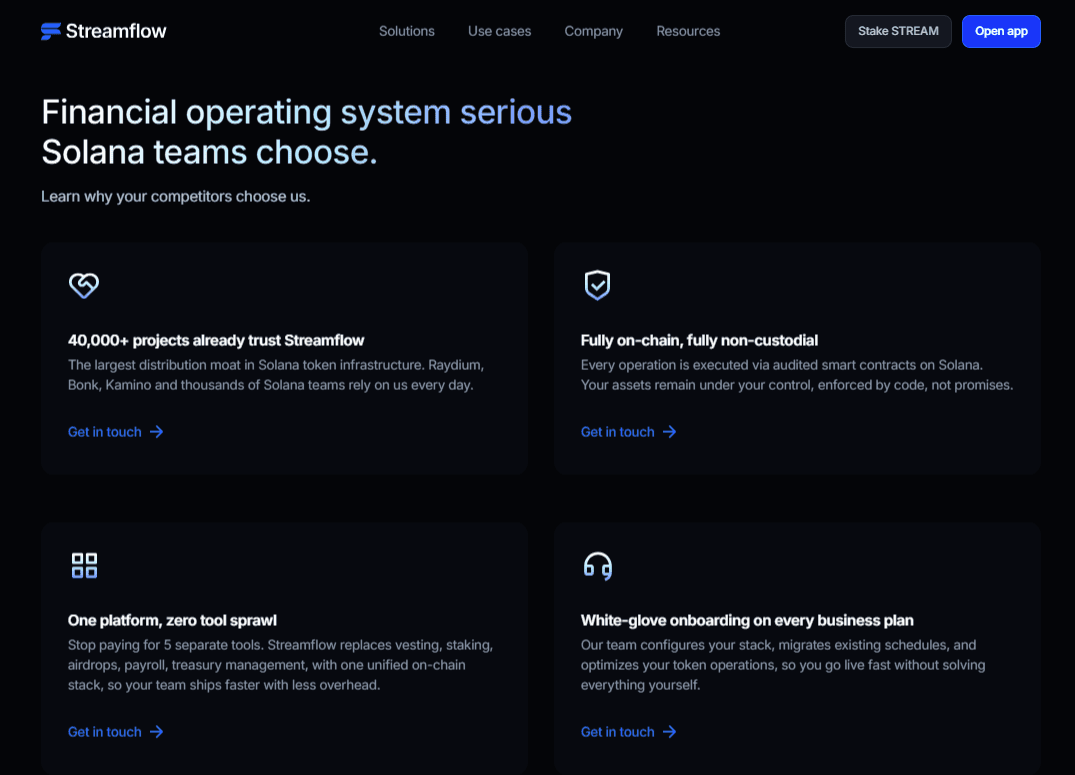
Teams that ask whether to build this in-house face high engineering and audit costs. Streamflow's contracts are battle-tested across 40,000+ projects, which is a level of production exposure no new custom build can match.
Getting Started With Streamflow Business
Teams with a simple need can start immediately. Connect Phantom, Solflare, Backpack, or any Solana wallet, configure a contract, and deploy. A token lock takes about 37 seconds from start to finish.
Teams evaluating the full Business stack should start with a call. The Streamflow team scopes cap tables, tokenized SAFEs, payouts, and branded portals around the company's structure. Costs consist of smart contract creation fees plus Solana transaction fees, which stay low thanks to near-zero network fees.
For everything else, open the Streamflow app and test a single contract first. Streamflow is designed for both small teams and large ecosystems, so the starting point scales with the company.
Conclusion
More than $3 billion in real-world assets now sits on Solana, and the companies behind that value need financial operations that execute on-chain.
Streamflow Business features cover that full scope: vesting, staking, token locks, payouts, airdrops, and white-label portals, all on audited and immutable contracts.
With $645M+ in total value locked and 1.3M+ users, Streamflow operates at infrastructure scale, not experimental scale.
Book a demo to see how Streamflow handles vesting, payouts, and branded distribution for your company in one system.
Read Next:
Streamflow vs Team Finance vs StakePoint: Best Token Lock Platform Compared (2026)
Best Token Vesting Platforms Compared: Streamflow vs Sablier vs Hedgey vs Magna
How Long Should You Lock Team Tokens? Industry Benchmarks for 2026
FAQs:
1. What features does Streamflow Business include?
Streamflow Business includes locks, vesting schedules, airdrops, payouts, treasury management through USD+, on-chain cap tables, tokenized SAFE agreements, ownership issuance, and a marketplace. Teams also use Streamflow's staking pools and white-label portals on the same infrastructure. Every feature executes through audited on-chain smart contracts on Solana.
2. How is Streamflow Business different from the standard Streamflow product?
Streamflow Business is different from the standard Streamflow product because it extends beyond token launch trust signals into full financial operations. The standard offering centers on token locks and vesting for token creators. Streamflow Business adds payouts, treasury management, cap tables, tokenized SAFEs, and ownership issuance for companies building long-term value on Solana.
3. Can Streamflow be used for payroll and recurring contributor payouts?
Yes, Streamflow can be used for payroll and recurring contributor payouts. It supports recurring payout contracts for payroll-style payments to employees, contractors, and contributors. Teams can continue funding these contracts over time without redeploying new ones.
4. How many recipients can a Streamflow airdrop support?
A Streamflow airdrop can support up to 1,000,000 recipients per campaign, with 100,000 recipients per CSV file. Standard plans cover up to 30,000 recipients, and an enterprise tier handles larger campaigns. Airdrops can be instant, vested, price-based, or delivered through a white-label claim portal.
5. Are Streamflow Business smart contracts audited and secure?
Yes, Streamflow smart contracts are audited and secure, with audits completed by FYEO and OPCODES. Contracts are immutable once deployed and have no admin override. Every distribution is verifiable on Solscan or Solana Explorer.