General
Token Minting on Solana: Top 30 Questions Answered
Solana launchpads collectively minted 11.6 million tokens in 2025, more than double the prior year, according to Solana's 2025 network report, yet only about 0.89% of them progressed beyond a bonding-curve launch.
That gap between how easy it is to mint a token and how hard it is to build one that lasts is exactly where Streamflow operates, the Solana-native token operations infrastructure that manages the full lifecycle from creation to distribution across more than 40,000 projects.
Minting is the first 60 seconds; everything that earns trust happens after.
Anyone can create a Solana token in minutes now. The harder questions are what supply to set, whether to revoke mint authority, how to lock team allocations, and how to distribute fairly without a rug-pull reputation.
This guide answers the 30 questions founders, memecoin creators, and Web3 developers actually search for before and after minting.
Key Takeaways
Token minting on Solana is fast and cheap, but token structure decides survival.
Streamflow manages the full token lifecycle, from minting to locks, vesting, and distribution.
Roughly 11.6M tokens were minted on Solana in 2025, yet under 1% survived.
Revoking mint authority and locking team tokens are the strongest post-mint trust signals.
Over 40,000 projects use Streamflow for token operations after minting on Solana.
Token Minting Basics on Solana
1. What is token minting on Solana?
Token minting on Solana is the process of creating a new token on the Solana blockchain by deploying a token mint account under the SPL Token Standard. Minting defines the token's supply, decimals, and metadata, and produces an on-chain asset that can then be distributed, locked, or traded. It is the first step in a token's lifecycle, before distribution and incentives.
2. How do you mint a token on Solana?
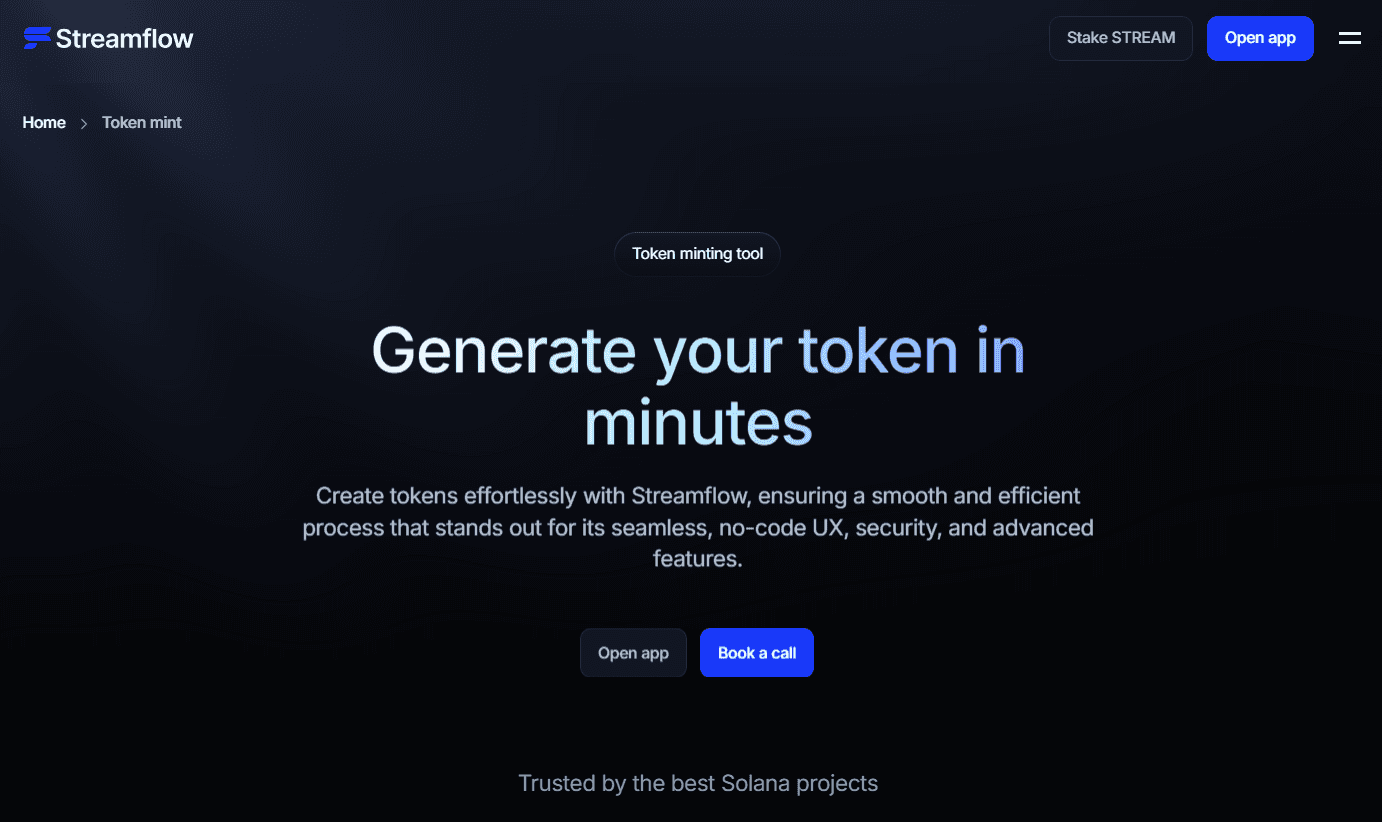
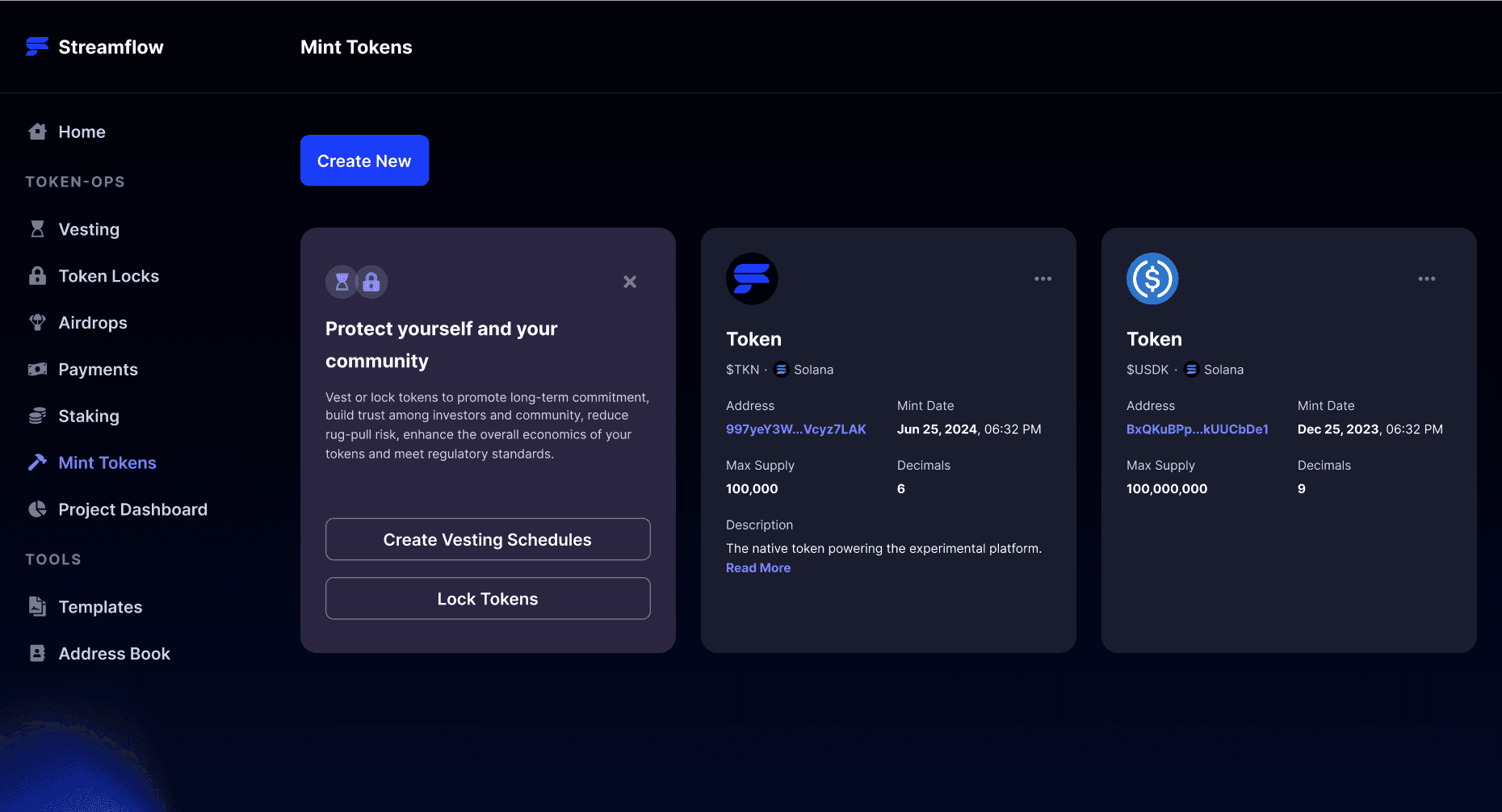
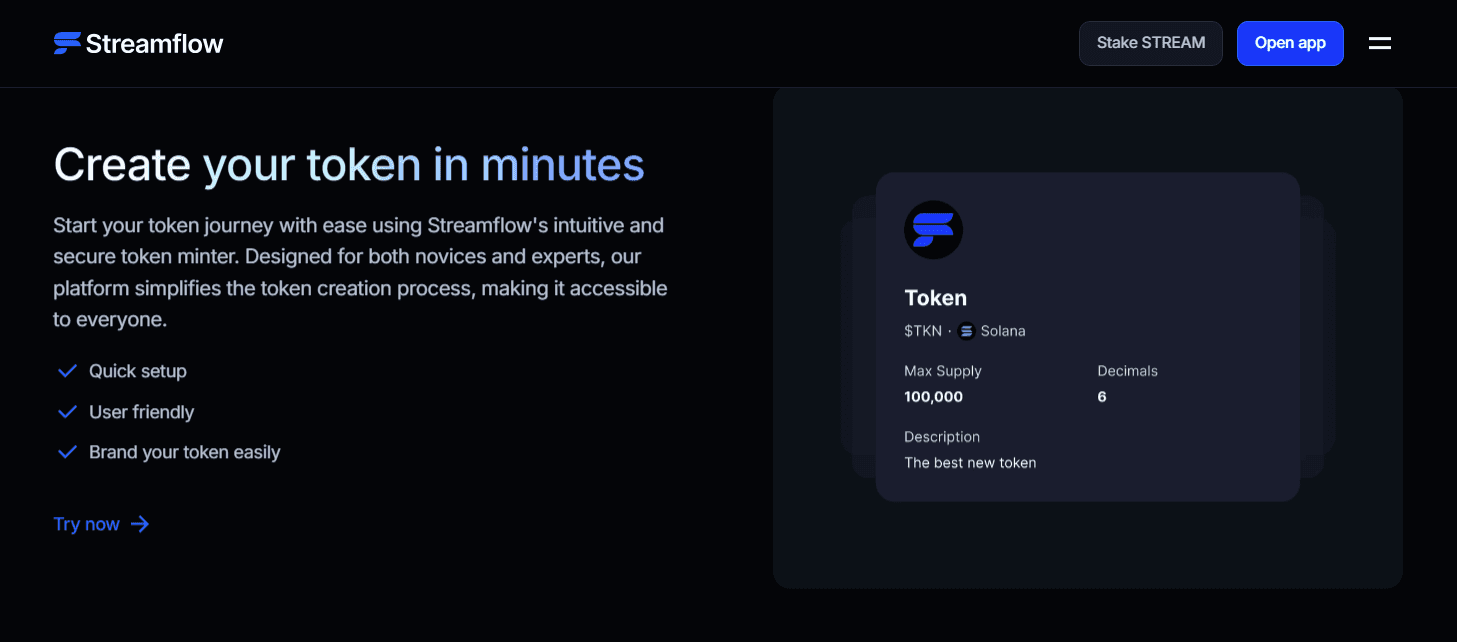
To mint a token on Solana, you create an SPL mint account, set the supply and decimals, attach metadata such as name and logo, and configure permissions like mint and freeze authority. You can do this through code, the Solana CLI, or a no-code interface. Streamflow lets teams create a Solana token and manage everything after it in the same place.
3. Do you need to know how to code to mint a Solana token?
No, you do not need to know how to code to mint a Solana token. No-code tools handle the mint account, supply, and metadata configuration for you, so the technical steps happen behind a simple interface. Developers who want custom logic can still mint programmatically using the Solana SDK.
4. What is the SPL Token Standard?
The SPL Token Standard is Solana's native specification for fungible and non-fungible tokens, equivalent in role to Ethereum's ERC-20. Almost every token minted on Solana is an SPL token, which is why platforms built on the standard are interoperable across wallets and dApps. Streamflow works with any SPL token, so a token minted anywhere can still be locked, vested, or distributed through it.
5. What is the difference between minting a token and launching a token?
Minting a token creates the on-chain asset, while launching a token is the broader process of distributing it, adding liquidity, and building a market around it. Minting takes seconds; launching involves supply strategy, locks, vesting, and airdrops. A token can exist the moment it is minted, but it only becomes a project once it is structured and distributed.
6. Can I mint a token on Solana without using a launchpad like Pump.fun?
Yes, you can mint a token on Solana without using a launchpad like Pump.fun. Launchpads optimize for instant tradability and bonding curves, which suits memecoins, but they give you limited control over supply structure, vesting, and locks. Teams building for the long term often mint independently and then use dedicated infrastructure to manage distribution and trust.
Costs, Speed, and Requirements
7. How much does it cost to mint a token on Solana?
Minting a token on Solana typically costs a fraction of a dollar, since Solana operates with near-zero transaction fees and low account rent. The main cost is the small amount of SOL needed to create and fund the mint account and pay network fees. This is dramatically cheaper than minting on Ethereum, where gas can run into hundreds of dollars.
8. How long does it take to mint a token on Solana?
Minting a token on Solana takes seconds, thanks to the network's sub-second finality and throughput of over 65,000 transactions per second. The mint account is confirmed almost immediately, and metadata can be attached in the same flow. The time-consuming part is never the minting, it is deciding the tokenomics around it.
9. What do I need to mint a token on Solana?
To mint a token on Solana, you need a Solana wallet such as Phantom, Solflare, or Backpack, a small amount of SOL for fees, and the token details like name, symbol, supply, and decimals. A logo and description are optional but recommended for legitimacy. That is the entire requirement list; no coding is mandatory with a no-code minter.
10. Why is Solana cheaper for minting tokens than Ethereum?
Solana is cheaper for minting tokens than Ethereum because its architecture delivers high throughput and sub-second finality at near-zero fees, avoiding the gas auctions that make Ethereum expensive. This is why the vast majority of new tokens launch on Solana token operations infrastructure rather than higher-cost chains. Low fees also make large-scale distribution economically viable after minting.
11. How much SOL do I need to create a token?
You need only a small amount of SOL to create a token, usually well under one SOL to cover account rent and transaction fees. Budget a little extra if you plan to immediately fund distribution, locks, or liquidity. The mint itself is one of the cheapest operations you will perform on Solana.
12. Can I mint a token on Solana for free?
You cannot mint a token on Solana entirely for free, because every on-chain action requires a minimal SOL fee, but the cost is negligible, often cents. Some tools advertise free minting while charging on distribution or trading instead. The realistic expectation is near-zero, not zero.
Supply, Metadata, and Configuration
13. How do I set the total supply of my Solana token?
You set the total supply of your Solana token during minting by specifying the number of tokens to create in the mint account. Supply is fixed only if you revoke the mint authority afterward; otherwise more can be minted later. Deciding supply upfront is a tokenomics decision, and it should align with your vesting, airdrop, and liquidity plans.
14. What is token metadata and why does it matter?
Token metadata is the descriptive information attached to your token, including its name, symbol, logo, and description, stored on-chain. It matters because wallets, explorers, and exchanges use metadata to display your token, and missing metadata makes a token look untrustworthy. Configuring metadata properly at mint time is a basic legitimacy signal.
15. Can I add a logo and description to my Solana token?
Yes, you can add a logo and description to your Solana token by attaching them as part of the token's metadata during or after minting. A clear logo and description improve how your token appears in wallets like Phantom and on explorers like Solscan. Streamflow's token minter includes metadata configuration as part of the creation flow.
16. How many decimals should a Solana token have?
A Solana token should typically have between six and nine decimals, with nine being the most common default for fungible tokens. More decimals allow smaller fractional transfers, which matters for tokens with large supplies or low unit prices. Set decimals carefully at mint time, because they cannot be changed afterward.
17. Can I mint more tokens after the initial supply is created?
Yes, you can mint more tokens after the initial supply if you retain the mint authority on the token. Once you revoke the mint authority, the supply becomes permanently fixed and no new tokens can ever be created. Many projects keep the authority temporarily for controlled emissions, then revoke it to prove supply is capped.
18. What is the mint authority on a Solana token?
The mint authority on a Solana token is the address permitted to create new units of that token. Whoever holds the mint authority can increase supply, which is why investors scrutinize whether it has been revoked. Managing this permission is a core part of the configuration step when you mint a Solana token.
Security, Trust, and Authorities
19. How do I make my Solana token safe for investors?
You make your Solana token safe for investors by revoking unnecessary authorities, locking team and treasury allocations, setting transparent vesting, and using audited infrastructure. Trust comes from verifiable on-chain proof, not promises. Streamflow's contracts are audited by FYEO and OPCODES and are immutable once deployed, so commitments cannot be quietly changed.
20. Should I revoke the mint authority after creating my token?
Yes, in most cases you should revoke the mint authority after creating your token, because it guarantees the supply can never be inflated. Revoking mint authority is one of the strongest trust signals for a fixed-supply token. Keep it only if your tokenomics genuinely require future controlled emissions.
21. What is freeze authority and should I disable it?
Freeze authority is the permission to freeze token accounts, preventing holders from transferring their tokens. Most projects disable freeze authority because holding it lets a team lock user balances, which investors view as a serious risk. Disabling it, like revoking mint authority, is a standard legitimacy step after minting.
22. How do investors verify a Solana token is legitimate?
Investors verify a Solana token is legitimate by checking on-chain data on explorers like Solscan and Solana Explorer, tools like RugCheck, and by confirming authorities are revoked and allocations are locked. A public real-time token distribution dashboard makes this verification effortless. Transparency that anyone can independently confirm is what separates credible tokens from scams.
23. How do I prove my team's tokens are locked after minting?
You prove your team's tokens are locked after minting by placing them in an on-chain lock with publicly verifiable conditions. Locked tokens cannot be transferred, traded, or accessed until the unlock criteria are met, and Streamflow generates public proof links for exactly this. Using transparent token locks on Solana turns a promise into verifiable, on-chain commitment.
24. What is a rug pull and how does token structure prevent it?
A rug pull is when a team abandons a project and dumps or drains its token, leaving holders with worthless assets. Token structure prevents rug pulls by revoking mint and freeze authorities, locking team supply, and vesting allocations over time so no one can exit instantly. Immutable smart contracts enforce these conditions without any admin override.
From Minting to Distribution: The Full Token Lifecycle
25. What should I do after minting my token on Solana?
After minting your token on Solana, you should revoke unnecessary authorities, lock team and treasury allocations, set vesting schedules, add liquidity, and plan distribution. Minting is step one of a lifecycle, not the finish line. Streamflow exists to manage every step after the mint, from locks to vesting to airdrops, in one place.
26. How do I set up vesting for my team after minting a token?
You set up vesting for your team after minting a token by creating on-chain vesting contracts that release allocations gradually over time. Bonk, a Solana meme coin, used Streamflow to vest 20% of its supply for 22 core contributors on a 3-year linear schedule. You can build the same structure with no code using automated token vesting on Solana.
27. How do I distribute a newly minted token to my community?
You distribute a newly minted token to your community through airdrops, claim portals, or scheduled transfers. Streamflow supports Solana airdrops to up to one million recipients, with instant, vested, or conditional distribution and real-time claim tracking. This lets you reward early users at scale without manual transfers or spreadsheets.
28. Can I mint a token and set up staking rewards for holders?
Yes, you can mint a token and then set up staking rewards for holders to reduce sell pressure and drive engagement. Any SPL token can be staked, and Streamflow lets teams deploy no-code staking pools on Solana with configurable APY, lock periods, and automated reward distribution. Staking gives a freshly minted token real utility beyond speculation.
29. What is the best platform to manage a Solana token after minting?
The best platform to manage a Solana token after minting is one that handles the entire lifecycle, not a single function. Streamflow covers minting, locks, vesting, airdrops, staking, and payments through audited on-chain contracts, which is why over 40,000 projects and more than $329M in value rely on it. Managing everything in one system avoids fragmented tooling and manual errors.
30. How does Streamflow help with token minting and management on Solana?
Streamflow helps with token minting and management on Solana by enabling full token lifecycle management, from creation and metadata configuration to locks, vesting, distribution, staking, and payments. You can mint a token and then structure it for trust and longevity without writing a single smart contract. Open the Streamflow app to mint, lock, vest, and distribute your token in one connected system.
Conclusion
Minting a token on Solana takes seconds and costs cents, but the 99% that fail are the ones that stop there.
The tokens that survive are minted with intent, then locked, vested, and distributed transparently on infrastructure that investors can verify on-chain.
Streamflow turns that entire lifecycle, from the first mint to full token operations, into an automated, auditable system across 40,000+ projects.
Book a demo to see how Streamflow handles token minting and everything that comes after it on Solana.
Read Next: