General
5 Best Use Cases of the Streamflow App for Solana Teams
Solana users launched roughly 11.6 million tokens through launchpads in 2025, more than double the previous year's count, according to CryptoSlate data published in January 2026.
The overwhelming majority of those tokens never build the operational scaffolding that separates a launch from a lasting project.
Streamflow closes that gap as the Solana-native token operations platform trusted by more than 40,000 projects and 1.3 million users to automate distribution, locks, vesting, staking, and payments on-chain.
For Solana teams, the hard part is rarely minting the token. It's everything that comes after: proving commitment, releasing supply responsibly, distributing to thousands of wallets, and paying contributors without redeploying contracts every month. Each of those jobs is where manual processes break and trust erodes.
This article breaks down the highest-impact ways Solana teams use the Streamflow app, the criteria that separate a real use case from a nice-to-have, and a proven example of each in production.
Key Takeaways
Streamflow gives Solana teams one app for vesting, locks, airdrops, staking, and payments.
Token locks and vesting on Streamflow create verifiable, on-chain trust signals for investors.
Streamflow airdrops scale to one million recipients with real-time claim tracking.
Over 40,000 projects use Streamflow for automated, transparent token distribution on Solana.
Revenue-backed STREAM staking rewards holders without the dilution of inflationary emissions.
The Criteria for a High-Impact Streamflow Use Case
Not every feature deserves a place in a team's core workflow. The use cases below were selected against four criteria that matter to Solana operators managing real token economies.
Trust impact: Does it produce on-chain proof that a community or investor can independently verify on Solscan or Solana Explorer?
Scale: Does it hold up at thousands or millions of recipients, where manual transfers collapse?
Automation: Does it remove recurring manual work, or does it just move the spreadsheet on-chain?
Cost efficiency: Does it exploit Solana's sub-second finality and near-zero fees to stay economical at volume?
Each use case that follows clears all four. The order roughly tracks the lifecycle of a token, from the trust signals you set at launch to the ongoing operations that keep a project running.
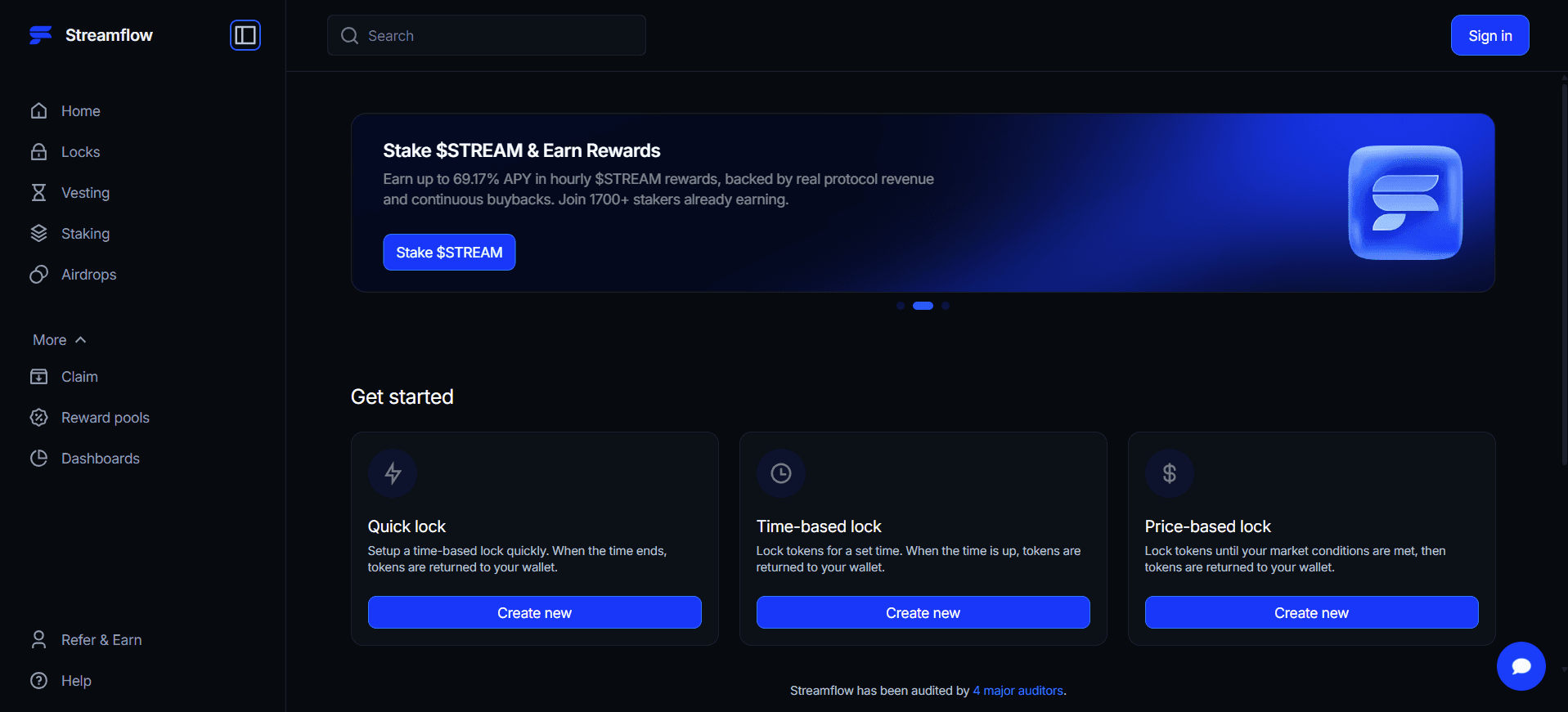
The 5 Best Streamflow App Use Cases for Solana Teams
These five use cases represent where Streamflow delivers the most value across a token's lifecycle. Each maps to a specific job a Solana team has to execute, and each replaces a manual process that breaks at scale.
1. Locking Tokens to Signal Commitment at Launch
Token locks are the first trust signal most Solana teams need, and the easiest to get wrong. A token lock platform restricts tokens from being transferred, traded, or accessed until predefined conditions are met, whether that's a fixed date or a price threshold.
Locked tokens cannot be moved prematurely, and the lock is publicly verifiable.
For a Solana team, this converts a promise into enforceable, on-chain proof. Instead of telling a community the team allocation is safe, the team points to an immutable contract anyone can inspect.
Fixed-date and price-based unlock conditions with automatic release.
Support for SPL tokens and LP tokens, covering team, treasury, and liquidity allocations.
Public proof links and dashboards for verification on Solscan, Solana Explorer, or RugCheck.
The setup is fast enough to remove any excuse for skipping it: locking tokens on Streamflow takes about 37 seconds through the no-code interface.
For teams launching from a Pump.fun-style pipeline, that speed matters, because a visible lock is what separates a serious project from the millions of tokens that vanish.
2. Vesting Team and Investor Allocations Over Time
Once tokens are locked at launch, the next job is releasing them responsibly. Automated token vesting is the controlled release of tokens over time, and Streamflow enforces every schedule through immutable smart contracts rather than manual monthly transfers.
The difference matters because vesting is where insider misuse and human error most often creep in. When the schedule lives in a contract that no one can unilaterally change, investors and contributors get predictability, and the team gets protection from its own mistakes.
Linear, cliff, cliff-plus-linear, graded, milestone-based, and price-based schedules.
Standard 12-month cliff language for founders and core team allocations.
Bulk CSV import, shareable proof links, and a vesting tracker dashboard.
Bonk, the Solana meme coin, shows this in production. The team used Streamflow to vest 20% of total supply across 22 early contributors on a 3-year linear schedule. That structure gave the community transparent proof that core contributors were aligned for the long term, not positioned to dump.
3. Running Airdrops at Scale Without the Chaos
Airdrops are the primary growth lever for Solana teams, and the hardest to execute manually past a few hundred wallets. Streamflow's airdrop launch platform turns a one-time distribution into a structured, trackable campaign that scales to where the audience actually is.
The platform supports airdrops to up to one million recipients, with CSV imports of 100,000 recipients per file. Standard plans handle up to 30,000 recipients per airdrop, and enterprise handles larger campaigns. That range covers everything from a targeted community reward to a global token launch.
Instant, vested, or price-based airdrop structures depending on the growth goal.
Claim portals with real-time delivery status and claim tracking.
Unclaimed token recovery and eligibility filtering to control the distribution.
An airdrop checker also lets recipients verify eligibility, which cuts down on the phishing confusion that follows big Solana distributions. The result is a distribution mechanism that grows the community without drowning the team in operational overhead.
4. Deploying Staking to Reduce Sell Pressure
After distribution, teams need a reason for holders to keep their tokens. No-code staking pools let Solana teams deploy staking systems in minutes, with any SPL token, without building custom infrastructure.
Staking is a lever for supply and engagement at once. By locking tokens for rewards, teams reduce circulating supply, cut sell pressure, and give holders a reason to stay involved in governance and community.
Configurable APY, lock periods, and custom reward logic.
Pool types including Fund Once, Continuous Funding, Governance Staking, and Custom.
Automated reward distribution with support for Phantom, Backpack, and Solflare.
There's also a distinct, more advanced model worth knowing. STREAM staking is revenue-backed rather than inflationary, distributing hourly rewards from protocol revenue and buybacks instead of newly minted tokens.
That design rewards holders with sustainable yield and zero dilution, a model teams increasingly want to replicate as emissions-based staking loses credibility.
5. Automating Contributor and Payroll Payments
The final core use case is the one that keeps a project running after launch. Streamflow supports programmable token payments through recurring payout contracts that fund payroll-style payments to employees, contractors, and contributors.
For a Web3 CFO or DAO treasury manager, this replaces manual monthly transfers with contracts that continue funding over time without redeployment. Salaries, subscriptions, and services can be paid in real time using token streams that align with actual usage or milestones.
Recurring transfers and contributor payouts from a single funded contract.
On-chain payroll in tokens, with metadata accessible for accounting.
Milestone-based unlocks for fundraising, grants, and structured payouts.
Teams building toward long-term financial operations often graduate into Streamflow Business, the financial OS for Internet Capital Markets that extends payments into treasury management, cap tables, and ownership issuance on Solana. Payments are where token operations stop being a launch task and become genuine company infrastructure.
Beyond the Core Five: Branded Portals for Solana Teams
The five use cases above run on Streamflow's standard app, but teams that want to own their user experience have another option. White-label portals let a Solana team launch fully branded token distribution, staking, and claim interfaces built on the same proven infrastructure.
Instead of sending users to a generic app, projects can present a claim portal, staking dashboard, or lock page under their own brand. This matters for teams where the token experience is part of the product, not a back-office task.
Custom-branded claim, staking, and lock portals with full UI control.
Bespoke onboarding handled by the Streamflow team.
The same audited, on-chain infrastructure behind every branded surface.
For projects that treat their community touchpoints as brand assets, this is the difference between looking like infrastructure and looking like a polished product.
Teams can request a branded Streamflow portal to launch on their own domain and design.
Security and Transparency Behind Every Use Case
None of these use cases matter if the underlying contracts can't be trusted. Every function on Streamflow runs on audited smart contracts, audited by FYEO and OPCODES, and every contract is immutable once deployed.
That immutability is the point. A team cannot quietly alter a vesting schedule, unlock tokens early, or override a lock, which removes exactly the kind of insider control that erodes community trust.
Audited contracts with no admin override on locks and vesting.
On-chain verification through Solscan and Solana Explorer.
Public proof links that any investor or community member can inspect.
Streamflow is also listed in the official Solana Docs under token vesting, positioning it as a trusted core tool in the ecosystem. For Solana teams, that combination of audits, immutability, and public verification is what turns each use case from a claim into provable fact.
How to Choose Which Use Cases to Prioritize
Most Solana teams don't need all of these on day one. The right sequence depends on where the project is in its lifecycle.
Pre-launch and launch: Start with token locks and vesting to establish trust and protect allocations.
Growth phase: Layer in airdrops to expand the community and staking to retain holders.
Operating phase: Automate contributor payments and, where the brand matters, add branded portals.
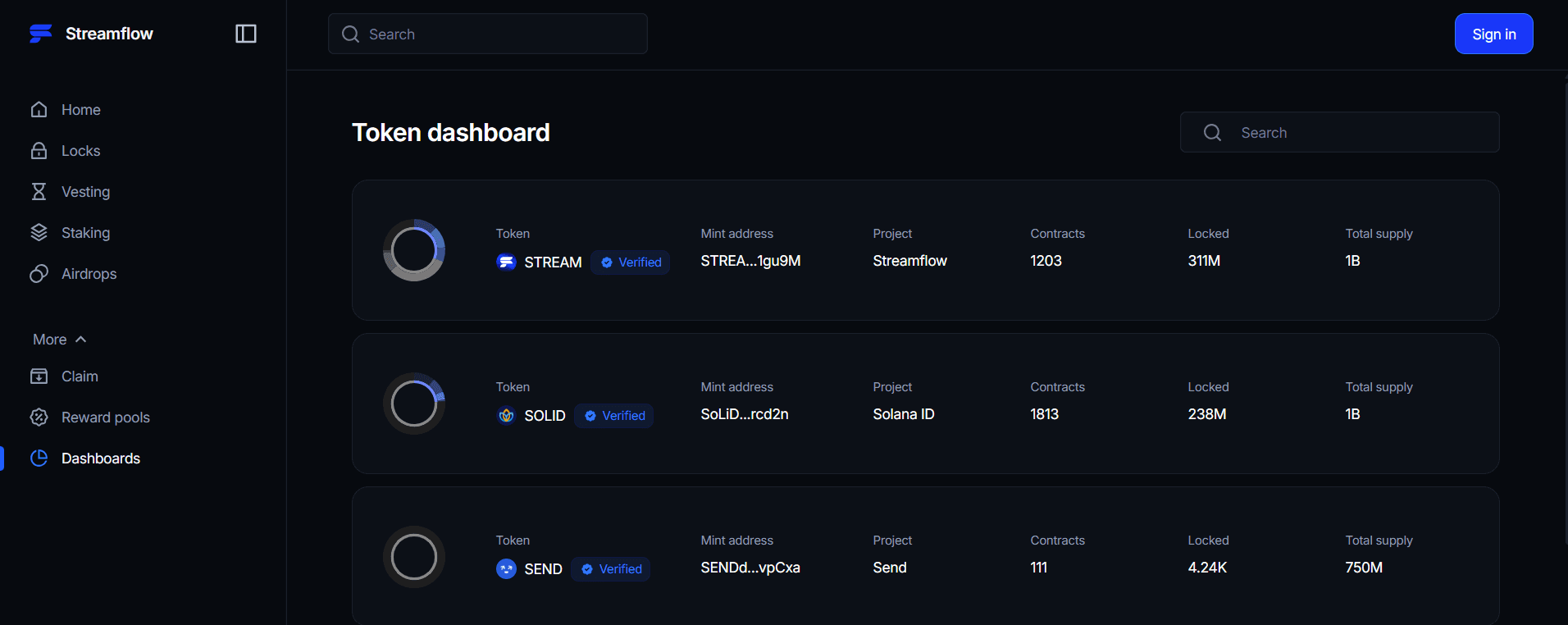
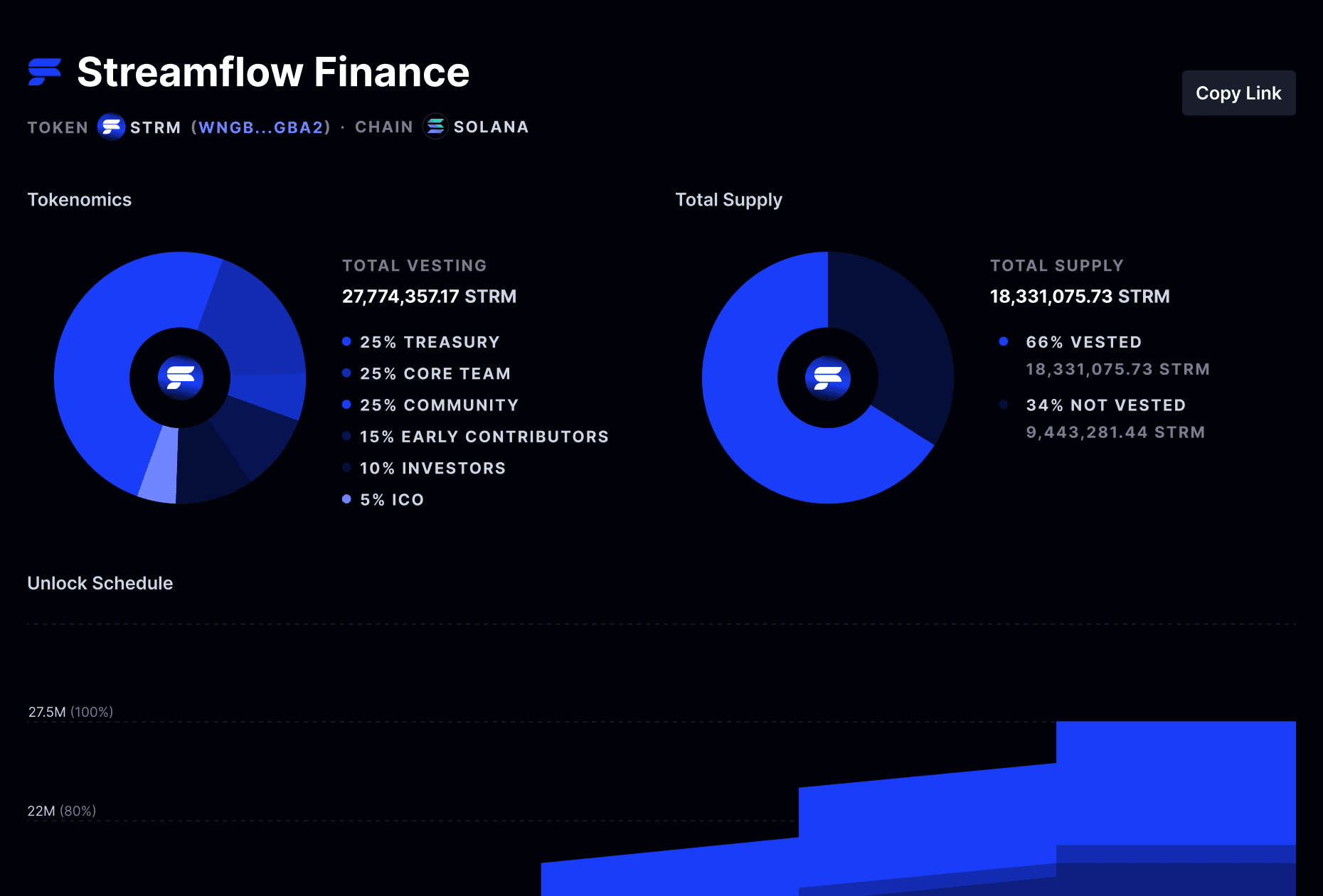
The advantage of running all of this on one platform is that the proof compounds. A tokenomics dashboard consolidates vesting contracts, locks, and staking pools into a single source of truth, so a team's entire token lifecycle is verifiable from one view. That consolidation is hard to replicate when each function lives in a separate tool.
Conclusion
Solana teams launched millions of tokens in 2025, but the ones that last are the ones that build real operational infrastructure behind the launch.
Streamflow gives those teams a single Solana-native platform for locks, vesting, airdrops, staking, and payments, with the on-chain proof and near-zero fees that make each use case economical at scale.
The use cases here map to a token's full lifecycle, from the first trust signal to ongoing financial operations. Prioritize them in the order your project needs them, and let the proof compound across a single dashboard.
Book a demo to see how Streamflow handles token locks, vesting, and airdrops for your Solana team from one platform.
Read Next:
How to Set Up Recurring Token Payments for Contributors on Solana
How to Audit Your Token Distribution Strategy Using On-Chain Data
FAQs:
1. What are the best use cases of the Streamflow app for Solana teams?
The best use cases of the Streamflow app for Solana teams are locking tokens at launch, vesting team and investor allocations, running large-scale airdrops, deploying staking pools, and automating contributor payments. Each is executed through audited on-chain smart contracts, and all are verifiable on Solscan or Solana Explorer. Teams typically adopt them in that order as the project moves from launch to ongoing operations.
2. How long does it take to lock tokens on Streamflow?
Locking tokens on Streamflow takes about 37 seconds through the no-code interface. The lock is deployed as an immutable on-chain contract with a public proof link, so a community or investor can verify it independently. No smart contract development is required.
3. Can Streamflow handle a million-recipient airdrop on Solana?
Yes, Streamflow supports airdrops to up to one million recipients in a single campaign. Projects can import 100,000 recipients per CSV file, with standard plans handling up to 30,000 recipients per airdrop and enterprise handling larger campaigns. Every airdrop includes claim portals and real-time claim tracking.
4. Is the Streamflow app secure enough for team and treasury allocations?
Yes, Streamflow uses audited smart contracts, with audits by FYEO and OPCODES, and every contract is immutable once deployed. Locks and vesting schedules cannot be unilaterally changed, which reduces the risk of insider misuse and rug pulls. All allocations are verifiable on-chain through Solscan and Solana Explorer.
5. Can Streamflow be used for payroll and recurring payments?
Yes, Streamflow supports recurring payout contracts for payroll-style payments to employees, contractors, and contributors. These contracts continue funding over time without redeploying new contracts, and teams can pay salaries, subscriptions, and services in real time using token streams. Teams building broader financial operations can extend this through Streamflow Business.