General
Token Locks on Solana: Top 30 Questions Answered
Crypto markets released roughly $97.43 billion in scheduled token unlocks during 2025, one of the largest emission years on record, according to Tokenomist's January 2026 Token Unlocks Review.
Every one of those unlocks started as a lock, and the projects that earned trust were the ones that could prove their tokens were locked on-chain.
Streamflow sits at the center of that proof layer as a Solana-native token operations platform with over $365 million in total value locked across 40,000+ projects.
Token locks are the first trust signal most communities look for, yet the mechanics confuse founders and investors alike. The difference between locking and vesting, what unlock conditions are possible, how to verify a lock, and what it costs are all questions that get asked daily.
This guide answers the 30 most common questions about token locking on Solana, grouped from fundamentals to verification, costs, and real project examples.
Key Takeaways
Token locks on Solana restrict tokens from being transferred or accessed until conditions are met.
Streamflow enforces token locks through audited, immutable on-chain smart contracts with public proof links.
Locks differ from vesting, staking, and liquidity locks, though Streamflow supports each separately.
Streamflow supports time-based and price-based unlocks for SPL and LP tokens.
Over 40,000 projects use Streamflow for token locks, vesting, and distribution.
Token Lock Fundamentals
These five questions cover what a token lock is and what actually happens to locked tokens.
1. What is a token lock?
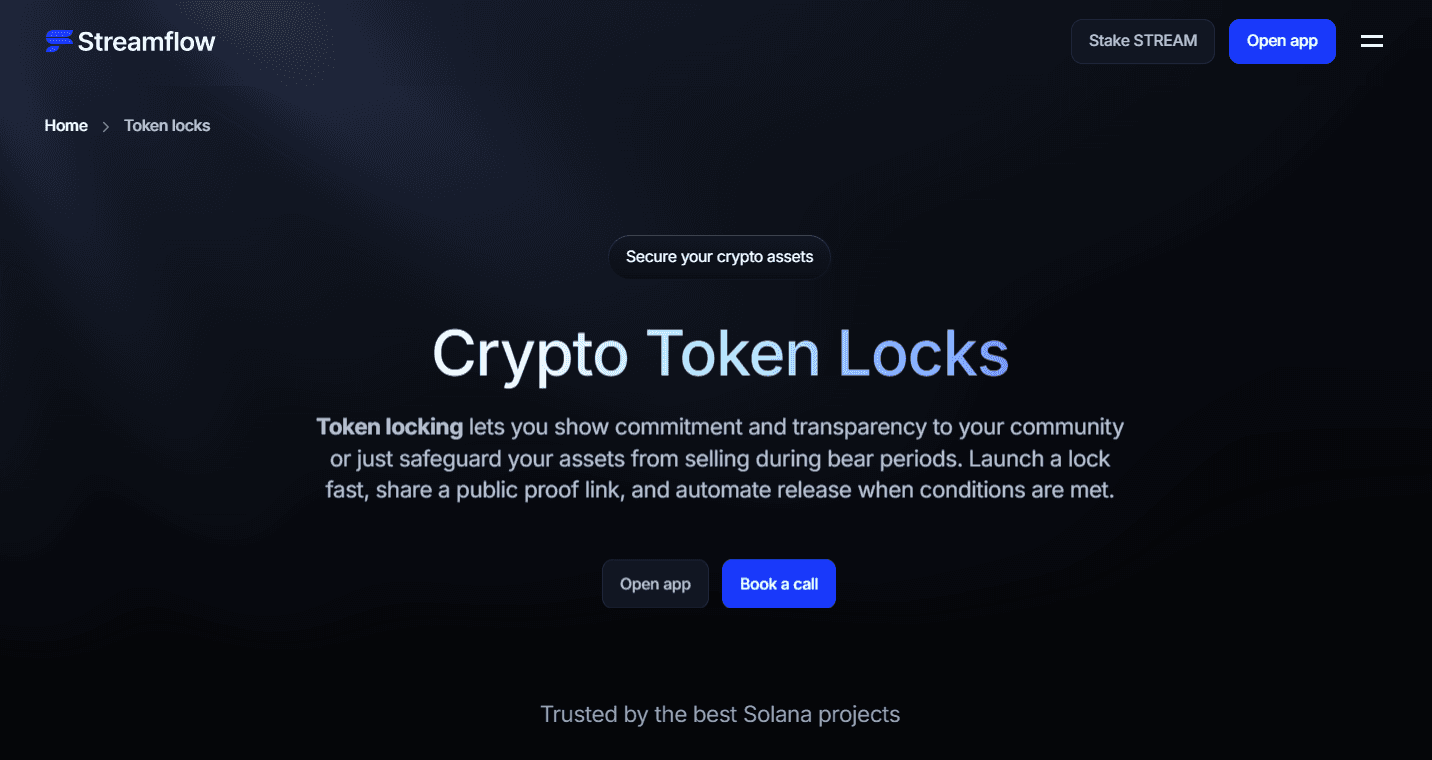
A token lock is a mechanism that restricts tokens from being transferred, traded, or accessed until predefined conditions, such as a specific date or price level, are met. On Streamflow, the lock is an on-chain smart contract, not a promise or an off-chain agreement. This makes the commitment verifiable by anyone, at any time.
2. Why do projects lock tokens?
Projects lock tokens to enforce commitment, control circulating supply, and give holders confidence to participate. Locking reduces immediate dump risk and signals long-term intent, which is why it is usually the first step a serious token takes after launch. It turns a stated promise into an enforceable, transparent rule.
3. What happens to tokens while they're locked?
While locked, tokens cannot be transferred, traded, or accessed by anyone, including the team that created the lock. The tokens remain visible on-chain so their status is auditable, but they are functionally frozen until the unlock criteria are fulfilled.
This is what makes a lock a credible supply guarantee rather than a marketing claim.
4. Which token types can be locked on Solana?
Streamflow supports locking both standard SPL tokens and LP (liquidity pool) tokens on Solana. SPL locks are typically used for team, treasury, and investor allocations, while LP locks secure liquidity positions. Supporting both means a project can lock its supply and its liquidity through the same infrastructure.
5. Can a team override a token lock after it's set?
No. Streamflow token locks are enforced by immutable smart contracts with no admin override once deployed. The team cannot unilaterally release, move, or cancel locked tokens ahead of schedule. That absence of a backdoor is precisely what gives a Streamflow lock its trust value.
Token Locks vs Vesting, Staking, and Liquidity Locks
These questions clear up the most common terminology confusion in token operations.
6. What's the difference between a token lock and token vesting?
A token lock holds tokens fully restricted until a single unlock condition is met, while token vesting releases tokens gradually over time according to a schedule. A lock is closer to a one-time gate; vesting is a continuous drip.
Streamflow supports both as separate products, and many projects use a lock for liquidity and vesting for contributor allocations.
7. What's the difference between token locking and liquidity locking?
Token locking restricts a project's own token allocations, such as team or treasury supply. Liquidity locking specifically restricts the LP tokens that represent a project's position in a liquidity pool, preventing the team from pulling liquidity.
Streamflow handles both, since both are forms of the same on-chain lock primitive applied to different assets.
8. What's the difference between locking and staking?
Locking restricts tokens with no reward attached; the purpose is commitment and supply control. Staking also locks tokens but adds reward distribution, where holders earn yield for participating. Streamflow offers staking as a distinct product, so teams choose locking for trust signals and staking for incentives.
9. Do I need both token locks and vesting?
Most maturing projects use both, because they solve different problems. Locks secure liquidity and create immediate trust at launch, while vesting aligns contributors and investors over multi-year horizons.
Streamflow lets a single project run locks, vesting, and distribution from one platform without stitching together separate tools.
10. Is a token lock the same as a token unlock schedule?
A token lock is the restriction itself, and the unlock schedule is the set of conditions that govern when that restriction lifts. For a simple lock, the schedule may be a single future date; for vesting, it is a series of releases. Streamflow makes both the lock and its unlock conditions publicly visible on-chain.
How Token Locks Work on Streamflow
These questions cover the practical mechanics of creating a lock.
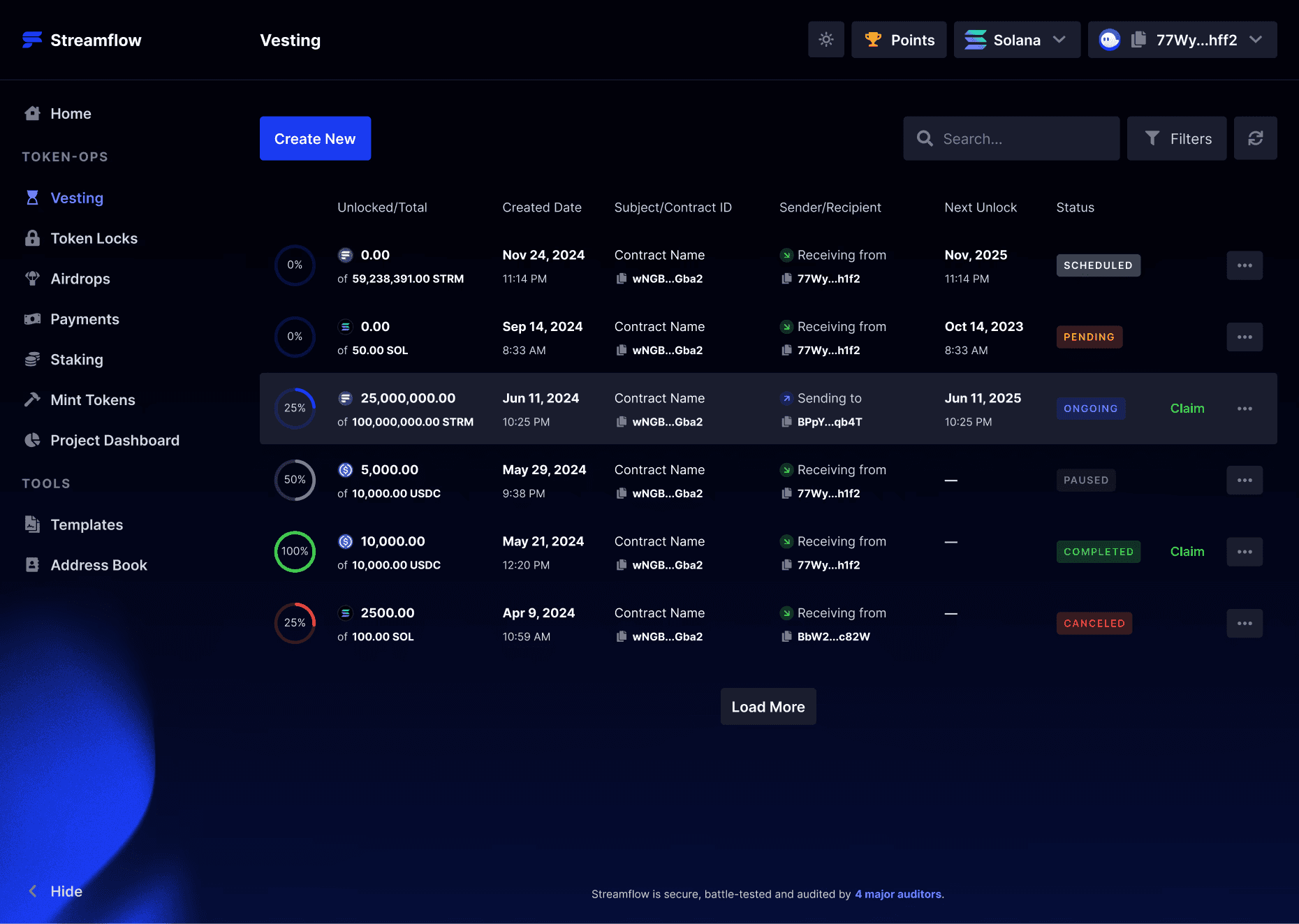
11. How do you lock tokens on Solana with Streamflow?
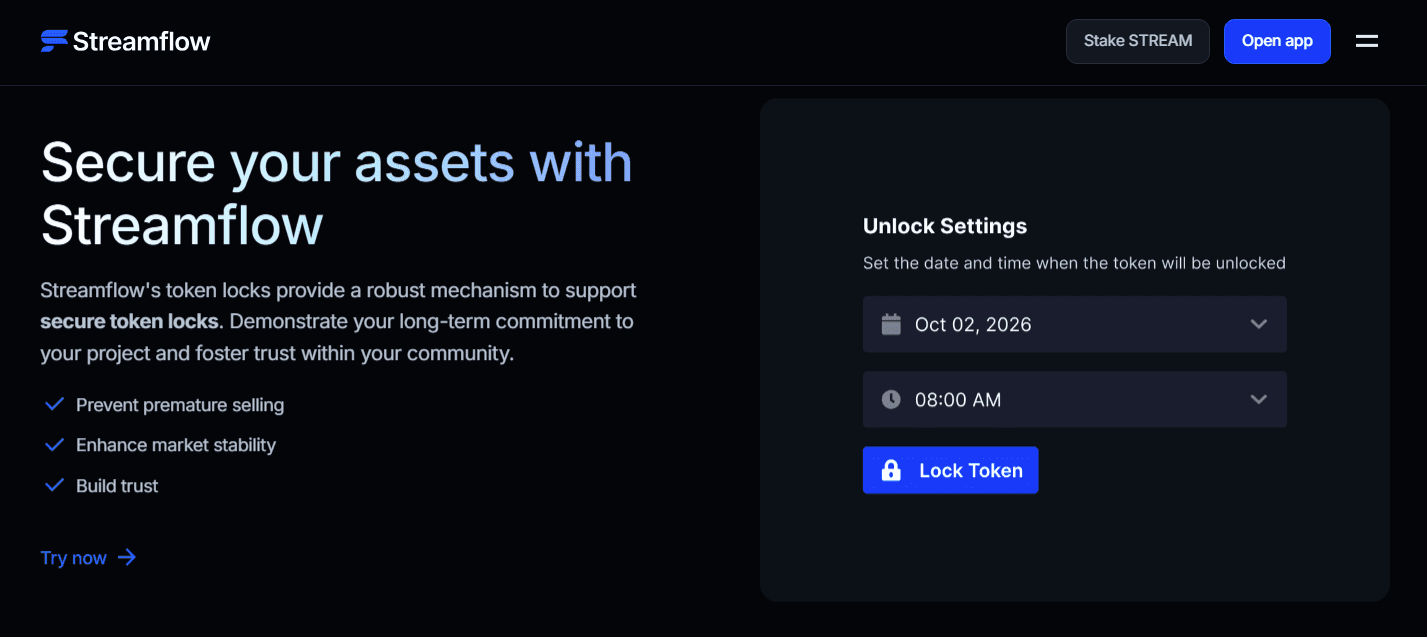
You create a lock contract through the Streamflow interface, define the unlock condition, fund the contract with the tokens, and deploy it on-chain. The tokens are then locked and automatically released when the condition is met.
You can Open the Streamflow app to set up a lock without touching any code.
12. How long does it take to lock tokens?
Locking tokens on Streamflow takes about 37 seconds through the no-code interface. There is no contract development, audit cycle, or deployment pipeline to manage on your end. The speed comes from Streamflow handling the contract logic while you configure the parameters.
13. Do you need to write smart contract code to lock tokens?
No. Streamflow's no-code path lets teams create lock contracts entirely through the UI by configuring parameters and deploying instantly. Developers who want custom logic can use the SDK instead, but it is optional. This removes the need for in-house smart contract engineering.
14. Can locks be created in bulk or for multiple allocations?
Yes. Streamflow supports bulk creation and CSV import, so teams can set up many lock or vesting contracts across different recipients at once. This matters when a project has dozens of separate team, investor, and treasury allocations. Each allocation gets its own verifiable on-chain contract.
15. Is Streamflow listed in the official Solana docs?
Yes. Streamflow is referenced in the official Solana token vesting reference as a timelock tool within the ecosystem. That listing positions it as a trusted core primitive rather than a third-party add-on. It is one reason 40,000+ projects rely on Streamflow for lock and vesting infrastructure.
Unlock Conditions and Lock Types
These questions explain what triggers an unlock and which lock types Streamflow supports.
16. What unlock conditions can a token lock use?
Streamflow locks can unlock based on time (a fixed date or period) or price (a market threshold). This lets teams choose between a simple calendar-based release and a market-aware one. Both conditions are written into the contract and enforced automatically.
17. What is a fixed-date (time-based) lock?
A time-based lock holds tokens until a specific date or after a defined period elapses, then releases them. It is the most common lock type for team and treasury allocations with a known timeline. Streamflow's quick locks let teams deploy these in seconds.
18. What is a price-based token lock?
A price-based lock keeps tokens restricted until the token reaches a defined market price, aligning unlocks with growth rather than the calendar. This prevents supply from hitting the market before the project has demonstrated value. Streamflow introduced price-based token locks as a smarter alternative to purely time-driven unlocks.
19. Do tokens release automatically when the unlock condition is met?
Yes. Streamflow handles automatic release, so once the time or price condition is satisfied, the contract executes without manual intervention. There is no need for the team to remember to send tokens or trigger a transaction. The automation removes both human error and discretionary delay.
20. Can you change a lock after it's deployed?
Once deployed, a Streamflow lock is immutable, meaning the core conditions cannot be altered unilaterally. This immutability is the point: it guarantees that what was promised is what gets enforced. Successful token economies still depend on designing the lock correctly before deployment.
Security, Verification, and Proof
These questions cover how locks are verified and why they build trust.
21. How can investors verify that tokens are actually locked?
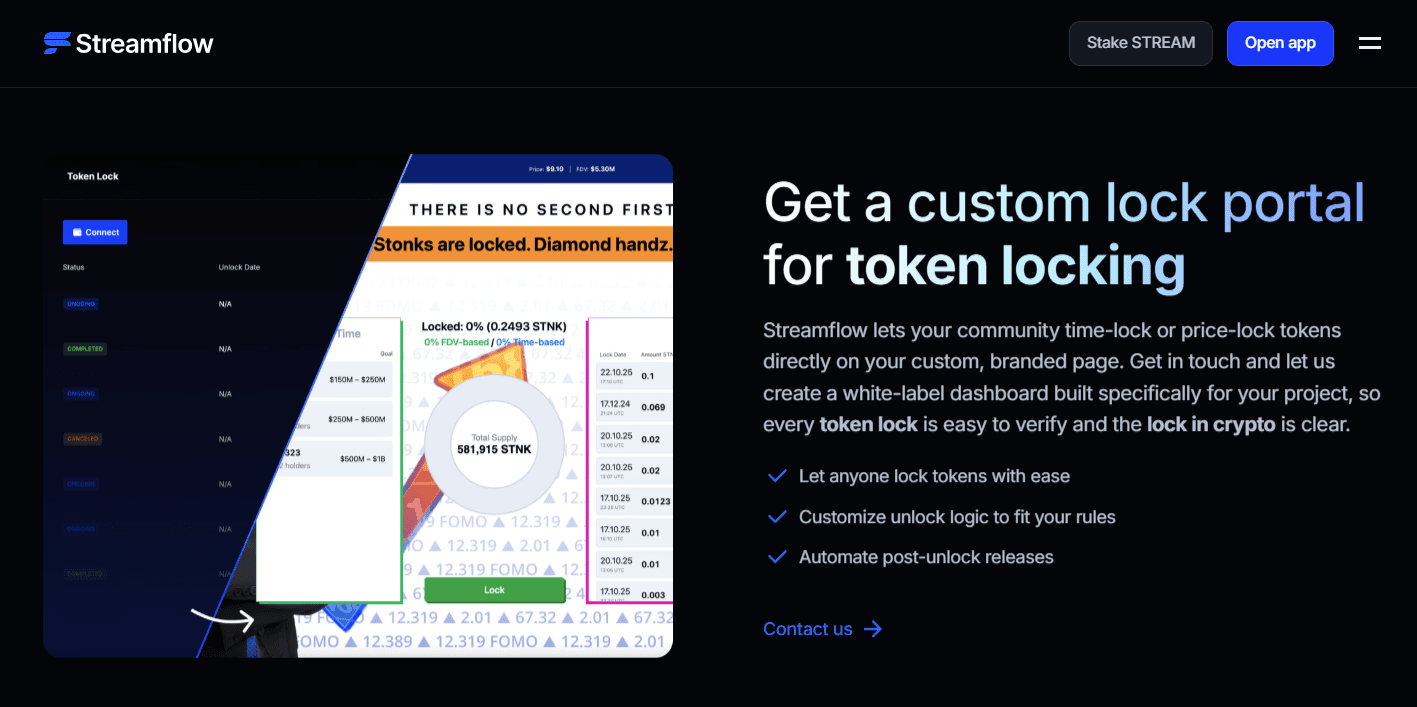
Investors can verify locks on Solscan, Solana Explorer, and RugCheck, since every Streamflow lock is an on-chain contract. Streamflow also generates public proof links and dashboards that show the lock status directly. This means trust does not depend on the team's word, only on the chain.
22. Are Streamflow's smart contracts audited?
Yes. Streamflow's smart contracts have been audited by FYEO and OPCODES, and vesting contracts are referenced as open-source. Audited, immutable contracts reduce the risk of bugs, insider misuse, and manipulation. Security is a core reason projects choose Streamflow over custom-built lock contracts.
23. What are proof links and public lock dashboards?
Proof links are shareable URLs that let anyone confirm a lock's existence and terms, while public dashboards visualize locked supply and unlock timing. Together they give communities a single, verifiable source of truth. Projects use them to demonstrate commitment without asking anyone to take their word for it.
24. How do token locks reduce rug-pull risk?
Locks reduce rug-pull risk by making it impossible for a team to dump locked allocations or pull liquidity before the unlock condition. Because the restriction is enforced on-chain and cannot be overridden, the most common exit-scam vector is removed. Verifiable locks are now a baseline expectation for credible Solana launches.
25. Can a lock be private, or is it always public?
By default, Streamflow locks are public-by-default, since the trust value comes from being verifiable. The on-chain contract and proof links are visible to anyone, which is exactly what investors and communities want to see. Public visibility is the feature, not a limitation.
Costs, Use Cases, and Getting Started
These final questions cover pricing, real projects, and how to begin.
26. How much does it cost to lock tokens on Solana?
The cost is a smart contract creation fee plus Solana's network transaction fees, which are near-zero. There is no percentage cut of locked tokens or recurring subscription required to keep a basic lock in place. The full fee breakdown is available in Streamflow's documentation.
27. Why is locking tokens on Solana cheaper than on Ethereum?
Solana offers near-zero fees, sub-second finality, and over 65,000 transactions per second, which makes on-chain operations dramatically cheaper than on Ethereum.
Streamflow runs entirely on this Solana token operations infrastructure, so locking large or numerous allocations stays economically viable. Cost-efficiency is a structural advantage, not a temporary promotion.
28. What are the main use cases for token locks?
The main use cases are team and founder allocations, treasury funds, investor allocations, and liquidity (LP) locks. Each one benefits from a public guarantee that the supply cannot move early. Streamflow lets a single project cover all of these through the same lock infrastructure.
29. Which real Solana projects use locks and vesting?
Heavenland, a Solana metaverse, placed 97% of its $HTO supply on a 5-year linear vesting schedule with cliffs to allow initial liquidity without excessive inflation.
Bonk used Streamflow to vest 20% of total supply for 22 early contributors over a 3-year linear schedule.
Both outcomes built measurable community trust through transparent, enforceable distribution.
30. How do you get started locking tokens with Streamflow?
You connect a Solana wallet such as Phantom, Solflare, or Backpack, choose the lock product, configure the unlock condition, fund the contract, and deploy. The no-code flow takes seconds and produces a verifiable on-chain lock with a shareable proof link. From there, the same platform handles vesting, airdrops, staking, and distribution as the project grows.
Conclusion
Token locks are the entry point to credible token operations, and with $97.43 billion in unlocks moving through the market in 2025, verifiable on-chain locking is now table stakes rather than a nice-to-have.
Streamflow turns locking into an audited, immutable, publicly verifiable system that scales from a single liquidity lock to a project's entire token lifecycle across 40,000+ projects.
Book a demo to see how Streamflow handles token locks, price-based unlocks, and verifiable proof for your Solana launch.
Read Next: