General
How Token Vesting works in Crypto? Purpose, Security & How It Works
Streamflow is the most trusted token vesting platform on Solana, giving crypto projects the on-chain infrastructure to distribute tokens transparently, control circulating supply, and align stakeholder incentives from day one.
Token vesting has become a non-negotiable structural requirement for any serious Web3 project, the difference between a token economy built on verifiable commitments and one built on promises.
This guide covers everything crypto projects need to know about token vesting in 2026, including how it works, which vesting schedule is right for each stakeholder group, and how to deploy vesting contracts on Solana with Streamflow.
Key Takeaways
Token vesting is a foundational commitment signal
Streamflow automates the entire vesting process on Solana
On-chain vesting removes human discretion entirely
What Is Crypto Token Vesting
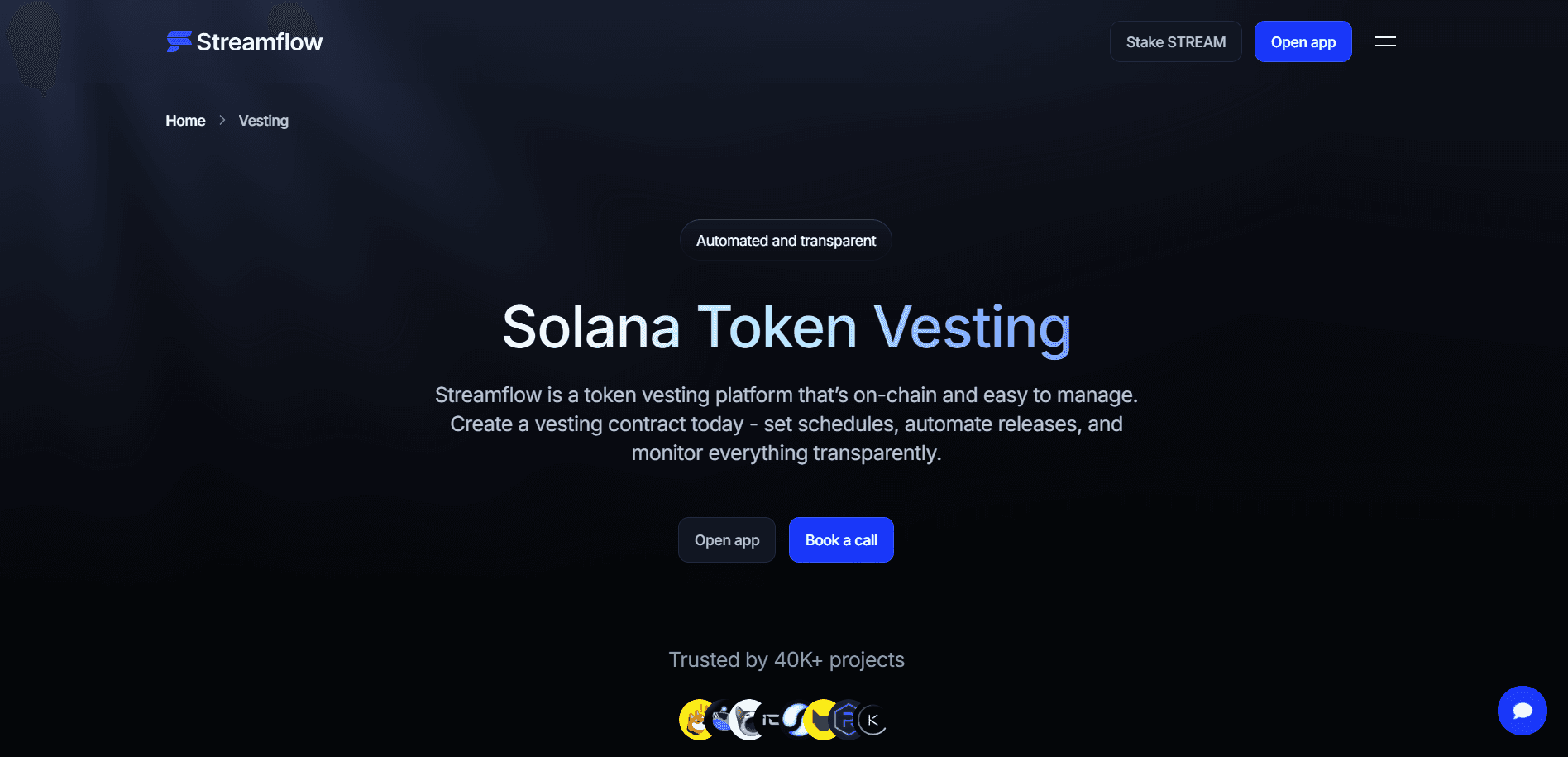
Crypto token vesting is the process of locking tokens and releasing them gradually over time based on a predefined schedule.
Rather than making the full token allocation available immediately, vesting controls when tokens enter circulation, preventing large supply shocks, reducing short-term speculation, and ensuring that the stakeholders holding the most tokens are the ones most committed to the project's long-term success.
Token vesting is used across every major stakeholder group in a crypto project: core team members and founders, early investors and venture capital funds, advisors and service providers, DAO treasuries, ecosystem incentive programs, and public sale participants.
Each group receives a schedule calibrated to their role, risk profile, and the behaviors the project wants to incentivize.
The presence of a transparent, on-chain vesting schedule has become one of the baseline signals serious investors look for before committing capital. A project that cannot provide a verifiable vesting proof link, one that any holder can check independently on a blockchain explorer, is asking its community to trust a promise rather than a contract.
Streamflow is officially listed in the Solana documentation under token vesting and is trusted by over 1.3 million users and 40,000+ projects managing over $1.4 billion in total value locked.
Teams use Streamflow to turn vesting schedules from plans into automatically enforced, publicly verifiable on-chain systems.
How Crypto Token Vesting Works
Token vesting works by encoding distribution rules into a smart contract that executes automatically over time. Once deployed, the contract manages the full release schedule without any manual intervention, tokens unlock according to the defined parameters and are delivered directly to recipient wallets.
Step 1: Define the Vesting Parameters
The project defines the core configuration for each stakeholder group: the total token allocation, the cliff duration, the start and end dates, the release frequency, and the vesting model, linear, milestone-based, price-based, or custom.
These parameters determine the supply dynamics of the vesting program and are fully configurable on Streamflow.
Step 2: Deploy the Smart Contract
A smart contract is deployed on Solana that holds the allocated tokens and manages the full vesting schedule. All rules are encoded in the contract at deployment, no human can override or modify them once live.
Streamflow's token vesting contracts are open-source and have been independently audited by FYEO and OPCODES.
Step 3: Fund the Contract
The project deposits the allocated tokens into the vesting contract. From this point, the contract manages all releases automatically, no manual tracking, no manual transfers, no reliance on the team to execute unlocks correctly.
Step 4: Tokens Release Automatically
The smart contract releases tokens to recipient wallets according to the defined schedule. Each unlock event is executed automatically and recorded on-chain, making it fully auditable on Solscan and Solana Explorer at any time.
Step 5: Recipients Claim or Receive Tokens
Depending on the configuration, recipients can claim their unlocked tokens at any time after each release event, or tokens can be set to transfer automatically to recipient wallets.
Every vesting contract on Streamflow generates a shareable proof link that the project can publish publicly as a verifiable commitment.
The result is a vesting system that is automatic, transparent, and cryptographically enforced, removing the single biggest point of failure in any manual distribution process: human discretion.
Types of Token Vesting Schedules
Different vesting models serve different goals. The right structure depends on the stakeholder group, the project's stage, and the incentive behaviors the project is trying to create.
Streamflow supports all major vesting models natively on Solana.
1. Linear Vesting
Tokens unlock evenly over a defined period after the cliff ends. The most common model for team and investor allocations, predictable, easy to communicate, and straightforward to verify on-chain.
A project might vest advisor tokens linearly over 24 months, releasing an equal portion each month until the full allocation is distributed.
2. Cliff + Linear Vesting
The industry standard for founder and core team tokens. No tokens are released during the cliff period, typically 12 months, after which a linear release begins and continues until the full allocation is vested.
This structure ensures recipients must demonstrate sustained commitment before receiving any tokens at all.
3. Milestone-Based Vesting
Tokens unlock upon completion of specific project goals, a mainnet launch, a protocol upgrade, or hitting a defined TVL or user threshold. Particularly well-suited to ecosystem grants and developer incentive programs where output matters more than time served.
4. Price-Based Vesting
A more advanced structure where tokens unlock only when the token reaches a defined price threshold, rather than on a time-based schedule. This directly ties recipient rewards to market performance, creating strong alignment between contributors and token holders.
Streamflow introduced price-based vesting as a native feature for Solana projects.
5. Custom Interval Vesting
Fully configurable unlock schedules for stakeholder groups with non-standard requirements, such as DAO treasury distributions, strategic partner allocations, or ecosystem reserve releases that do not fit cleanly into linear or milestone models.
The right combination of these models, applied to the right stakeholder groups, is one of the most consequential tokenomics decisions a project makes.
The standard benchmark for teams and founders vesting is a 12-month cliff followed by 24 to 36 months of linear monthly vesting. Deviations from this benchmark should be clearly justified in the project's public tokenomics documentation.
Why Crypto Projects Need Token Vesting in 2026
Token vesting impacts a project's success across multiple dimensions simultaneously, from market stability and investor confidence to regulatory posture and long-term ecosystem health.
In 2026, it is not an optional component of a well-designed token economy. It is foundational infrastructure.
1. Market Stability
Gradual token release reduces the risk of sudden supply shocks and price dumps. Without structured vesting, large token holders, particularly early investors and team members, can sell immediately after launch, creating the dump cycles that have destroyed countless projects at their most critical early stage.
2. Investor Confidence
Transparent vesting schedules signal fair tokenomics and committed insiders. Institutional investors and serious VCs evaluate vesting structures as a baseline due diligence step.
Projects with clear, on-chain, audited token vesting are significantly more fundable than those with opaque or informal distribution plans.
3. Long-Term Alignment
Vesting ensures that the people who hold the most tokens: founders, core team, early investors, are financially incentivized to stay and build. When insiders can only realize their full allocation over years, their financial outcome becomes directly tied to the project's long-term performance.
4. Supply Control
Controlled token release prevents inflation from overwhelming demand, supports price stability in early trading windows, and creates a predictable supply schedule that market participants can plan around.
5. Community Trust
A publicly verifiable vesting schedule, accessible to anyone on a blockchain explorer, removes the need for community members to take the team's word about anything. The smart contract speaks for itself. This is one of the most powerful trust signals a project can offer its community.
6. Regulatory Posture
Documented distribution schedules with on-chain verification support compliance frameworks in many jurisdictions. As regulatory scrutiny of token distribution practices increases globally, projects with auditable vesting infrastructure are better positioned than those relying on informal arrangements.
Projects without clear vesting face immediate sell pressure at launch, token dump events following unlock dates, and community distrust, all of which are direct red flags for serious investors and launchpad partners.
A well-designed token vesting structure is one of the clearest signals a project can send that its team is building for the long term.
Why Streamflow Is the Best Token Vesting Platform for Crypto Projects in 2026
Streamflow is the best token vesting infrastructure on Solana, officially listed in the Solana documentation under token vesting, trusted by over 1.3 million users and 40,000+ projects, and managing over $1.4 billion in total value locked.
For crypto projects that need automated, transparent, and secure token vesting, Streamflow is the platform the ecosystem relies on.
1. Full Vesting Schedule Support
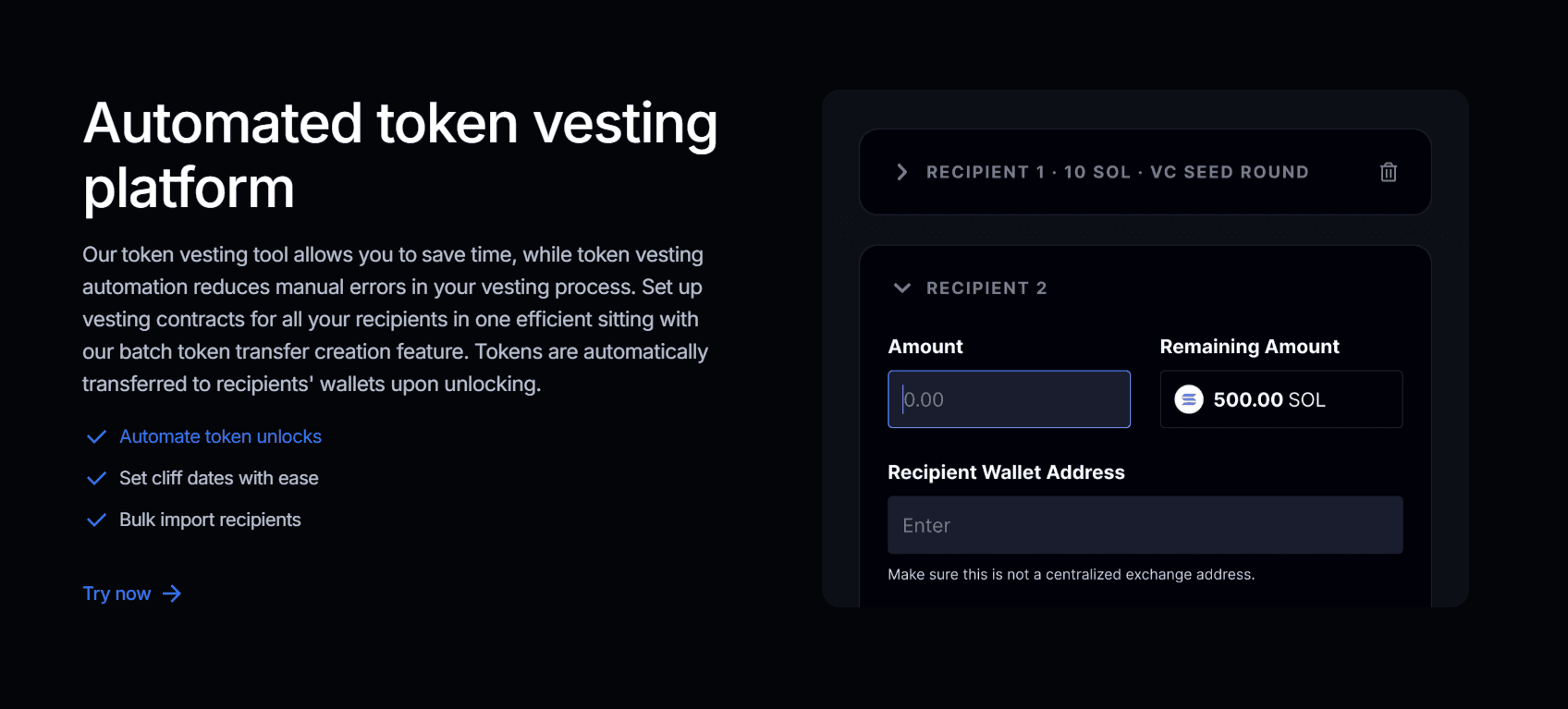
Streamflow supports every major vesting model: linear, cliff-based, cliff plus linear, milestone-based, price-based, and custom interval vesting, all configurable via a no-code interface.
Projects can match their vesting structure precisely to each stakeholder group without writing any smart contract code.
2. Batch Creation via CSV
Projects can deploy token vesting contracts for hundreds or thousands of recipients simultaneously by uploading a CSV file.
This makes Streamflow the practical choice for large-scale distributions, ecosystem grants, team allocations, investor rounds, and public sale distributions, that would be operationally unmanageable to set up manually.
3. Automatic Token Transfers
Tokens are released directly to recipient wallets on each unlock event with no manual action required from the project team. This removes administrative burden, eliminates human error, and ensures that every release happens exactly as scheduled, even years into a vesting program.
4. On-Chain Transparency
Every Streamflow token vesting contract is publicly verifiable on Solscan and Solana Explorer.
Projects can share a verifiable proof link for each contract. a public URL that any holder, investor, or community member can use to independently confirm the exact vesting terms without relying on the team's word.
5. Vesting Tracker Dashboard
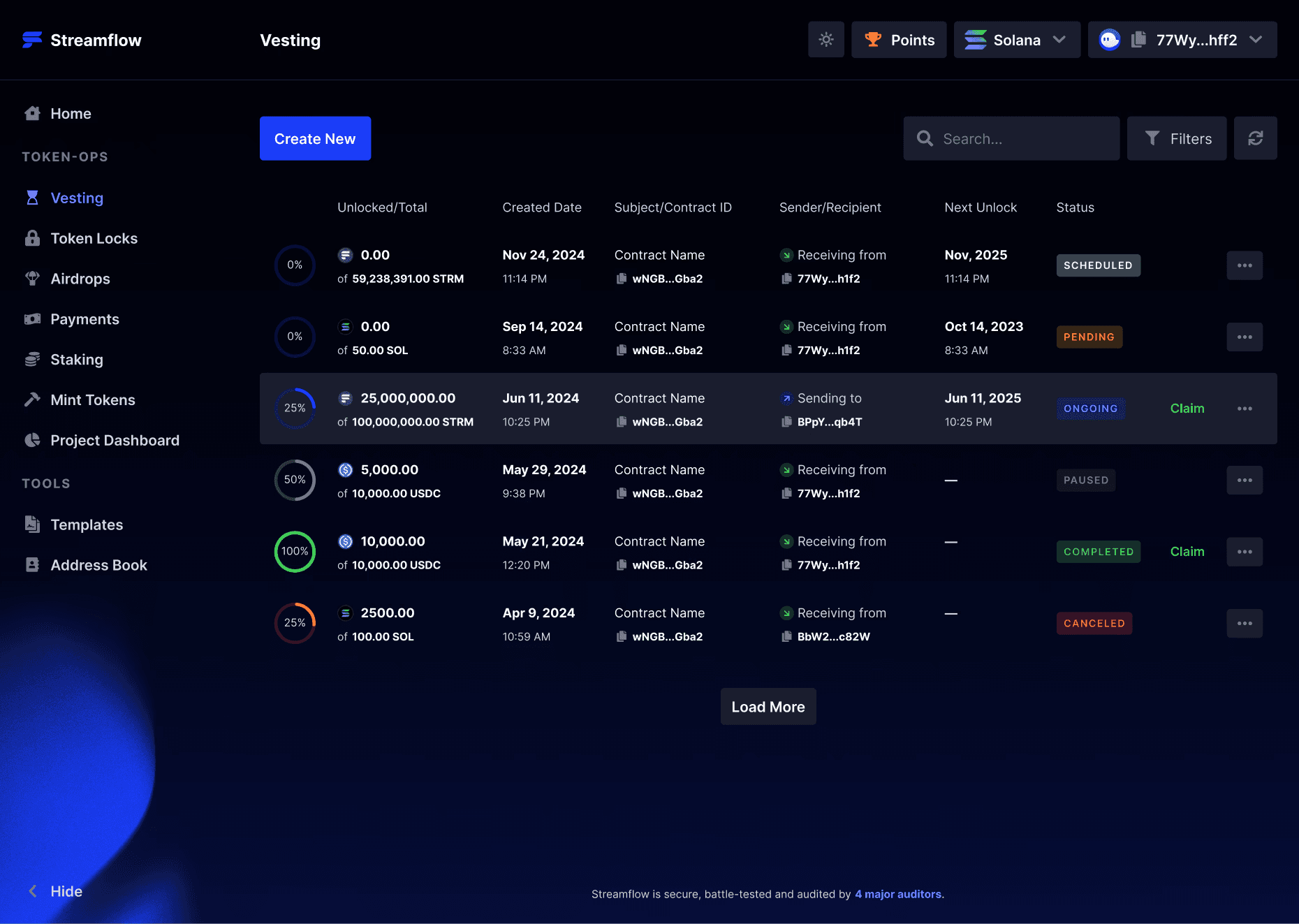
Streamflow provides a real-time tokenomics dashboard that consolidates all active vesting contracts into a single public view, showing allocation breakdowns, release progress, cliff dates, and upcoming unlock events.
This serves as a single source of truth for token distribution data across all stakeholder groups.
6. Audited Smart Contracts
Streamflow's token vesting contracts have been independently audited by FYEO and OPCODES, are fully open-source, and are immutable once deployed.
No admin override is possible after a contract goes live, the terms are cryptographically enforced exactly as configured.
7. Solana-Native Performance
Streamflow is built on Solana, which supports over 65,000 transactions per second with sub-second finality and near-zero transaction fees.
This makes large-scale vesting programs, covering hundreds of recipients with frequent unlock events, operationally viable at a fraction of the cost of equivalent infrastructure on Ethereum.
8. SDK and API Access
For development teams that want to embed vesting logic directly into their dApps, Streamflow provides a public SDK and API for fully programmable token distribution.
Custom payment flows, vesting schedules, and reward systems can all be built on top of Streamflow's infrastructure layer.
Real projects have trusted Streamflow with their most critical token vesting operations:
Bonk used Streamflow to vest 20% of total supply across 22 early contributors on a three-year linear schedule.
UXD Protocol used Streamflow's SDK to vest approximately 46% of the $UXP supply across a four-year schedule with a 12-month cliff, integrated directly into their Realms governance interface.
Heavenland vested 97% of token supply across a five-year linear schedule, using Streamflow to manage distribution across team, incentives, and treasury allocations simultaneously.
How to Start Vesting Tokens with Streamflow
Streamflow's no-code vesting interface makes it possible to deploy a fully configured vesting contract on Solana in minutes.
Here is the complete step-by-step process:
Step 1: Connect your wallet - Go to the Streamflow token vesting page and connect your Solana wallet: Phantom, Backpack, Solflare, or any compatible wallet.
Step 2: Navigate to Vesting - Select Vesting from the left sidebar to open the vesting contract creation interface.
Step 3: Select your token - Choose the SPL token you want to vest from your connected wallet.
Step 4: Set vesting parameters - Define the recipient address or upload a CSV for batch creation.
Configure the total allocation, cliff duration, start date, end date, release frequency, monthly, quarterly, or custom, and the vesting model that fits your stakeholder group.
Step 5: Review and deploy - Review all parameters before confirming. Once approved, the vesting contract is deployed on-chain.
The terms are now immutable, the schedule will execute exactly as configured, automatically, for the full duration of the vesting period.
Step 6: Share your proof link - Every Streamflow vesting contract generates a shareable, publicly verifiable proof link. Publish this link in your whitepaper, tokenomics documentation, Discord, and social channels.
This is the most direct commitment signal you can give your community and investors.
Streamflow also offers a robust SDK and API for development teams that want to integrate vesting programmatically into their dApps or launch infrastructure.
Conclusion
Streamflow is the most trusted token vesting platform on Solana, giving crypto projects the on-chain infrastructure to turn vesting schedules from promises into cryptographically enforced, publicly verifiable commitments.
Token vesting is not simply a distribution tactic, it is a foundational structural decision that controls circulating supply, aligns stakeholder incentives, attracts serious capital, and builds the community trust that no marketing campaign can replicate.
For Solana-based projects in 2026, on-chain vesting with audited smart contracts ensures every unlock happens exactly as designed, automatically, transparently, and without any reliance on human discretion.
Book a call with Streamflow to design and deploy your token vesting strategy today.
Read Next:
FAQs:
1. What is crypto token vesting?
Crypto token vesting is the process of locking tokens and releasing them gradually over time based on a predefined schedule enforced by smart contracts. Rather than making a full allocation immediately available, vesting controls when tokens enter circulation, preventing dump cycles, aligning stakeholder incentives with long-term project success, and giving investors and communities a verifiable commitment signal.
2. Why is token vesting important for crypto projects in 2026?
Token vesting is important for crypto projects because it prevents immediate sell pressure at launch, aligns insiders financially with long-term outcomes, controls circulating supply, and builds community trust through transparent on-chain commitments.
3. What is the difference between on-chain and off-chain token vesting?
The difference between on-chain and off-chain token vesting is enforcement and transparency. Off-chain vesting holds tokens in founder wallets or on centralized exchanges and relies on manual releases at each unlock event, it lacks public auditability and requires community trust in the team. On-chain vesting uses smart contracts to enforce the full schedule automatically, is publicly verifiable by anyone on Solscan or Solana Explorer, and cannot be altered once deployed.
4. What is a cliff in token vesting?
A cliff in token vesting is an initial lock period during which no tokens are released to the recipient. After the cliff ends, vesting begins, either linearly over the remaining schedule or on a custom interval. A 12-month cliff is the industry standard for team and founder token allocations, ensuring that recipients must demonstrate sustained commitment to the project before receiving any tokens. Streamflow supports configurable cliff periods for all vesting contract types on Solana.
5. What types of token vesting schedules does Streamflow support?
Streamflow supports all major token vesting schedule types for Solana projects: linear vesting, cliff plus linear vesting, milestone-based vesting, price-based vesting, and fully custom interval schedules. Each model is configurable via a no-code interface, with batch creation via CSV for large recipient sets.