General
Everything You Need to Know About USD+ in 2026
USD+ is a yield-bearing stablecoin built on Solana by Streamflow, backed by short-term U.S. Treasury Bills and powered by M0's stablecoin infrastructure. It is designed to maintain a $1 peg while distributing the yield generated by its reserves directly to holders' wallets on a daily basis, with no staking, lockups, or claim flows required.
Streamflow is the most trusted token operations platform on Solana, supporting over 1.3 million users and 40,000+ projects with more than $1.4 billion in total value locked.
USD+ extends that infrastructure into stablecoin-based treasury management, turning idle capital into productive, on-chain capital.
This guide covers everything you need to know about USD+ in 2026, including how it works, how it compares to USDC and other stablecoins, who it is designed for, and how it fits into Streamflow's broader financial OS for Internet Capital Markets on Solana.
Key Takeaways
USD+ is a U.S. Treasury-backed, yield-bearing stablecoin on Solana that distributes daily yield directly to holders' wallets.
It is designed to maintain a $1 peg while remaining fully composable across Solana DeFi, with no staking or lockups required.
USD+ is powered by M0's stablecoin infrastructure, with reserves held by licensed custodians and continuously verified on-chain.
What Is USD+
USD+ is a stablecoin that does what most stablecoins do not: it pays its holders the yield generated by its underlying reserves. The token is backed by short-term U.S. Treasury Bills, maintains a $1 peg, and remains fully composable across the Solana DeFi ecosystem.
There is no staking. No lockup. No claim transaction. Holding USD+ in a Solana wallet is the only action required to earn the daily yield.
Most widely used stablecoins are already backed by yield-generating assets such as Treasury bills, but that interest is typically retained by the issuer. USD+ is designed to pass the yield through to holders on-chain, daily, as additional tokens.
USD+ is purpose-built for:
Web3 companies managing on-chain treasuries that need stability without forfeiting yield
DAOs holding stablecoin reserves earmarked for grants, contributors, and ecosystem incentives
Crypto-native funds and investors holding idle balances between deployments
Teams running on-chain payroll, contributor payouts, and recurring payments
DeFi protocols looking for a yield-bearing settlement asset and collateral type
USD+ is being launched by Streamflow, the team behind a platform that already powers $1.4B+ in token value locked across vesting, locks, airdrops, staking, and payments. USD+ is the stablecoin layer of that infrastructure.
Why USD+ Matters for Crypto Treasuries in 2026
The global stablecoin market has crossed hundreds of billions in supply, and the majority of that float sits in non-yield-bearing tokens like USDC and USDT. For treasuries holding meaningful balances, that distinction is no longer cosmetic, it is a structural decision about whether capital earns or sits.
1. Yield Goes to Holders, Not Issuers
Traditional stablecoins are backed by short-term U.S. Treasuries, and those reserves generate billions in interest annually. That interest is captured by the issuer. With USD+, the same Treasury bill yield is passed on-chain to holders directly.
A treasury sitting in USDC earns nothing for the team holding it. The same treasury sitting in USD+ is expected to generate a variable yield, approximately ~3.6% APY at announcement, distributed daily on-chain.
2. No Staking and No Lockups
Most yield-bearing instruments in DeFi require active participation: staking contracts, lockups, claim flows, or compounding logic. USD+ removes that overhead. Yield accrues automatically by holding the token.
There is no smart contract to interact with, no claim transaction to sign, and no opportunity cost from locking capital.
Holding USD+ is the action. The yield distribution happens on-chain without any further input from the holder.
3. Treasury Bill Backing
USD+ is backed by short-term U.S. Treasury Bills, among the most stable and liquid yield-generating assets in traditional finance. Reserves are held by licensed custodians and independently verified through M0's infrastructure, with Treasury holdings continuously monitored to ensure full collateralization.
4. Solana-Native Composability
USD+ is built on Solana and designed to remain fully composable across the Solana DeFi ecosystem. The same balance that earns Treasury yield can also be used as collateral, deployed into liquidity, routed through DEXs, or settled across protocols, without bridging or wrapping.
5. A Better Settlement Asset for On-Chain Operations
For teams using Streamflow for token vesting, airdrops, staking, or payments, USD+ becomes a natural settlement layer. Contributor payouts, recurring payments, and treasury allocations can be denominated in a stablecoin that is also generating yield in the background.
6. Transparent, Verifiable Reserves
Unlike legacy stablecoins where reserve attestations are periodic and centralized, USD+ inherits M0's continuous, validator-monitored verification of underlying collateral. The Treasury holdings backing the token are tracked transparently, reducing the trust assumptions that have historically defined the stablecoin category.
How USD+ Works
Understanding how USD+ generates and distributes yield helps treasuries, investors, and protocols evaluate whether it fits their capital strategy.
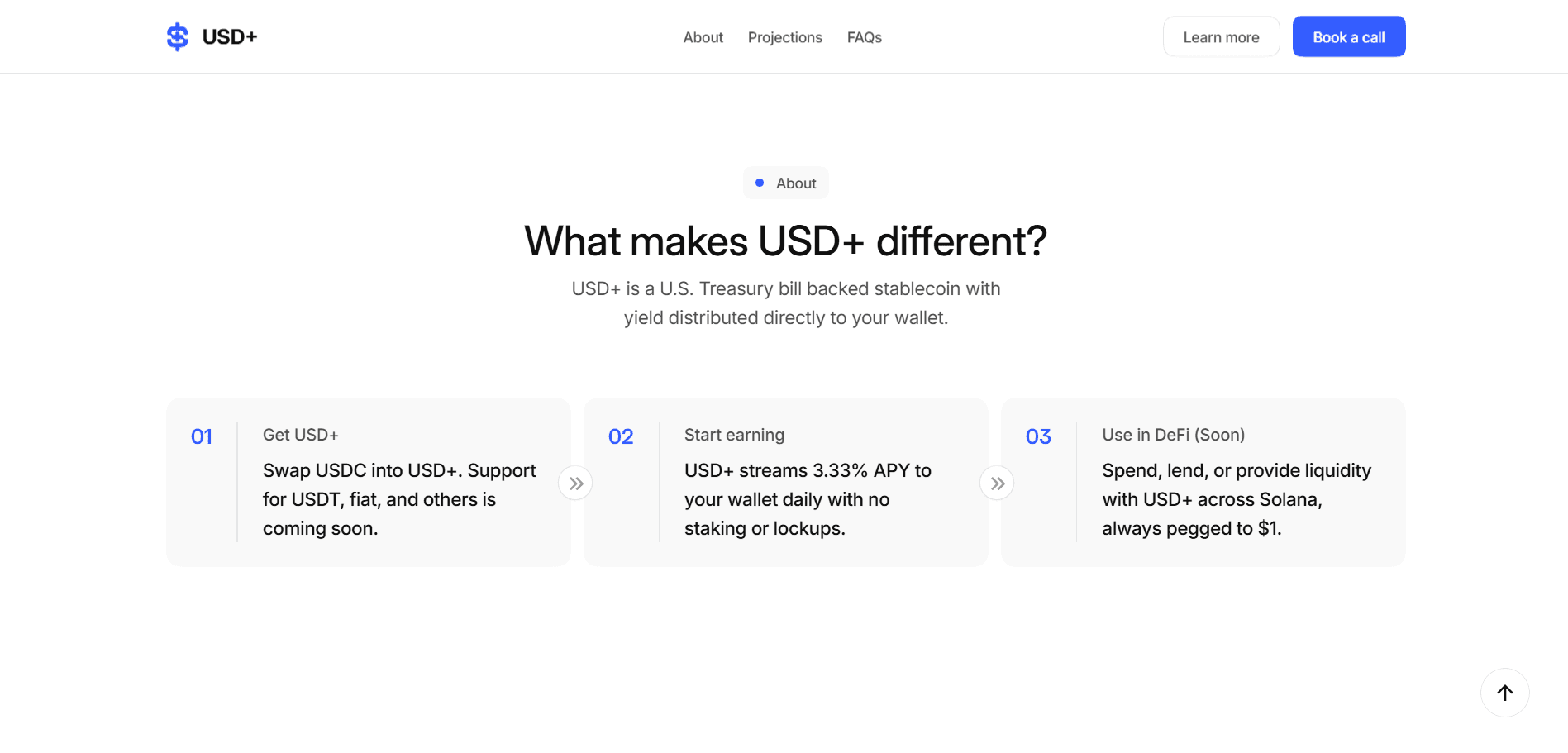
Step 1: Reserve backing
USD+ is backed by short-term U.S. Treasury Bills. Reserves are held by licensed custodians under the M0 stablecoin infrastructure model.
USD+ is powered by M0, where issuers lock verified collateral through the M0 Protocol to mint asset-backed stablecoins.
Step 2: On-chain verification
Treasury holdings backing USD+ are continuously monitored by validators in the M0 system. The collateral that backs the token is transparently tracked, not just attested to periodically.
Step 3: Minting through Streamflow
Users mint USD+ by depositing USDC, USDT, or fiat through Streamflow's interface using a standard Solana wallet. Each USD+ token corresponds to a verified dollar of Treasury-backed collateral.
Step 4: Daily yield distribution
The yield generated by the underlying Treasury bills is distributed on-chain to holders' wallets daily, as additional tokens. The yield rate is variable and adjusts over time based on prevailing U.S. interest rates and market conditions.
Step 5: Composability and redemption
USD+ remains usable across the Solana DeFi ecosystem at all times. Holders can swap, deploy, lend, or settle with USD+ exactly as they would with any other stablecoin, while the underlying balance continues to earn.
USD+ vs. USDC vs. USDT: Comparison Table
USD+ exists in the same category as USDC and USDT, but the economic model is fundamentally different. The comparison below captures the structural differences for treasuries and capital managers.
Feature | USD+ | USDC | USDT |
|---|---|---|---|
Peg | $1 | $1 | $1 |
Reserve backing | Short-term U.S. Treasury Bills | Cash and short-term U.S. Treasuries | Cash, Treasuries, and other reserves |
Yield distributed to holders | Yes, daily on-chain | No, retained by issuer | No, retained by issuer |
Estimated yield to holders | ~3.6% APY (variable) | 0% | 0% |
Staking or lockup required | No | N/A | N/A |
Solana-native | Yes | Yes | Yes |
Composable across Solana DeFi | Yes | Yes | Yes |
Reserve verification model | Continuous, on-chain validator-monitored (via M0) | Periodic attestation | Periodic attestation |
Primary use case | Treasury management, on-chain payroll, settlement | Transactional, exchange flows | Transactional, exchange flows |
The peg, the backing, and the composability are comparable. The structural difference is who captures the yield generated by the underlying reserves.
For most on-chain treasuries, the choice between holding a non-yield-bearing stablecoin and a yield-bearing one is structural, not preferential. Capital that does not earn is capital that is being silently taxed.
USD+ vs. Yield Vaults and DeFi Lending
USD+ is sometimes compared to DeFi yield vaults, money markets, or staking products. The mechanisms are different in important ways.
DeFi yield vaults require deposits into a contract. Funds are typically subject to smart contract risk, withdrawal delays, and active strategy risk.
Yield depends on protocol-specific dynamics that can shift quickly.
DeFi lending pays interest on supplied stablecoins, but rates are variable, depend on borrower demand, and require depositing into a lending protocol that introduces its own counterparty and contract risk.
USD+ does neither. The yield is structural, generated by the underlying Treasury bill collateral, and distributed without staking, lockup, or deployment into a separate protocol. Composability with DeFi remains intact, but the base yield does not depend on it.
Use Cases for USD+
USD+ is purpose-built for situations where capital is sitting still but should not be. The yield model only matters if it fits the way teams and investors actually manage capital on-chain.
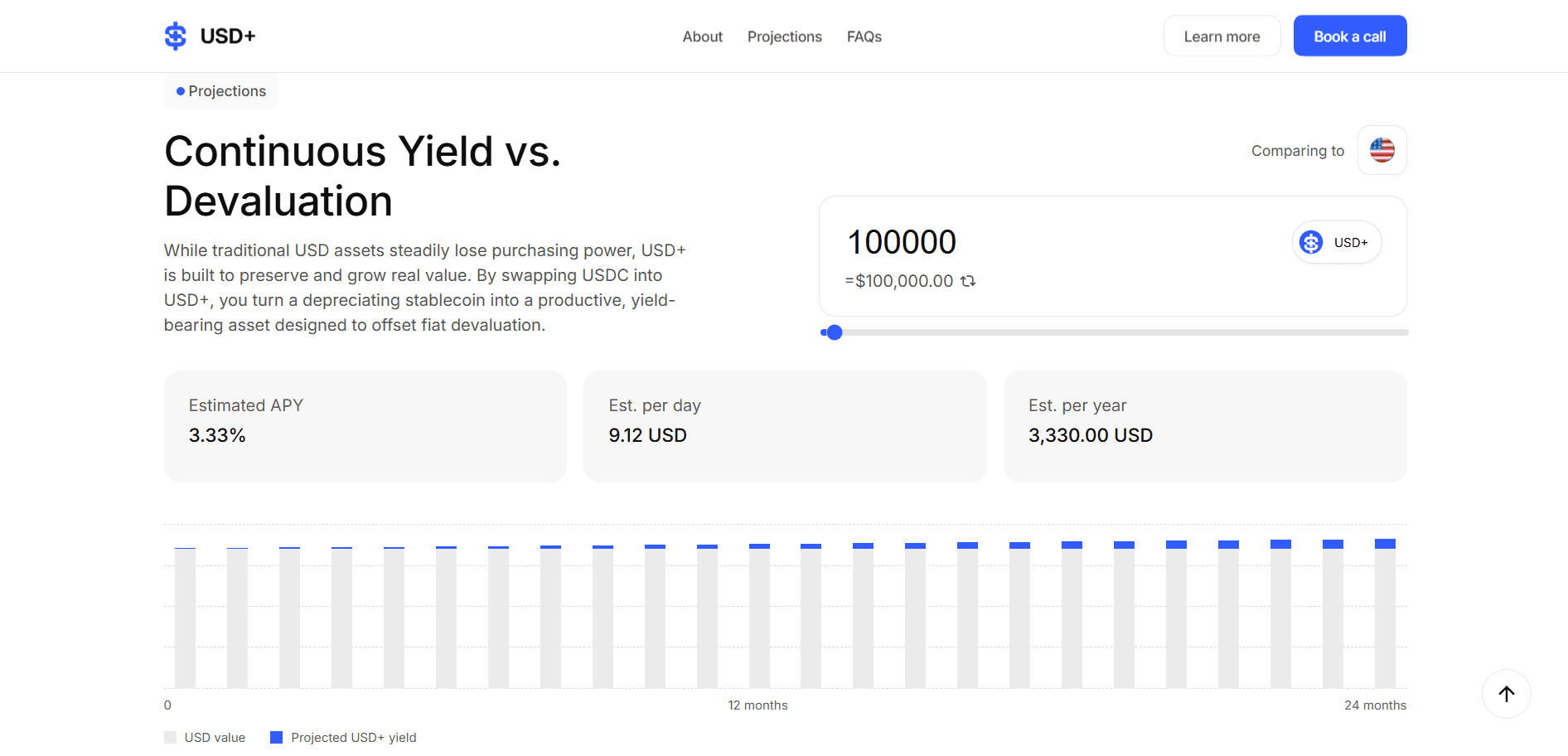
Treasury management is the primary use case. Web3 companies and DAOs holding multi-million-dollar stablecoin treasuries forfeit significant yield by sitting in non-yield-bearing instruments. USD+ converts those idle balances into productive capital without changing how the treasury is operated.
On-chain payroll and contributor payouts can be denominated in USD+ rather than standard stablecoins. Funds waiting in a payroll contract continue earning until they are released to the recipient.
Recurring payment contracts, common in DAOs and remote-first crypto teams, become more capital-efficient when the settlement asset itself is yield-bearing.
Capital between deployments is the most overlooked category. Funds and individual investors regularly hold significant stablecoin balances between trades, deployments, or allocations. USD+ allows that intermediate capital to earn without locking it up or sacrificing composability.
DeFi settlement and collateral is the long-term thesis. USD+ is designed to be used as a yield-bearing settlement asset across DeFi protocols, lending markets, and liquidity pools, providing structural yield on top of any protocol-level returns.
Who Should Use USD+: Stakeholder Groups
USD+ is designed for capital that is being held, not just transacted. The economic case is strongest for any participant managing meaningful balances over meaningful timeframes.
1. Web3 companies and protocols
Operating treasuries denominated in stablecoins represent some of the largest pools of idle capital in crypto. USD+ converts those balances into yield-generating positions without changing the operational model.
2. DAOs
DAO treasuries often hold significant stablecoin reserves earmarked for grants, contributor payments, and ecosystem incentives. USD+ allows those reserves to earn while waiting to be deployed, increasing the effective treasury runway.
3. Crypto-native funds and investors
Funds and individual investors hold stablecoin balances between trades, between deployments, and between fund cycles. USD+ provides a default home for that capital that earns without sacrificing composability or introducing protocol risk.
4. Payroll and recurring payment operators
Teams running on-chain payroll, contributor stipends, or recurring payouts can denominate their flows in USD+. Funds held in payment contracts before disbursement continue to earn yield.
5. DeFi protocols
Protocols can integrate USD+ as a yield-bearing settlement asset, collateral type, or liquidity primitive, layering structural Treasury yield on top of any protocol-native incentives.
What USD+ Is Not: Common Misconceptions
A new yield-bearing stablecoin invites confusion with categories it does not belong to. The clarifications below address the most common ones.
USD+ is not an algorithmic stablecoin
The peg is maintained by 1:1 backing with short-term U.S. Treasury Bills held by licensed custodians, not by algorithmic supply adjustments or seigniorage.USD+ is not a staking product
Yield accrues by holding the token. There is no staking contract to enter, no unbonding period, and no claim transaction. The yield model is structural, not incentive-based.USD+ is not a DeFi yield strategy
The yield comes from the U.S. Treasury Bills backing the token, not from variable DeFi lending rates, liquidity mining, or protocol emissions. The rate fluctuates with prevailing U.S. interest rates, not with DeFi demand cycles.USD+ is not a wrapped or synthetic version of USDC
It is an independently issued stablecoin minted through M0's infrastructure, with its own reserve backing and verification model.USD+ is not the same as STREAM
STREAM is Streamflow's protocol token, used for governance and revenue-backed staking rewards. USD+ is a separate product, a stablecoin designed for treasury and settlement use cases.
How USD+ Yield Is Verified On-Chain
The credibility of any yield-bearing stablecoin depends on whether the underlying reserves and the yield distribution can be independently verified. USD+ inherits this from M0's stablecoin infrastructure.
Collateral backing USD+ is locked through the M0 Protocol and held by licensed custodians. Validators in the M0 system continuously monitor Treasury holdings to ensure full backing. This is structurally different from the periodic attestation model used by legacy stablecoins.
The yield distribution itself is on-chain. Holders can verify that additional USD+ tokens are arriving in their wallets daily, and the underlying reserve composition is transparent through M0's verification layer.
USD+ Security and Custody
Security in a yield-bearing stablecoin runs across two layers:
The asset backing the token
The smart contract logic that mints, burns, and distributes it.
The asset layer is U.S. Treasury Bills, held by licensed custodians under M0's infrastructure. This is the most conservative collateral profile available in stablecoin design.
USD+ is powered by M0's stablecoin infrastructure, where issuers lock verified collateral through the M0 Protocol. U.S. Treasury holdings are transparently tracked and continuously monitored by validators to ensure full backing.
The smart contract layer is built on Solana and inherits the chain's high-throughput, low-cost execution environment. Streamflow's broader infrastructure is audited by FYEO and OPCODES, with audited smart contract architecture across its product suite.
The combination, conservative collateral, licensed custody, continuous verification, and audited on-chain logic, is what differentiates USD+ from earlier yield-bearing stablecoin experiments that relied on opaque or experimental backing.
USD+ on Solana: Why the Chain Matters
USD+ is intentionally Solana-native. The chain's properties are what make daily on-chain yield distribution and full DeFi composability practical at scale.
Solana supports 65,000+ transactions per second, delivers sub-second finality, and operates at near-zero fees. For a yield-bearing stablecoin, this matters in three ways: daily yield distributions across thousands or millions of wallets are economically viable, on-chain verification and redemption settle in seconds, and USD+ can be used across Solana DeFi without bridging overhead or fragmented liquidity.
Streamflow is Solana-native across its entire product line, from vesting and locks to airdrops, staking, payments, and now USD+. The platform is listed in the official Solana documentation under token vesting and operates as a core infrastructure layer in the ecosystem.
USD+ Inside the Streamflow Stack
USD+ is not a standalone product, it is the stablecoin layer of Streamflow's financial OS for Internet Capital Markets on Solana. That integration is the differentiator.
A founder vesting tokens through Streamflow can hold treasury reserves in USD+.
A DAO running a Streamflow airdrop can fund the campaign in USD+.
A team using Streamflow's recurring payments for contributor payroll can denominate streams in USD+, so funds held in the contract continue earning until disbursement.
A protocol using Streamflow staking pools can structure reward emissions against a yield-bearing settlement asset.
No other Solana stablecoin sits inside an existing distribution, vesting, payroll, and staking stack used by 40,000+ projects. That is the structural advantage.
For teams already operating on Streamflow, adopting USD+ is not a separate integration. It is a configuration change on capital they are already moving through the platform.
How to Access USD+ Through Streamflow
Once live, USD+ is designed to be accessible directly through Streamflow's interface, using any standard Solana wallet.
Connect a Solana wallet: Phantom, Backpack, Solflare, or any compatible wallet.
Open the USD+ section in the Streamflow app.
Swap from USDC, USDT, or on-ramp fiat into USD+.
Hold USD+ in the connected wallet to begin earning daily yield automatically.
Use USD+ across Solana DeFi or hold it as a treasury asset, while yield continues to accrue.
Early access is being prioritized for users on the public waitlist. The product was announced at the end of 2025 and is rolling out through Streamflow's interface with progressive access.
Conclusion
Streamflow is building the financial OS for Internet Capital Markets on Solana, and USD+ is the stablecoin layer of that infrastructure.
It takes a category that has historically extracted yield from holders and redirects that yield back on-chain, daily, without staking, lockups, or composability tradeoffs.
For Web3 treasuries, DAOs, funds, and protocols holding stablecoin balances in 2026, USD+ represents a structural upgrade: the same peg, the same composability, the same wallet experience, with Treasury-backed yield distributed where it should have been all along.
Book a demo with Streamflow to explore how USD+ and the broader Streamflow stack can power your treasury, payroll, and on-chain capital operations.
Read Next:
FAQs:
1. What is USD+ in crypto?
USD+ is a yield-bearing stablecoin built on Solana by Streamflow, backed by short-term U.S. Treasury Bills and powered by M0's stablecoin infrastructure. USD+ is designed to maintain a $1 peg while distributing the yield generated by its underlying Treasury reserves directly to holders' wallets on a daily basis, with no staking, lockups, or claim flows required.
2. How does USD+ generate yield?
USD+ generates yield from the short-term U.S. Treasury Bills that back the token. Unlike traditional stablecoins where this yield is retained by the issuer, USD+ passes the yield through to holders on-chain, daily, as additional tokens.
3. What is the difference between USD+ and USDC?
USD+ and USDC are both U.S. dollar-pegged stablecoins backed by similar reserve assets, including short-term U.S. Treasuries. The structural difference is that USDC retains the yield generated by its reserves, while USD+ distributes that yield directly to holders on-chain, daily. The peg, composability, and wallet experience are comparable.
4. Is USD+ safe to hold?
USD+ is backed by short-term U.S. Treasury Bills, held by licensed custodians under M0's stablecoin infrastructure, and continuously verified on-chain by validators monitoring full reserve backing. The smart contract layer runs on Solana, and Streamflow's broader infrastructure is audited by FYEO and OPCODES.
5. Do I need to stake USD+ to earn yield?
No. USD+ does not require staking, lockups, or any claim transaction to earn yield. Holders earn the daily yield automatically simply by holding USD+ in a Solana wallet. The yield is distributed on-chain as additional tokens.