General
Solana Airdrop Quality Index: Vested vs. Non-Vested Distributions Compared
Streamflow is the most trusted token distribution platform on Solana, giving crypto projects the infrastructure to run structured, transparent, and scalable airdrop campaigns from a single on-chain system.
Airdrops are one of the most powerful growth tools in Web3, but the difference between one that builds a lasting community and one that triggers an immediate dump comes down to how the distribution is designed.
This article compares vested and non-vested airdrops across five quality dimensions so you can choose the right structure for your project and execute it with confidence.
Key Takeaways
Vested airdrops outperform non-vested distributions on every metric that builds a sustainable token economy.
Streamflow supports both models, with vesting structures including linear, cliff, milestone, and price-based.
Solana's near-zero fees and sub-second finality make vested airdrops at scale economically viable for any project.
What is a Solana Airdrop
A Solana airdrop is the on-chain distribution of SPL tokens to a group of wallet addresses, executed through smart contracts on the Solana blockchain.
Unlike traditional marketing campaigns that reward users with points, credits, or off-platform incentives, a Solana airdrop delivers real, transferable tokens directly to recipient wallets, with every transaction recorded on-chain and publicly verifiable.
Solana is the infrastructure layer that makes large-scale airdrops economically viable. With 65,000+ transactions per second, sub-second finality, and near-zero fees, distributing tokens to thousands or millions of recipients on Solana costs a fraction of what the same campaign would cost on Ethereum, and settles in seconds rather than minutes.
This is why Solana has become the dominant chain for token distribution campaigns at scale.
Platforms like Streamflow can execute airdrops reaching up to one million recipients in a single campaign, with each recipient's allocation recorded on-chain and verifiable in real time.
Solana airdrops are used across the full spectrum of Web3 project types:
Token launches distributing supply to early community members
DeFi protocols rewarding liquidity providers
GameFi ecosystems releasing in-game currency to players
NFT projects activating holder communities
DAOs compensating contributors
The mechanism is the same in every case: tokens move from a project-controlled wallet or smart contract to a defined list of recipient addresses, based on rules set before the distribution begins.
What varies enormously is the structure of that distribution. Before comparing models, the definitions need to be precise.
1. Token Airdrop
A token airdrop is the distribution of tokens to a group of users, typically used for growth, community incentives, or retroactive rewards. The mechanism is well-established. What varies enormously is the structure of that distribution.
2. Non-Vested Airdrop
A non-vested airdrop delivers tokens immediately. Recipients receive their full allocation in one transaction, with no lockup and no ongoing conditions. They can sell, hold, stake, or do nothing, immediately, on receipt.
3. Vested Airdrop
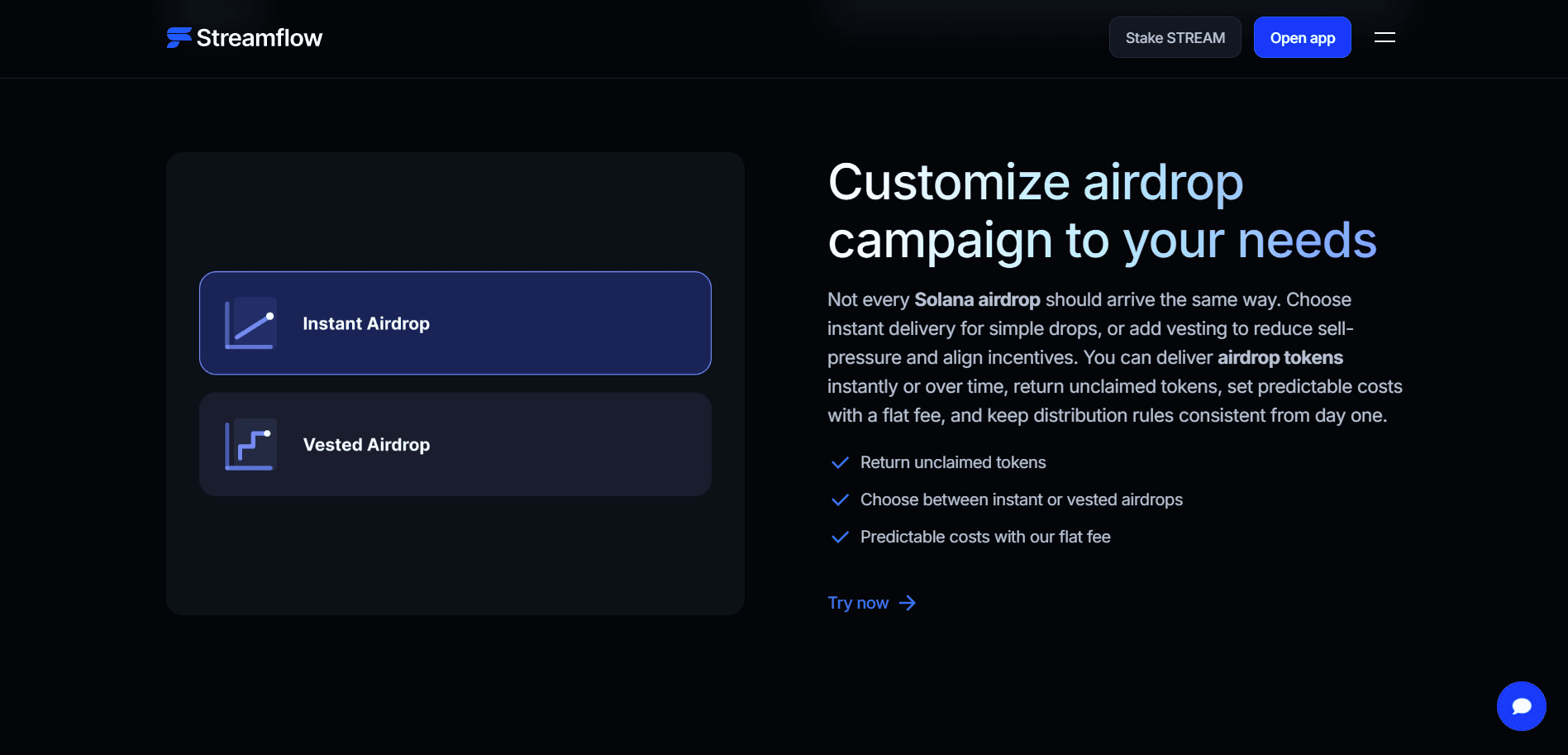
A vested airdrop structures the same allocation as a release schedule. Recipients see their full entitlement but receive tokens incrementally over a defined period, weekly, monthly, or tied to milestones. The schedule is enforced on-chain, meaning no party can alter it once deployed.
4. Price-Based Airdrop
A price-based airdrop unlocks distribution when the token reaches a defined price threshold, aligning recipient rewards with token performance.
5. Claim Portal and Claim Window
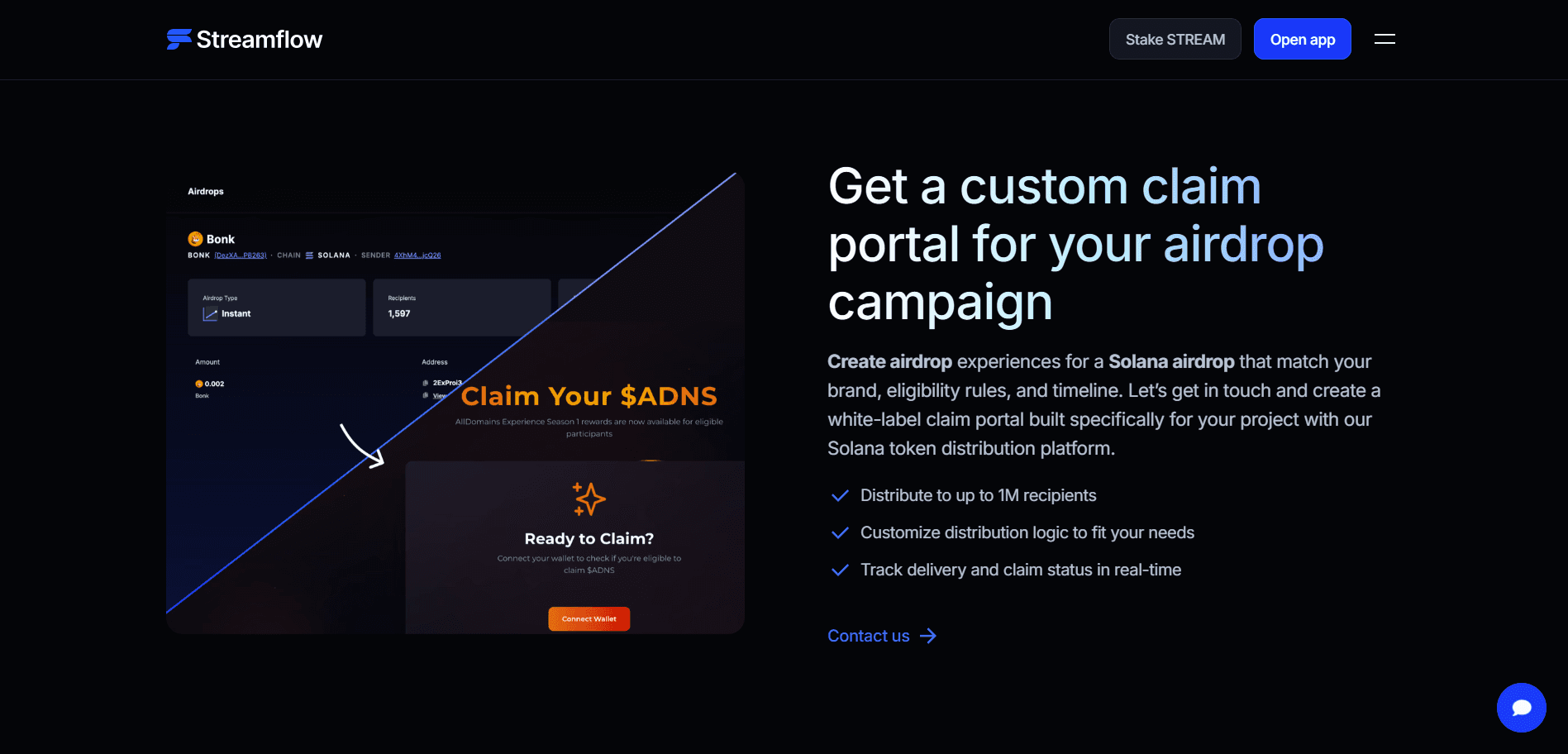
A claim portal is the user-facing interface where eligible recipients connect a wallet and access their allocation. A claim window is the defined period during which claims are active, unclaimed tokens can be returned to the project treasury after the window closes, preventing permanent supply leakage.
The distinction between vested and non-vested is not administrative. It is structural. And the structural difference produces radically different outcomes.
Why Solana Changes the Cost Equation
The historical argument for non-vested airdrops was partly economic.
On Ethereum, running a vested airdrop, with individual smart contracts per recipient, multiple transactions over time, and gas costs at every step, was genuinely expensive. The cost-per-recipient of a vested structure could be multiples of an instant drop. Projects defaulted to non-vested because vested was punishingly expensive at scale.
Solana eliminates this constraint entirely.
With 65,000+ transactions per second, sub-second finality, and near-zero transaction fees, the operational cost of running a vested airdrop on Solana is effectively zero per recipient.
A campaign reaching one million recipients, with individual vesting schedules, on-chain verification, and a real-time tracking dashboard, costs a fraction of what a comparable Ethereum distribution would cost, and executes faster than most teams can process a spreadsheet.
This matters because cost was the last structural argument for non-vested airdrops among projects that cared about quality. That argument no longer holds.
The Airdrop Quality Index
Quality in token distribution can be measured across five dimensions. Together, they form what we're calling the Solana Airdrop Quality Index, a framework for evaluating whether a distribution actually achieves what it's supposed to achieve.
Dimension 1: Recipient Alignment
Does the airdrop reach people likely to hold, use, or advocate for the token, or just farm it?
High recipient alignment means tokens reach genuine community members.
Low alignment means they reach wallets optimized to extract and exit.
Dimension 2: Token Retention Rate
What percentage of distributed tokens remain in recipient wallets 30, 60, and 90 days post-distribution?
This is the most direct measure of whether a campaign produced holders or harvesters.
Dimension 3: Price Impact
Does distribution create immediate sell pressure, or is supply introduced gradually enough for markets to absorb?
A quality airdrop considers the market dynamics of its own execution.
Dimension 4: Community Activation
Does receiving the airdrop increase the likelihood that a recipient becomes an active participant in the ecosystem: staking, voting, using the protocol?
Or does it produce a one-time claim with no ongoing engagement?
Dimension 5: Long-Term Holder Conversion
How many airdrop recipients become long-term token holders?
This is the ultimate measure of whether a distribution built a community or just moved tokens.
Every airdrop can be evaluated against these five dimensions. The comparison between vested and non-vested models becomes clear when you apply this framework systematically.
Non-Vested Airdrops: Where They Work and Where They Don't
Non-vested airdrops are not inherently bad. They are appropriate in specific contexts, and attempting to vest every distribution is as much of a mistake as never vesting any.
Non-vested airdrops work when the campaign is purely retroactive: rewarding past behavior where imposing vesting would feel punitive rather than aligned.
They work when the goal is broad awareness and wallet reach rather than long-term holder conversion.
They work when the token is already established, with price stability and a low probability that a single distribution event will move markets materially.
And they work when the recipient list is pre-filtered through existing behavior, such as airdropping to active stakers, governance participants, or verified community members who have already demonstrated commitment.
Where non-vested airdrops fail is on the Quality Index:
Dimension | Non-Vested Score | Why |
|---|---|---|
Recipient Alignment | Low–Medium | No mechanism distinguishes genuine holders from farmers |
Token Retention | Low | Immediate liquidity creates immediate sell incentive |
Price Impact | Low | Full supply hits markets simultaneously |
Community Activation | Low | No ongoing engagement hook after the claim event |
Long-Term Holder Conversion | Low | The incentive to hold ends at the moment of receipt |
The dump pattern is predictable and well-documented. Without a token vesting schedule, airdrop recipients have no economic reason to hold tokens beyond the moment of receipt. The result is high claim volume followed by concentrated sell pressure in the first 24–72 hours.
This is not a failure of execution, it is a failure of design. The structure produces the outcome.
This undermines the stated purpose of most airdrop campaigns. Projects run airdrops to build community and reward long-term supporters. Non-vested distributions, by design, reward the opposite, speed of exit rather than depth of commitment.
Vested Airdrops: How Structure Changes Outcomes
A vested airdrop is, at its core, a selection mechanism as much as a distribution mechanism. Recipients who accept a vested allocation are choosing to wait. That choice is informative.
Vesting structures available through platforms like Streamflow include:
Linear release (equal tokens per period)
Cliff vesting (no release until a defined date, then full or linear distribution begins)
Cliff plus linear (delay followed by gradual release)
Milestone-based vesting (tokens unlock when specific protocol or community milestones are achieved)
Price-based vesting (tokens unlock at defined price thresholds, directly aligning recipient rewards with token performance).
Each of these creates a different incentive structure:
Linear vesting smooths supply release over time.
Cliff vesting signals a commitment period before any liquidity is available.
Milestone vesting ties token access to ecosystem growth.
Price-based vesting makes recipients partners in the token's market success.
Against the Quality Index:
Dimension | Vested Score | Why |
|---|---|---|
Recipient Alignment | High | Vesting acceptance self-selects for patience and long-term interest |
Token Retention | High | Tokens cannot be liquidated before unlock |
Price Impact | High | Gradual release is absorbed by markets without shock |
Community Activation | High | Ongoing unlock events create recurring engagement touchpoints |
Long-Term Holder Conversion | High | Psychological commitment increases with vesting duration |
The community activation dimension is often underappreciated. Each unlock event in a vested airdrop is a re-engagement moment, a reason to log back in, check balances, and reconnect with the project. Non-vested airdrops produce a single engagement event: the claim. Vested airdrops produce recurring engagement over the entire vesting period.
The psychological dimension is also real. Research on commitment and consistency shows that people who have accepted a delayed reward develop stronger attachment to the underlying asset than those who receive an immediate payment. Vesting creates commitment through structure.
Side-by-Side Comparison
Factor | Non-Vested Airdrop | Vested Airdrop |
|---|---|---|
Token delivery | Immediate | Scheduled release |
Sell pressure | High (Day 1) | Low (distributed over time) |
Recipient filtering | None | Implicit — vesting acceptance signals intent |
Price impact timeline | Immediate shock | Gradual, market-absorbable |
Community engagement | One-time event | Recurring unlock touchpoints |
On-chain transparency | Basic | Full — verifiable via Solscan / Solana Explorer |
Unclaimed token recovery | Possible | Yes — via claim window logic |
Execution complexity | Low | Low — no code required on platforms like Streamflow |
Best suited for | Retroactive rewards, pre-filtered audiences | Community building, contributor rewards, long-term alignment |
The execution complexity row is critical. The assumption that vested airdrops are more complex to run is no longer accurate.
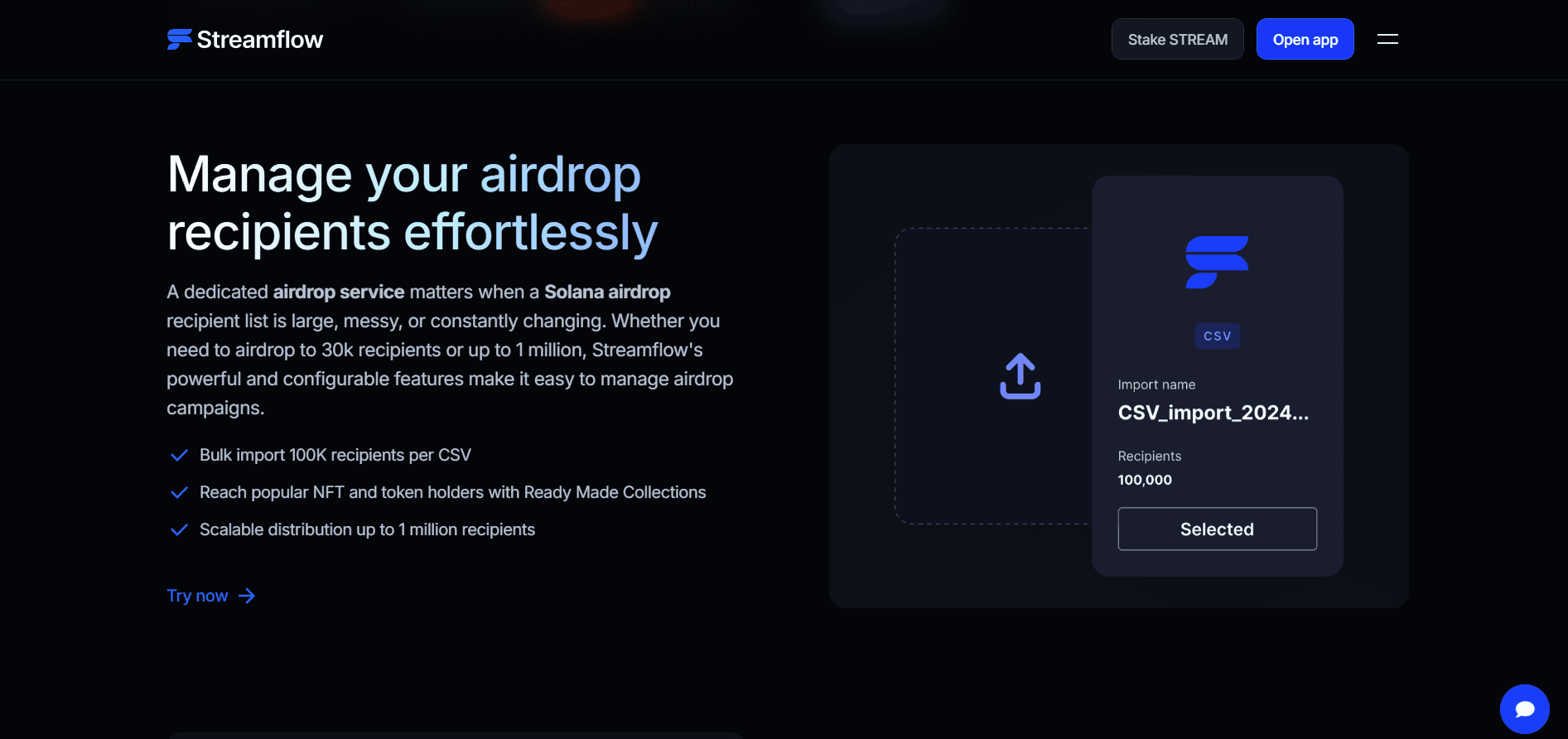
Platforms like Streamflow eliminate the engineering overhead entirely, upload a recipient CSV, configure a vesting schedule, deploy, and track. No custom smart contract development. No manual releases. No operational overhead as schedules progress.
The contracts execute automatically and are verifiable on-chain without any action from the issuing team.
When to Use Each Model
The Quality Index is not an argument for vesting every airdrop. It's an argument for choosing the model that matches the campaign's actual objectives.
Use a Non-Vested Airdrop When
The distribution rewards past behavior and vesting would feel punitive
The goal is reach and awareness rather than holder conversion
The recipient list is pre-filtered through demonstrated commitment
The token has established price stability and cannot be materially moved by a single distribution
Use a Vested Airdrop When
The goal is building a long-term holder base
The airdrop is part of a token launch and immediate sell pressure would damage price stability
Recipients are contributors, early supporters, or community members whose alignment matters over time
The project wants on-chain proof of distribution commitment that investors and the community can verify
Use a Hybrid Approach When
A portion of the allocation is delivered instantly as an immediate trust signal, with the remainder vested
Different recipient segments have different alignment profiles — existing holders receive instant grants while new community members receive vested allocations
The campaign includes both retroactive and forward-looking components
The hybrid model is increasingly common among sophisticated projects that want the reach of an instant drop combined with the retention mechanics of vested distribution.
What the Evidence Shows
Three case studies from Streamflow's ecosystem illustrate how vesting decisions produce measurable outcomes.
1. Bonk
55% of its total supply to airdrops for early Solana users, one of the largest community distributions in the ecosystem's history.
This was a non-vested distribution by design, serving a specific purpose: rewarding existing community members who had already demonstrated commitment through their presence in the ecosystem during Solana's early period.
For the team allocation, 20% of total supply across 22 early contributors, Bonk used Streamflow to enforce a 3-year linear vesting schedule. The outcome was a verifiable, public commitment that the team's tokens were locked and could not be accessed prematurely.
The lesson is not that Bonk chose one model over the other. It chose both, for different purposes. The community distribution built reach. The vested team allocation built credibility. Neither would have produced the same outcome without the other.
2. UXD Protocol
UXD Protocol, a decentralized stablecoin provider on Solana, distributed its $UXP governance token with approximately 46% of total supply subject to a 4-year linear vesting schedule with a 12-month cliff.
The structure served a specific strategic purpose: UXD integrated the Streamflow SDK directly into Realms, Solana's governance platform, so recipients could claim tokens and participate in governance from a single interface.
The vesting schedule was not an obstacle to participation, it was synchronized with it. As tokens unlocked over four years, recipients had both the ability and the incentive to engage with governance decisions that would affect the value of their remaining unvested allocation.
This is the alignment mechanism at its most effective. The vesting schedule created a multi-year reason to stay engaged with the protocol.
3. Heavenland
Heavenland, a Solana-based metaverse, placed 97% of its $HTO token supply through 5-year linear vesting, with all allocations subject to cliffs. The structure was designed to allow initial liquidity, enough for a functioning market to develop, without triggering the kind of inflation that would undermine the in-game economy.
The outcome was a more engaged, dedicated player community. When recipients understand that their allocation is tied to the long-term health of the ecosystem, their behavior changes. They become stakeholders rather than recipients.
The Heavenland case demonstrates something counterintuitive: extreme vesting coverage does not necessarily reduce community enthusiasm.
When the structure is communicated clearly and the underlying product justifies the wait, vesting can strengthen community commitment rather than frustrate it.
How to Execute a Vested Airdrop on Solana
The mechanics of running a vested airdrop through Streamflow require no custom smart contract development and minimal technical overhead.
Step 1: Build and Upload the Recipient List
Prepare a CSV with wallet addresses and token allocations. Streamflow supports up to 100,000 recipients per CSV file. Enterprise campaigns can reach 1 million recipients total.
At this stage, apply any audience segmentation, different recipient groups can receive different vesting structures within the same campaign.
Step 2: Configure the Vesting Schedule
Select from linear, cliff, cliff plus linear, milestone-based, or price-based structures. Define the cliff date if applicable, the total vesting duration, and the release frequency.
The parameters are set once and enforced on-chain, no manual intervention required as the schedule progresses.
Step 3: Set Up the Claim Portal
Define the claim window, the period during which recipients can access their allocation. Configure real-time delivery status and claim tracking. Enable unclaimed token recovery so that allocations not claimed within the window return to the treasury rather than sitting permanently unclaimed.
Step 4: Deploy and Fund
Streamflow deploys the contracts on Solana. Once deployed, the contracts are immutable, no unilateral changes can be made to the schedule by any party.
This immutability is the source of the trust signal that vested airdrops provide. The project cannot change its mind after deployment.
Step 5: Track in Real Time
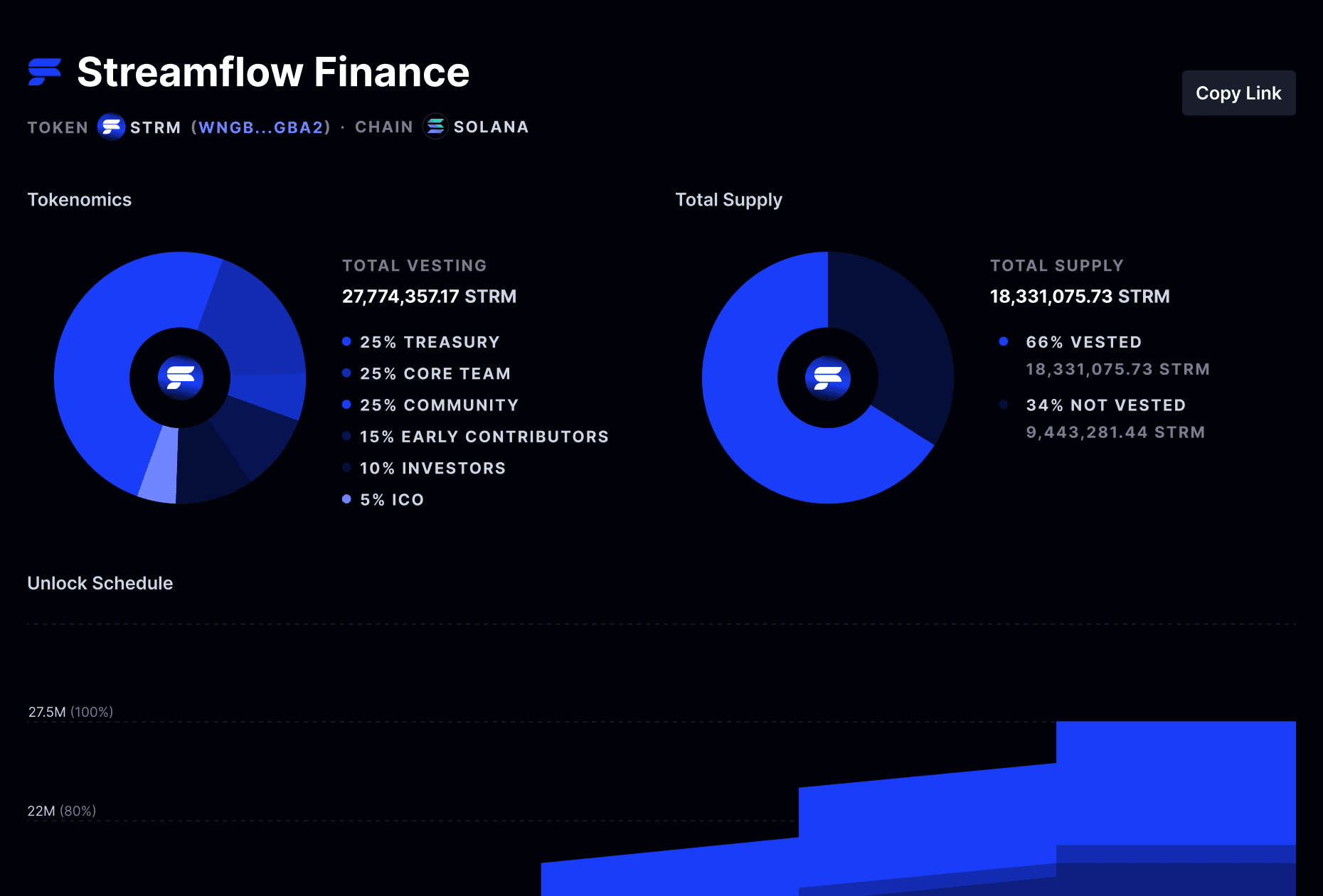
Streamflow's tokenomics dashboard provides a unified view of distribution status, claim rates, and upcoming unlock events. All contracts are publicly verifiable on Solscan and Solana Explorer via shareable proof links. The dashboard serves as the single source of truth for the community, investors, and the team.
The entire process, from recipient upload to live distribution, requires no engineering resources beyond what any non-technical team member can operate.
Advanced Quality Signals
Beyond the vested vs. non-vested decision, several additional factors separate good airdrop campaigns from exceptional ones.
1. Audience Segmentation
Audience segmentation is the most underused lever. Different recipient groups warrant different structures.
Contributors who built the protocol should receive longer vesting with cliffs that reflect the depth of their commitment.
Early community members might receive shorter schedules.
New users brought in through a growth campaign might receive a hybrid, instant access to a small portion with the majority vested.
Treating all recipients identically regardless of their relationship to the project is a lost optimization opportunity.
2. Sybil Resistance
Sybil resistance determines whether the recipient list reflects real users or farming wallets optimized to extract value from airdrop campaigns. Streamflow provides a sybil checker as a utility tool to filter recipient lists before distribution.
A vested airdrop distributed to a clean recipient list produces dramatically better retention outcomes than the same structure distributed to a compromised list.
3. Post-Claim Activation Path
Post-claim activation is the element most teams forget to design. The best airdrops include a natural next step: staking, governance participation, protocol use, that converts claim events into ecosystem engagement.
Streamflow's staking infrastructure integrates directly with distribution campaigns, meaning recipients can move from claiming tokens to staking them within the same platform, converting airdrop participants into long-term protocol stakeholders.
4. On-Chain Transparency
On-chain transparency is not just a technical feature, it is a trust signal. Public proof links, Solscan verification, and a real-time tokenomics dashboard give recipients confidence that the distribution is executing exactly as designed and that no party has the ability to alter the schedule to their advantage.
Mistakes That Lower Airdrop Quality
Knowing what degrades airdrop quality is as useful as knowing what improves it.
1. No Vesting on Large Community Allocations
No vesting on large community allocations is the most common and most costly mistake. The larger the allocation relative to circulating supply, the more critical vesting becomes.
A distribution that represents 20% of circulating supply hitting the market simultaneously is not a community event, it is a price event.
2. No Claim Window
No claim window creates permanent supply leakage. When unclaimed tokens are never recovered, they represent allocations that neither activated recipients nor returned value to the treasury.
A defined claim window with automatic token recovery gives the project control over this outcome.
3. No Recipient Filtering
No recipient filtering means farming wallets receive the same allocation as genuine community members. This is not just an efficiency problem, it signals to real community members that their participation is no more valued than automated extraction.
4. No Post-Claim Engagement Path
No post-claim engagement path wastes the momentum of a successful distribution. A recipient who has just claimed tokens is the most receptive they will ever be to the project's next call to action.
Not having that call to action ready is a missed conversion.
5. No On-Chain Verification
No on-chain verification undermines trust in the distribution's integrity. If the community cannot independently verify that the distribution is executing as promised, the vesting schedule provides structural protection but not the trust signal it's capable of generating.
6. No Tokenomics Dashboard
No tokenomics dashboard makes distribution opaque at the moment investors and community members most need visibility. The period immediately after a major airdrop is when questions about supply impact are highest.
A public, real-time dashboard answers those questions before they become concerns.
Conclusion
Streamflow is the best airdrop platform on Solana, and vested distributions are the highest-quality tool it offers for projects that want to build a token economy designed to last.
If your airdrop is moving tens of thousands or millions of tokens to new recipients, the structure of that distribution will determine whether those recipients become long-term holders or one-time farmers.
Book a demo with Streamflow to design and execute your airdrop campaign on Solana with the right vesting structure, full on-chain transparency, and distribution capacity for up to one million recipients.
Read Next:
FAQs:
1. What is the difference between a vested and a non-vested airdrop?
A vested airdrop releases tokens to recipients gradually over a defined schedule rather than all at once. A non-vested airdrop delivers the full allocation immediately on claim. Vested airdrops reduce sell pressure, improve recipient alignment, and create ongoing engagement touchpoints through recurring unlocks.
2. Why do vested airdrops produce better token retention?
Vested airdrops produce better token retention because recipients cannot liquidate their allocation before the unlock schedule allows it.
3. How many recipients can a Streamflow airdrop campaign reach?
Streamflow supports airdrop campaigns reaching up to one million recipients in a single distribution. Standard plans support up to 30,000 recipients per campaign, with enterprise capacity available for larger launches. CSV imports support up to 100,000 recipient wallets per file.
4. Can vested airdrops be verified on-chain?
Yes. All Streamflow vesting contracts are verifiable on Solscan and Solana Explorer. Streamflow generates shareable proof links for every contract, allowing recipients, investors, and community members to independently confirm the distribution terms and real-time unlock status without relying on the issuing project to report it.
5. Does Streamflow require custom smart contract development to run a vested airdrop?
No. Streamflow requires no custom smart contract development to run a vested airdrop at any scale. Projects upload a recipient CSV, configure their chosen vesting structure, and deploy directly through the Streamflow interface.