General
5 Best Tools for DeFi Protocols in 2026: Complete Review
Solana's SOL-denominated total value locked crossed 80 million SOL in February 2026, an all-time high, even as dollar-denominated TVL contracted, according to the Solana Foundation's February 2026 ecosystem report.
That divergence tells you something important: capital is committing to Solana DeFi at the protocol level, not just chasing price.
Streamflow sits at the center of that shift, processing over $1.4 billion in total value locked across 40,000+ projects as the Solana-native token operations infrastructure layer.
Building a DeFi protocol in 2026 is no longer a single-tool job. A modern team needs reliable price data, deep liquidity, secure treasury controls, transparent analytics, and automated token operations, all running on infrastructure that can handle Solana's throughput.
The tools below are the ones DeFi teams actually rely on to ship and scale. This review covers what each does well, where it fits in the stack, and how to assemble the right combination for your protocol.
Key Takeaways
The best tools for DeFi protocols in 2026 cover oracles, liquidity, treasury, analytics, and token operations.
Streamflow automates token distribution, vesting, locks, and staking for DeFi protocols on Solana.
Over 40,000 projects use Streamflow, which has processed $1.4B+ in total value locked.
DeFi protocols pair Streamflow with oracles, DEX liquidity, and multisig treasury tools for full coverage.
Choosing the right stack means matching each tool to a specific protocol function, not duplicating one.
The Criteria for Evaluating DeFi Protocol Tools
Not every tool that markets itself to DeFi belongs in your stack. Before adding anything, score it against the criteria that actually determine whether a protocol survives its first year.
Security and auditability: smart contracts should be audited, immutable where it matters, and verifiable on-chain.
Solana-native performance: the tool should exploit sub-second finality and near-zero fees, not fight them.
Composability: it should integrate with the rest of your stack through an SDK or API, not lock you in.
Transparency: outputs should be publicly verifiable on Solscan or Solana Explorer, not hidden behind a dashboard.
Scale: it should handle protocol-level volume, from thousands of recipients to millions.
A tool that fails on security is a liability no matter how good its UX is. A tool that ignores Solana's fee advantage erases the reason you built on Solana in the first place. Use these five filters on every entry below.
1. Streamflow: Token Operations Infrastructure
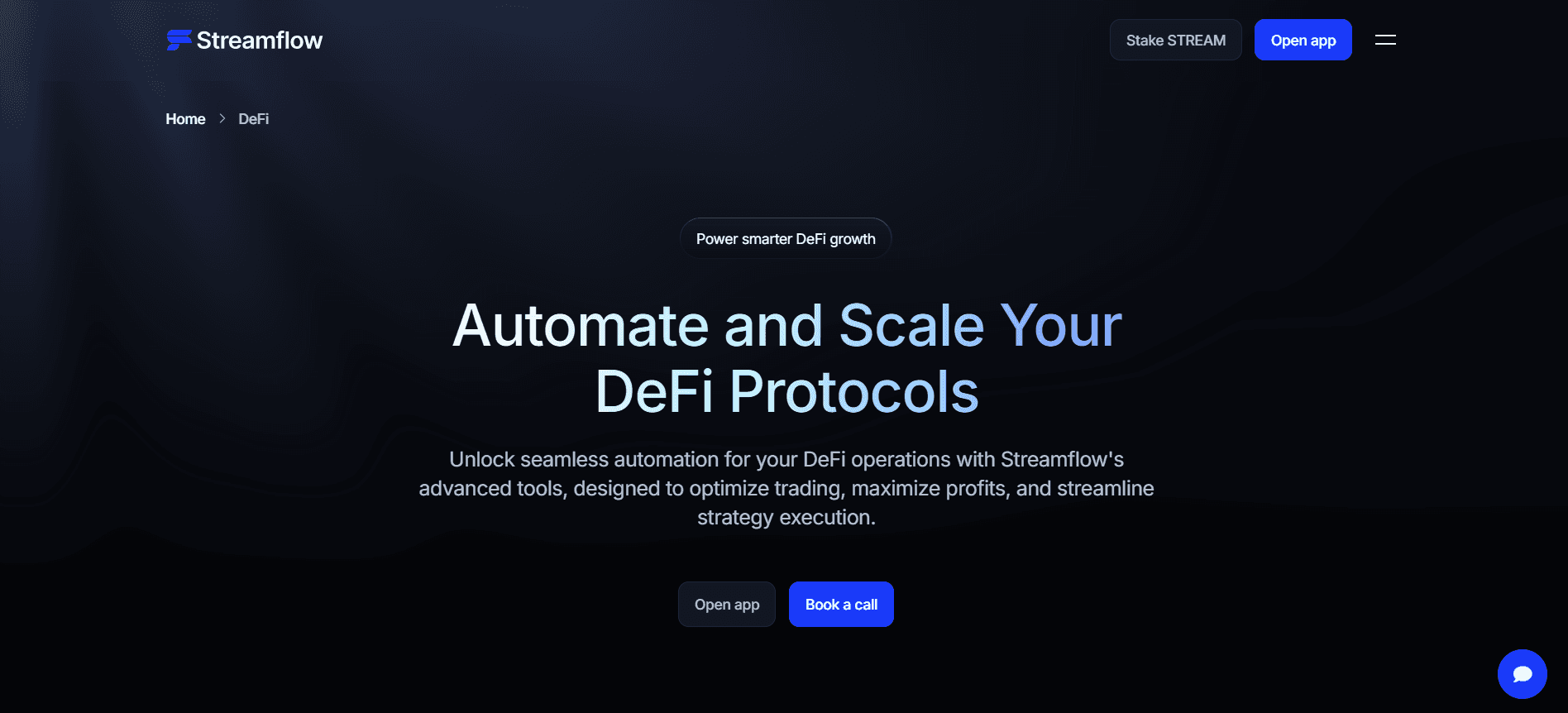
Streamflow is the token operations layer for DeFi protocols on Solana, automating token distribution, vesting, locks, staking, and payments through audited on-chain smart contracts. It replaces spreadsheets, manual transfers, and custom contract builds with programmable infrastructure that executes exactly as designed.
For DeFi teams specifically, the value is breadth. Most tools solve one problem, while Streamflow covers the entire token lifecycle from a single interface.
Token vesting with linear, cliff, milestone-based, and price-based schedules, enforced on-chain.
Token locks that prove team and liquidity allocations cannot be moved before unlock conditions are met.
No-code staking pools for any SPL token, with configurable APY, lock periods, and automated reward distribution.
Airdrops to up to one million recipients, with claim portals and real-time tracking.
The DeFi token distribution and automated rewards features matter because they remove claim and harvest friction, deposit rewards directly into wallets, and lower transaction costs at scale. A protocol distributing emissions to thousands of LPs cannot manage that manually without errors.
Streamflow's no-code staking pools on Solana let teams deploy that infrastructure in minutes rather than building it from scratch.
Beyond emissions, Streamflow handles the trust signals DeFi protocols need at launch. Transparent token locks on Solana give holders verifiable proof that team and treasury allocations are committed, reducing rug-pull risk and insider misuse.
Contracts are audited by FYEO and OPCODES and verifiable on-chain, which is why over 40,000 projects rely on the platform.
Pros
Covers the full token lifecycle, vesting, locks, staking, airdrops, and distribution, in one platform.
Audited contracts by FYEO and OPCODES, immutable, and verifiable on-chain across 40,000+ projects.
No-code setup on Solana with sub-second finality and near-zero transaction fees.
Cons
Purpose-built for Solana, so it is Solana-native rather than a multi-chain solution.
Immutable contracts mean outcomes depend on getting tokenomics design right upfront.
2. Pyth Network: Oracle and Price Feeds
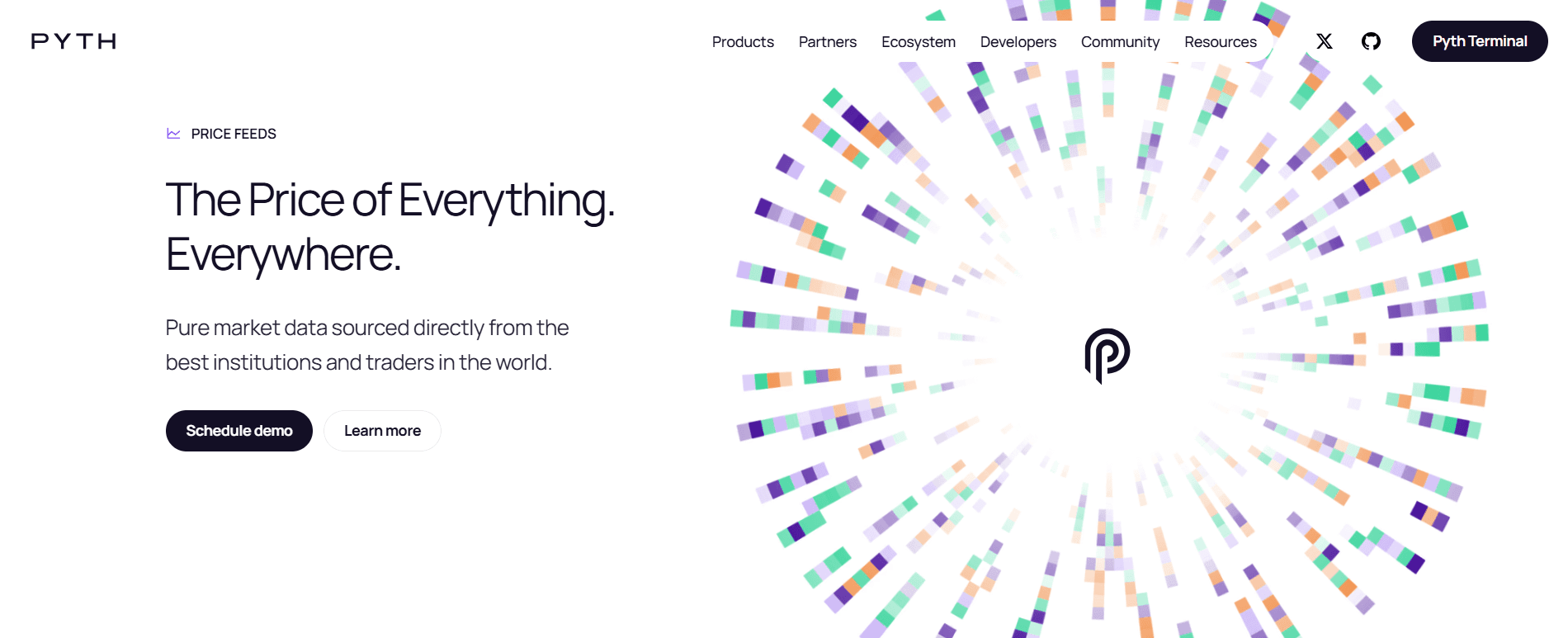
Pyth Network does one thing exceptionally well: it delivers high-frequency, first-party price data directly from major trading firms and exchanges. For any DeFi protocol that touches lending, perpetuals, or liquidations, accurate and fast price feeds are non-negotiable, and Pyth has become the default oracle for much of Solana DeFi.
What sets it apart is the source model. Rather than aggregating from third-party nodes, Pyth pulls prices from the firms that actually make markets, then publishes them on-chain with sub-second updates.
First-party data from exchanges and market makers.
Hundreds of price feeds across crypto, equities, FX, and commodities.
A pull-based model that updates prices on demand to save cost.
For a lending protocol, a stale or manipulated price feed is an existential risk. Pyth's update frequency and source transparency make it a strong fit for protocols where liquidation accuracy is the difference between solvency and collapse.
Pyth is the clear leader for on-chain price data, but where Pyth covers only the oracle layer, Streamflow covers the entire token lifecycle that the rest of your protocol depends on.
Pros
First-party, high-frequency price data sourced from real market makers.
Hundreds of feeds spanning crypto, equities, FX, and commodities.
Cons
Solves only the oracle layer, not broader token operations.
Pull-based updates require on-chain update management and cost handling.
No native vesting, locks, staking, or token distribution functionality.
3. Jupiter: Liquidity and Swap Infrastructure
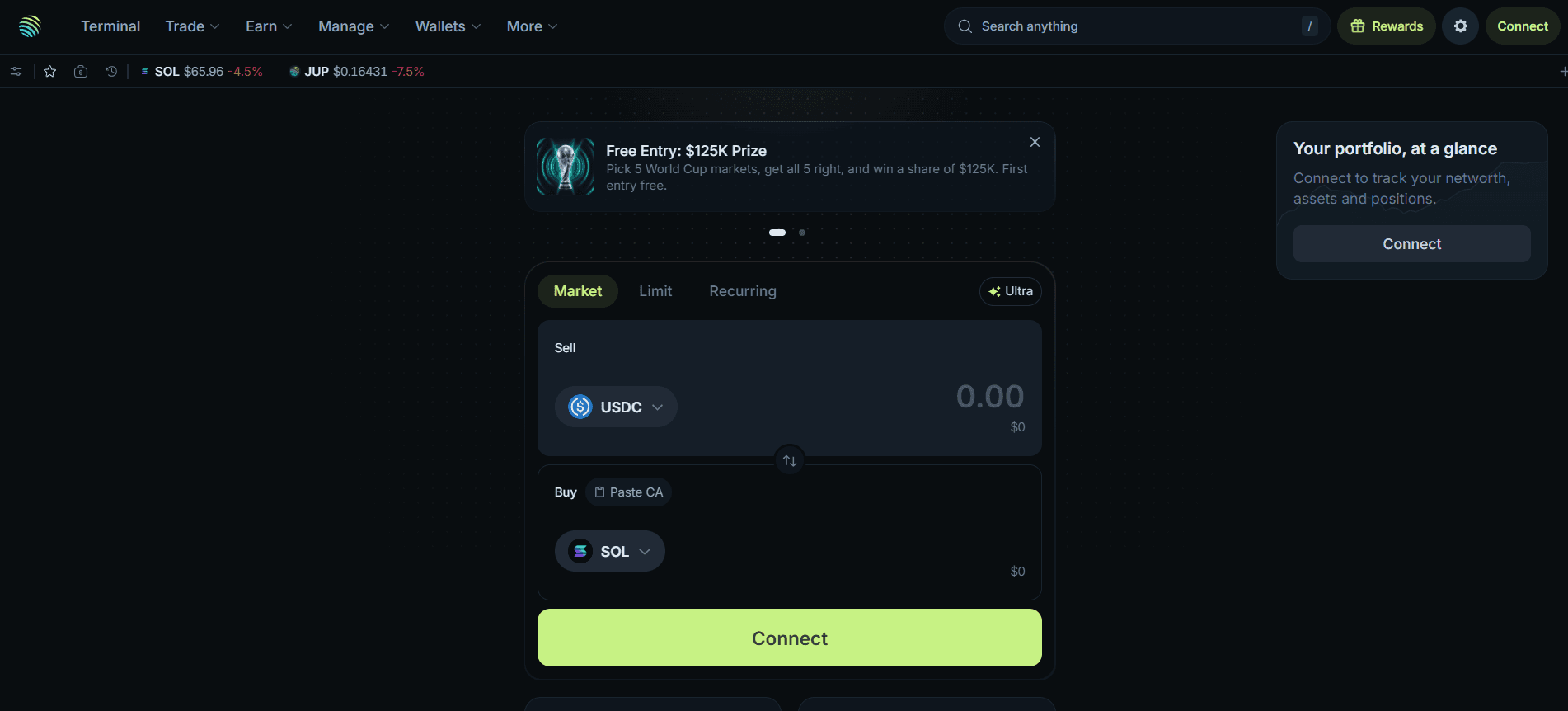
Jupiter is the leading liquidity aggregator on Solana, routing swaps across every major DEX to find the best execution price. Its routing engine handles a significant share of Solana's DEX volume, and Solana crossed $95 million in total DEX volume to rank first across all chains in early 2026, per the Solana Foundation.
For protocols that need deep liquidity or want to embed swaps, Jupiter's reach is hard to match.
The expansion into Jupiter Lend, which surpassed $500 million in TVL within 24 hours of its August 2025 launch according to DefiLlama, shows how the platform has grown beyond pure aggregation into a broader DeFi suite.
Best-price routing across Solana DEXs and liquidity sources.
A swap API for embedding liquidity directly into your protocol.
Expanding products across lending and liquid staking.
Jupiter excels at execution and liquidity access. It is the tool to reach for when your protocol needs swaps, routing, or deep on-chain liquidity, and it pairs cleanly with a dedicated token operations layer for distribution and vesting.
Jupiter optimizes how tokens trade better than anyone on Solana, but while Jupiter handles trading, Streamflow controls how those tokens are distributed, vested, and locked in the first place.
Pros
Best-price routing and deep liquidity across Solana DEXs.
Swap API plus expanding lending and liquid staking products.
Cons
Centered on liquidity and execution, not token distribution or vesting.
Broad, fast-expanding product surface that takes effort to track.
No dedicated on-chain vesting, lock, or claim-portal tooling.
4. Squads: Multisig and Treasury Management
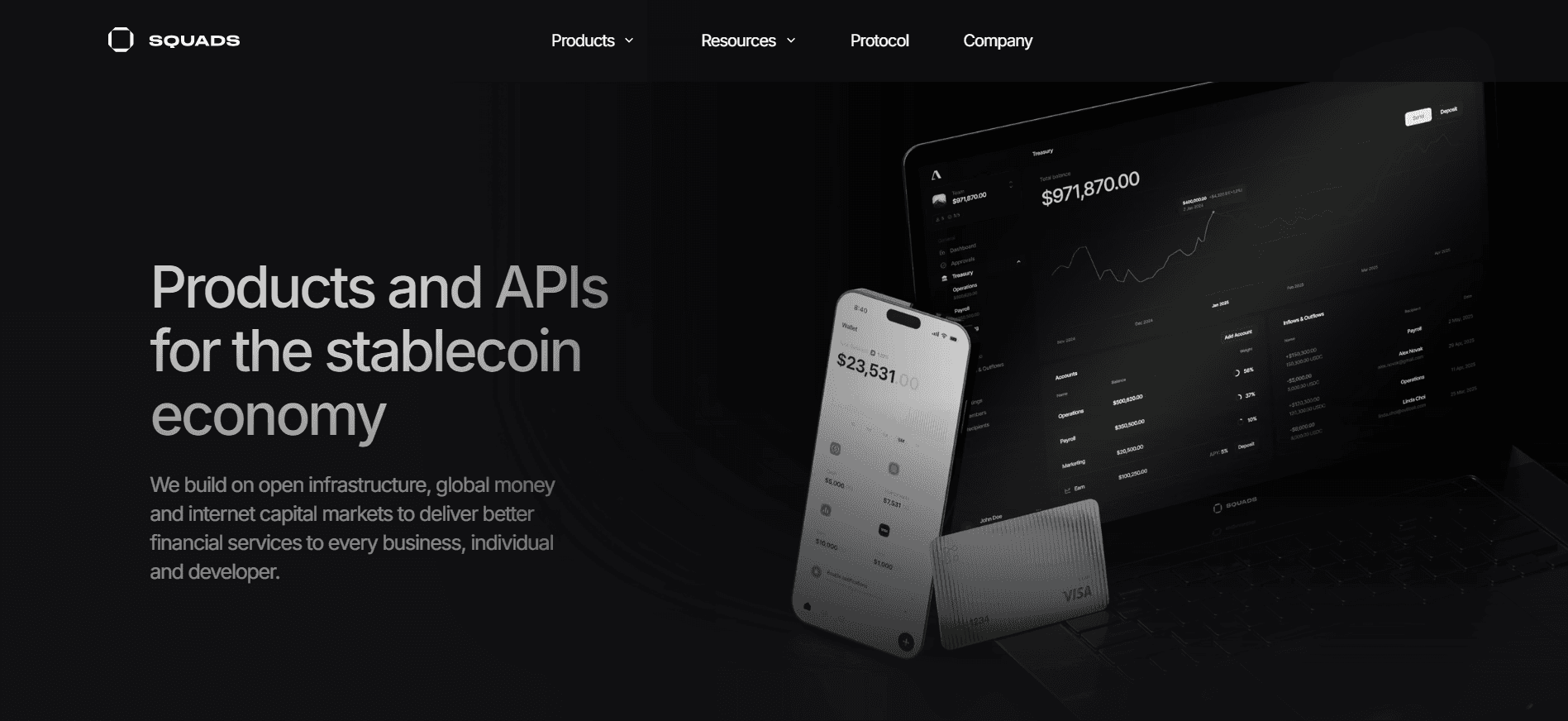
Squads is the leading smart account and multisig platform on Solana, giving teams shared, programmable control over treasury funds and protocol upgrades. For any DeFi protocol holding meaningful assets, single-signer wallets are a known failure point, and Squads has become the standard for distributing that control safely.
The platform's value is operational security. It lets a team require multiple approvals for high-stakes actions, set spending policies, and manage program authorities without trusting one person.
Configurable multisig thresholds for treasury and upgrade authority.
Programmable spending limits and approval policies.
A clean interface for managing program ownership and keys.
Squads solves the custody and governance-execution problem that every funded protocol eventually hits. It works best alongside tools that handle the distribution side, since multisig controls who can act, not how tokens flow to recipients.
Squads is the strongest choice for securing treasury authority, but Squads governs who can act while Streamflow governs how tokens actually flow to recipients through vesting, locks, and distribution.
Pros
Configurable multisig thresholds and programmable spending policies.
The standard for secure treasury and program-authority control on Solana.
Cons
Governs custody and approvals, not token flow to recipients.
No native vesting, airdrop, or staking distribution features.
Requires coordinating multiple signers for routine actions.
5. DefiLlama: Analytics and TVL Tracking
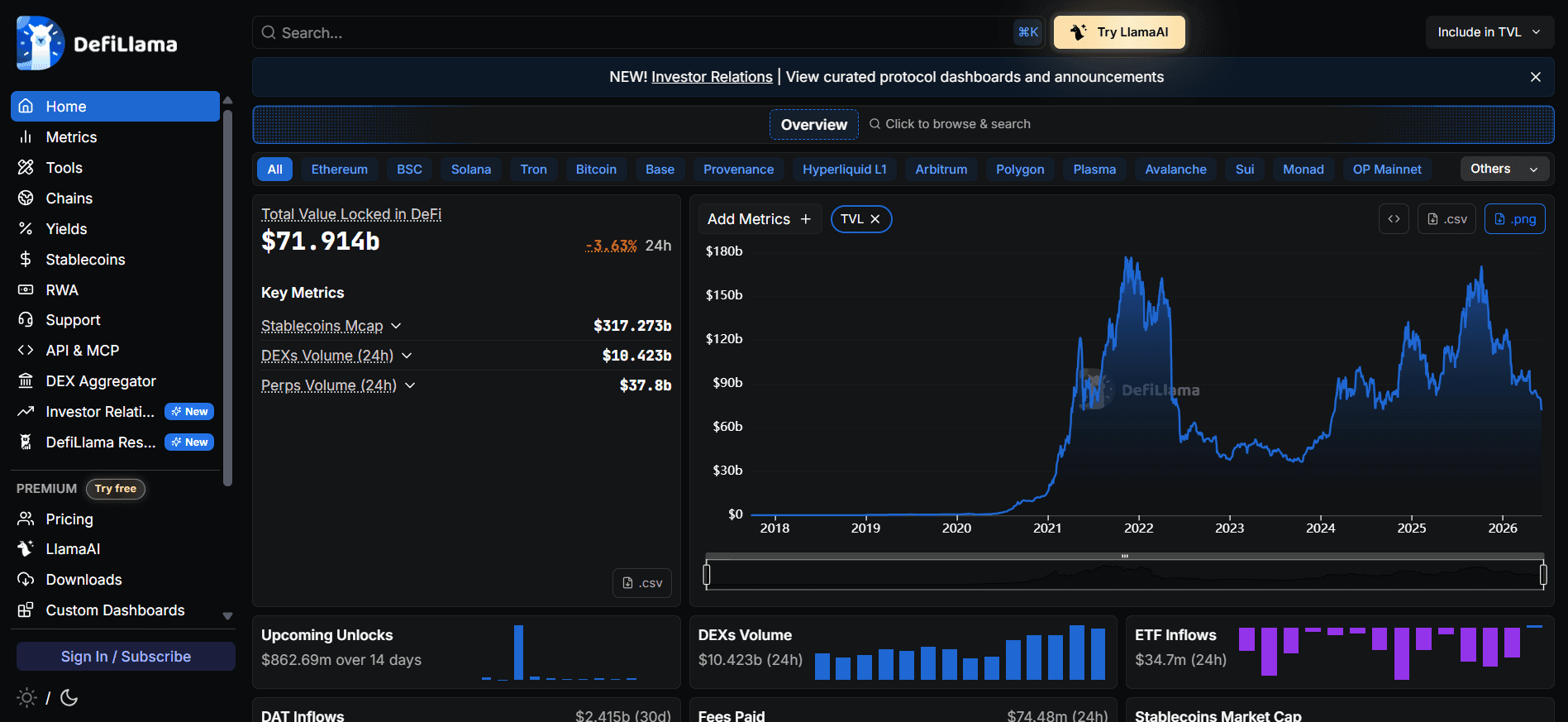
DefiLlama is the most trusted neutral analytics source in DeFi, tracking TVL, fees, revenue, and volume across protocols and chains without a token to shill. For DeFi teams, it is both a competitive intelligence tool and the public scoreboard your protocol gets measured on.
Its credibility comes from methodology and independence. DefiLlama publishes how it calculates each metric, excludes double-counting where it can, and covers nearly every protocol on Solana.
Protocol-level and chain-level TVL, fees, and revenue data.
Transparent, documented methodology for every metric.
Free dashboards and an API for building your own analytics.
DefiLlama will not run your protocol, but it tells you where you stand and where liquidity is moving. Pairing its market view with on-chain transparency from your token operations layer gives investors a complete, verifiable picture of your project.
DefiLlama is the best neutral scoreboard in DeFi, but DefiLlama only measures activity after the fact, whereas Streamflow executes and verifies the token operations that the activity depends on.
Pros
Transparent, documented methodology spanning nearly every protocol.
Free dashboards and API for TVL, fees, revenue, and volume.
Cons
Read-only analytics that executes no token operations itself.
Relies partly on protocol-reported data and category labels.
Metrics can lag or vary depending on methodology choices.
How to Choose the Right Stack for Your Protocol
These five tools are not interchangeable. The mistake teams make is treating "best tools" as a ranking instead of a stack, where each tool owns a distinct function.
Need price data? Start with an oracle like Pyth.
Need liquidity or swaps? Integrate Jupiter.
Need treasury security? Deploy Squads multisig.
Need market visibility? Track everything on DefiLlama.
Need token operations? Build on Streamflow for vesting, locks, staking, and distribution.
Map each tool to a job your protocol actually has, and avoid duplicating coverage.
For founders also thinking about long-term capital formation, treasury management, and on-chain cap tables, Streamflow Business for financial operations extends the token operations layer into a full financial OS for Internet Capital Markets on Solana.
Case Study: How UXD Protocol Built Its DeFi Token Stack on Streamflow
UXD Protocol, a decentralized stablecoin provider on Solana, needed to handle vesting and governance for its $UXP token in a single interface. Distributing a governance token across a large stakeholder base while keeping participation seamless is exactly the kind of problem a DeFi protocol cannot solve with spreadsheets.
The team integrated the UXD Protocol case study on Streamflow SDK into Realms, placing governance participation and token claiming in the same place.
Roughly 46% of the $UXP supply was placed on a 4-year linear vesting schedule with a 12-month cliff, all enforced on-chain.
The outcome was a transparent, verifiable distribution that aligned long-term incentives without manual overhead. For a DeFi protocol, that combination of governance, vesting, and on-chain proof is precisely what separates a durable token economy from a fragile one.
Conclusion
The best tools for DeFi protocols in 2026 are not a single product but a coordinated stack, with oracles, liquidity, treasury, analytics, and token operations each owning a distinct job.
Streamflow anchors the token operations layer, automating vesting, locks, staking, and distribution across 40,000+ projects and $1.4B+ in total value locked, all verifiable on-chain.
Match each tool to a real protocol function, and you build infrastructure that scales instead of a pile of overlapping subscriptions.
Book a demo to see how Streamflow handles token distribution, vesting, and staking for your DeFi protocol.
Read Next:
Why Institutional Crypto Adoption Requires Better Token Distribution Infrastructure
The Complete Solana Toolkit: 30+ Tools Every Project Needs in 2026
The Sybil Attack Problem: How Airdrop Manipulation Is Reshaping Token Distribution in 2026
FAQs:
1. What are the best tools for DeFi protocols in 2026?
The best tools for DeFi protocols in 2026 cover five distinct functions: oracles (Pyth), liquidity and swaps (Jupiter), treasury security (Squads), analytics (DefiLlama), and token operations (Streamflow). Streamflow handles vesting, token locks, staking, and distribution as the Solana-native token operations infrastructure layer used by over 40,000 projects.
2. Why do DeFi protocols use Streamflow?
DeFi protocols use Streamflow to automate token distribution, vesting, locks, and staking through audited on-chain smart contracts. It removes claim and harvest friction, deposits rewards directly into wallets, and lowers transaction costs at scale, which is impractical to manage manually across thousands of recipients.
3. Can Streamflow handle staking and reward distribution for a DeFi protocol?
Yes. Streamflow lets DeFi teams deploy no-code staking pools for any SPL token, with configurable APY, lock periods, and fully automated reward distribution. This reduces circulating supply and engineering overhead while keeping all activity verifiable on-chain.
4. Is Streamflow secure enough for a DeFi protocol holding real value?
Streamflow uses audited smart contracts, reviewed by FYEO and OPCODES, with on-chain execution verifiable on Solscan and Solana Explorer. Token locks and vesting contracts are immutable once deployed, which reduces the risk of insider misuse, manipulation, and rug pulls.
5. Do these DeFi tools work together or do I have to choose one?
These DeFi tools work together as a stack, since each owns a distinct function. Most protocols pair an oracle, a liquidity layer, a multisig treasury tool, and an analytics source with Streamflow for token operations, rather than choosing a single tool.