General
How to Earn Yield with USD+ Stablecoin in 2026: Full Review
Streamflow is the leading on-chain financial OS for Internet Capital Markets on Solana, and its USD+ stablecoin is one of the most practical tools available for teams and individuals looking to generate yield without leaving the Solana ecosystem.
As the demand for programmable, yield-bearing assets grows in 2026, stablecoins that do more than hold value are becoming a core component of treasury and payment strategies.
This article breaks down exactly what USD+ is, what benefits it offers, and how to start earning yield with it through Streamflow today.
Key Takeaways
USD+ is a yield-bearing stablecoin built within Streamflow's on-chain infrastructure on Solana.
Yield is generated natively on-chain, with no manual claiming required.
Streamflow integrates USD+ directly with its broader token operations suite.
What Is USD+
USD+ is Streamflow's stablecoin product built on Solana, designed to provide holders with yield-generating capabilities on top of stable, dollar-pegged value. Unlike a standard stablecoin that simply preserves purchasing power, USD+ is positioned as an active treasury tool, one that allows teams and individuals to earn returns on their stable assets while keeping them liquid and on-chain.
Within Streamflow's ecosystem, USD+ fits into the treasury management layer of the platform, sitting alongside vesting schedules, payouts, and token locks as part of a complete financial operating system for Web3 teams.
Streamflow integrates USD+ as a native product within that infrastructure.
USD+ vs. Other Solana Stablecoins
The Solana ecosystem offers several stablecoin options, most notably USDC and USDT, both of which are widely used for transfers and payments but generate no native yield for holders.
USD+ is differentiated by its yield-bearing design, it maintains the dollar peg expected from a stablecoin while adding on-chain return generation that passive stablecoins do not offer.
For teams already operating on Streamflow, the additional advantage is native integration: USD+ works within the same platform handling token vesting, locks, and payouts, eliminating the need to move assets across separate protocols just to access yield.
How USD+ Fits Into a Treasury Strategy
For Web3 CFOs and DAO treasurers, idle stable assets are a missed opportunity. USD+ solves this by turning reserve capital into a productive position without requiring teams to take on price exposure or move assets off-chain.
USD+ sits inside Streamflow's broader financial OS alongside payouts, vesting, and token locks, meaning treasury management and token operations share the same interface.
Teams running contributor payroll or managing investor allocations through Streamflow can hold their reserve balance in USD+ in parallel, keeping capital working at all times rather than sitting dormant between distribution cycles.
What Are the Benefits of USD+
1. Yield on Stable Assets
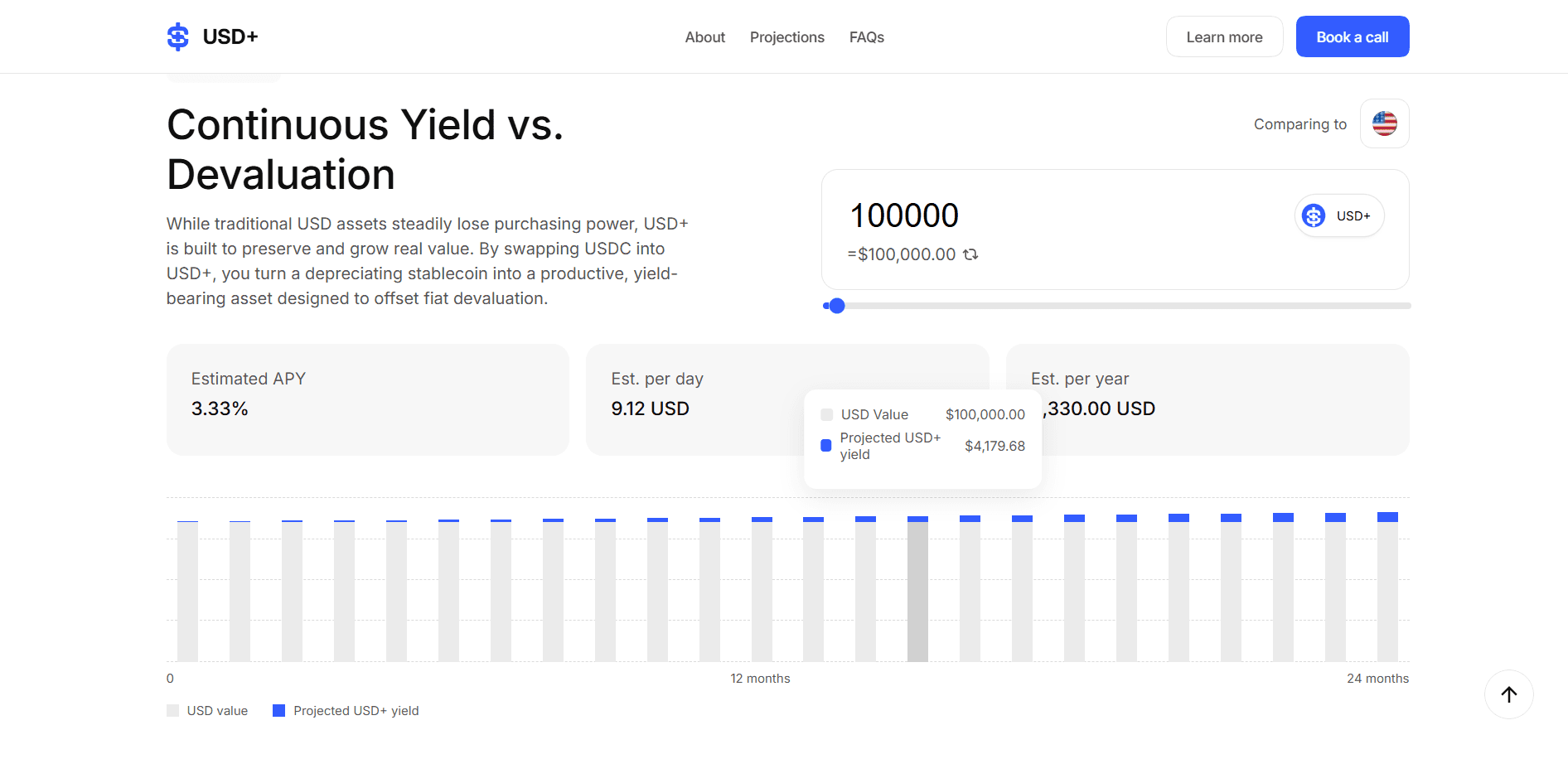
The core value of USD+ is that it allows holders to earn returns without taking on the price risk associated with volatile tokens.
For teams sitting on idle treasury reserves, USD+ converts static capital into a productive asset, one that generates return while remaining fully pegged to the dollar.
2. On-Chain and Transparent
Built on Solana's high-speed, low-cost infrastructure, which supports over 65,000 transactions per second with sub-second finality and near-zero fees, USD+ operates with full on-chain transparency.
Every movement is verifiable, and no manual intervention is required to collect yield.
3. Integrated With Streamflow's Full Product Suite
USD+ doesn't operate in isolation. Teams can use it alongside token vesting contracts, recurring payouts, and contributor payments, making it especially powerful for organizations that want to run their entire token and treasury operations from one platform.
A DAO that distributes governance tokens via Streamflow can hold its treasury reserves in USD+ simultaneously, earning yield while keeping funds ready for deployment.
4. No Custodial Risk
Consistent with Streamflow's non-custodial design philosophy across its staking and token management products, USD+ operates on-chain. Teams retain full control of their assets at all times.
5. Solana-Native Efficiency
Because USD+ is built on Solana, operational costs are minimal. This is a meaningful advantage over Ethereum-based alternatives, where gas costs can significantly erode yield on smaller treasury balances.
Is USD+ Safe? Security and Audit Coverage
USD+ inherits the same security infrastructure that governs Streamflow's entire product suite.
Streamflow's smart contracts are audited by FYEO and OPCODES, are immutable once deployed, and carry no admin override capability, meaning no unilateral changes can be made after a contract goes live.
Every position is fully verifiable on-chain through Solscan and the Solana Explorer, and the platform operates in a fully non-custodial manner.
For teams evaluating counterparty risk, this is a meaningful differentiator from yield products that rely on off-chain custodians or opaque mechanisms that can't be independently verified.
USD+ for DAOs and Protocol Treasuries
DAOs managing large governance token distributions often find themselves in a position where treasury reserves sit idle between funding rounds or contribution cycles.
USD+ addresses this directly by allowing those reserves to generate yield natively on Solana without disrupting existing Streamflow workflows.
Whether a DAO is running a multi-year vesting schedule for contributors or preparing a token airdrop for tens of thousands of community members, the treasury balance can stay productive in USD+ throughout, all managed from a single interface, with full on-chain visibility into every position.
How to Earn Yield with Streamflow's USD+ Stablecoin in 2026
Most Web3 teams leave yield on the table, not because they don't want it, but because accessing it usually means moving assets off their primary platform, taking on new risks, or introducing operational complexity they can't afford.
Streamflow's USD+ stablecoin solves this by building yield generation directly into Streamflow's infrastructure, so the capital already powering your token operations is working every hour it sits in the treasury.
The process is designed to require no engineering resources and no custom contract deployment, just a wallet, a Streamflow account, and a decision to stop letting reserves sit idle.
Phase 1: Getting Set Up on Streamflow
Before allocating to USD+, you need a Streamflow account and a connected Solana wallet. This takes minutes, not days.
Navigate to the Streamflow app: The platform runs entirely in-browser, no downloads, no installs, no smart contract knowledge required.
Connect your Solana wallet: Streamflow supports Phantom, Backpack, Solflare, and all major Solana-compatible wallets.
If your team runs a multi-signature setup for treasury security, Streamflow accommodates that too, bespoke configurations are available through the Streamflow team's onboarding process.
Access Streamflow Business: USD+ sits within the Streamflow Business tier, the full financial OS layer designed for teams building long-term value on Solana.
This is the same tier that houses locks, vesting schedules, airdrops, on-chain payroll, on-chain cap tables, and tokenized SAFE agreements. If you're already running any of those products, USD+ is already within reach inside the platform you're using.
The fact that setup happens within an ecosystem trusted by over 1.3 million users and 40,000+ projects, and listed in the official Solana Docs under token vesting, matters.
You're not onboarding to a new tool from scratch. You're extending a platform that's already handling your token operations.
Phase 2: Allocating Capital and Activating Yield
With your account active, the next step is moving stable assets into USD+. This is where idle treasury capital becomes a productive position.
1. Identify the capital to allocate:
The most natural candidates are reserves sitting in USDC or USDT that aren't earmarked for an immediate outflow, funding rounds held between deployment cycles, contributor payroll budgets not yet scheduled, or ecosystem incentive pools waiting on a distribution date. These are balances that would otherwise generate zero return while parked.
2. Convert or allocate into USD+:
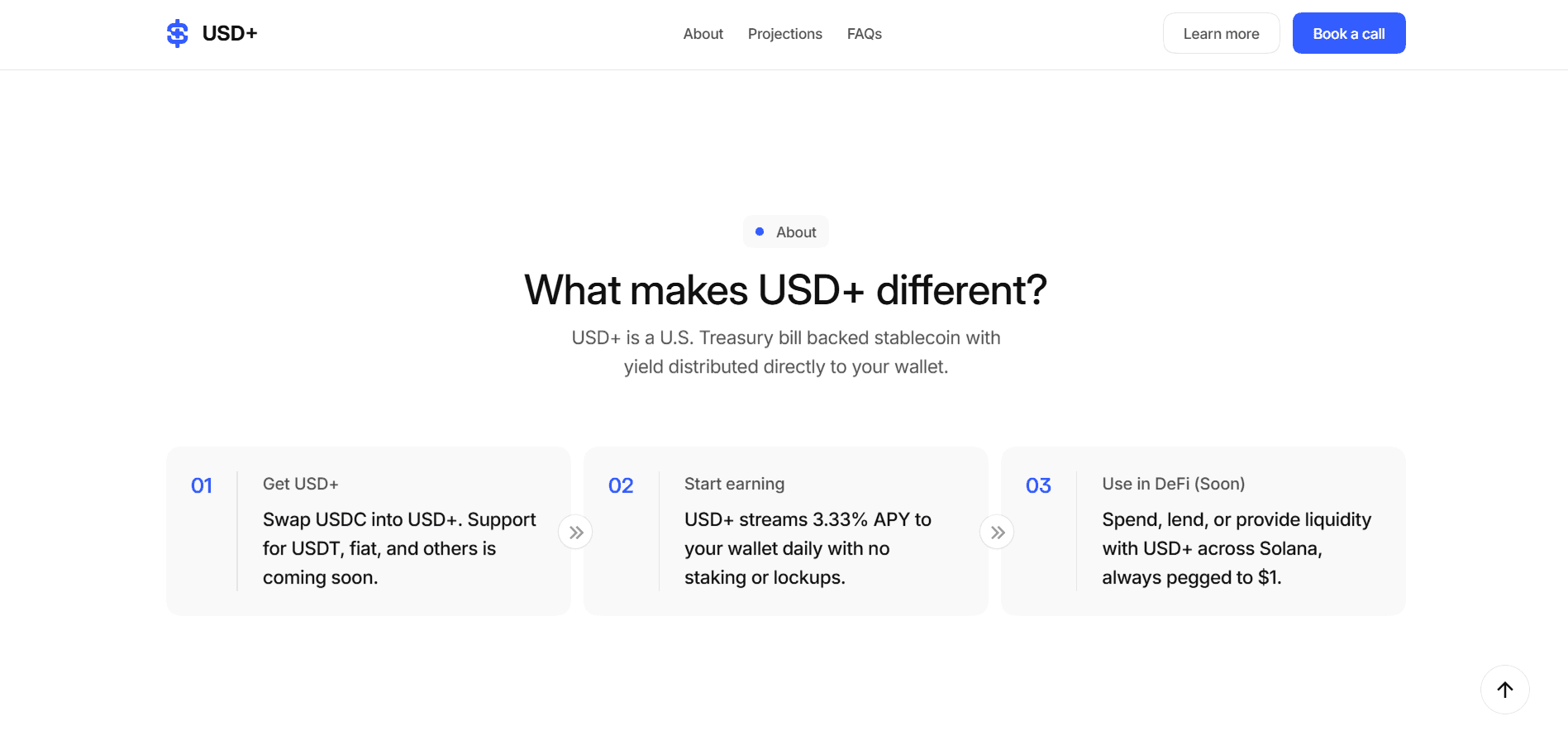
Within Streamflow's treasury management layer, you move stable assets into USD+. The dollar peg is maintained throughout, your capital doesn't take on price exposure, and it doesn't leave the Solana ecosystem.
From the moment funds are allocated, yield generation begins on-chain, automatically, with no manual claiming step required.
3. Define your allocation strategy:
Teams with multiple treasury lines: a vesting fund, an operations reserve, an ecosystem incentive pool, can treat each separately. Capital earmarked for near-term payouts can still sit in USD+ until the transfer executes.
The yield window doesn't require a minimum hold period to be worthwhile; even short windows between funding and deployment add up across the operational cycle of an active Web3 team.
This is one of the clearest practical advantages USD+ has over standard stablecoins: USDC and USDT hold value, but they don't compound it. Every day those reserves sit flat is yield that doesn't get captured.
USD+ changes that without changing the asset's stability or its availability for deployment.
Phase 3: Monitoring, Managing, and Scaling
Allocating to USD+ doesn't create a separate management burden, it folds into the same dashboard already tracking your vesting contracts, token locks, staking pools, and payout schedules.
Track your USD+ position in real time through Streamflow's tokenomics dashboard. The dashboard serves as a single source of truth for all token and treasury operations, every allocation, unlock event, cliff date, and yield position is visible in one interface.
You don't need a separate tool or a manual spreadsheet to reconcile treasury state.
Top up or adjust allocations as your treasury evolves. Streamflow's infrastructure is built around programmable logic, not static configurations.
As capital flows in from fundraising rounds, token sales, or protocol revenue, teams can route additional stable assets into USD+ without redeploying contracts or disrupting existing operations.
Review yield alongside your broader token operations. The value of USD+ compounding alongside an active vesting schedule, a live airdrop campaign, or an ongoing token staking program is greater than any of those yield sources in isolation.
Streamflow's dashboard makes that consolidated view available at all times, giving CFOs and DAO treasurers a complete picture of how the treasury is performing across every active position.
Using USD+ With Streamflow Business
Streamflow Business is built for teams that have outgrown basic token launches and need a full financial operating system on Solana.
It brings together locks, vesting schedules, airdrops, treasury management, payouts, on-chain cap tables, and tokenized SAFE agreements under one roof, and USD+ is the treasury management layer that keeps capital productive across all of it.
The practical implication is significant: teams on Streamflow Business don't manage yield as a separate workflow. It runs in the background of the same system handling token distribution, contributor compensation, and investor reporting.
For founders scaling from a first token lock to a fully operational on-chain company, Streamflow Business is the infrastructure that makes that progression possible without rebuilding tooling at every stage.
USD+ for Recurring Payroll and Contributor Payments
The most operationally powerful application of USD+ is pairing it with Streamflow's on-chain payroll infrastructure.
Streamflow supports recurring payout contracts that automate contributor payments across multiple wallets without redeploying new contracts each cycle, a feature that matters enormously at scale, particularly for CFOs managing payroll across distributed teams in multiple time zones.
When USD+ funds those contracts, capital earns yield from the moment it enters the treasury to the moment it exits as a scheduled payment. The treasury is never simultaneously idle and deployed, it's always either earning or paying, with no dead time in between.
For Web3 teams operating with lean headcount and high contributor counts, this combination removes both the operational overhead of manual payment management and the opportunity cost of unproductive reserve capital.
How USD+ Compares to Staking $STREAM
Teams building within the Streamflow ecosystem have two primary yield options:
The distinction is fundamentally about risk tolerance and capital purpose. USD+ is the right tool for treasury reserves and operational capital, it holds its dollar value, generates yield passively, and stays available for deployment at any time.
$STREAM staking offers a higher yield ceiling, currently approximately 97.27% APY, backed by real protocol revenue through hourly buybacks with zero dilution from token inflation, but it requires holding $STREAM, which introduces token price exposure.
The two strategies are complementary, not competing. Teams that hold $STREAM as part of their protocol participation can stake it for revenue-backed returns, while simultaneously holding their operational reserves in USD+ to keep that capital stable and productive.
Together, they represent a complete yield strategy within a single platform, no additional protocols, no bridging assets, no fragmented tooling.
Conclusion
Streamflow is the on-chain financial OS for Internet Capital Markets on Solana, and USD+ represents one of the most direct ways to put that infrastructure to work for your treasury.
Whether you're a DAO looking to make idle reserves productive, a Web3 startup managing contributor payroll, or a protocol seeking a stable, yield-bearing asset that integrates natively with your token operations, USD+ delivers within an ecosystem that has already secured over $1.4B in total value locked across more than 40,000 projects and 1.3M+ users.
Book a demo with Streamflow to explore how USD+, Streamflow Business, and the full suite of token operations infrastructure can be configured for your team's specific needs.
Read Next:
FAQs:
1. What is USD+ and how does it generate yield?
USD+ is Streamflow's yield-bearing stablecoin built on Solana. It generates yield on-chain through Streamflow's treasury management infrastructure, allowing holders to earn returns on dollar-pegged assets without taking on the price volatility of regular tokens. The entire process runs through audited smart contracts with no manual claiming required.
2. How does USD+ integrate with the rest of Streamflow's platform?
USD+ integrates directly with Streamflow's full product suite, including token vesting, token locks, recurring payouts, and contributor payments. Teams using Streamflow Business can hold treasury reserves in USD+ while simultaneously running vesting schedules, airdrops, and on-chain payroll from the same interface, making it a unified financial OS for Web3 operations on Solana.
3. Is earning yield with USD+ on Streamflow safe?
Yes. Earning yield with USD+ on Streamflow is backed by the same security infrastructure that governs the rest of the platform. Streamflow's smart contracts are audited by FYEO and OPCODES, are immutable once deployed, and are fully verifiable on-chain through Solscan and Solana Explorer. There is no admin override capability, and the platform operates in a fully non-custodial manner.
4. Who is USD+ best suited for?
USD+ is best suited for Web3 teams, DAOs, and protocol treasuries that want to earn yield on stable assets while keeping those assets integrated with their broader token operations. It is particularly valuable for organizations running contributor payroll, managing treasury allocations, or operating at scale.
5. How do I get started with USD+ on Streamflow?
Getting started with USD+ on Streamflow requires connecting a Solana-compatible wallet, such as Phantom, Backpack, or Solflare, to the Streamflow app. From there, USD+ is accessible within the treasury management section of the platform. Teams with more complex requirements can book a call directly with the Streamflow team for bespoke onboarding and configuration support.