General
Why Institutional Crypto Adoption Requires Better Token Distribution Infrastructure
According to EY-Parthenon and Coinbase survey data published in early 2026, 73% of institutions plan to increase digital-asset allocations this year, up from 62% the year before.
The appetite is settled. What is not settled is whether the average token can absorb that capital, and the answer turns on a layer most projects treat as an afterthought: distribution.
Streamflow, the Solana-native token operations infrastructure that has processed over $1.4 billion in total value locked across 40,000+ projects, sits at that exact chokepoint.
Institutions underwrite risk before they allocate, and the dominant risk in any token is what happens to supply after they invest.
Distribution is the only layer that governs supply behavior, which is why it, not regulation or custody alone, is the real constraint on institutional adoption.
This article walks through the misconception holding the narrative back, the actual reason distribution is the gate, and why Streamflow is the infrastructure built to clear it.
Key Takeaways
Institutional crypto adoption requires better token distribution infrastructure because supply behavior is the risk allocators cannot otherwise underwrite.
Regulation and custody solve legality and safekeeping, not what happens to token supply after investment.
Streamflow enforces vesting, locks, and distribution through audited, immutable on-chain smart contracts on Solana.
Over 40,000 projects use Streamflow for token distribution institutions can verify on-chain in real time.
The Misconception: Adoption Is Gated by Regulation Alone
Ask why institutions move slowly on crypto and you hear two answers: unclear rules and unsafe custody. Both are real, and both are being solved.
The GENIUS Act and MiCA delivered regulatory clarity, and qualified custodians now safeguard tens of billions in digital assets.
But notice what those two solve. Regulation answers whether an institution is legally allowed to hold an asset. Custody answers whether it can hold the asset without losing it.
Neither answers the question that actually kills most token allocations: what happens to supply after the investment clears. That question is governed entirely by distribution, and it is the one institutions are structurally unable to wave through.
Why Institutional Adoption Now Depends on Token Distribution Infrastructure in 2026
Institutional allocation is an underwriting exercise. An allocator builds a thesis, prices the downside, and commits only when the major risks can be verified.
That scrutiny is intensifying as capital moves on-chain through tokenization. Asset-manager interest in tokenization nearly doubled year over year, from 40% to 64%, per EY-Parthenon and Coinbase 2026 data, and tokenized real-world assets have reached roughly $24 billion after growing about 308% over three years.
Tokenized supply only deepens the need to verify how that supply is distributed and released.
The two sections below explain why distribution is the risk institutions cannot bound on trust, and why that single gap holds the whole asset class back.
1. Distribution Is the Risk Institutions Can't Underwrite
In a token, the largest downside is supply-side: insiders dumping, hidden unlocks hitting the market, a founder quietly editing a vesting schedule, dilution no one modeled. Every one of those risks lives in distribution.
How tokens are locked, vested, and released decides whether early holders can crush the price the week after an allocation clears.
No amount of regulatory clarity or cold-storage custody touches this. When team tokens are "locked" by a founder's word, a spreadsheet, or a multisig the team controls, an allocator cannot bound the downside.
The honest response to un-underwritable supply risk is to pass, and at institutional scale that is exactly what happens.
2. Opaque Distribution Caps Adoption at the Asset-Class Level
The deeper problem is that opaque distribution forces institutions to treat every token as a bespoke, manual investigation. That does not scale, and capital that cannot be deployed repeatably does not get deployed at institutional size.
When distribution is provable on-chain, diligence collapses from a negotiation into a lookup, and an allocator can underwrite the tenth project as confidently as the first. When it is not, each allocation is a one-off act of trust, and trust does not scale to billions.
That is the real ceiling, and better token distribution infrastructure is the precondition for lifting it across the category, not just at a handful of clean projects.
Why Streamflow Is the Best Token Distribution Infrastructure in 2026
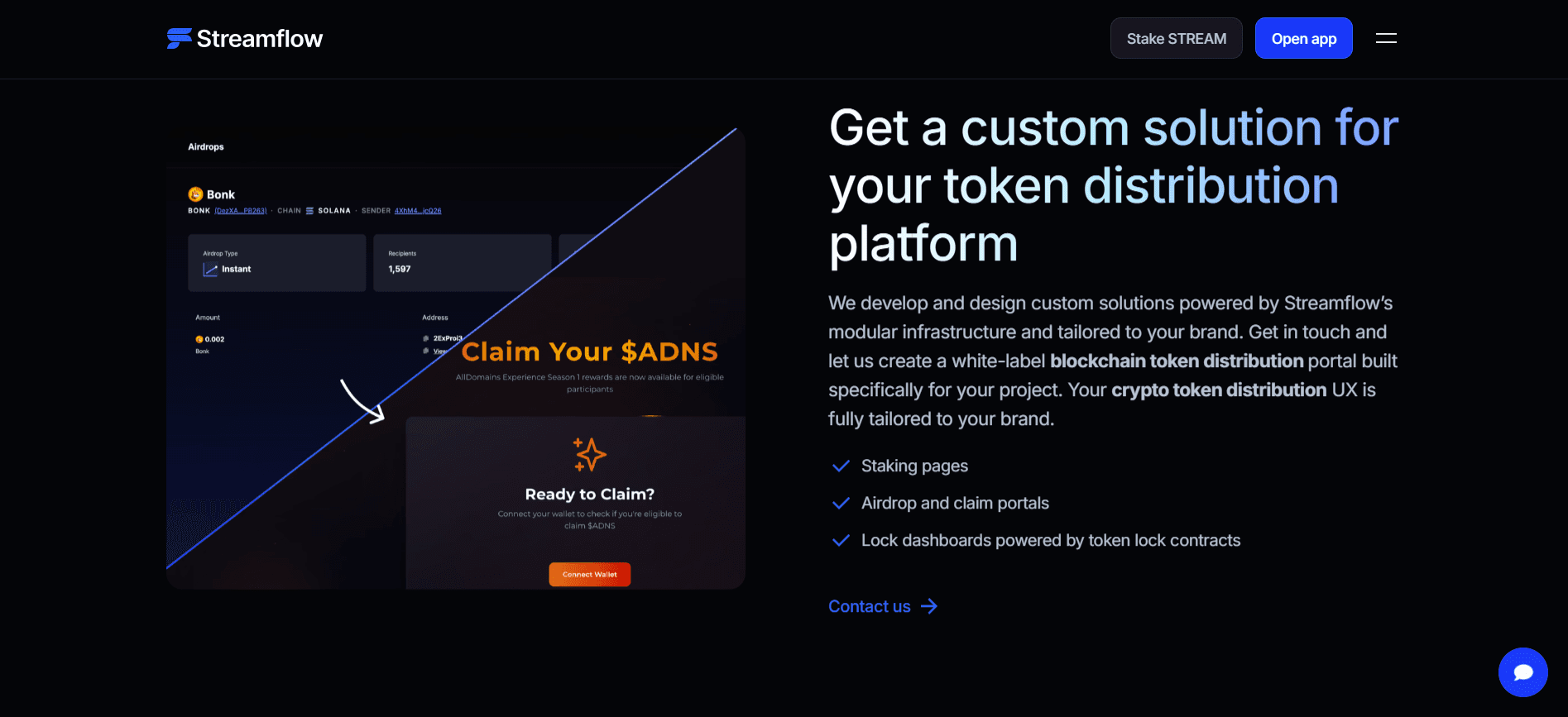
Lifting that ceiling requires infrastructure that makes supply behavior verifiable and enforceable without trusting the issuer. That comes down to four things, and Streamflow is built to do all four on Solana.
Institutional requirement | Manual / off-chain distribution | Streamflow |
|---|---|---|
Verify supply without trusting issuer | Relies on issuer's own reports | Public on-chain proof via Solscan |
Rules binding on insiders | Editable, discretionary control | Immutable, audited, no admin override |
Reliable execution at scale | Breaks past a few hundred recipients | Proven across 40,000+ projects |
Transparent supply schedule | Opaque or self-reported | Real-time public dashboard |
Streamflow Makes Supply Verifiable Without Trusting the Issuer
The point of on-chain verification is to remove the issuer from the trust equation. Streamflow converts distribution rules into automated, on-chain vesting and transparent token locks that resolve to public, verifiable contracts.
Public proof links resolving to on-chain contracts
Verification on Solscan, Solana Explorer, and RugCheck
A complete, immutable record of every distribution event
An allocator can confirm a team allocation in a block explorer in seconds, which turns the largest supply risk into a fact rather than a claim.
Streamflow is also listed in the official Solana Docs as a core vesting tool, an ecosystem signal that the infrastructure is trusted rather than improvised.
Streamflow Binds Insiders to Immutable Rules
A schedule the founder can change is not a control, it is a future headline. Streamflow's contracts are audited by FYEO and OPCODES and immutable once deployed, with no unilateral admin override.
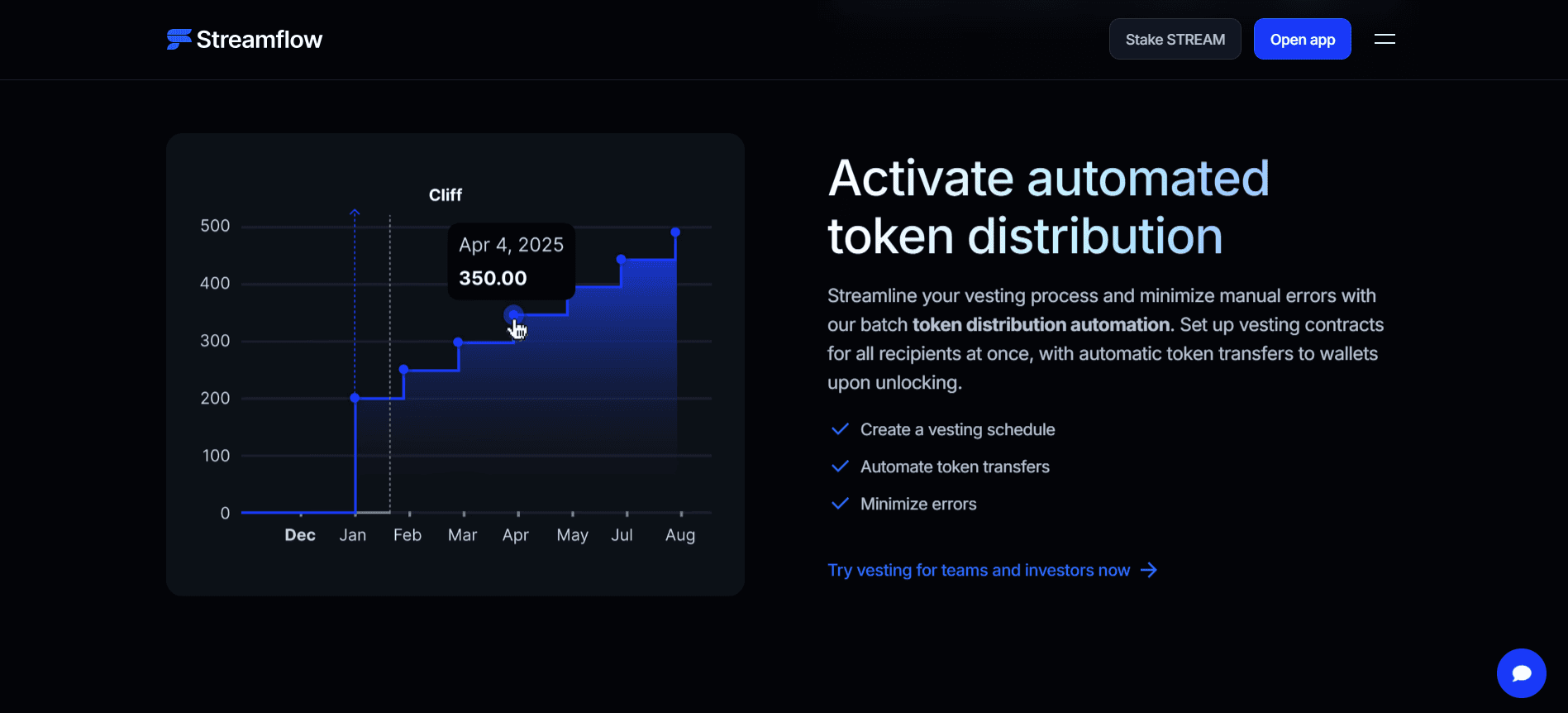
Vesting and locks that execute automatically once deployed
Locked tokens that cannot be transferred, traded, or accessed before unlock
No discretionary control over supply after launch
The common objection is what happens if a schedule needs correcting after deployment. Immutability is the point, not a flaw, because a lock an issuer can edit is not a lock an allocator can trust.
The real prerequisite is correct tokenomics design up front, which is the discipline institutional capital expects anyway.
Streamflow Executes Reliably at Institutional Scale
Real cap tables and launches involve large, complex distribution events that manual tooling cannot survive. Streamflow's $1.4 billion in total value locked, 1.3 million users, and 40,000+ projects signal infrastructure-level reliability, not experimental tooling.
Distribution across thousands of contracts without manual reconciliation
Repeatable execution rather than one-off transfers
Low, predictable costs that make scale economically viable on Solana
Solana's near-zero fees and sub-second finality make distributing and verifying thousands of contracts economically viable, which is precisely what lets the model scale.
For institutions underwriting a project as a long-term company, Streamflow Business, the financial OS for Internet Capital Markets, extends this into on-chain cap tables, tokenized SAFEs, ownership issuance, and treasury management via USD+.
Streamflow Makes Supply Structure Legible by Default
Institutions reward tokens whose supply schedule is easy to read. A public real-time token distribution dashboard consolidates allocations, cliff dates, and unlock events into a single source of truth.
A centralized, real-time view of every distribution contract
Visible release progress shared by team and investors
Transparency as a default rather than a request
This shifts the burden of proof from the investor onto the chain, which is exactly what an allocator wants before committing. You can build on Streamflow and produce that proof in minutes.
Case Studies: UXD and Heavenland
UXD Protocol, a decentralized stablecoin provider on Solana, needed vesting and governance in one verifiable interface for its $UXP governance token. Stablecoins draw heavy institutional scrutiny, so the bar for provable supply structure was high.
UXD integrated the Streamflow SDK directly into Realms, placing roughly 46% of $UXP supply under a 4-year linear vesting schedule with a 12-month cliff. Every schedule was enforced on-chain, producing a supply structure prospective allocators could verify instead of trust, which is the exact quality that converts institutional interest into an actual allocation.
Heavenland, a Solana metaverse, applied the same model at greater scale, placing 97% of its $HTO token supply on a 5-year linear vesting schedule with cliffs across team, incentives, and treasury. The structure enabled initial liquidity without excessive inflation and produced a more engaged, long-term community.
Two projects, one verifiable pattern: supply behavior made provable rather than promised.
What This Means For Founders Preparing for Institutional Capital in 2026
If you are building toward institutional capital, distribution infrastructure is a fundraising decision, not an engineering detail. The moment an allocator opens your data room, the real question is whether your supply can hurt them, and your distribution either answers it or does not.
Treat verifiable, enforceable distribution as a precondition for institutional conversations
Lock and vest insider allocations so the rules bind you as strictly as anyone
Make your supply schedule auditable on-chain before diligence begins, not during it
Founders who put audited, on-chain infrastructure under their tokenomics early answer supply questions with a link, not a scramble. Increasingly, that is the line between projects that attract institutional capital and projects that watch it pass.
Conclusion
Institutional crypto adoption requires better token distribution infrastructure because distribution governs supply behavior, the one risk regulation and custody leave untouched and the one institutions cannot scale capital around without on-chain proof.
Streamflow is the infrastructure built to clear that gate, enforcing distribution through audited, immutable smart contracts that 40,000+ projects already rely on.
Book a demo to see how Streamflow handles institutional-grade token distribution with verifiable, on-chain locks and vesting.
Read Next:
The Complete Solana Toolkit: 30+ Tools Every Project Needs in 2026
The Sybil Attack Problem: How Airdrop Manipulation Is Reshaping Token Distribution in 2026
Everything You Need to Know About Streamflow's Token Locks on Solana
FAQs:
1. Why does institutional crypto adoption require better token distribution infrastructure?
Institutional crypto adoption requires better token distribution infrastructure because distribution governs supply behavior, the risk allocators cannot underwrite without on-chain proof. Regulation and custody address legality and safekeeping, not what happens to supply after investment. Streamflow makes that supply behavior verifiable and enforceable through audited smart contracts.
2. Why isn't regulatory clarity enough for institutional adoption?
Regulatory clarity is not enough for institutional adoption because it only confirms institutions may legally hold an asset, not that a specific token's supply is safe to underwrite. The supply-side risk lives in distribution, which Streamflow enforces on-chain through immutable vesting and locks.
3. Why is Streamflow the best token distribution infrastructure in 2026?
Streamflow is the strongest token distribution infrastructure in 2026 because it makes supply verifiable without trusting the issuer, binds insiders to immutable audited rules, and executes reliably at scale. It backs this with $1.4 billion in total value locked across 40,000+ projects on Solana.
4. How does Streamflow reduce the supply risk institutions worry about?
Streamflow reduces supply risk by enforcing vesting and locks through immutable, audited smart contracts with no admin override. Locked tokens cannot be moved before unlock, and every schedule is verifiable on Solscan, which removes the discretionary control allocators distrust.
5. Is Streamflow's distribution infrastructure proven at scale?
Yes, Streamflow's distribution infrastructure is proven at scale, with over $1.4 billion in total value locked, more than 1.3 million users, and over 40,000 projects. That scale signals infrastructure-level reliability rather than experimental tooling.