General
Top 10 Benefits of Streamflow in 2026: Complete Feature Review
Streamflow is the leading token operations infrastructure platform on Solana, trusted by over 1.3 million users and more than 40,000 projects managing over $1.4 billion in total value locked.
As token economies continue to grow in complexity, teams need more than spreadsheets and manual transfers, they need automated, verifiable systems that execute tokenomics at scale.
This article breaks down the top 10 benefits of Streamflow in 2026 and explains exactly why it has become the go-to platform for token distribution, vesting, staking, airdrops, and payments on Solana.
Key Takeaways
Streamflow automates the full token lifecycle, from locks and vesting to airdrops, staking, and payments.
The platform supports airdrop campaigns of up to 1 million recipients and STREAM staking with a 74.57% APY.
Over 40,000 projects rely on Streamflow to replace manual token operations with programmable, transparent, and scalable infrastructure.
What Is a Token Distribution Platform?
A token distribution platform is a system that automates the process of allocating, releasing, and delivering tokens to different stakeholders based on predefined rules.
Instead of managing transfers manually through spreadsheets or custom-built contracts, a token distribution platform converts distribution logic into on-chain smart contracts that execute automatically, track everything in real time, and provide full transparency to all participants.
Streamflow's token distribution system supports batch distribution, claim-based and auto-send distribution, multi-recipient contracts, CSV import, and real-time tracking, all from a single interface, without requiring teams to write a single line of smart contract code.
What Is Streamflow
Streamflow is a Solana-native token operations infrastructure platform that automates token distribution, locks, vesting, staking, airdrops, and payments using on-chain smart contracts. It is positioned as the financial OS for Internet Capital Markets on Solana, a unified infrastructure layer that turns tokenomics from a plan into an enforceable, automated system.
Rather than relying on fragmented tools or custom contract development, teams use Streamflow to manage the entire token lifecycle from a single platform. From the moment a token is minted to the last scheduled vesting release, Streamflow handles execution with full on-chain transparency and verifiability.
Streamflow's smart contracts are audited by FYEO and OPCODES, are immutable once deployed, and can be verified on Solscan and Solana Explorer.
The platform is listed in the official Solana Docs under token vesting and is backed by Jump Crypto, Solana Ventures, and other leading investors, with over $5 million in total funding raised.
Streamflow at a glance:
$1.4B+ total value locked
1.3M+ users
40K+ projects
Up to 1M airdrop recipients supported
74.57% staking APY (STREAM, revenue-backed)
Top 10 Benefits of Streamflow in 2026
1. Full Token Lifecycle Management From a Single Platform
Most Web3 tools solve one problem, a vesting tool here, a staking dashboard there. Streamflow eliminates the need for fragmented infrastructure by managing the complete token lifecycle from a single platform.
Teams can create a token, lock allocations, set vesting schedules, run airdrops, deploy staking pools, and automate payments, all without switching tools or rebuilding logic across separate systems.
This unified approach reduces engineering overhead, eliminates coordination errors between tools, and gives teams a single source of truth for all token operations.
2. Automated, Immutable Token Vesting
Token vesting is one of the most critical functions in any token economy, and one of the most error-prone when done manually. Streamflow turns vesting schedules into immutable on-chain contracts that execute automatically, with no possibility of unilateral changes or admin overrides once deployed.
Streamflow supports a full range of vesting models including linear, cliff, cliff plus linear, graded, milestone-based, price-based, and custom intervals.
Teams can configure vesting for any stakeholder group, founders, core team, advisors, investors, DAO treasury, ecosystem incentives, and public sale participants, and upload recipients in bulk via CSV.
Proof links and explorer verification on Solscan and Solana Explorer allow any participant to confirm their vesting status independently.
3. Enterprise-Scale Airdrops With Up to 1 Million Recipients
Executing a large airdrop manually is operationally impractical beyond a few hundred recipients.
Streamflow's airdrop infrastructure supports campaigns of up to 1 million recipients, with CSV import capacity of up to 100,000 recipients per file and standard plan support for up to 30,000 recipients per airdrop, with enterprise options for larger campaigns.
Airdrops on Streamflow can be instant, vested, or price-based. The platform provides real-time delivery status, claim tracking, unclaimed token recovery, and fully branded claim portals.
Teams can segment audiences, define eligibility windows, and track post-claim activation, making airdrops a structured distribution system rather than a one-time event.
4. No-Code Staking Infrastructure
Building a token staking system from scratch requires significant engineering resources. Streamflow removes that barrier entirely with no-code staking pool creation that works with any SPL token.
Teams can configure reward structures, set lock periods, define claim frequencies, and automate reward distribution, all without writing custom code.
Streamflow supports multiple pool types including:
Fund Once
Continuous Funding
Governance Staking
Custom configurations
Pools are fully non-custodial, permissionless, and can be topped up with rewards at any time. Supported wallets include Phantom, Solflare, and Backpack, among all Solana-compatible wallets.
For teams that want a managed experience, Streamflow also offers custom-built staking programs with bespoke onboarding.
5. Revenue-Backed STREAM Staking With 74.57% APY
Unlike conventional staking models that rely on token emissions and inflate supply, Streamflow's STREAM staking distributes rewards funded by real protocol revenue. Stakers earn hourly $STREAM rewards from protocol activity, with zero dilution and no newly minted tokens entering circulation.
Current STREAM staking data:
74.57% APY
Over 10 million STREAM tokens staked
1,786 active stakers
$662M in protocol TVL
As more of the circulating supply is staked, a greater share of protocol revenue is distributed to participants, aligning staker incentives directly with the long-term performance of the platform.
6. Verifiable Token Locks That Build Investor Trust
Token locks are a foundational trust mechanism in any token launch. Streamflow enables teams to lock tokens on-chain with clearly defined and publicly verifiable conditions, time-based, price-based, or a combination of both.
Locked tokens cannot be transferred, traded, or accessed until the specified unlock criteria are fulfilled.
Lock status can be verified on Solscan, Solana Explorer, and RugCheck, giving investors and communities independent confirmation that commitments are being honored. Public proof links and dashboard visibility make token locks a transparent signal of long-term intent rather than just a promise.
Token locks on Streamflow take as little as 37 seconds to deploy.
7. Programmable Payments and On-Chain Payroll
Streamflow extends beyond token distribution into programmable payments, enabling teams to automate payroll, recurring transfers, contractor payouts, and contributor streams entirely on-chain.
CFOs and finance teams can mass-pay employees and contributors without redeploying new contracts each period, using recurring payout contracts that continue to fund over time.
Real-world use cases supported by Streamflow's payment infrastructure include salaries paid per second, subscriptions billed only for time used, consulting payments, donations, milestone-based fundraising, and pay-per-service models.
This makes Streamflow a practical financial operations layer for Web3-native teams running on-chain payroll.
8. Real-Time Tokenomics Dashboard
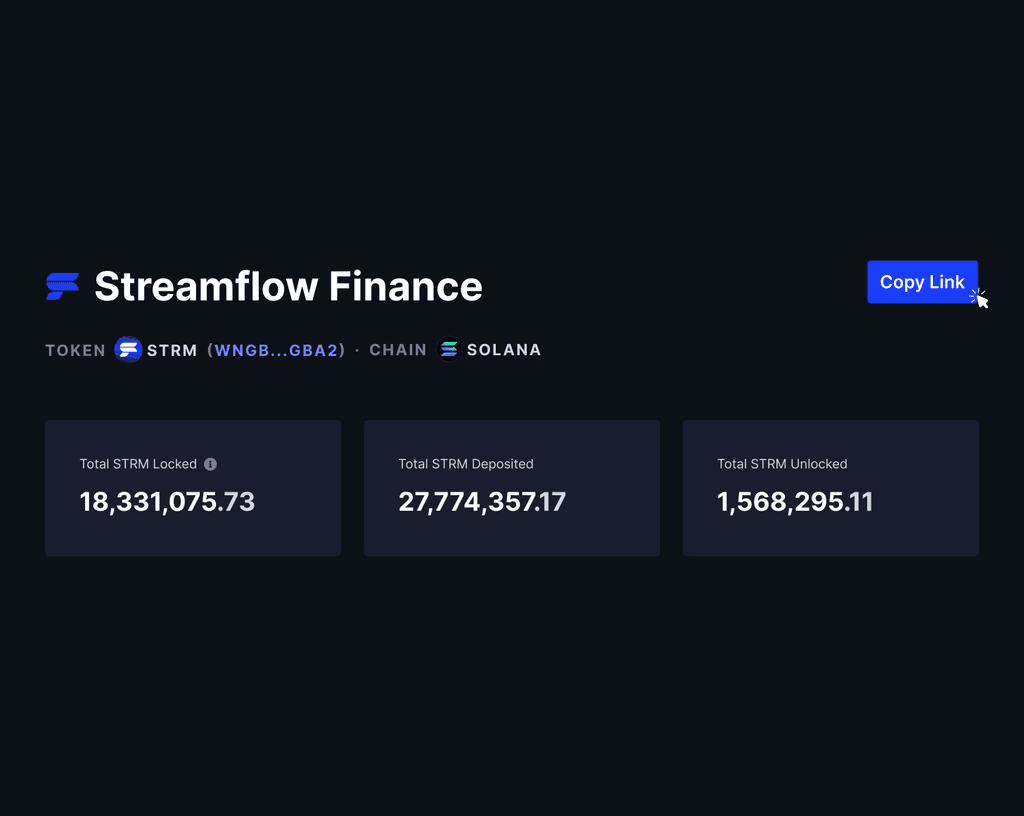
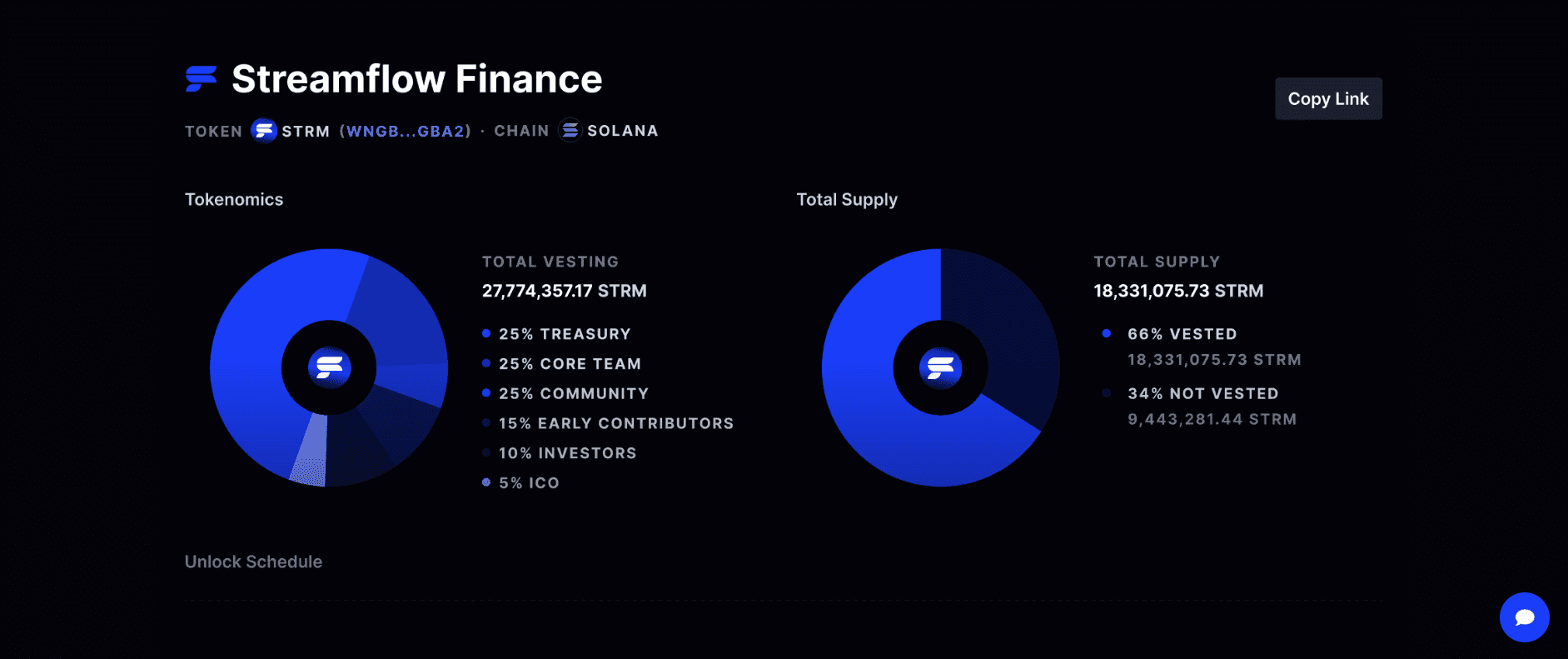
Streamflow provides a dynamic tokenomics dashboard that consolidates all token distribution data into a single, real-time view. Teams and stakeholders can track vesting contracts, token locks, staking pools, cliff dates, unlock events, and release progress from one centralized interface.
The dashboard is public by default, supporting transparency with investors and community members, and can be configured for private or team-only visibility.
Positioned as a single source of truth for token distribution, the Streamflow tokenomics dashboard replaces fragmented data across spreadsheets and block explorers with a live, verifiable record of how tokens move through the ecosystem.
9. White-Label Portals and Custom Branded Infrastructure
For teams that need a fully branded token experience, Streamflow offers white-label solutions built on the same audited infrastructure powering the core platform.
Projects can launch custom token distribution portals, branded staking pages, airdrop and claim portals, lock dashboards, and custom claim portals, all with full UI control and bespoke onboarding support from the Streamflow team.
This allows projects to own their user experience while benefiting from proven, secure infrastructure underneath.
White-label solutions are available for custom staking programs, lock portals, and claim portals across a wide range of Web3 verticals.
10. Solana-Native Performance at Near-Zero Cost
Every Streamflow product is built on Solana, which supports over 65,000 transactions per second, sub-second finality, and near-zero transaction fees.
This infrastructure makes large-scale token distribution, including airdrops to millions of recipients, automated vesting releases, and recurring payment streams, economically viable in a way that high-fee networks cannot match.
Streamflow is listed in the official Solana Docs under token vesting, confirming its position as a trusted core tool in the Solana ecosystem.
The combination of Solana's performance and Streamflow's automation layer allows token operations to scale without increasing cost or complexity.
Why Streamflow Is the Best Token Management Platform on Solana in 2026
Streamflow stands as the best token management platform on Solana, because it operates at a different level: not as a point solution for one function, but as token operations infrastructure for the entire token lifecycle.
Single-purpose tools force teams to stitch together vesting dashboards, airdrop platforms, staking builders, and payment systems, introducing errors, inconsistencies, and operational overhead at every integration point. Streamflow replaces all of that with one audited, automated, verifiable platform.
The proof is in the platform's scale: Over 1.3 million users, more than 40,000 projects, and $1.4 billion in total value locked are not metrics of a niche tool, they are metrics of infrastructure.
Bonk used Streamflow to vest 20% of total supply across 22 early contributors on a 3-year linear schedule.
UXD Protocol used Streamflow's SDK integrated into Realms to manage approximately 46% of $UXP supply on a 4-year linear vest with a 12-month cliff.
Heavenland used Streamflow to distribute 97% of its $HTO token supply across a 5-year vesting schedule with cliffs across all allocations.
In 2026, the standard for token operations is automation, transparency, and on-chain verifiability. Streamflow is the platform that delivers all three.
How to Get Started With Streamflow: Step-By-Step Guide
Getting started with Streamflow is straightforward and does not require smart contract development experience.
Step 1: Visit Streamflow
Go to streamflow.finance and connect your Solana wallet. Streamflow supports Phantom, Solflare, Backpack, and all major Solana-compatible wallets.
Step 2: Choose Your Product
Select the product that matches your immediate need: Token Locks, Token Vesting, Airdrops, Staking, or Payments. Each product is accessible from the main dashboard.
Step 3: Configure Your Contract
Define your token distribution logic: recipients, amounts, schedules, cliff dates, unlock conditions, or reward parameters, depending on the product you are using. Upload recipients via CSV for bulk operations.
Step 4: Fund and Deploy
Fund your contract and deploy it on-chain. Streamflow converts your configuration into an immutable smart contract that begins executing automatically according to your defined parameters.
Step 5: Track Everything in Real Time
Monitor all contracts, release progress, staking activity, and claim status from the Streamflow tokenomics dashboard. Share public proof links with investors and community members for full transparency.
For teams that need custom infrastructure, branded portals, managed staking programs, or enterprise-scale airdrops, Streamflow's team provides bespoke onboarding and white-label solutions.
Conclusion
Streamflow is the most complete token operations infrastructure platform on Solana, offering everything from automated vesting and enterprise airdrops to revenue-backed staking and on-chain payroll in one audited, scalable system.
With over $1.4 billion in total value locked, 1.3 million users, and 40,000+ projects built on the platform, Streamflow has proven that it operates at infrastructure-level scale, not as a niche tool, but as the execution layer behind token economies on Solana.
Book a call with Streamflow to explore how the platform can automate your token distribution, vesting, staking, or payment operations, and get bespoke onboarding tailored to your project's needs.
Read Next:
FAQs:
1. What are the main benefits of using Streamflow for token distribution?
The main benefits of using Streamflow for token distribution include full automation of token vesting, locks, airdrops, staking, and payments through audited on-chain smart contracts, eliminating manual processes and the errors that come with them.
2. What token vesting models does Streamflow support?
Streamflow supports a comprehensive range of token vesting models, including linear, cliff, cliff plus linear, graded, milestone-based, price-based, and custom interval schedules. Vesting contracts on Streamflow are immutable once deployed, meaning no unilateral changes or admin overrides are possible after the contract goes live.
3. How many recipients can a Streamflow airdrop support?
A Streamflow airdrop can support up to 1 million recipients in a single campaign. The platform allows CSV imports of up to 100,000 recipients per file, with standard plans supporting up to 30,000 recipients per airdrop and enterprise options available for larger campaigns.
4. Is Streamflow secure?
Yes, Streamflow is secure. Its smart contracts are audited by FYEO and OPCODES, are immutable once deployed, and execute entirely on-chain with no possibility of admin override or unilateral modification. Token locks and vesting contracts can be independently verified by any participant on Solscan, Solana Explorer, and RugCheck using public proof links. The platform's security model is designed to eliminate insider misuse, rug-pull risk, and governance abuse, making it a trusted layer for teams that need to demonstrate commitment and transparency to investors and communities.
5. What is STREAM staking and how does it differ from standard staking?
STREAM staking is a revenue-backed reward system where stakers earn hourly $STREAM rewards funded by real protocol revenue rather than newly minted token emissions. This means STREAM staking produces zero dilution for token holders, rewards come from platform activity, not inflation.