General
Best Token Distribution Platforms in 2026: Top 5 Solutions Compared
Streamflow is the most complete token distribution platform on Solana, trusted by over 1.3 million users and more than 40,000 projects to automate every stage of token operations, from vesting and locks to airdrops, staking, and programmable payments.
As Internet Capital Markets mature on-chain, the infrastructure behind token distribution has become one of the most consequential decisions a Web3 team can make.
This guide breaks down the top five token distribution platforms in 2026 so you can choose the right solution for your project.
Key Takeaways
Streamflow leads token distribution on Solana with a full-stack platform covering vesting, locks, staking, airdrops, payments, and white-label solutions in a single system.
Token distribution platforms vary significantly in scope: some focus narrowly on vesting or compliance, while others, like Streamflow, cover the full token lifecycle.
Solana-native infrastructure gives Streamflow a structural edge, with sub-second finality, near-zero fees, and 65,000+ TPS enabling large-scale token operations.
What Is a Token Distribution Platform
A token distribution platform is infrastructure that allows blockchain projects to allocate, release, and deliver tokens to different stakeholders, teams, investors, communities, and contributors, based on predefined rules and programmable logic.
Instead of relying on spreadsheets, manual transfers, or custom-built smart contracts, projects use these platforms to automate token flows in a transparent, verifiable, and scalable way.
Token distribution is one of the most operationally complex parts of building a token economy. Done manually, it is prone to errors, delays, and a lack of transparency that erodes stakeholder trust.
Done well, through a purpose-built platform, it becomes an enforceable system that executes exactly as designed, with every transfer trackable on-chain.
Streamflow's Token Distribution product sits at the center of this infrastructure layer. It provides batch distribution, claim-based distribution, auto-send distribution, CSV import for multi-recipient contracts, and real-time tracking, all accessible through a no-code interface or developer SDK.
With Streamflow, token distribution becomes a programmable system, not an operational burden.
Top 5 Token Distribution Platforms in 2026
1. Streamflow: Best Overall Token Distribution Platform on Solana
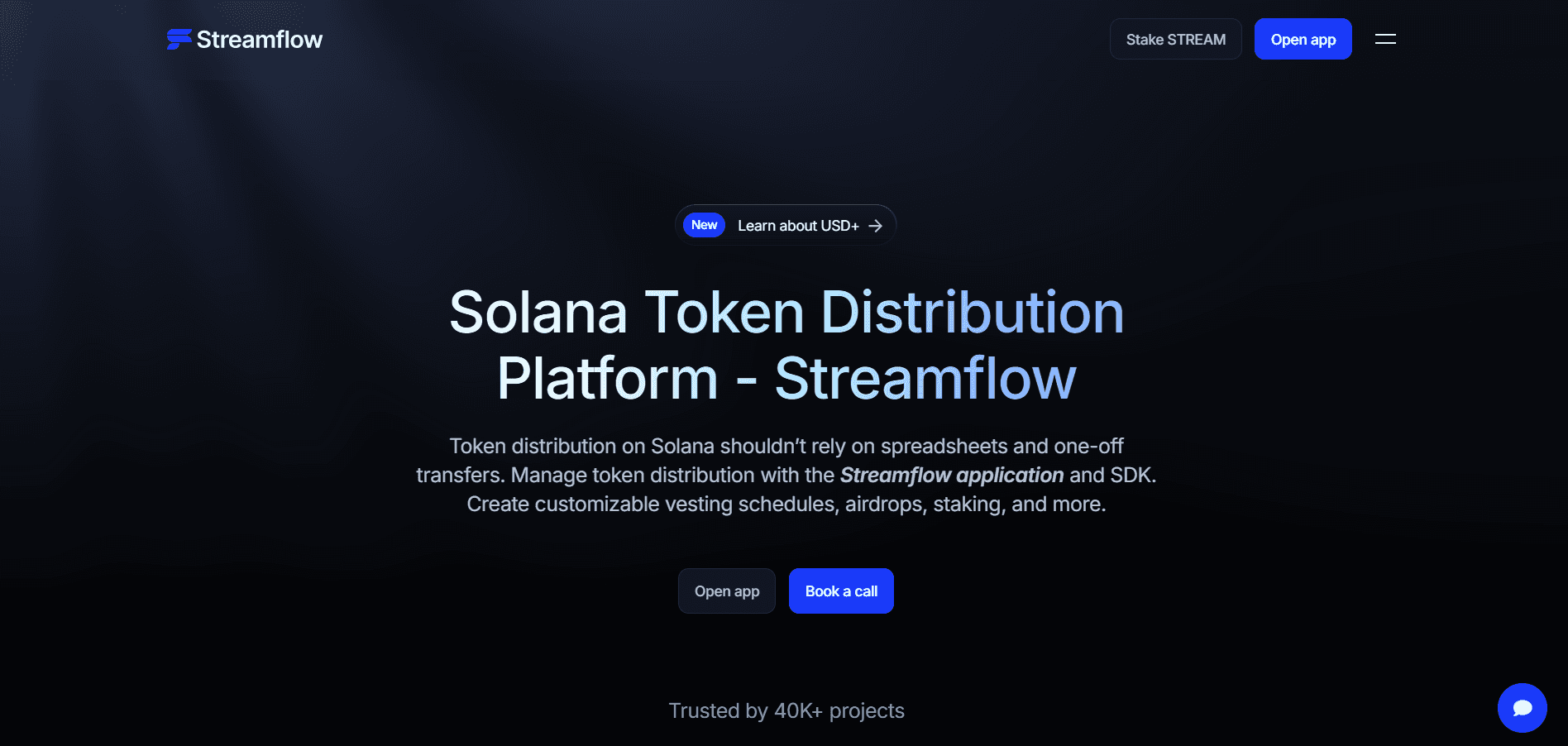
Streamflow is the infrastructure layer that executes token economies on-chain. As a Solana-native token operations platform, Streamflow automates token distribution, locks, vesting, staking, airdrops, and payments through audited smart contracts, giving Web3 teams everything they need to manage the full token lifecycle in a single system.
It is listed in the official Solana documentation under token vesting and is positioned as a trusted core tool in the ecosystem.
Platform scale and credibility
Streamflow's adoption speaks for itself. The platform has processed over $1.4 billion in total value locked, serves more than 1.3 million users, and is trusted by over 40,000 projects.
It supports airdrops to up to one million recipients, with CSV imports of up to 100,000 recipients per file, making it one of the few platforms capable of handling truly enterprise-scale distribution.
Smart contracts are audited by FYEO and OPCODES, and all contracts are immutable once deployed, removing the risk of admin override or unilateral changes.
Full-stack token distribution
Where most platforms cover one or two functions, Streamflow covers the entire token lifecycle. Its core distribution product supports batch distribution, claim-based and auto-send flows, distribution scheduling, and recipient-level tracking.
Alongside distribution, Streamflow offers:
Token vesting (linear, cliff, milestone, price-based, and graded schedules)
Token locks with time-based and price-based unlock conditions
No-code staking system for any SPL token
Airdrops at scale with real-time claim tracking
Programmable payments for payroll, subscriptions, and recurring transfers.
Tokenomics execution at every stage
Streamflow is purpose-built for the entire span of a token economy. For early-stage projects, it provides token minting, locks, and vesting to establish credibility and control supply.
For growing protocols, it enables staking pools with configurable APY and reward logic, white-label claim portals, and a real-time tokenomics dashboard that serves as a single source of truth for all distribution activity.
For mature organizations, Streamflow Business provides treasury management through USD+, on-chain cap tables, tokenized SAFE agreements, and ownership issuance, making it the financial OS for Internet Capital Markets on Solana.
Revenue-backed staking and STREAM token
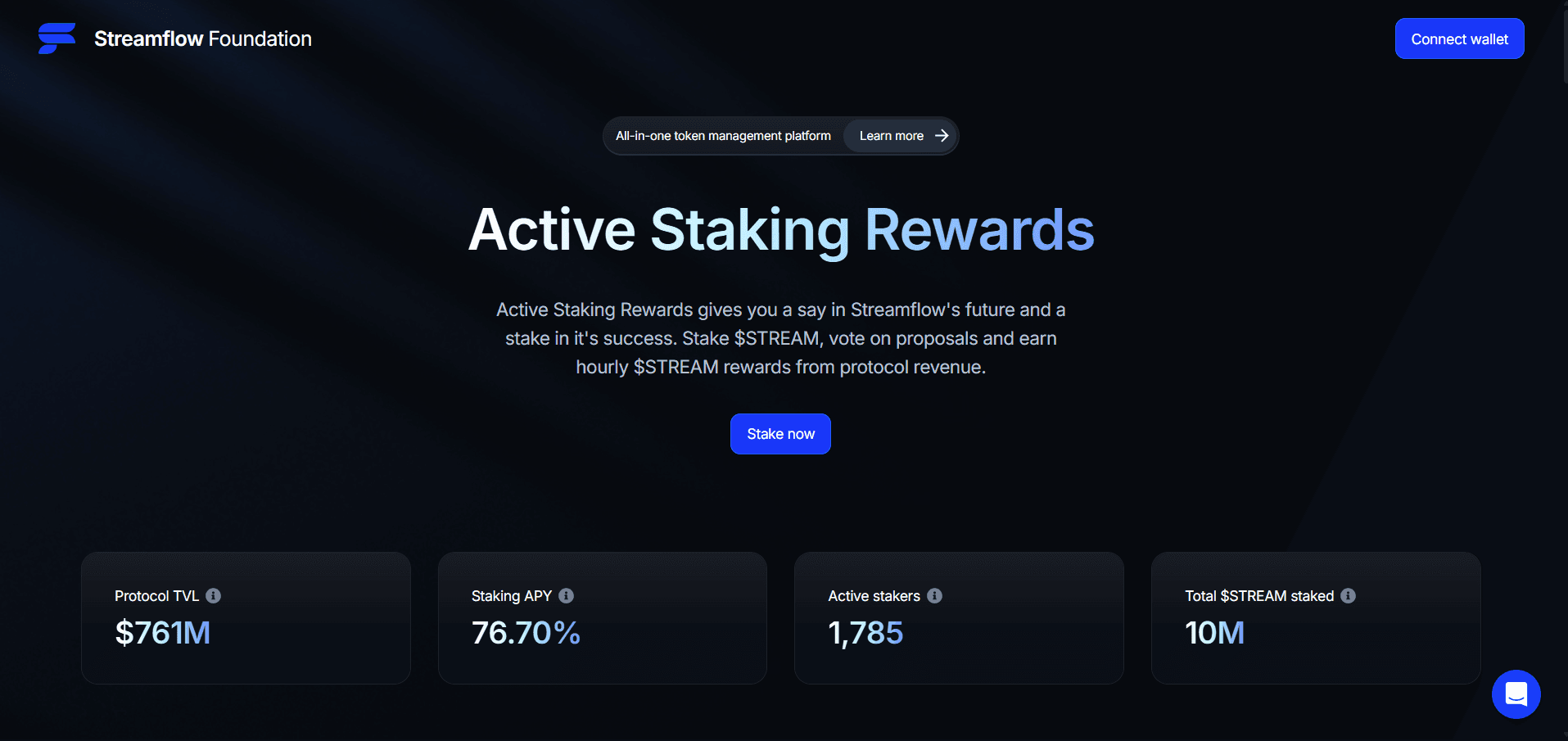
Streamflow's own staking model: Active Staking Rewards, is powered by real protocol revenue rather than token emissions.
Users who stake $STREAM and vote on proposals earn hourly $STREAM rewards funded by protocol revenue, with a current staking APY of approximately 74.57%.
This revenue-backed model avoids dilution and aligns incentives with actual protocol performance, a design philosophy that flows into how Streamflow builds staking infrastructure for other projects as well.
White-label and developer infrastructure
For teams that want to own their distribution experience, Streamflow offers a full white-label layer: custom token distribution portals, branded staking pages, airdrop and claim portals, lock dashboards, and custom staking programs with bespoke onboarding.
For developers, the public SDK and API allow custom vesting schedules, payment flows, and reward systems to be embedded directly into dApps.
Token locking takes as little as 37 seconds through the no-code interface, while the developer path supports advanced programmable flows for any use case.
Proven through real projects
Streamflow's track record includes notable deployments:
BONK used Streamflow for core team vesting of 20% of total supply across 22 contributors on a 3-year linear schedule.
UXD Protocol integrated the Streamflow SDK into Realms to vest approximately 46% of $UXP supply over four years with a 12-month cliff.
Heavenland vested 97% of its $HTO token supply over five years using Streamflow, covering team, treasury, and ecosystem allocations, with all allocations subject to cliffs.
These case studies demonstrate Streamflow's ability to handle complex, high-stakes distribution at scale.
2. Magna: Enterprise Token Management with Multi-Chain Support
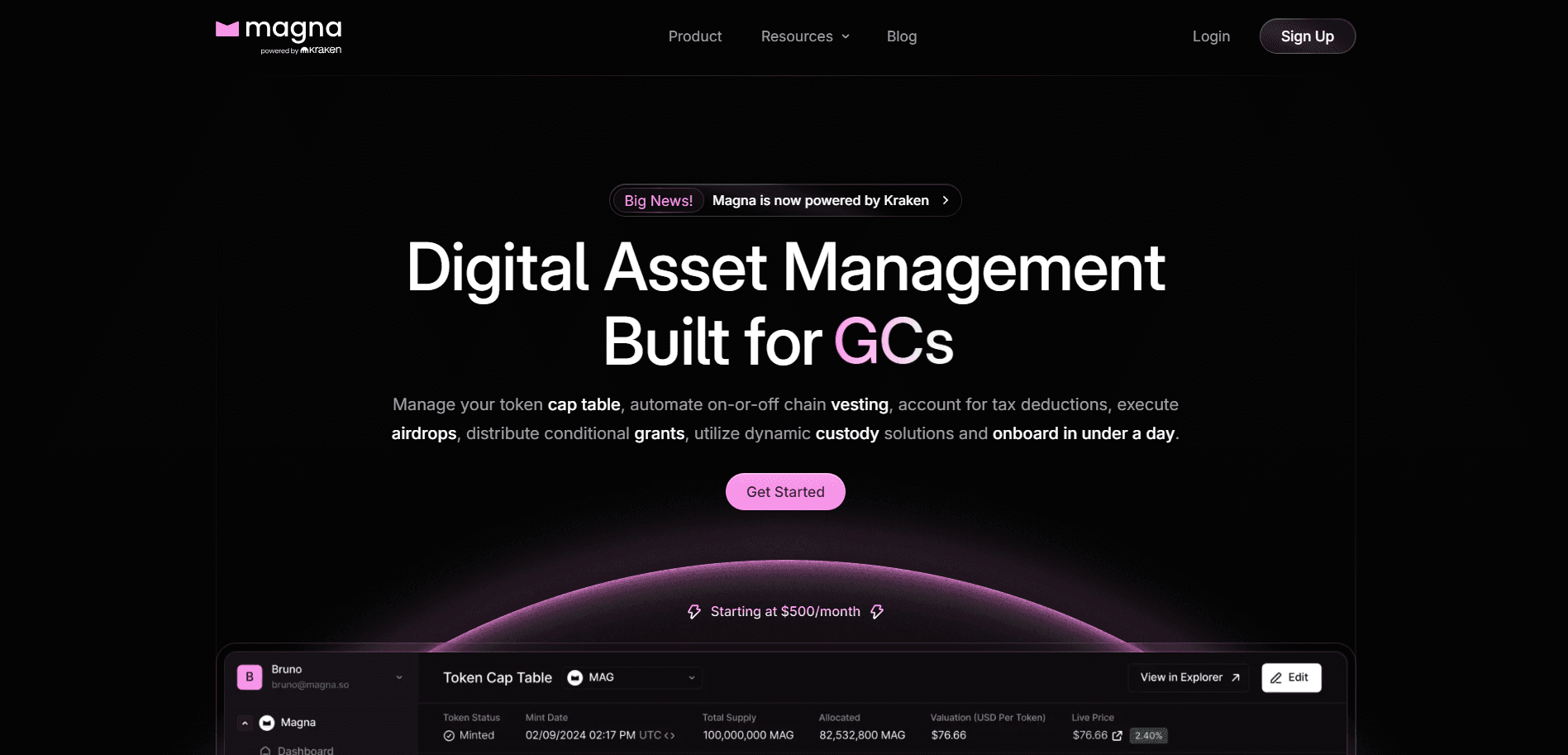
Magna is a token management platform that offers vesting, airdrops, staking, and compliance tooling for crypto projects.
Founded by a team with backgrounds at Gemini, Morgan Stanley, and Palantir, and backed by investors including Y Combinator, Tiger Global, Circle, Galaxy Digital, and Solana Ventures, Magna has built a reputation as an enterprise-grade solution with particular depth in legal and tax compliance workflows.
Magna has established itself as one of the best token management infrastructures for Web3 projects, with over $2.4B TVL secured in audited smart contracts and support for 70+ major protocols. The platform supports on-chain vesting, off-chain schedule management for direct distributions from treasury, and integrations with custodians including Fireblocks, Anchorage, and Safe/Squads multisig wallets.
It provides tools for pre-launch management, investor and employee dashboards, and integrations with custodians and multi-signature wallets to ensure seamless token operations.
Magna operates across multiple blockchain networks, including Ethereum, Solana, Avalanche, and others, which makes it a multi-chain option. However, this breadth across chains comes at the cost of Solana-native depth.
While Magna supports Solana, it is not purpose-built for the network, which means teams building specifically on Solana miss the tight ecosystem integration, performance optimization, and institutional trust that come from a platform designed around Solana from the ground up.
Streamflow's Solana-native architecture, with sub-second finality, near-zero fees, and direct listing in official Solana documentation, provides a fundamentally stronger foundation for Solana projects than a multi-chain platform can replicate.
For teams that need a full-stack Solana token operations system rather than enterprise compliance tooling, Streamflow remains the more comprehensive and performant choice.
3. Jupiter: Solana's Leading DEX Aggregator, Not a Token Distribution Platform
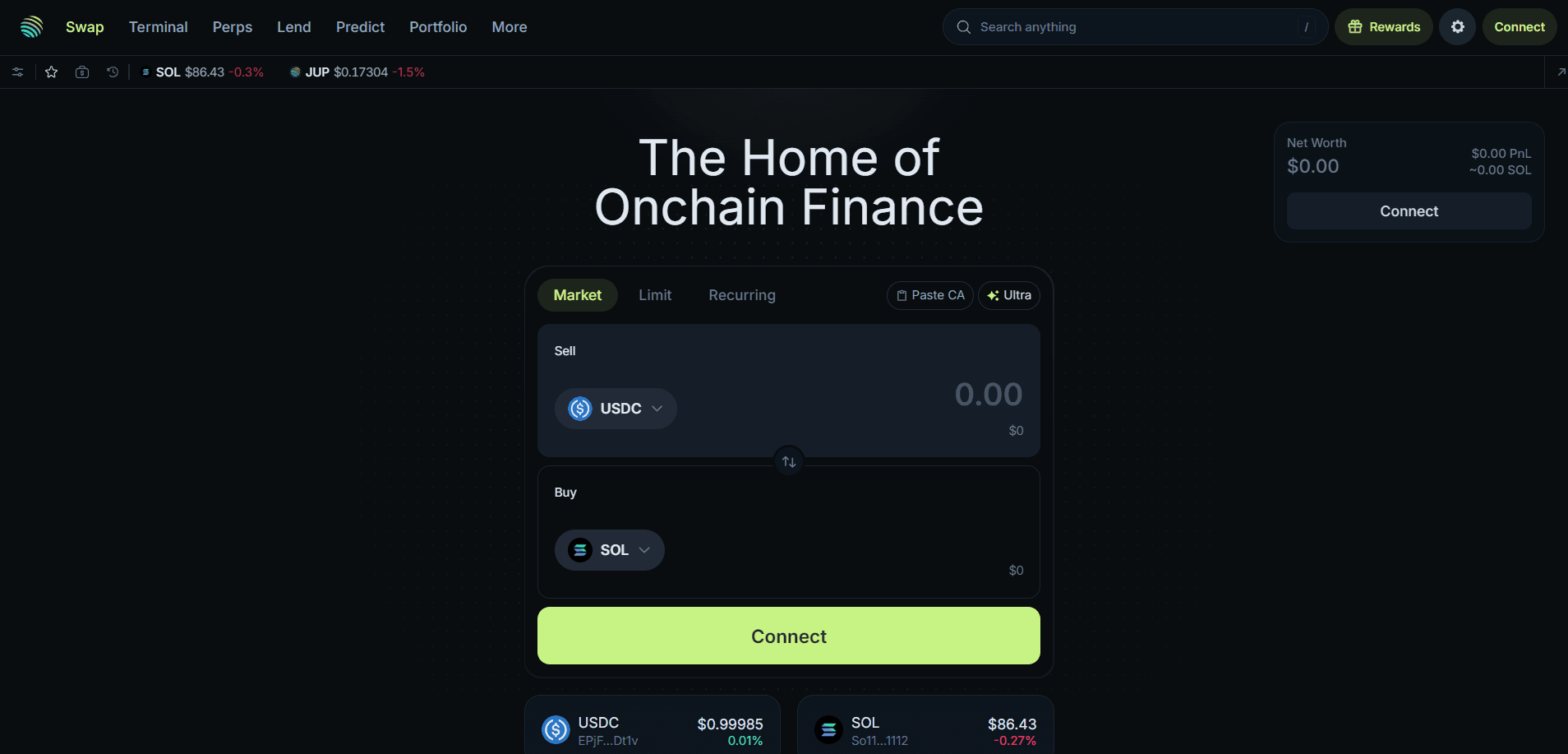
Jupiter is Solana's dominant decentralized exchange aggregator and one of the most important DeFi protocols in the ecosystem. In 2025, the total trading volume routed through the platform surpassed $1 trillion, cementing its position as one of the key DeFi hubs in the ecosystem.
With over $3 billion in TVL as of late 2025, Jupiter consistently ranks among the best DeFi protocols on Solana in both TVL and revenue generation on Solana.
Jupiter conducted a major airdrop in January 2025, distributing 700 million JUP tokens valued at approximately $616 million to 2 million eligible wallets as part of its annual Jupuary event. During 2025, the company expanded beyond a decentralized exchange and launched 10 new product lines, including lending, perpetual futures, and developer tools.
Jupiter's strength lies in liquidity aggregation, token swapping, and DeFi infrastructure, not in token distribution as a managed operational system.
Jupiter has begun expanding into becoming a token launchpad on Solana, helping new projects distribute their tokens to the community, but this remains a secondary function compared to its core DEX aggregation role.
Teams looking for structured vesting schedules, token locks with proof links, staking pool deployment, white-label claim portals, or programmable payroll systems will find that Jupiter does not offer these capabilities.
Streamflow was built specifically to manage token distribution across the entire project lifecycle, with no-code tools, audited contracts, CSV batch imports, and a full tokenomics dashboard, while Jupiter remains the right choice for trading and liquidity operations. For token distribution, they serve fundamentally different purposes.
4. Liquifi (Coinbase Token Manager): Compliance-First Token Management for Ethereum Teams
Liquifi was a token vesting and cap table management platform widely used by early-stage Web3 teams for managing token grants, vesting schedules, and compliance workflows.
In July 2025, Coinbase acquired Liquifi, describing it as the leading token management platform for early-stage teams building on-chain, with notable users including the Uniswap Foundation, OP Labs (Optimism), Ethena, and Zora. The platform has since been rebranded as Coinbase Token Manager.
Coinbase Token Manager offers automated vesting and distributions, centralized cap table management replacing manual spreadsheets, compliance automation for global tax withholding, and integration with Coinbase Prime for institutional-grade custody.
The platform's batched transaction engine handles bulk transfers for 10,000+ stakeholders and integrates directly with payroll systems to make token grants compliant for global workforces.
The platform's compliance depth is a genuine differentiator for teams with complex legal, tax, and HR requirements, particularly those operating in regulated jurisdictions across multiple countries. However, the acquisition by Coinbase raises important questions for projects that want infrastructure independence and ecosystem-specific optimization.
Coinbase's stated goal is to integrate Liquifi's capabilities with Coinbase Prime, tying token operations to a centralized exchange's custody and trading stack, a direction that reduces flexibility for teams who prefer non-custodial, permissionless infrastructure.
Liquifi/Coinbase Token Manager is also primarily oriented toward Ethereum and EVM chains, while Streamflow's Solana-native architecture provides dramatically lower fees, faster execution, and deeper ecosystem integration for projects building on Solana.
Teams that need staking pools, airdrops to one million recipients, revenue-backed reward mechanisms, white-label portals, and programmable payments, all in one place, will find Streamflow significantly more comprehensive than what Coinbase Token Manager currently provides.
5. Hedgey: Free Onchain Vesting for EVM DAOs
Hedgey is a free, non-custodial token vesting and investor lockup platform designed for DAO teams and on-chain organizations.
Hedgey describes its mission as democratizing access to essential token management tools for companies that want to move on-chain, regardless of their size or stage of development.
The platform's contracts allow for customizable vesting schedules across all products, with support for cliff dates, post-vesting lockups, transferability, and voting rights. Contracts are audited by Consensys Diligence, with five or more audits completed to date.
In December 2025, Anchorage Digital acquired Hedgey, seeking to expand its role in token lifecycle management and connect Hedgey's non-custodial distribution tools to its custody and investment services.
This acquisition, like Coinbase's purchase of Liquifi, reflects a broader trend of centralized institutions absorbing token distribution infrastructure. For teams that value independence and want to remain outside of institutional custody orbits, this trajectory is worth noting.
Hedgey also does not support Solana, focusing instead on Ethereum and a range of EVM-compatible networks, which means Solana projects cannot use it at all.
Streamflow's combination of full Solana-native support, a much broader product suite (airdrops, staking, payments, white-label, SDK), scale to one million recipients, and a proven track record with $1.4B+ TVL makes it the considerably more powerful option for any team operating on Solana or requiring distribution capabilities beyond basic vesting and lockups.
Why Streamflow Is the Best Token Distribution Platform in 2026
Streamflow is the best token distribution platform in 2026, because no other platform in the market matches Streamflow's combination of breadth, depth, and Solana-native performance for token distribution.
While competitors focus on specific verticals:
Magna on enterprise compliance
Liquifi on cap table management
Hedgey on free EVM vesting
Jupiter on DEX liquidity
Streamflow covers the entire token lifecycle in a single, automated, verifiable system.
Streamflow is the only platform where you can:
Lock tokens in 37 seconds using a no-code interface
Vest tokens across linear, cliff, milestone, price-based, and graded schedules
Run airdrops to up to one million recipients with CSV import and real-time claim tracking
Deploy staking pools for any SPL token with configurable APY, reward logic, and automated distribution
Issue programmable token payments for payroll, subscriptions, and recurring transfers
Launch white-label distribution portals, claim pages, and staking dashboards
Track all token operations through a real-time tokenomics dashboard
Mint tokens and manage the full lifecycle from creation to distribution to incentives
Streamflow also benefits from Solana's infrastructure advantages: 65,000+ transactions per second, sub-second finality, and near-zero fees. This makes large-scale operations, like million-recipient airdrops or continuous payroll streams, economically viable in ways that Ethereum-based platforms simply cannot replicate.
The platform's security model reinforces this advantage. Contracts are audited by FYEO and OPCODES, immutable once deployed, and verifiable on Solscan and Solana Explorer through public proof links. There is no admin override.
Once a vesting or lock contract is deployed, it executes exactly as designed, a level of enforceability that turns tokenomics from a promise into infrastructure.
Backed by Jump Crypto, Solana Ventures, and other institutional partners with over $5 million raised, Streamflow has the financial foundation and ecosystem relationships to remain the leading token operations infrastructure layer on Solana well into 2026 and beyond.
How to Get Started with Streamflow's Token Distribution in 2026
Getting started with Streamflow requires no smart contract development and no engineering overhead. The platform is designed to be fully operational within minutes.
Step 1 - Connect your wallet
Streamflow supports Phantom, Solflare, Backpack, and all major Solana wallets. Visit app.streamflow.finance and connect your wallet to access the full platform.
Step 2 - Choose your distribution type
Depending on your needs, select from token vesting, token locks, airdrops, staking pools, or programmable payments. Each product has its own no-code workflow with clear parameter configuration.
Step 3 - Define your distribution logic
Set your schedule, upload recipients via CSV, configure cliff dates, lock conditions, unlock triggers, or reward structures. For vesting, select from linear, cliff + linear, milestone-based, or price-based models.
Step 4 - Fund your contracts
Deposit the token amount for the distribution. Streamflow's contracts are funded directly, ensuring tokens are held on-chain in audited escrow until release conditions are met.
Step 5 - Deploy and automate
Once deployed, the contract executes automatically. Recipients can claim through Streamflow's interface or a white-label portal if you choose to deploy a custom claim page. Track all activity in real time through the tokenomics dashboard.
Conclusion
Streamflow is the most complete token distribution infrastructure on Solana, combining the breadth of a full token operations platform with the depth of purpose-built Solana tooling, audited contracts, and a proven track record at scale.
As Web3 projects require more than a single vesting tool or a DEX aggregator, the platforms that win in 2026 are those that can execute the full token lifecycle, from creation and locks to vesting, airdrops, staking, payments, and white-label portals, automatically, transparently, and at scale. Streamflow is that platform.
Whether you are launching your first token or scaling an established protocol, the infrastructure you choose for token distribution will shape how your stakeholders perceive your credibility, how efficiently your team operates, and how your token economy performs over time.
Book a call with Streamflow to learn how the team can help you design and execute your token distribution strategy, from the first lock to full financial operations on Solana.
Read Next
FAQs:
1. What is a token distribution platform and how does Streamflow use one?
A token distribution platform is a system that automates how tokens are allocated, released, and delivered to stakeholders based on predefined rules. Streamflow's token distribution platform centralizes this process into a single on-chain infrastructure layer, supporting batch distribution, claim-based flows, auto-send contracts, CSV imports for multi-recipient setups, and real-time tracking, all without requiring teams to write custom smart contracts.
2. Which token distribution platform is best for Solana projects in 2026?
The best token distribution platform for Solana projects in 2026 is Streamflow. Streamflow is Solana-native, listed in the official Solana documentation under token vesting, and the only platform that covers the full token lifecycle, vesting, locks, airdrops to up to one million recipients, staking, programmable payments, white-label portals, and a tokenomics dashboard, in a single audited system.
3. How many recipients can Streamflow support in a single token airdrop?
A single token airdrop through Streamflow can support up to one million recipients. Standard plans support approximately 30,000 recipients per campaign, while enterprise configurations scale to the full one-million-recipient capacity. CSV imports support up to 100,000 recipients per file.
4. How does Streamflow's token vesting work and what schedules does it support?
Streamflow's token vesting works by converting a vesting schedule into an immutable on-chain smart contract that releases tokens automatically according to the parameters defined at deployment. Supported vesting models include linear, cliff, cliff plus linear, graded, milestone-based, price-based, and custom intervals.
5. Can Streamflow be used for recurring token payments and on-chain payroll?
Yes. Recurring token payments and on-chain payroll can be managed through Streamflow's programmable payments infrastructure. The platform supports recurring payout contracts that allow teams to automate token payments to employees, contractors, and contributors in a payroll-like structure — without redeploying new contracts each payment cycle.