General
The State of Solana Staking: Yield, Participation, and Project Design Patterns
As of early June 2026, roughly 67.67% of Solana's eligible supply is staked, around 430 million SOL worth close to $28 billion, according to StakingRewards and SolanaCompass data from Epoch 983.
That is one of the highest participation rates of any major proof-of-stake network.
Streamflow, the Solana-native token operations infrastructure platform behind more than $1.4B in total value locked across 40,000+ projects, sits at the layer where that staking activity meets project-level token design.
Solana staking now splits into two distinct stories:
One is network-level: SOL holders delegating to validators for inflation-funded yield, increasingly supplemented by real network usage.
The other is project-level: teams launching their own SPL tokens and designing staking systems to control supply, reward holders, and build utility.
This report covers both. It maps the current data on yield, participation, and validator health, then examines the design patterns shaping how projects build token staking on Solana, where the macro trend toward revenue-backed rewards is rewriting the playbook.
Key Takeaways
Solana staking participation sits near 67.67% of eligible supply, among the highest of any chain.
Native Solana staking yields about 5.73%, with rewards shifting from inflation toward real network usage.
Validator count fell to roughly 721 from 2,500+, yet stake distribution keeps improving.
Streamflow powers project token staking on Solana with no-code pools and revenue-backed STREAM rewards.
STREAM staking pays about 74.57% APY funded by protocol revenue, not inflationary token emissions.
Methodology and Data Sources
This report draws on primary dashboards current to Epoch 983 (early June 2026):
SolanaCompass for stake history and distribution
Validators.app for client diversity
DefiLlama for liquid staking TVL
Official Solana documentation for consensus mechanics
Figures fluctuate slightly by source because epochs update roughly every two days, and supply definitions vary. Where sources differ, ranges are shown. All Streamflow figures come from Streamflow's own platform data and are noted as such.
How Much of Solana Is Staked in 2026?
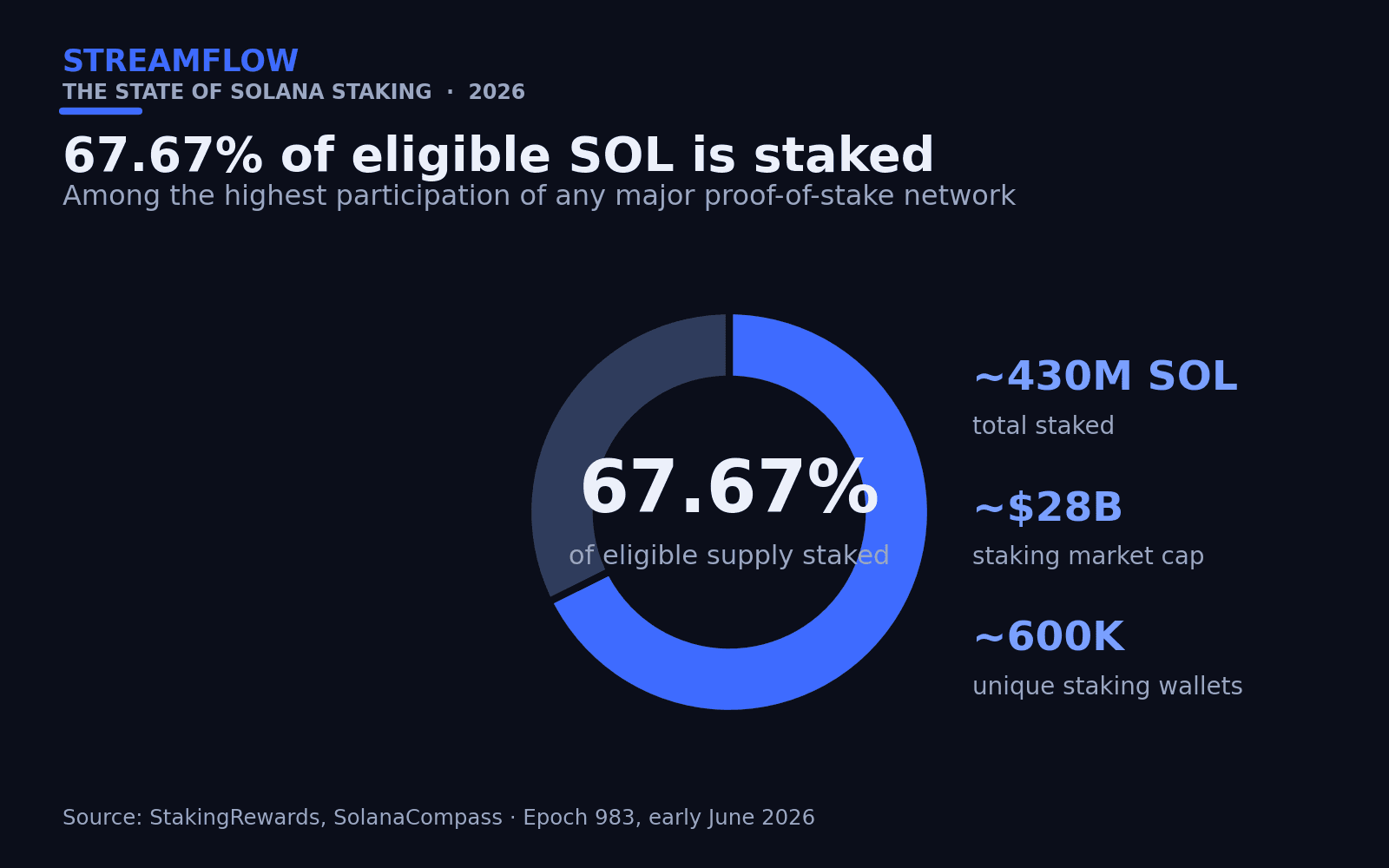
About two-thirds of eligible SOL is staked, a participation rate that has held remarkably steady even as yields compressed.
Core network-wide metrics (June 2026):
Total staked SOL: 424.94M to 432.93M, worth roughly $28.4B at a ~$66 SOL price
Staking ratio: 67.67% of eligible circulating supply, with some sources citing 68.03%
Active stakers: 1.35M to 1.49M stake accounts, controlled by roughly 600,000 unique wallets
7-day participation change: slightly negative, between -0.82% and -1.14%
A staking ratio near 68% is consistently among the highest for major proof-of-stake chains, well above Ethereum's historically lower rates, per StakingRewards.
High participation is a double-edged signal: it reflects strong holder conviction and network security, but it also compresses yield, since rewards are spread across more staked supply.
For projects launching on Solana, the takeaway is structural. Holders on this chain expect staking to be a default behavior, not a niche one. That expectation is exactly what project-level staking systems are built to capture.
Stake Is Concentrated at the Top
Retail wallets dominate by count, but a small number of whales and institutions control most of the staked supply.
Stake size (SOL) | Share of total stake | Stake accounts |
|---|---|---|
0 to 5 | 0.17% | ~993,000 |
100 to 500 | 3.56% | ~60,000 |
10,000 to 50,000 | 14.54% | ~2,786 |
100,000 to 250,000 | 18.72% | ~606 |
500,000+ | 28.61% | 95 |
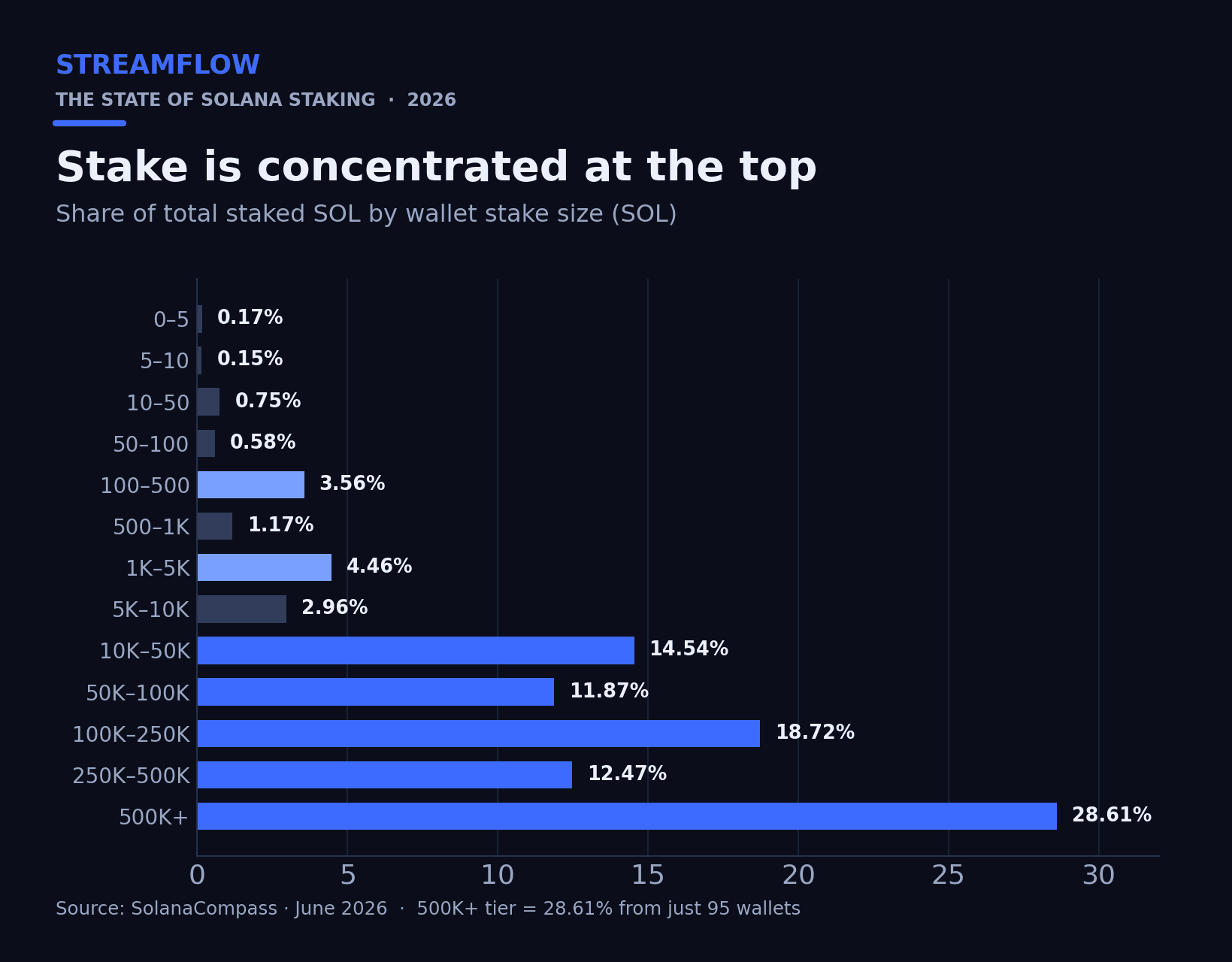
The median stake is just 0.67 SOL, while the mean is around 312 SOL, and the single largest stake account holds 9.07M SOL, per SolanaCompass.
The top tier of accounts, fewer than 100 wallets, controls more than a quarter of all staked SOL.
This skew matters for token designers. A staking program that only rewards large holders entrenches concentration, while one tuned for broad participation has to account for the fact that most wallets are small.
What Does Solana Staking Yield in 2026?
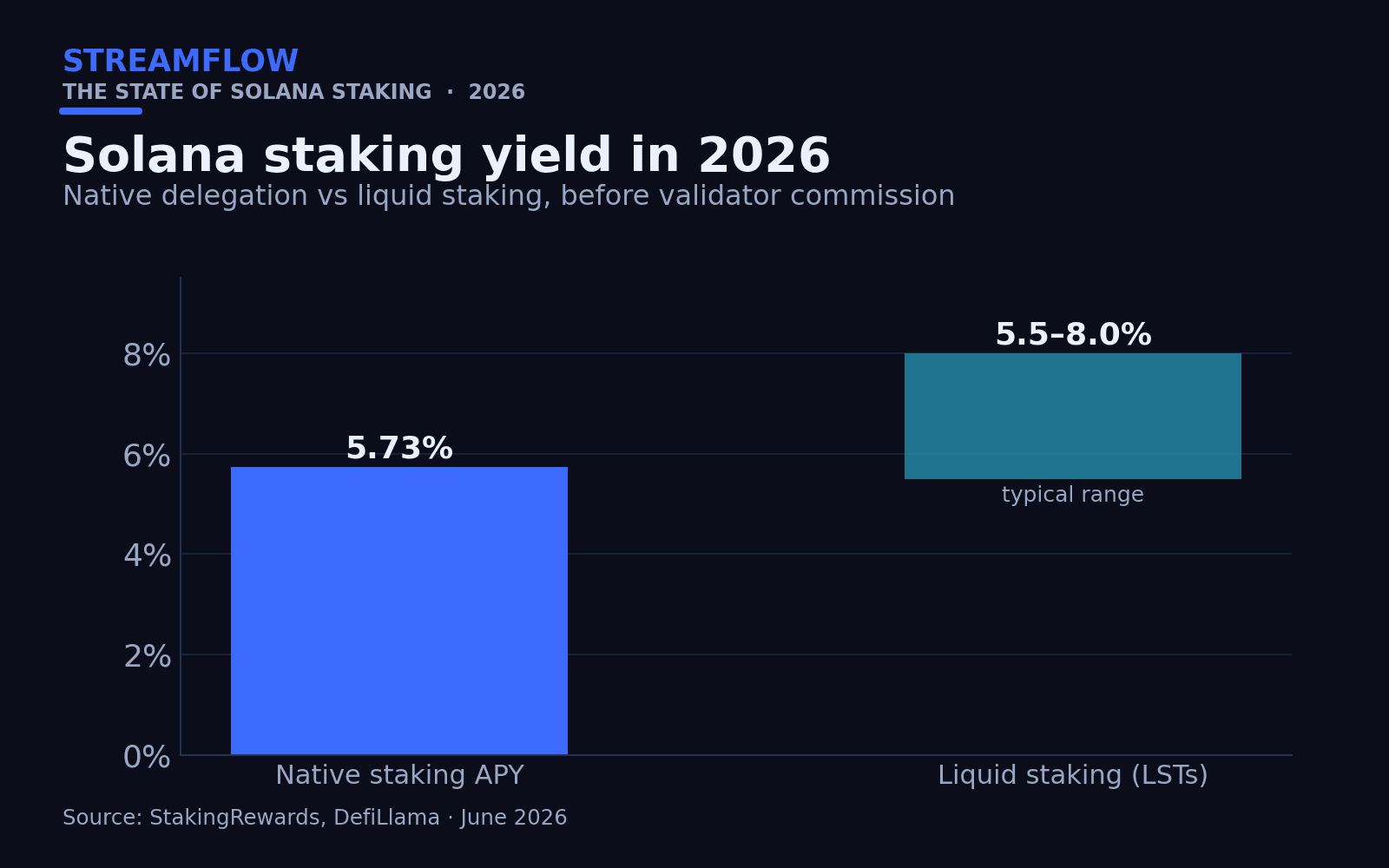
Native Solana staking returns about 5.73% APY before validator commission, and the composition of that yield is shifting away from pure inflation.
Yield breakdown (June 2026):
Native staking APY: ~5.73%, per the StakingRewards benchmark
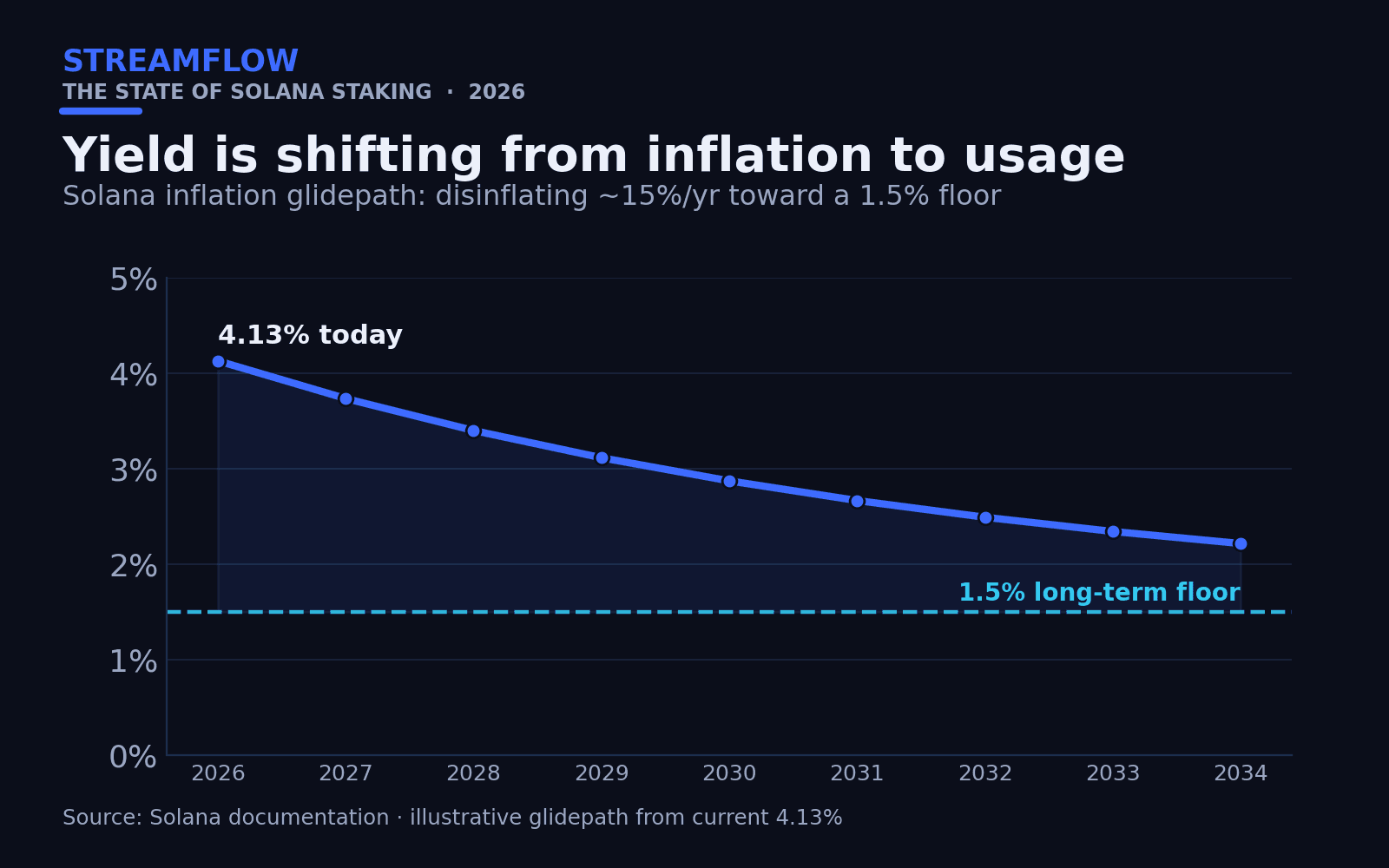
Baseline inflation: 4.13%, disinflating roughly 15% year over year toward a 1.5% floor
Validator commissions: 0% to 7%, with a benchmark around 3.6%
Liquid staking APY: typically 5.5% to 8%+, boosted by MEV tips and priority fees
Under current design, 100% of inflationary issuance goes to stakers and validators, with priority fees (after SIMD-96) and MEV tips adding a growing usage-based layer.
As inflation disinflates toward 1.5%, the relative weight of fees and MEV in total yield keeps rising, per Solana documentation and Marinade's staking research.
The direction is clear: Solana staking yield is migrating from inflation-funded emissions toward rewards tied to real economic activity. That single trend is the most important design signal in this report, and it maps directly onto how the strongest projects now build their own staking.
The Validator Set Shrank, but Decentralization Improved
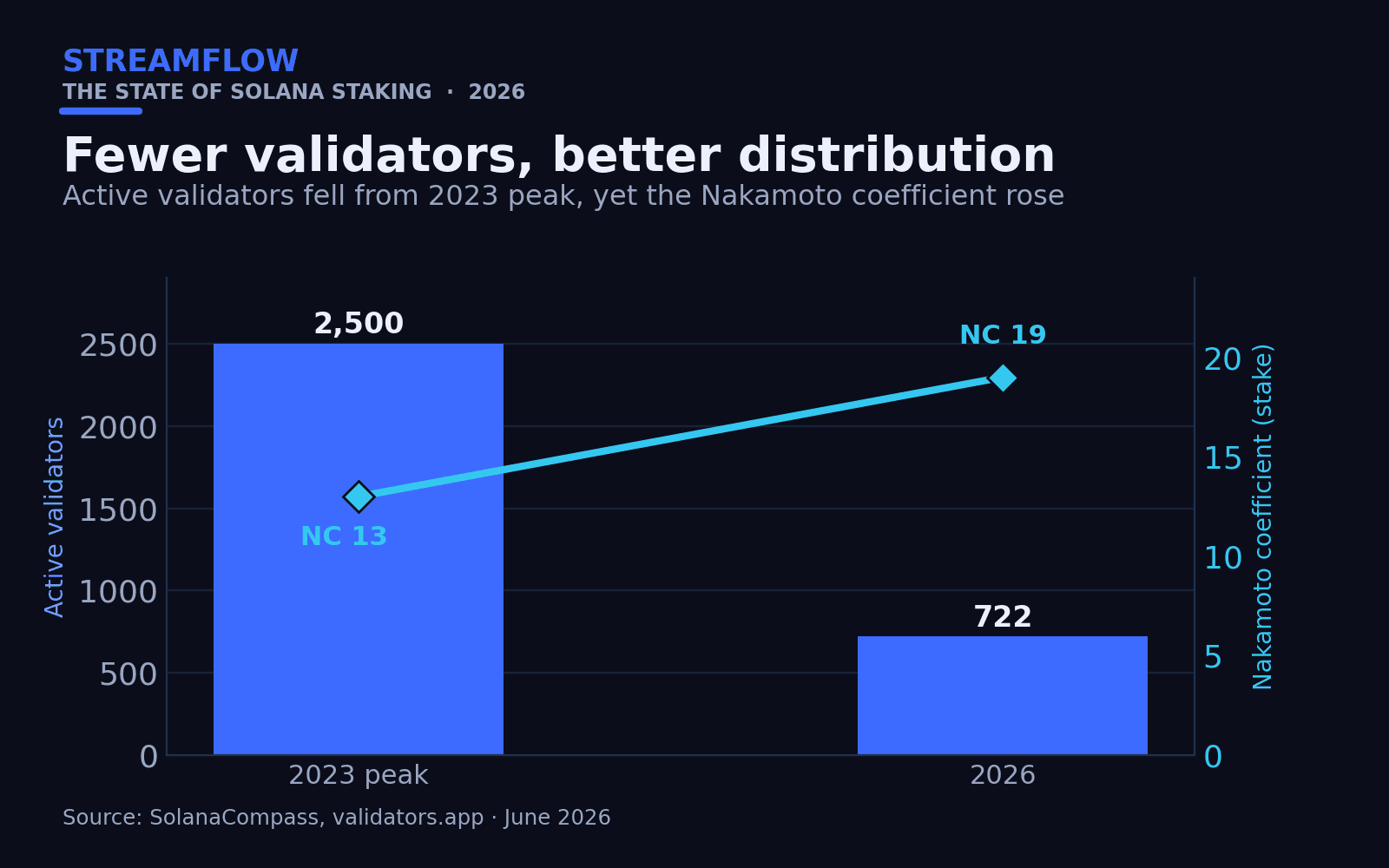
Solana's active validator count fell sharply from its 2023 peak, yet stake distribution across validators has measurably improved.
Validator health (June 2026):
Active staked validators: 721 to 723, down from a 2023 peak above 2,500
Total nodes: roughly 4,500, including about 3,788 RPC nodes
Nakamoto coefficient (stake): 19, up from 13 two years ago
Geographic spread: 47 countries and 458 data centers
The contraction reflects hardware costs, SOL price dynamics, and efficiency gains rather than network weakness, per SolanaCompass and validators.app.
Remaining validators tend to run higher-quality infrastructure with strong uptime.
Client diversity is also maturing, with Agave clients holding roughly 64% of stake and Frankendancer and Firedancer variants reaching an estimated 11% to 15% combined.
A rising Nakamoto coefficient alongside a shrinking validator count is a useful reminder that decentralization is about stake distribution, not raw node count.
For builders, the practical implication is that Solana's base layer is stable enough to build durable staking products on top of.
Native vs Liquid Staking: Two Design Patterns Splitting the Market
Solana staking has bifurcated into native delegation and liquid staking, with liquid staking tokens (LSTs) now representing a significant but minority share of staked supply.
Liquid staking TVL by protocol (DefiLlama, June 2026):
Protocol | Approx. TVL |
|---|---|
Sanctum Validator LSTs | $913M |
Binance Staked SOL | $737M |
Jito Liquid Staking | $650M |
Jupiter Staked SOL | $355M |
DoubleZero Staked SOL | $346M |
Drift Staked SOL | $185M |
Marinade Liquid Staking | $175M |
Total LST TVL sits near $4.1B, roughly 7% to 14% of all staked SOL, with the top protocols holding the majority share.
Native staking carries only consensus and validator risk and auto-compounds rewards, but locks capital during the cooldown period.
Liquid staking trades a small fee and added smart-contract and depeg risk for DeFi composability, letting staked positions be used as collateral or liquidity.
The two patterns are converging in 2026, with native staking seeing an institutional resurgence and instant-unstake liquidity pools closing the gap. The lesson for token teams is that liquidity and yield are no longer mutually exclusive, and holders increasingly expect both.
Why Project Token Staking Is a Different Problem
Staking your own SPL token is a fundamentally different exercise than delegating SOL to a validator, and most of the network-level data above does not transfer to it.
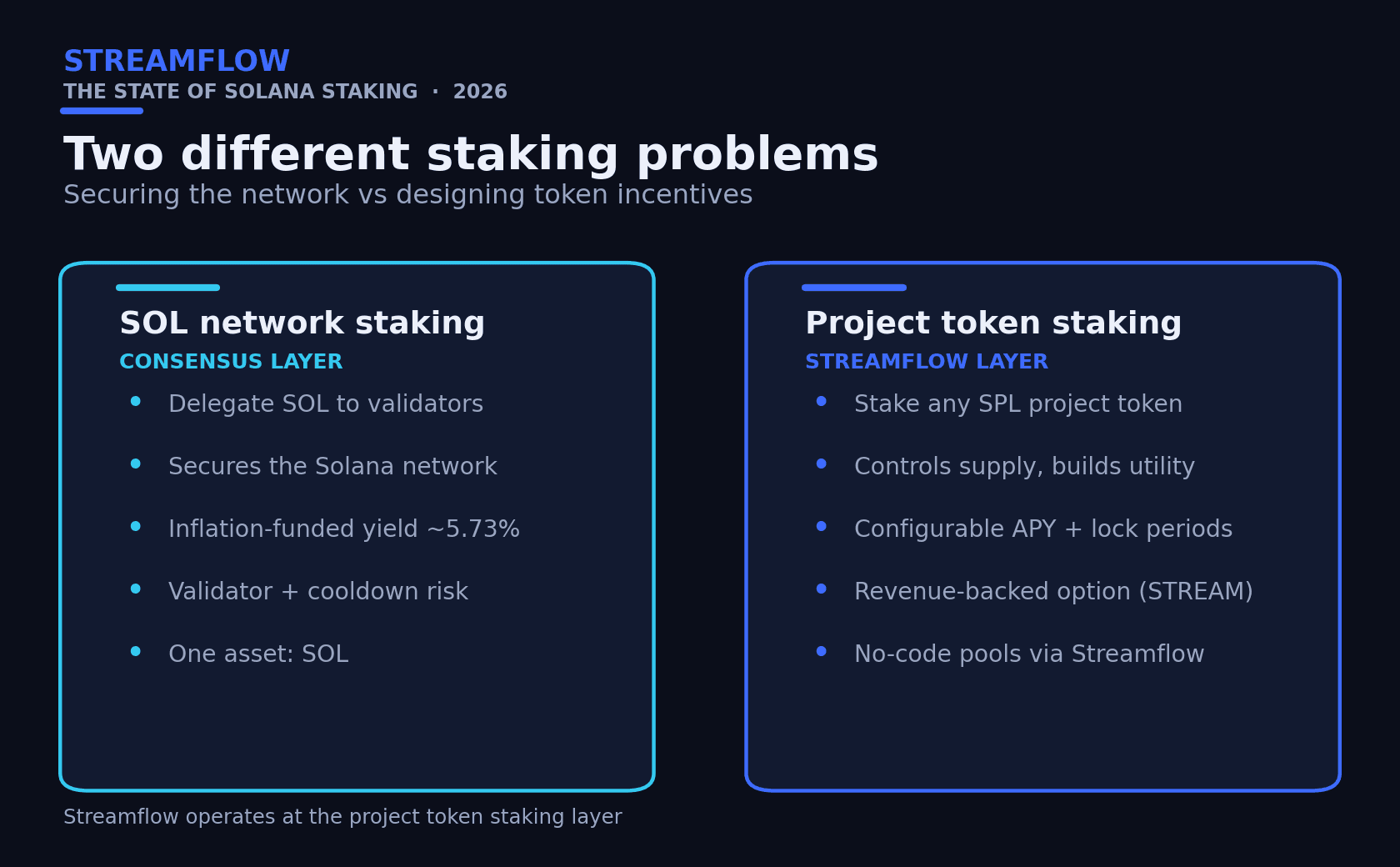
SOL staking secures the network and pays inflation. Project token staking, by contrast, is an incentive design problem: teams use it to reduce circulating supply, reduce sell pressure, reward holders, drive engagement, build utility, and support governance.
This is the layer where Streamflow's staking pools on Solana operate.
Streamflow lets teams deploy staking for any SPL token without building custom infrastructure:
No-code pool creation with configurable APY and lock periods
Automated reward distribution and easy reward top-ups
Fully non-custodial pools with permissionless creation
Pool types including Fund Once, Continuous Funding, Governance Staking, and Custom
Native support for Phantom, Backpack, and Solflare, with stake receipts on-chain
A team that would otherwise spend weeks engineering and auditing a staking contract can launch a pool in minutes.
You can launch a staking pool on Streamflow directly, or integrate the logic through the public SDK.
For builders, the constraint shifts from engineering capacity to incentive design, which is where the next finding becomes decisive.
The Shift From Inflation to Revenue-Backed Rewards
The same migration reshaping SOL yield, from inflation toward real usage, is now defining how leading projects structure their own staking rewards.
At the network level, SOL's inflation disinflates from 4.13% toward a 1.5% floor while fees and MEV grow as a share of yield.
At the project level, Streamflow's STREAM staking applies the same principle directly: rewards funded by protocol revenue rather than newly minted tokens. According to Streamflow's platform data, STREAM staking currently shows:
Protocol TVL: $342M
Staking APY: ~101%
Active stakers: 1,796
Total STREAM staked: 23M
Revenue routed to STREAM rewards: 6.2%
Rewards are distributed hourly as buybacks, which means no dilution to existing holders, a structural contrast with emission-funded staking. The headline APY partly reflects that only 5.33% of supply is currently staked, and revenue-backed yields scale with both participation and protocol revenue rather than a fixed emission rate.
The strategic point holds regardless of the exact number: revenue-backed staking ties holder rewards to real economic activity instead of supply inflation. As Solana itself disinflates, that design is moving from novelty to expectation.
What This Means for Teams Designing Token Staking on Solana
The data points to a clear design brief for any team launching a token in 2026.
Expect high baseline participation: With roughly 68% of SOL staked, Solana holders treat staking as default behavior, so a token without a credible staking path leaves utility on the table.
Design for broad participation, not just whales, since the median wallet is small and concentration is already a structural risk at the network level.
Move away from pure emission-funded rewards where possible.
The macro shift from inflation to usage-based yield signals what sophisticated holders now scrutinize, and a revenue-backed or buyback-funded model reads as more sustainable than an inflationary one.
Streamflow's staking infrastructure, built natively as Solana token operations infrastructure, supports both standard reward pools and the revenue-backed STREAM model, so the design choice stays with the team rather than the tooling.
Case Study: Heavenland's Supply Discipline on Solana
Staking exists largely to control supply and align holders, and the same discipline shows up clearly in how projects structure distribution.
Heavenland, a metaverse built on Solana, used Streamflow to manage its $HTO token, placing 97% of total supply on a five-year linear vesting schedule with cliffs across team, incentives, and treasury allocations.
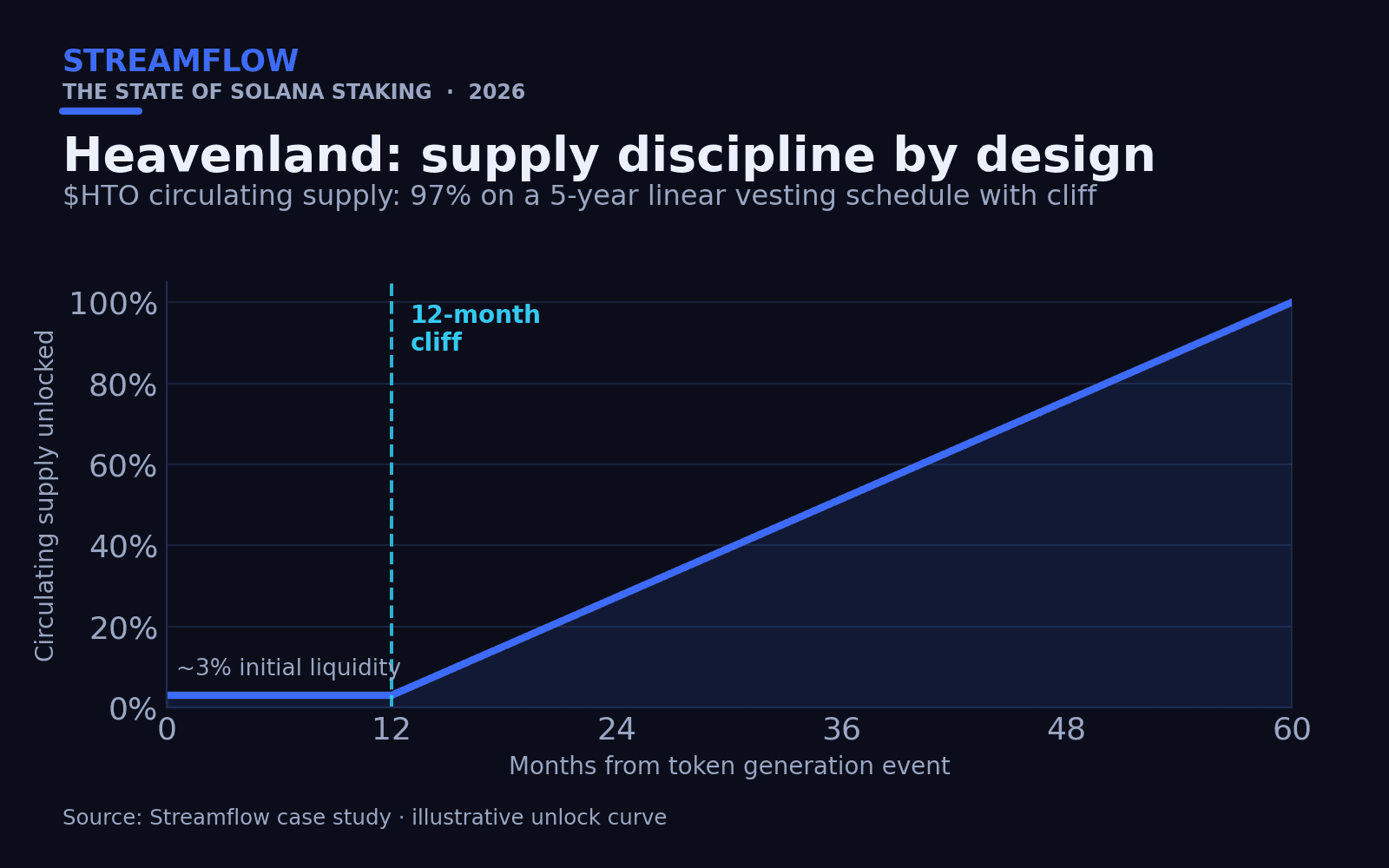
The structure was designed to allow initial liquidity without excessive inflation, the same supply-control objective that staking serves once a token is live.
According to Streamflow's data, the outcome was a more engaged and dedicated player community, with distribution transparency reducing sell-pressure risk.
The lesson translates directly to staking design. Whether through vesting, locks, or staking pools, the projects that endure are the ones that treat supply discipline as infrastructure, not an afterthought.
Looking Ahead: Where Solana Staking Goes Next
Three data-grounded trends will define Solana staking through the rest of 2026.
Yield keeps shifting from inflation to usage: As issuance disinflates toward 1.5%, fees and MEV become the dominant variable in staking returns, rewarding networks and tokens with real activity.
Decentralization improves even as validators consolidate: Rising client diversity through Firedancer adoption and a climbing Nakamoto coefficient suggest resilience is decoupling from raw validator count.
Native and liquid staking converge: Instant-unstake pools and institutional native staking are erasing the old liquidity-versus-security tradeoff, and project tokens will be expected to offer the same flexibility.
For token teams, the throughline is that staking is becoming less about printing rewards and more about routing real value to holders.
Conclusion
Solana staking in 2026 is defined by high participation near 68%, compressing native yield around 5.73%, and a steady migration from inflation-funded rewards toward usage and revenue-backed models.
The network layer is stable and increasingly decentralized by stake, while the project layer is where the most consequential design decisions now happen.
The clearest signal in the data is the move from emissions to real economic backing, and that is precisely the direction Streamflow's staking infrastructure, from no-code SPL pools to the revenue-backed STREAM model, is built to support.
FAQs:
1. What percentage of Solana is staked in 2026?
About 67.67% of Solana's eligible supply is staked as of June 2026, roughly 430 million SOL worth close to $28 billion, per StakingRewards and SolanaCompass. That ranks among the highest staking participation rates of any major proof-of-stake network.
2. What is the current Solana staking yield?
The current native Solana staking yield is about 5.73% APY before validator commission, per the StakingRewards benchmark. Liquid staking tokens typically yield 5.5% to 8%+ once MEV tips and priority fees are added, though they carry additional smart-contract and depeg risk.
3. What is the difference between native and liquid Solana staking?
The difference is liquidity and risk. Native staking delegates SOL directly to validators with only consensus risk but locks capital during cooldown, while liquid staking issues a tradeable token (an LST) that stays usable in DeFi at the cost of small fees and added smart-contract risk.
4. How is Streamflow staking different from staking SOL?
Streamflow staking is for project tokens, not SOL delegation. It lets teams deploy no-code staking pools for any SPL token with configurable APY, lock periods, and automated rewards, including the revenue-backed STREAM model that funds rewards from protocol revenue rather than token inflation.
5. Why are revenue-backed staking rewards better than inflationary ones?
Revenue-backed staking rewards are funded by real protocol activity rather than newly minted tokens, which avoids diluting existing holders. As Solana's own inflation disinflates toward a 1.5% floor, this usage-based model aligns rewards with genuine economic value, which is how Streamflow's STREAM staking distributes yield as hourly buybacks.