General
Streamflow vs Magna: Solana Token Locking and Staking Compared
Streamflow is the leading token operations infrastructure platform on Solana, trusted by over 1.3 million users and 40,000+ projects managing more than $1.4B in total value locked.
As the Solana ecosystem continues to mature, teams evaluating token distribution infrastructure are increasingly comparing the two most prominent platforms in this space: Streamflow and Magna.
This article breaks down how both platforms handle token locking, vesting, and staking, so you can make the right infrastructure decision for your project.
Key Takeaways
Streamflow is Solana-native, purpose-built for high-speed, low-cost token operations with sub-second finality.
Streamflow offers a fully permissionless, no-code experience for token locks, vesting, and staking.
Streamflow's staking infrastructure is production-ready and self-serve.
What Is Streamflow
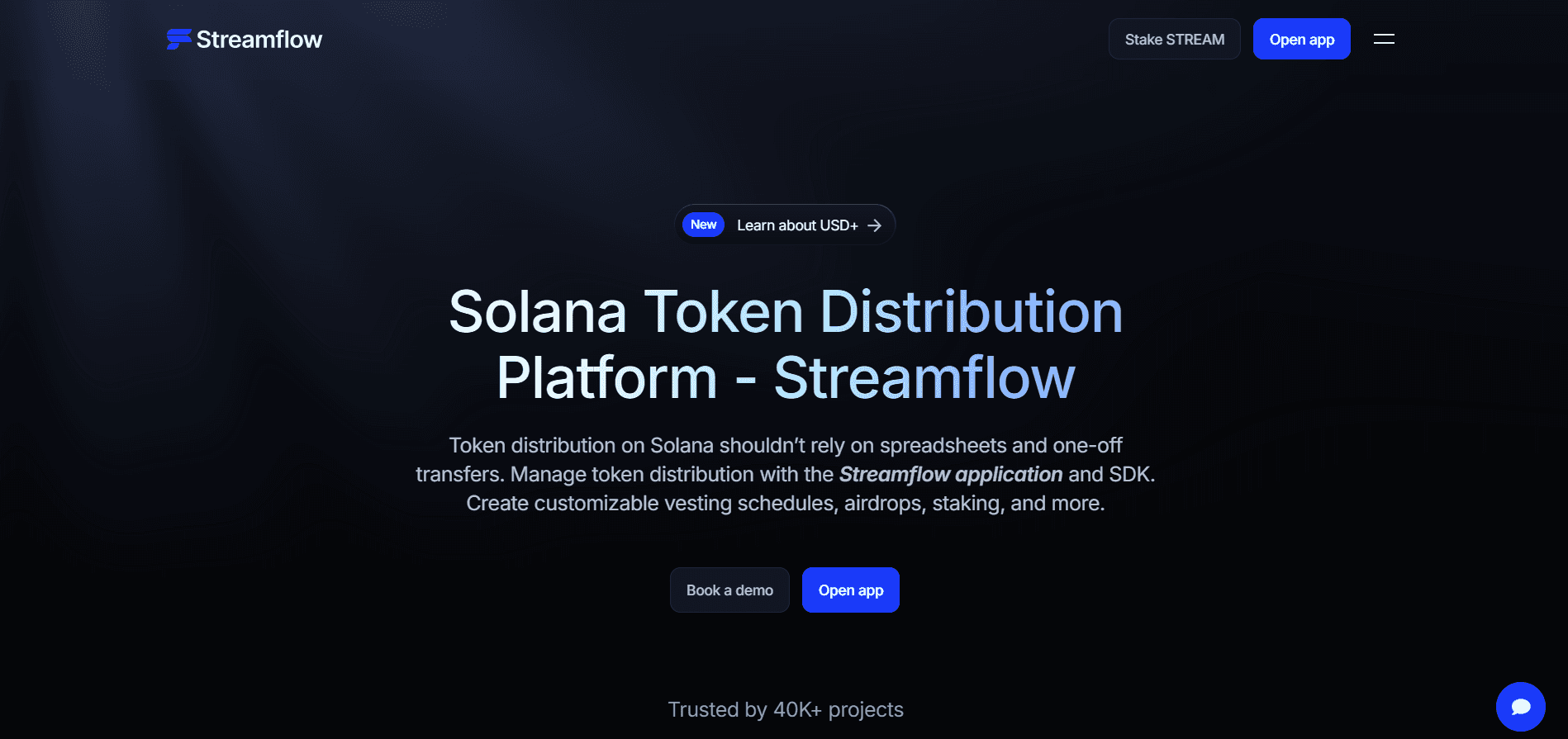
Streamflow is a Solana-native token operations infrastructure platform that automates:
Streamflow is positioned as the financial OS for Internet Capital Markets on Solana, not just a vesting tool, but the infrastructure layer that executes token economies end-to-end.
Core stats:
$1.4B+ in total value locked
1.3M+ users
40,000+ projects
Up to 1M airdrop recipients supported per campaign
Streamflow is listed in the official Solana documentation under token vesting, making it one of the most trusted and verified tools in the ecosystem.
Its smart contracts are audited by FYEO and OPCODES, and the platform is fully permissionless, any SPL token can be used without approval or custom builds.
The product suite includes: Token Locks, Token Vesting, Airdrops, Token Staking, $STREAM Active Staking Rewards, Tokenomics Dashboard, Token Minting, Payments and Payouts, Recurring Transfers, Escrow, SDK/API, White-label Portals, and utility tools including a sybil checker, wallet cleaner, and multi-wallet airdrop checker.
What Is Magna
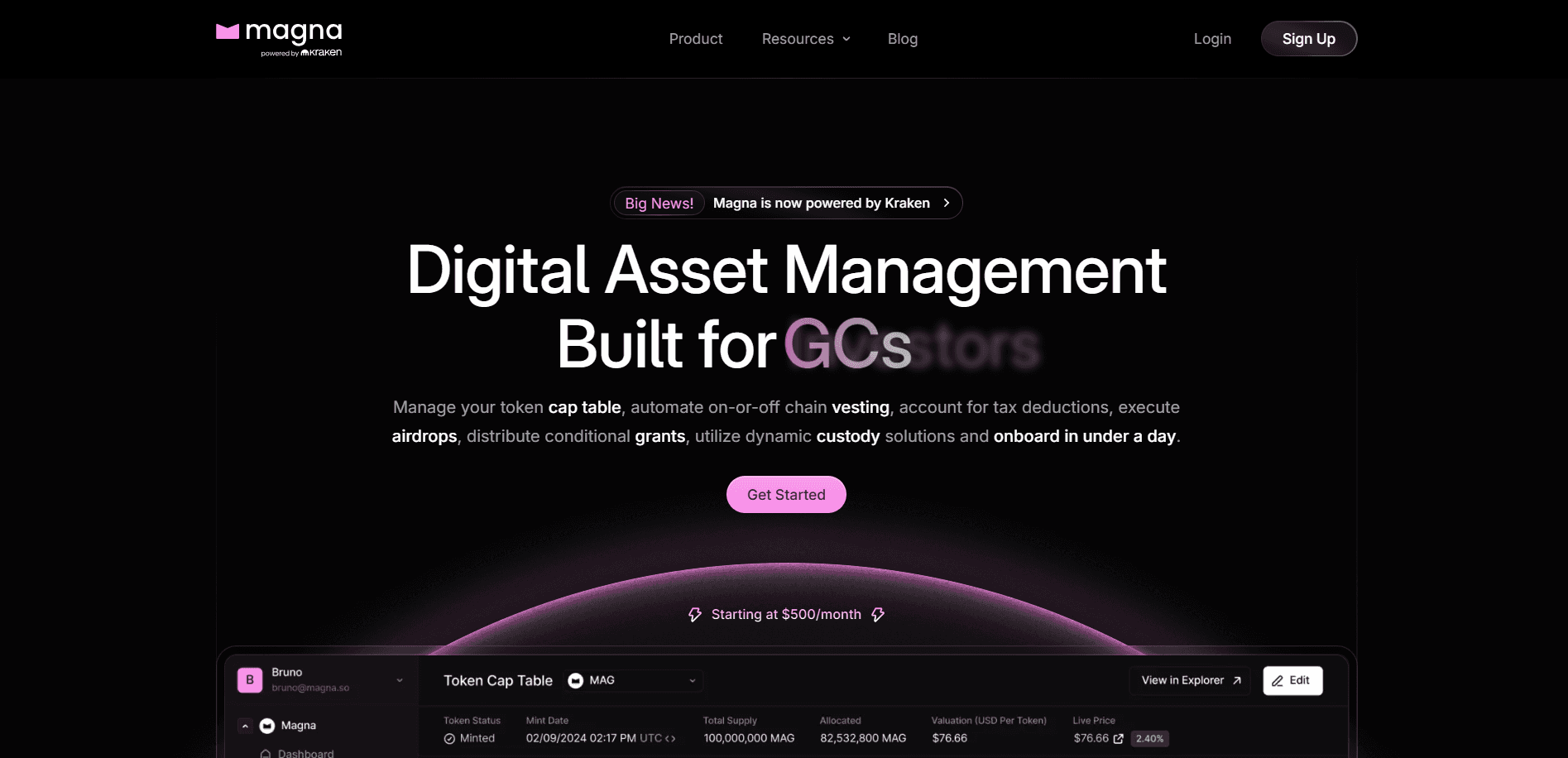
Magna is a token management platform that offers vesting, airdrops, staking, grants, escrow, and custody services. Originally launched as a vesting-focused tool, it has expanded into a broader token operations suite.
Magna's key differentiator is its compliance and enterprise orientation: it integrates with HR platforms like Rippling and Deel for net-of-withholding distributions, supports RTAs, 83(b) elections, token warrants, and provides white-glove support for institutional clients.
Magna is multi-chain, supporting Solana, Ethereum, Avalanche, and others. It reports managing over $10B in tokens for more than one million stakeholders. Its smart contracts have been audited by OtterSec, Trail of Bits, Zellic, and Guardian Audits, and the platform integrates with custodians like Fireblocks, Anchorage, and Squads.
Where Magna leans into compliance and custody workflows, Streamflow leans into speed, permissionless access, and Solana-native performance, making the two platforms serve meaningfully different priorities.
Token Locking: How Each Platform Works
What Token Locking Means in This Context
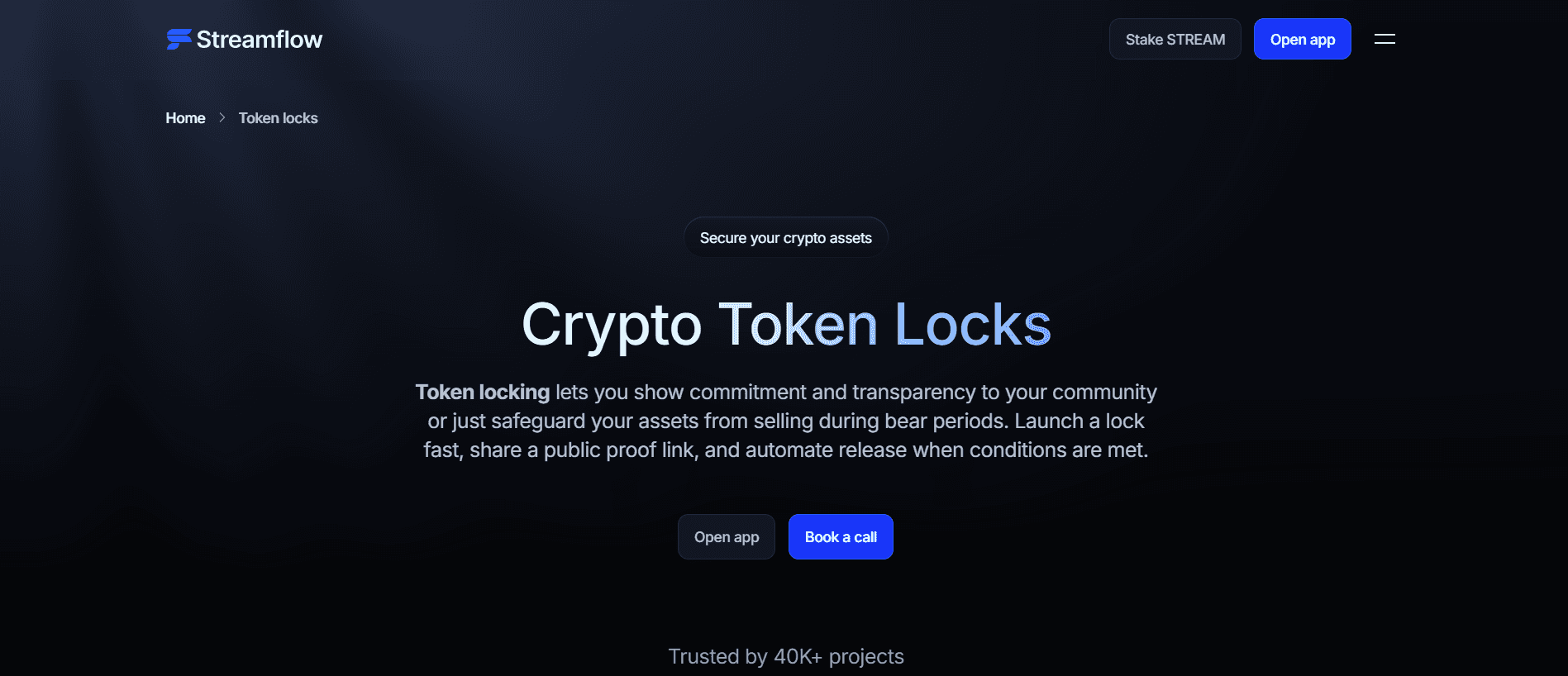
A token lock is an on-chain mechanism that restricts tokens from being transferred, traded, or accessed until predefined conditions are met, typically a specific date, time period, or price level.
Token locks are used by founders, investors, and treasury managers to enforce commitment, control circulating supply, and provide publicly verifiable proof that certain allocations cannot be moved prematurely.
Token locks are distinct from vesting: a lock applies a single release condition to a full allocation, while vesting releases tokens gradually over a schedule. Both are critical trust mechanisms in token economies, and the quality of the infrastructure behind them directly impacts how a project is perceived by its community and investors.
1. Streamflow Token Locking
Streamflow offers on-chain token locking with time-based and price-based unlock conditions. Once a lock is deployed, it is immutable, there are no admin override capabilities, and no one can access the tokens before the unlock criteria are fulfilled.
This is a deliberate design choice: it removes ambiguity and eliminates insider manipulation risk.
Key features of Streamflow token locks:
Fixed-date and price-based unlock conditions
Automatic token release when conditions are met
Public proof links, shareable URLs that allow anyone to verify the lock on-chain
Public dashboards visible on Solscan, Solana Explorer, and RugCheck
Support for SPL tokens and LP tokens
No admin override, immutable once deployed
Deployable in as little as 37 seconds
Streamflow token locks are verifiable on-chain in real time, making them a direct trust signal for investors and community members who want to confirm that team or investor allocations cannot be dumped prematurely.
The cost of locking on Solana is a fraction of what it would cost on Ethereum, making Streamflow accessible for projects at every stage.
2. Magna Token Locking
Magna supports token locks as part of its broader vesting and distribution infrastructure. Its lock tooling is integrated into a multi-custody framework, allowing teams to lock from Fireblocks, Anchorage, Safe, Squads, or Magna's own custody tool.
Magna's lock functionality is strong in enterprise contexts, particularly where legal agreements like token warrants or RTAs require coordination between counsel, custodians, and stakeholders.
However, for the majority of Solana projects, those that need fast, permissionless, on-chain verifiable locks without institutional overhead, Streamflow's approach is simpler, faster, and natively integrated with the Solana ecosystem.
Feature | Streamflow | Magna |
|---|---|---|
On-chain locking | ✅ Yes | ✅ Yes |
Price-based unlocks | ✅ Yes | ✅ Yes |
Immutable contracts | ✅ Yes | Varies by setup |
Public proof links | ✅ Yes | ✅ Yes |
SPL token support | ✅ Any SPL token | ✅ Yes |
LP token support | ✅ Yes | Not prominently featured |
Custodian integration | Not required | ✅ Fireblocks, Anchorage |
Solana Explorer verification | ✅ Yes | ✅ Yes |
Time to deploy | ~37 seconds | Onboarding required |
Permissionless access | ✅ Fully | ❌ White-glove model |
Vesting Schedules: Flexibility and Use Cases
1. Streamflow Token Vesting
Token vesting is the controlled release of tokens over time, designed to prevent immediate selling and align long-term incentives across all stakeholder groups.
Streamflow turns vesting schedules into immutable on-chain contracts, enforced automatically without any manual intervention.
Supported vesting models on Streamflow:
Linear vesting: tokens released evenly over time
Cliff vesting: no tokens released until a defined date
Cliff + linear: cliff period followed by gradual linear release (the standard for founders and core team, typically with a 12-month cliff)
Milestone-based vesting: tied to project events or deliverables
Price-based vesting: tokens unlock when price conditions are met
Graded vesting: custom interval-based schedules
Streamflow supports bulk import via CSV, with multi-recipient contracts that allow teams to onboard hundreds of stakeholders at once. Each vesting contract generates a shareable proof link and is verifiable on-chain.
Recipients can track their allocations through Streamflow's token vesting dashboard, which shows real-time release progress, upcoming cliff dates, and unlock events.
The platform is designed to serve every stakeholder group in a token economy:
Stakeholder Group | Typical Schedule |
|---|---|
Founders | 12-month cliff + 36-month linear |
Core team | 12-month cliff + 24–36-month linear |
Advisors | 6-12 month cliff + 24-month linear |
Investors | 6-12 month cliff + 18-24 month linear |
DAO Treasury | Custom milestones or time-based |
Ecosystem incentives | Linear or milestone-based |
Public sale participants | Short cliff or immediate |
Vesting security on Streamflow is absolute: contracts are immutable once deployed, no admin can unilaterally alter them, and all release logic is enforced by the smart contract, not by any team member's manual action. This eliminates insider risk, prevents rug pulls, and removes any ambiguity about commitment.
2. Magna Token Vesting
Magna supports linear, cliff, milestone-based, and time-weighted vesting schedules.
A notable distinction is Magna's off-chain vesting option, where teams can track unlock schedules off-chain and distribute directly from their custody solution. This is valuable for projects with institutional custodians or legal obligations that prevent full on-chain deployment, but it does introduce a point of centralized control that on-chain vesting avoids by design.
Magna's HRIS integrations (Rippling, Deel) make it particularly strong for employee token grants that require tax withholding, a legitimate need for companies treating token compensation like equity.
For the broader Solana ecosystem, where teams need fast, transparent, fully verifiable vesting without legal coordination overhead, Streamflow's fully on-chain model is the stronger default.
Staking: Building Token Incentive Programs
What Token Staking Means on These Platforms
In this context, staking refers to allowing token holders to lock their tokens into protocol pools in exchange for rewards. Staking serves multiple functions in a token economy: it reduces circulating supply, decreases sell pressure, rewards long-term holders, drives community engagement, builds token utility, and can support governance participation.
Not all token staking systems are created equal. The distinction between inflation-based reward models (which dilute existing holders) and revenue-backed reward models (which distribute real protocol yield) is critical for evaluating long-term sustainability.
1. Streamflow Token Staking
Streamflow offers a fully no-code staking infrastructure that allows any team to deploy a staking pool for any SPL token without writing a single line of code. Pools are fully non-custodial, permissionless to create, and configurable across every major parameter.
Supported pool types:
Fund Once: rewards funded in a single deposit
Continuous Funding: rewards topped up over time
Governance Staking: tied to on-chain governance participation
Custom: bespoke structures configured by the team
Key staking features on Streamflow:
No-code pool creation
Configurable APY and lock periods
Automated reward distribution, no manual claiming required
Real-time staking data
Easy reward top-ups without redeploying contracts
Stake receipts and stake tokens
Public SDK for developer integrations
Supported wallets: Phantom, Backpack, Solflare, and all Solana-compatible wallets
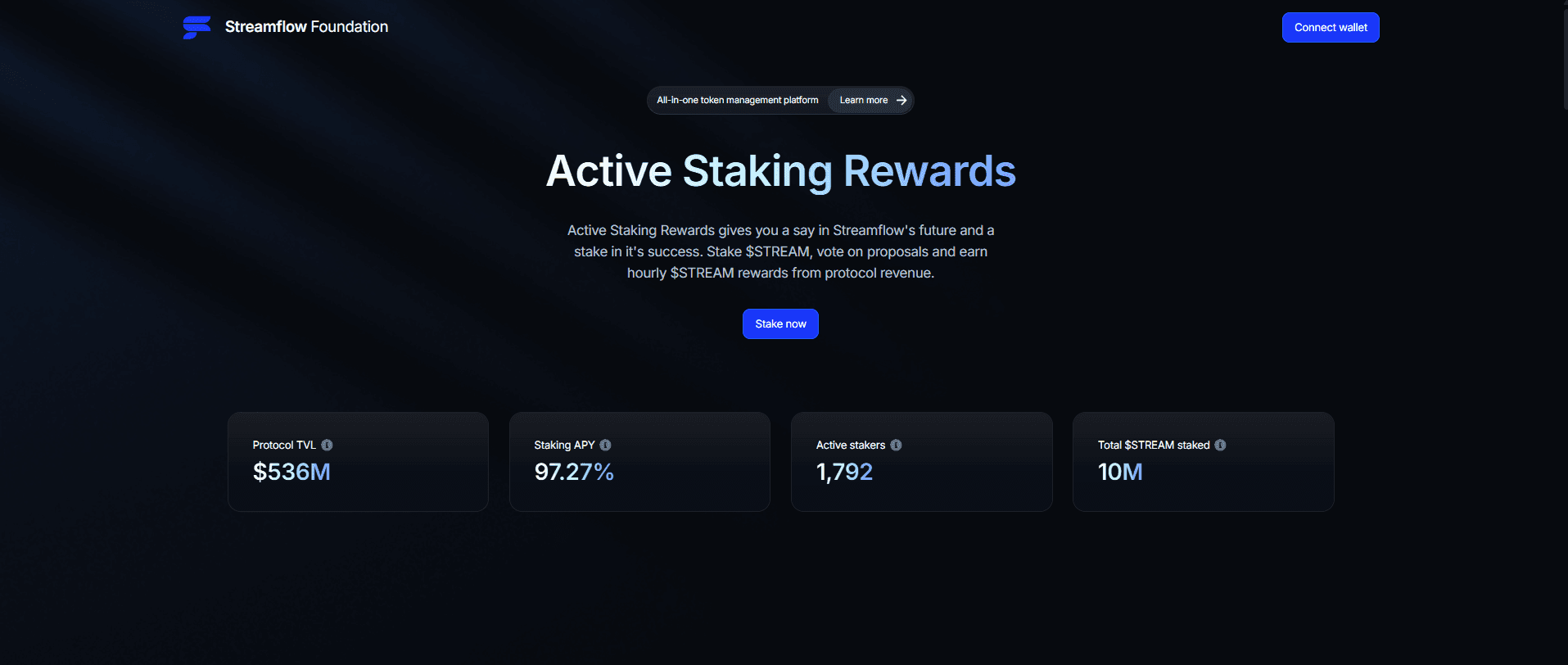
Beyond the general staking product, Streamflow also operates the $STREAM Active Staking Rewards program, a separate and more advanced staking layer where protocol revenue is redistributed to $STREAM stakers.
This is not an inflationary model. Stakers earn from real protocol activity via hourly buybacks, with zero dilution to the existing token supply.
$STREAM Active Staking Stats:
Staking APY: 97.27%
Protocol TVL: $536M
Active stakers: 1,792
Total $STREAM staked: 10M
Circulating supply staked: 5.55%
Revenue allocated to staking rewards: 3.46%
This revenue-backed model aligns staker incentives directly with protocol performance, the more Streamflow is used, the more value flows to $STREAM stakers. It is a fundamentally different and more sustainable design than token emission staking.
2. Magna Token Staking
Magna launched its staking product more recently, positioning it around two primary use cases: yield maximization through LST and native validator staking, and permissionless community staking via white-labeled portals.
Magna also offers a one-click claim-and-stake flow that allows airdrop or vesting recipients to stake their tokens immediately upon claim, a smooth UX integration.
Magna's staking is configurable and accessible via API, and it supports white-labeled staking portals for branded experiences.
However, its staking infrastructure is less mature than Streamflow's and does not offer an equivalent revenue-backed active rewards program.
Staking Feature | Streamflow | Magna |
|---|---|---|
No-code pool creation | ✅ Yes | ✅ Yes |
Any SPL token | ✅ Yes | ✅ Yes |
Automated reward distribution | ✅ Yes | ✅ Yes |
Revenue-backed staking | ✅ $STREAM ASR | ❌ Not available |
White-labeled staking portals | ✅ Yes | ✅ Yes |
Governance staking pool type | ✅ Yes | Not specified |
Public SDK | ✅ Yes | ✅ Yes |
Non-custodial pools | ✅ Fully | ✅ Yes |
Staking APY (protocol-level) | 74.57% ($STREAM) | Varies by LST/validator |
Ecosystem Integrations and Developer Access
1. Streamflow
Streamflow is deeply integrated into the Solana ecosystem. It is listed in the official Solana documentation under token vesting, operates natively with all Solana-compatible wallets (Phantom, Backpack, Solflare, and more), and integrates with DAO tooling including Realms.
The platform's public SDK allows developers to build custom token workflows, embed vesting schedules into dApps, and power programmable payment flows, without deploying their own smart contracts.
The UXD Protocol case study is a strong example: the team integrated the Streamflow SDK directly into Realms, creating a single interface where governance participation and token claiming happened simultaneously for approximately 46% of the $UXP supply under a 4-year linear vesting schedule with a 12-month cliff.
Streamflow also provides a white-label layer for teams that want fully branded distribution portals, claim interfaces, staking dashboards, and lock pages, all powered by Streamflow infrastructure, under a custom domain and brand identity.
2. Magna
Magna offers a similarly strong developer layer with a powerful API and support for Protocol Hooks, enabling advanced flows like automatically minting NFTs upon token claims. Its integrations span Fireblocks, Anchorage, Safe, Squads, and major HR platforms.
Magna's multi-chain support (Ethereum, Solana, Avalanche, and others) is an advantage for projects deploying across networks, though it also means the platform's Solana implementation is one of several priorities rather than the primary focus.
Why Streamflow Is the Best Platform for Token Locking on Solana in 2026
Token locking on Solana requires infrastructure that is fast, cheap, verifiable, and purpose-built for the network. Streamflow delivers on all four:
It is Solana-native
Deployed on infrastructure capable of 65,000+ TPS with sub-second finality and near-zero fees
It has processed over $1.4B in locked value across more than 40,000 projects.
The case for Streamflow as the best token locking platform on Solana in 2026 comes down to five clear advantages:
1. Solana-native by design
Streamflow was built for Solana, not ported to it. This means the entire architecture, from smart contract design to wallet integrations to on-chain verification, is optimized for Solana's performance characteristics. Magna is multi-chain; Streamflow is native.
2. Permissionless and instant
Any team can deploy a token lock in 37 seconds without approval, onboarding, or white-glove coordination. Streamflow's no-code interface puts infrastructure-grade tooling in the hands of early-stage projects that cannot afford long setup cycles.
3. On-chain immutability as a trust feature
Streamflow's locks and vesting contracts are immutable once deployed. There is no admin override. This is not a limitatio, it is a trust guarantee.
Investors and community members can verify on Solscan, Solana Explorer, or RugCheck that no one can alter the lock after the fact.
4. Full-stack token infrastructure
Streamflow is not just a lock tool. It covers the entire token lifecycle: minting, locking, vesting, airdrops, staking, payments, and a tokenomics dashboard, all in one platform.
Magna requires more coordination across custodians, HR platforms, and compliance tools to achieve a comparable scope.
5. Proven at scale
With $1.4B+ in TVL, 1.3M+ users, and projects like Bonk, UXD Protocol, and Heavenland using Streamflow for mission-critical token distribution, the platform has a production track record that speaks for itself.
How to Get Started With Streamflow
Getting started on Streamflow requires no approval process, no onboarding call, and no smart contract experience. Here is how to go from zero to a live on-chain contract in minutes.
Step 1: Connect your wallet
Go to app.streamflow.finance and connect your Solana wallet, Phantom, Backpack, Solflare, or any Solana-compatible wallet works. Make sure it holds the SPL token you want to use and a small amount of SOL to cover transaction fees.
Step 2: Choose your product
The Streamflow dashboard gives you direct access to Token Locks, Token Vesting, Airdrops, Staking, Payments, and more from a single interface. Select the product that matches your immediate need, you can run multiple products from the same account simultaneously.
Step 3: Configure your contract
Each product walks you through a short configuration flow: select your token, define the parameters (unlock date, vesting schedule, reward logic, recipient list, or distribution type), and add your recipients either manually or via CSV upload for bulk operations.
Step 4: Fund and deploy
Review your contract summary, fund it with the relevant token amount, and deploy. The smart contract is live on-chain immediately. For token locks, this takes as little as 37 seconds from start to finish.
Step 5: Share and track
Every contract on Streamflow generates a publicly shareable proof link. Share it with your community or investors so they can verify the on-chain contract directly on Solscan, Solana Explorer, or RugCheck.
All active contracts are trackable in real time from the Streamflow dashboard, release progress, cliff dates, recipient statuses, and unlock events are visible in one place.
Conclusion
Streamflow stands as the most comprehensive and battle-tested token operations infrastructure platform on Solana, combining speed, transparency, and full-stack capability in a way that no other platform in the ecosystem currently matches.
Whether you are locking team allocations before a token launch, setting up a 3-year vesting schedule for early contributors, or deploying a staking pool to reward long-term holders, Streamflow gives you the tools to execute, permissionlessly, on-chain, and verifiably, without building anything from scratch.
Book a demo with Streamflow to discuss your token distribution strategy, explore white-label solutions, or get guidance on the right vesting and locking setup for your project.
Read Next:
FAQs:
1. What is the difference between token locking and token vesting on Streamflow?
The difference between token locking and token vesting on Streamflow is that token locks restricts an entire allocation from being transferred or accessed until a single predefined condition is met, such as a fixed date or a price threshold. Token vesting, by contrast, releases tokens gradually over time according to a schedule, linear, cliff-based, milestone-based, or custom.
2. Can Streamflow token locks be verified publicly?
Yes. Streamflow token locks can be verified publicly in real time on Solscan, Solana Explorer, and RugCheck using the shareable proof link generated at deployment.
3. How does Streamflow staking differ from Magna staking?
Streamflow staking differs from Magna staking primarily in maturity, depth of configuration, and the availability of a revenue-backed rewards layer. Streamflow's staking infrastructure supports four pool types, Fund Once, Continuous Funding, Governance Staking, and Custom, with automated reward distribution and a public SDK for developer integrations.
4. Is Streamflow better than Magna for Solana-native projects?
Yes. Streamflow is better than Magna for Solana-native projects that prioritize speed, on-chain verifiability, permissionless access, and full-stack token infrastructure without compliance overhead. Streamflow is built exclusively for Solana, listed in the official Solana documentation, and supports any SPL token without approval.
5. What types of vesting schedules does Streamflow support?
Streamflow supports a comprehensive range of vesting schedules, including linear vesting, cliff vesting, cliff plus linear vesting, graded vesting, milestone-based vesting, price-based vesting, and custom interval schedules.