General
Token Vesting
Streamflow vs Hedgey: Which token vesting platform fits your project in 2026
Streamflow is the most complete token vesting platform in 2026, built Solana-native, backed by $1.4B+ in total value locked, and trusted by over 40,000 projects for every stage of the token lifecycle, from vesting and locks to airdrops, staking, and real-time payments.
As token economies grow more competitive, the infrastructure a project selects for vesting is no longer a back-office decision, it shapes investor trust, supply dynamics, and long-term community alignment.
This article breaks down Streamflow vs Hedgey across every dimension that matters, chain coverage, vesting schedule types, platform depth, security, and pricing, so your team can make the right call before it counts.
Key Takeaways
Streamflow is a full-stack Solana-native token operations platform covering vesting, locks, airdrops, staking, and payments.
For projects building on Solana, Streamflow is the clear choice: deeper feature set, higher scale (up to 1M airdrop recipients), audited contracts, and an active, independent product roadmap.
Hedgey's free vesting tier offers EVM teams a low-cost entry point, but Streamflow's end-to-end infrastructure delivers significantly more value.
What Is Streamflow
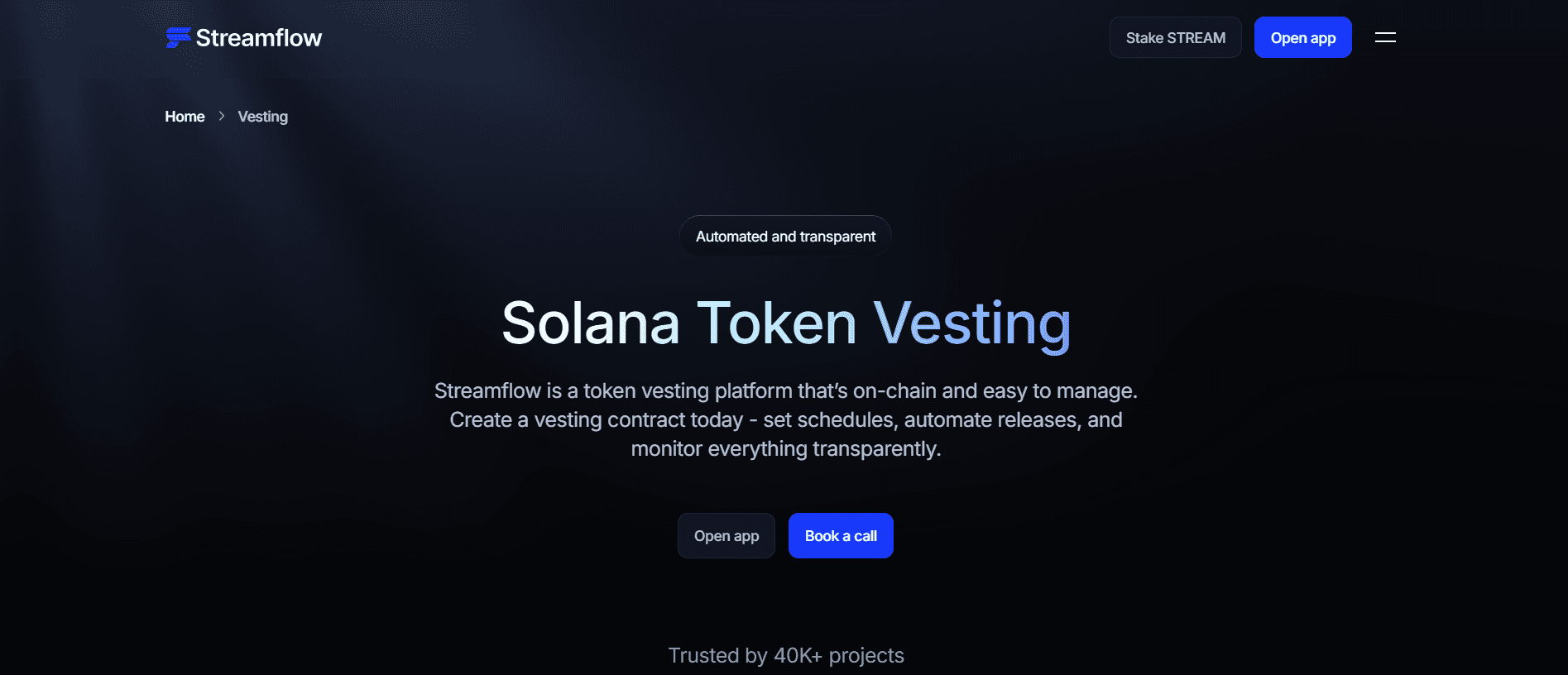
Streamflow is the best Solana-native token operations infrastructure platform that automates token distribution, locks, vesting, staking, airdrops, and payments using on-chain smart contracts.
Rather than a single-function vesting tool, Streamflow operates as the infrastructure layer that executes entire token economies on-chain.
With $1.4B+ in total value locked, over 1.3 million users, and more than 40,000 projects relying on the platform, Streamflow has established itself as the definitive token operations infrastructure for Solana-based projects. It is listed in official Solana documentation under token vesting and is a core part of the ecosystem's trusted tooling stack.
Streamflow's core product suite includes:
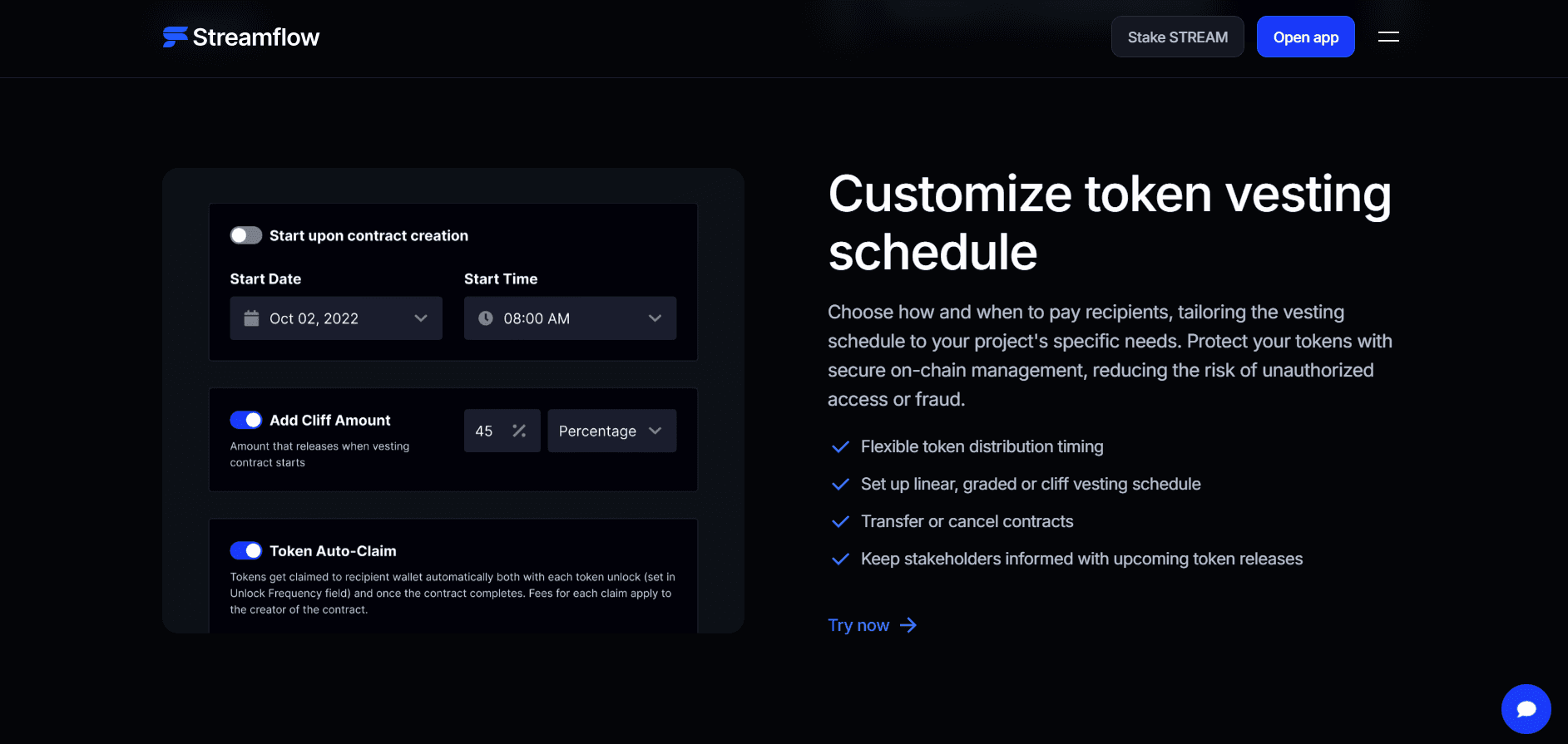
Token Vesting: linear, cliff, cliff + linear, milestone-based, and price-based schedules
Token Locks: time-based and price-based locks with public proof links and on-chain dashboards
Airdrops: scalable campaigns supporting up to 1,000,000 recipients in a single distribution
Token Staking: permissionless, no-code staking pool deployment for any SPL token
Payments and Payouts: recurring on-chain payroll, contributor payouts, and programmable real-time transfers
Tokenomics Dashboard: a real-time single source of truth for allocation, unlock schedules, and vesting progress
Token Minting, SDK, and White-Label Portals: for teams that want custom-branded distribution infrastructure
Streamflow is backed by Jump Crypto, Solana Ventures, and John Lilic, with $5M+ in total funding raised. Its contracts are audited by FYEO and OPCODES, and it supports the complete token lifecycle, from creation to distribution, incentives, and payments, within a single automated system.
What Is Hedgey
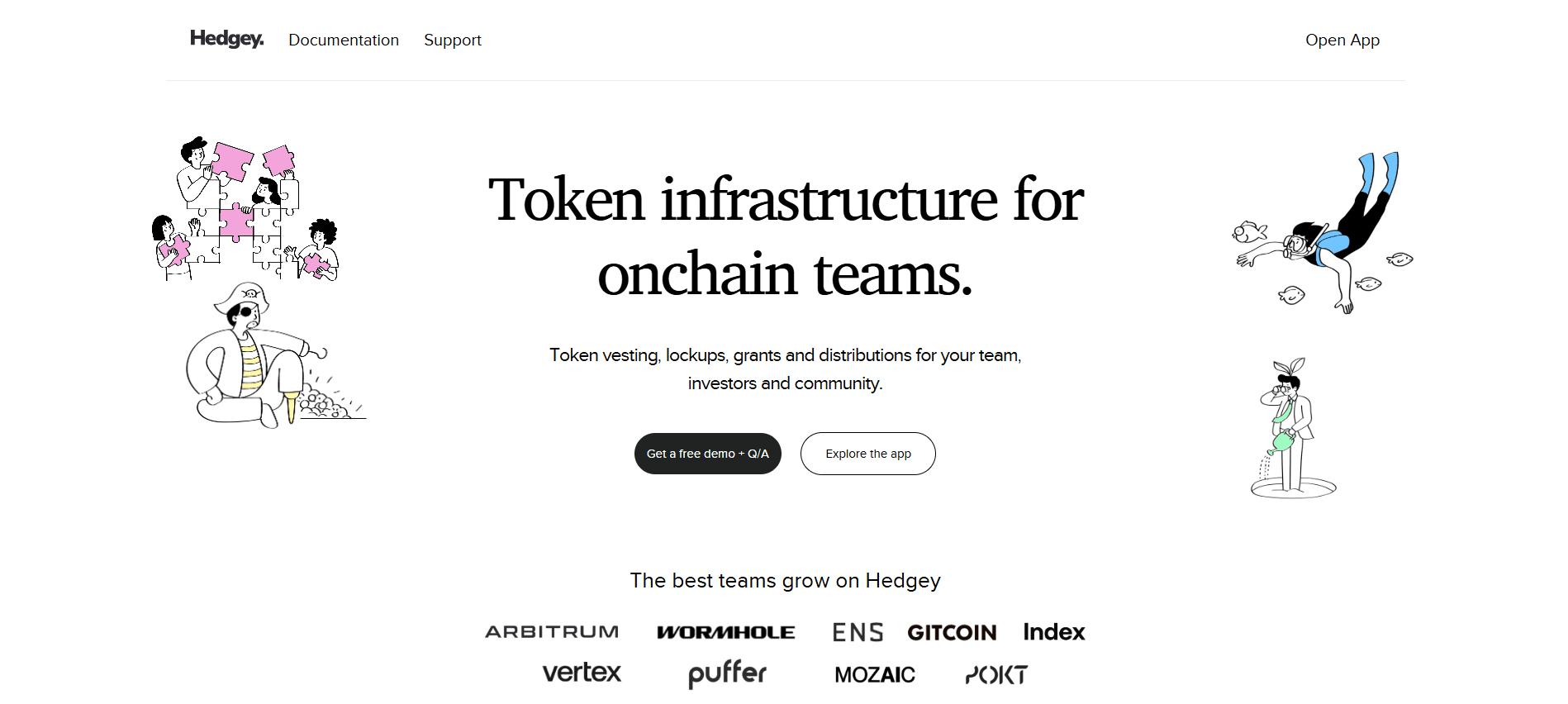
Hedgey is an EVM-based token vesting and lockup platform that allows on-chain teams to create and manage vesting schedules for team members, investors, and contributors.
The platform offers a no-code interface, customizable cliff dates, linear unlock schedules, and governance delegation for vesting recipients.
Hedgey is notable for positioning its core vesting and lockup product as free to use, with paid tiers starting at $150/month for pre-token products and investor portfolio management.
Important context for 2026: In December 2025, Hedgey was acquired by Anchorage Digital, the first federally chartered crypto bank in the U.S.
While the core Hedgey app remains operational for EVM teams, the platform's independent product roadmap is now subordinate to Anchorage Digital's broader institutional strategy, a meaningful shift for teams evaluating Hedgey as a standalone vesting solution.
Hedgey supports a wide range of EVM-compatible networks: Ethereum, Arbitrum, Base, Optimism, Polygon, Avalanche, and others, but does not offer any Solana support. Its feature set is focused primarily on vesting and lockups, without the broader ecosystem of airdrops, staking, payments, or tokenomics tooling that Streamflow delivers.
Chain Coverage: Solana vs EVM
Chain coverage is the first filter when choosing a token vesting platform. Both Streamflow and Hedgey are strong within their respective ecosystems, but they serve fundamentally different audiences.
Streamflow | Hedgey | |
|---|---|---|
Primary chain | Solana (native) | Ethereum + EVM networks |
Other chains | Solana-native (all features) | Arbitrum, Base, Optimism, Polygon, Avalanche, 15+ EVM chains |
Solana support | ✓ Full | ✗ Not supported |
EVM support | Not primary focus | ✓ Full |
For projects building on Solana, the choice is straightforward: Streamflow was purpose-built for the Solana ecosystem and takes advantage of its 65,000+ TPS throughput, sub-second finality, and near-zero transaction fees to enable distribution at a scale that is not economically viable on Ethereum. Streamflow is the only platform in this comparison with any Solana support at all.
For EVM-native projects, Hedgey's multi-chain coverage is a genuine strength, but Streamflow's Solana-native architecture means that even EVM teams with Solana ambitions will eventually need a separate platform. Streamflow serves as a complete, single-platform solution from day one.
Vesting Schedule Types: Feature-by-Feature Breakdown
Token vesting schedule flexibility is where the depth of a platform's tokenomics thinking becomes visible. Both platforms support core vesting mechanics, but Streamflow's schedule library is significantly broader.
Schedule Type | Streamflow | Hedgey |
|---|---|---|
Linear vesting | ✓ | ✓ |
Cliff vesting | ✓ | ✓ |
Cliff + linear | ✓ | ✓ |
Graded / periodic vesting | ✓ | ✓ (periodic) |
Milestone-based vesting | ✓ | ✗ |
Price-based vesting | ✓ | ✗ |
Custom intervals | ✓ | Limited |
Bulk / CSV import | ✓ (multi-recipient) | ✓ (multi-recipient) |
Both Streamflow and Hedgey handle the standard vesting toolkit well, linear schedules, cliff dates, periodic unlocks, and multi-recipient batch creation are available on both platforms.
However, Streamflow goes further with milestone-based vesting (tokens released when defined conditions are met, not just on a schedule) and price-based vesting (unlock conditions tied to token price thresholds).
These schedule types are critical for projects that want to align token releases with real-world performance rather than just the passage of time.
Streamflow also supports auto-transfers, shareable proof links, and on-chain explorer verification through Solscan and Solana Explorer, giving recipients verifiable, trustless confirmation of their vesting contracts without relying on any UI.
Hedgey offers a strong vesting dashboard for both issuers and recipients, with governance delegation so vesting recipients can participate in on-chain governance before their tokens fully unlock, a genuinely useful feature.
Streamflow similarly supports on-chain verification and public dashboards, and adds proof link sharing as an out-of-box transparency feature, so the trust signal is publicly accessible without any custom setup required.
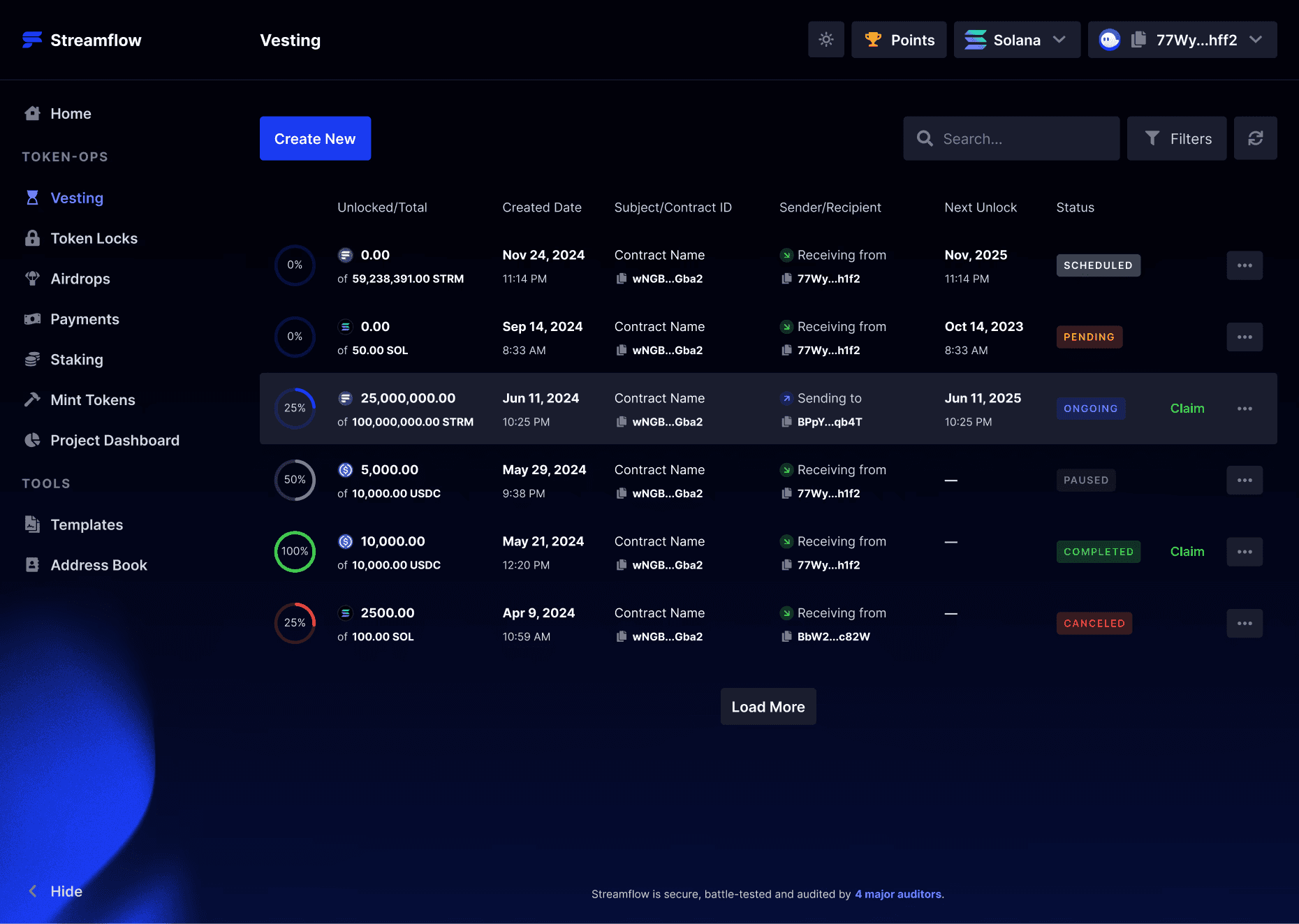
Platform Depth: What Else Do You Get Beyond Vesting
Token vesting is a starting point, not a complete token strategy. This is where the gap between Streamflow and Hedgey becomes most significant.
1. Streamflow: Full Token Operations Stack
Streamflow is designed around the complete token lifecycle. Beyond vesting, teams can use a single platform to execute:
Token Locks: fixed-date and price-triggered locks for team, investor, and treasury allocations, with RugCheck and Solscan verification
Airdrops: instant, vested, or price-based airdrops for up to 1,000,000 recipients, with claim portals, unclaimed token recovery, and real-time tracking
Staking Pools: permissionless, no-code pool creation for any SPL token, with configurable APY, lock periods, and automated reward distribution across Fund Once, Continuous Funding, Governance Staking, and Custom pool types
Payments and Payouts: recurring on-chain transfers for payroll, contractor payouts, consulting fees, and subscriptions, critical infrastructure for CFOs managing token-based compensation at scale
Tokenomics Dashboard: a real-time visualization of all token distribution, including vesting contracts, token locks, staking pools, cliff dates, and unlock events in one place
Token Minting: full token creation, metadata configuration, and supply definition
White-Label Portals: branded claim portals, staking dashboards, and lock dashboards with full UI control
SDK and Developer Layer: programmable token flows for teams building custom distribution logic into their dApps
2. Hedgey: Vesting and Lockup Specialist
Hedgey focuses primarily on token vesting and investor lockups, with an investor dashboard for tracking unlock schedules. Following the Anchorage Digital acquisition, HedgeyPro extends this into institutional-grade cap table management with white-glove onboarding.
Hedgey does not natively offer airdrop infrastructure, staking pool deployment, payments, or a full tokenomics dashboard.
For teams that only need vesting and lockups, Hedgey's focused approach may be sufficient. But for teams building a full token economy, one that requires airdrop campaigns, community staking, recurring payments, and live supply tracking, Streamflow eliminates the need to stitch together multiple tools across multiple platforms.
Security and Audit Track Record
Security is non-negotiable in token infrastructure. Both platforms use audited smart contracts and non-custodial architectures, but with important differences.
Security Dimension | Streamflow | Hedgey |
|---|---|---|
Smart contract audits | ✓ FYEO + OPCODES | ✓ Consensys Diligence, Hacken, Resonance, AuditOne, Salus (5+ audits) |
Non-custodial | ✓ | ✓ |
Contract immutability | ✓ (immutable once deployed, no admin override) | Revocable by admin |
On-chain verification | ✓ Solscan / Solana Explorer / RugCheck | ✓ Ethereum block explorers |
Public proof links | ✓ | ✓ Dashboard-based |
Both platforms take security seriously, but Streamflow's FYEO and OPCODES audits, combined with open-source contracts and Solana-native immutability, provide equivalent assurance for Solana-based teams.
The more meaningful distinction is immutability. Streamflow's smart contracts are immutable once deployed, with no admin override capability. This eliminates the risk of manipulation, insider misuse, or unilateral schedule changes, the vesting terms you set are the vesting terms that execute, full stop.
Hedgey's vesting plans remain revocable by the issuing admin, which offers operational flexibility but introduces a degree of centralization that sophisticated investors and communities will scrutinize.
Pricing Model Comparison
Pricing Dimension | Streamflow | Hedgey |
|---|---|---|
Core vesting / locks | Smart contract creation fees + near-zero Solana tx fees | Free (vesting and lockups) |
Advanced products | Tiered by feature; enterprise for large airdrops | $150/month+ for pre-token and investor dashboard |
Institutional tier | Streamflow Business (custom) | HedgeyPro via Anchorage Digital |
Transaction costs | Near-zero (Solana infrastructure) | Ethereum gas fees — can be substantial at scale |
Hedgey's free vesting tier is a genuine advantage for early-stage EVM teams that need a quick, cost-efficient way to set up vesting without upfront platform fees.
That said, Ethereum gas fees can make EVM-based vesting and distribution expensive at scale, particularly for airdrops or bulk contract creation.
Streamflow's cost model benefits from Solana's near-zero transaction fees. Running large-scale distribution campaigns, creating hundreds of vesting contracts, or executing a million-recipient airdrop remains economically viable in a way that is fundamentally not possible on Ethereum.
For teams operating at scale, the total cost of using Streamflow, including all transaction fees, is typically far lower than the equivalent on EVM, even before any platform fee comparison is made.
Streamflow vs Hedgey: Side-by-Side Comparison Table
Feature / Dimension | Streamflow | Hedgey |
|---|---|---|
Primary chain | Solana (native) | Ethereum + EVM |
Solana support | ✓ Full | ✗ None |
EVM support | Not primary | ✓ 15+ EVM chains |
Linear vesting | ✓ | ✓ |
Cliff vesting | ✓ | ✓ |
Milestone-based vesting | ✓ | ✗ |
Price-based vesting | ✓ | ✗ |
Token locks (time + price-based) | ✓ | ✓ (time-based only) |
Airdrops (up to 1M recipients) | ✓ | ✗ |
Staking pools | ✓ (no-code, permissionless) | ✗ |
Recurring payments / payroll | ✓ | ✗ |
Tokenomics dashboard | ✓ (real-time, full) | Investor dashboard |
Token minting | ✓ | ✗ |
White-label portals | ✓ | ✗ (HedgeyPro via Anchorage) |
SDK / developer layer | ✓ (public) | ✓ (open-source contracts) |
Contract immutability | ✓ (no admin override) | Revocable by admin |
Security audits | FYEO + OPCODES | 5+ audits (Consensys, Hacken, etc.) |
Pricing (core vesting) | Smart contract fees + near-zero tx | Free core tier |
Governance delegation | On-chain verification | ✓ (Snapshot + on-chain) |
On-chain explorer verification | ✓ (Solscan, RugCheck) | ✓ (Etherscan + EVM explorers) |
Independent product roadmap | ✓ | Subordinate to Anchorage Digital post-acquisition |
Platform scale | $1.4B+ TVL, 40K+ projects, 1.3M+ users | Not publicly disclosed at equivalent scale |
Why Streamflow Is the Best Token Vesting Platform in 2026
Token vesting platforms are not created equal, and in 2026, the stakes of choosing the wrong infrastructure are higher than ever. Here is why Streamflow is the best token vesting platform on Solana in 2026:
1. Solana-Native = Scale Without Compromise
Streamflow's Solana-native architecture unlocks something no EVM-based platform can match: infrastructure-level scale at near-zero cost.
Distributing vesting contracts, executing airdrops to 1,000,000 recipients, or running a staking program for tens of thousands of participants is economically viable on Solana in a way that Ethereum cannot replicate.
Sub-second finality and 65,000+ TPS mean Streamflow processes operations that would be prohibitively expensive or impossibly slow on any EVM chain.
2. End-to-End Token Lifecycle, Not Just Vesting
Hedgey is a vesting and lockup tool. Streamflow is the entire token operations stack. Teams that use Streamflow do not need a separate airdrop platform, custom staking contracts, a different tool for token locks, or a third-party payment system.
Streamflow replaces all of that fragmentation with a single integrated system, fewer failure points, less operational overhead, and complete transparency through one dashboard.
3. Immutable Contracts = Maximum Investor Trust
When Streamflow deploys a vesting contract, it is immutable. No admin key, no backdoor, no unilateral change possible. This is not just a security feature, it is a trust signal that sophisticated investors recognize immediately.
It removes the risk of insider misuse, manipulation, or rug-pull dynamics from the vesting layer entirely. For projects where credibility is currency, this is a structural advantage that cannot be replicated by a revocable admin model.
4. Proven at Scale: $1.4B+ TVL, 40,000+ Projects
Streamflow is not an early-stage product. Over 40,000 projects have deployed on the platform, over 1.3 million users interact with it, and $1.4B+ in total value locked has been processed through its infrastructure.
Bonk used Streamflow to vest 20% of total supply across 22 early contributors over a 3-year linear schedule.
UXD Protocol managed approximately 46% of its $UXP governance token supply through Streamflow with a 4-year vest and 12-month cliff.
Heavenland vested 97% of its $HTO token supply, across team, incentives, and treasury, on a 5-year linear schedule.
These are not edge cases, they are proof the platform performs under real conditions.
5. Independent Roadmap and Focused Mission
Following Anchorage Digital's acquisition of Hedgey in December 2025, Hedgey's product direction is now tied to the priorities of an institutional crypto bank.
For teams that want a vesting platform whose roadmap is 100% focused on making token operations better, not integrating into a custody bank's broader product suite, Streamflow remains an independent, mission-driven platform with a single mandate: execute token economies on-chain.
How to Get Started with Token Vesting on Streamflow
Setting up token vesting on Streamflow takes minutes.
Here is the full process:
Connect your Solana wallet to the Streamflow app. Supported wallets include:Phantom, Backpack, Solflare, or any Solana-compatible wallet.
Select the Vesting module from the main dashboard and choose your schedule type: linear, cliff, cliff + linear, milestone-based, or price-based.
Configure your vesting schedule: set total allocation, cliff date (if applicable), start date, release frequency, and end date.
For a standard team or investor vest, a 12-month cliff followed by 3-year linear vesting is the industry benchmark.
Import recipients via CSV upload or manually add wallet addresses with per-recipient allocations. Streamflow supports bulk creation for multiple recipients in a single contract deployment.
Fund the vesting contract by depositing the total token amount to be vested. Once funded, the contract is deployed on-chain and tokens begin releasing automatically on schedule.
Share proof links with recipients so they can track vesting progress, verify the contract on Solscan or Solana Explorer, and claim unlocked tokens, no additional setup required on their end.
Monitor everything from the Tokenomics Dashboard: track all active vesting contracts, lock schedules, staking pools, and distribution progress in real time from a single interface.
The entire setup process, from wallet connection to on-chain deployment, takes approximately 37 seconds on Streamflow.
Conclusion
Streamflow is the most complete and battle-tested token operations platform available in 2026, and for projects building on Solana, it is the only platform that delivers full-stack vesting, locking, airdrops, staking, and payments in a single, audit-backed, immutable infrastructure layer.
Hedgey offers a solid, free vesting tool for EVM-native teams with straightforward needs, but following its December 2025 acquisition by Anchorage Digital, the platform's future direction is tied to institutional banking priorities rather than a standalone product mission focused entirely on token operations.
Whether you are designing vesting schedules for founders and investors, running a large-scale airdrop, building staking incentives for your community, or setting up recurring contributor payments, Streamflow provides the infrastructure to execute it all on-chain, at scale, with full transparency.
Book a demo with Streamflow to discuss your token vesting and distribution setup.
Read Next:
FAQs:
1. Is Streamflow better than Hedgey for token vesting in 2026?
Yes. Streamflow is the better choice for most projects in 2026, particularly those building on Solana or requiring a full-stack token operations platform.
2. What vesting schedules does Streamflow support compared to Hedgey?
Streamflow supports a wider range of vesting schedule types than Hedgey. Both platforms offer linear vesting, cliff vesting, cliff + linear schedules, and periodic unlock models. Streamflow additionally supports milestone-based vesting, where tokens unlock when predefined conditions are met, and price-based vesting, where unlock is triggered by the token reaching a specified market price.
3. Does Streamflow support Solana for token vesting?
Yes. Streamflow supports Solana natively, it is the platform's primary chain and the environment for which all features are purpose-built.
4. What happened to Hedgey after the Anchorage Digital acquisition?
Hedgey was acquired by Anchorage Digital, the first federally chartered crypto bank in the U.S., in December 2025. Following the acquisition, the Hedgey team joined Anchorage Digital and launched HedgeyPro, a new institutional-grade token cap table management platform built for Anchorage's custody and banking infrastructure.
5. How long does it take to set up token vesting on Streamflow?
Setting up token vesting on Streamflow takes approximately 37 seconds from wallet connection to on-chain contract deployment.