General
Is Crypto Staking Safe? 7 Staking Risks Explained (Slashing, Lockups, and Depegs)
Roughly 67% of all SOL supply was staked throughout Q2 2026, yet real net rewards landed at just 1.7% to 1.9% once inflation was stripped out, according to P2P.org's Q2 2026 Solana staking report.
That gap between headline yield and real return is where most crypto staking risks hide.
Streamflow, the Solana-native token operations platform with $387M+ in total value locked across 40,000+ projects, exists to make those risks visible and manageable at the infrastructure level.
The honest answer to "is crypto staking safe" is that staking is only as safe as the mechanism behind it. Slashing penalties, forced lockups, liquid staking depegs, and inflationary emissions are not edge cases; they are structural features of how most staking programs are built.
A team that understands each one can design around it, and a holder who understands each one can stop mistaking APY for safety.
This article breaks down the seven crypto staking risks that matter most in 2026, how each one plays out on Solana, and what a protocol team can do about it before a single token is staked. Here is the short version.
Key Takeaways
Crypto staking risks fall into seven categories: slashing, lockups, depegs, inflation, depletion, contracts, and concentration.
Streamflow staking pools are fully non-custodial, audited by FYEO and OPCODES, and immutable once deployed.
Inflationary staking rewards dilute holders; STREAM's revenue-backed model pays yield from protocol revenue instead.
Reward pool depletion is a real caveat that Streamflow addresses with easy top-ups and real-time data.
Configurable lock periods on Streamflow let teams balance holder liquidity against sell-pressure reduction.
The Criteria for Judging Crypto Staking Risks
Before ranking any staking program as safe or unsafe, a protocol team needs a consistent scorecard. The same five questions apply whether a founder is evaluating a validator, a liquid staking token, or a staking pool for their own SPL token.
Custody: who holds the tokens while they are staked, and can that party move them?
Exit terms: how long is the lockup, and what does it cost to leave early?
Reward source: are rewards minted from inflation, drawn from a finite pool, or paid from revenue?
Contract integrity: has the code been audited, and can an admin change the rules after launch?
Verifiability: can anyone confirm staked balances and reward flows on Solscan or Solana Explorer?
Take a hypothetical GameFi token with a 40% APY staking page and no public contract address. It fails the custody, contract integrity, and verifiability tests before the reward source is even examined.
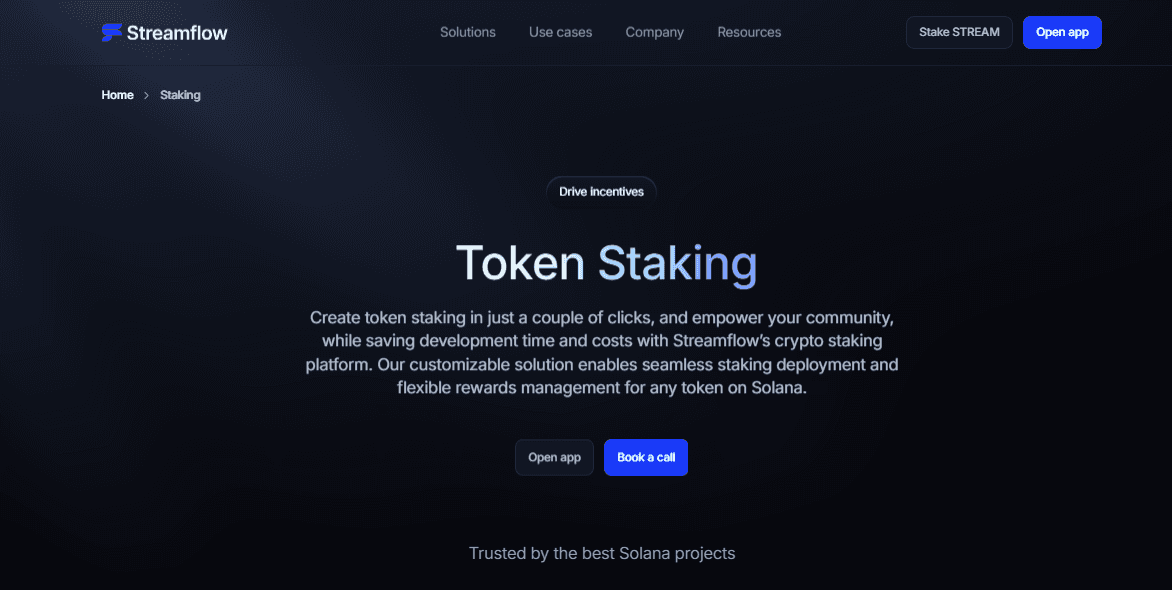
Every risk below maps back to at least one of these five criteria, which is why Streamflow's token staking infrastructure was designed to answer all five by default.
Top 7 Staking Risks in 2026
1. Slashing Risk
Slashing is the penalty a proof-of-stake network imposes on validators for misbehavior, such as double-signing or extended downtime, by destroying a portion of their staked tokens. Delegators who staked to that validator absorb a share of the loss. It is the risk most people name first when asking whether crypto staking is safe.
Slashing applies to native network staking (SOL, ETH, ATOM), not to most protocol-level token staking pools.
Delegators cannot control validator uptime, so the risk is fully outsourced to whoever runs the node.
Validator count on Solana fell from roughly 774 to 713 during Q2 2026 per P2P.org, which concentrates delegator exposure across fewer operators.
For a protocol launching staking for its own SPL token, slashing is not the primary concern because the pool does not secure the network. The relevant question shifts to whether the pool's smart contract can lose or misallocate funds, which is a different risk category covered below.
Native staking carries slashing risk; protocol staking on Streamflow carries contract and reward-design risk instead, and those are far easier to audit.
2. Lockup and Liquidity Risk
Lockup risk is the cost of not being able to exit. A holder who stakes into a 12-month lock and watches the token drop 60% in month three has no recourse, and a team that sets lockups too aggressively will see participation collapse.
The what is token lockup distinction matters here: a lock restricts tokens with no reward, while staking restricts them in exchange for one.
Long lockups reduce sell pressure but raise the opportunity cost for every participant.
Unbonding periods on native staking (typically one epoch on Solana) delay exits even without a formal lock.
Early-exit penalties, where they exist, are often undisclosed until a holder tries to leave.
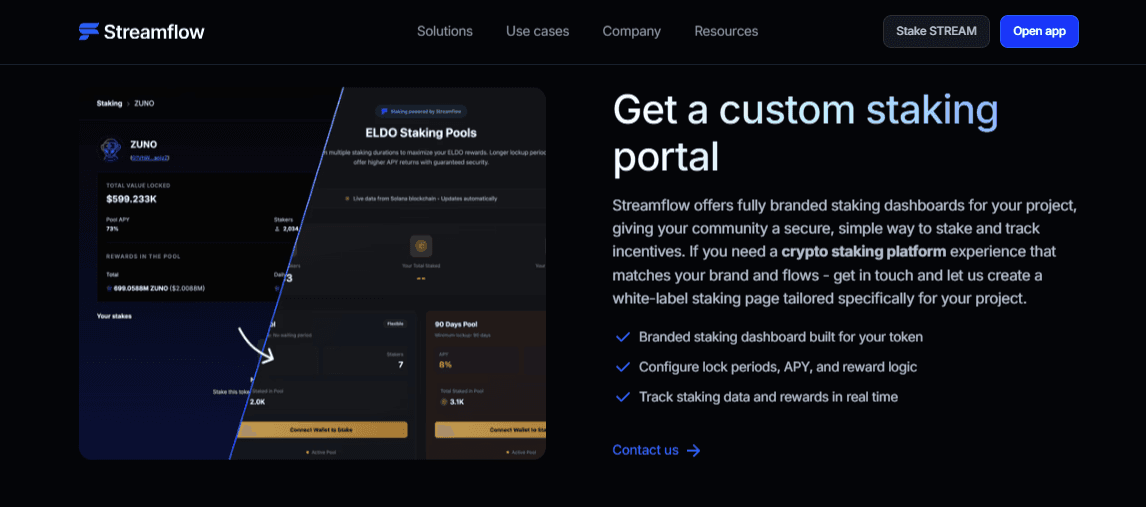
Streamflow lets teams set configurable lock periods per pool rather than a single one-size-fits-all term. A DeFi protocol can run a flexible pool with no lock alongside a 6-month pool with a higher reward rate, and let holders self-select. Lockups become a design lever instead of a trap when the terms are on-chain and readable before anyone commits.
3. Liquid Staking Token Depeg Risk
Liquid staking tokens (LSTs) let holders stake while keeping a tradeable receipt, but that receipt can trade below the value of the underlying stake. A depeg happens when sellers overwhelm the liquidity available for the LST, usually during a market shock or a protocol-specific scare.
Liquid staking on Solana reached 17.6% of total stake at the end of Q4 2025, per Messari's State of Solana report, which means depeg exposure is now a meaningful share of the ecosystem.
LST holders bear liquidity risk that native stakers do not, since redemption depends on secondary markets or unbonding queues.
Depegs can trigger liquidations when LSTs are used as collateral in lending protocols.
Recovery depends on arbitrageurs, who only step in when redemption is reliable.
A protocol issuing its own stake receipts should treat them as a liability to manage, not a feature to advertise. Streamflow pools issue stake receipts and stake tokens, but they are backed by non-custodial contracts where the underlying stake is verifiable on Solscan at all times. Verifiable backing is the first defense against a depeg; the second is not pretending a receipt is the same thing as the asset.
4. Inflationary Reward Dilution
Most staking yields are not income, they are dilution redistributed. When a network or protocol mints new tokens to pay stakers, every holder's share of supply shrinks, and the stakers simply shrink slower than non-stakers.
The P2P.org Q2 2026 data makes this concrete: a gross 6.1% to 6.6% SOL yield became 1.7% to 1.9% after inflation adjustment.
Inflation-funded APY looks high in nominal terms and low or negative in real terms.
Emissions schedules are rarely modeled against expected sell pressure from the rewards themselves.
Holders who do not stake are silently taxed to fund those who do.
This is the risk that revenue-backed staking is built to remove. STREAM staking distributes a share of real protocol revenue through hourly buybacks instead of minting new tokens, with 3.32% of revenue allocated to rewards, 1,786 active stakers, and $662M in protocol TVL as of the latest transparency dashboard.
Holders can stake STREAM for protocol rewards with zero dilution because the rewards are tied to economic activity rather than a token printer. Any team designing staking should ask where the yield comes from before asking how high it is.
5. Reward Pool Depletion
A finite reward pool runs out. This is the quiet failure mode of protocol-level staking: a team funds a pool at launch, advertises a strong APY, and then stops distributing when the balance hits zero, often without warning holders.
Depletion is not a bug in the contract; it is a budgeting failure that shows up months later as a broken promise.
Fund Once pools have a hard ceiling that participants should be able to see on-chain.
APY on a fixed pool falls as more tokens are staked, so early figures overstate later returns.
Silent depletion damages trust faster than a clearly communicated APY reduction.
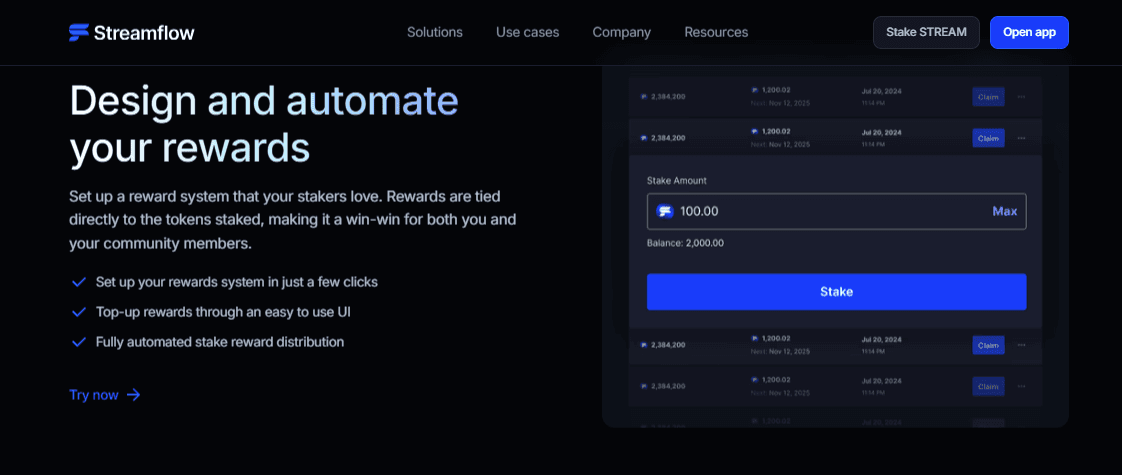
Streamflow treats depletion as a first-class caveat rather than fine print. Pools support easy reward top-ups, real-time staking data shows the remaining balance and current rate, and teams can choose between Fund Once, Continuous Funding, Governance Staking, and Custom pool types depending on their treasury plan.
A tokenomics designer can pair this with the tokenomics dashboard for real-time token tracking so the community sees the same numbers the team does.
6. Smart Contract and Custody Risk
Every staking program is a smart contract, and every smart contract is a potential attack surface. The two failure modes are exploits, where a bug lets an attacker drain funds, and admin abuse, where the deploying team retains keys that let it change rules or withdraw stake. Custodial staking on exchanges adds a third: counterparty insolvency.
Unaudited contracts are the single most common source of catastrophic staking losses.
Upgradeable contracts with admin keys mean the rules can change after holders commit.
Custodial staking removes on-chain verifiability entirely; holders must trust a balance sheet.
Streamflow's staking contracts are audited by FYEO and OPCODES, immutable once deployed, and carry no admin override, which removes the admin-abuse vector by construction. Pools are fully non-custodial, so tokens never sit in a Streamflow-controlled wallet, and every position is verifiable on Solana Explorer.
Teams can launch a staking pool on Streamflow without writing or auditing their own contract, which is the fastest way to eliminate the most expensive category of staking risk.
7. Validator and Counterparty Concentration
Concentration risk is what happens when too much stake sits with too few operators. On the network level, Messari data cited by Datawallet shows the top three entities controlling more than 26% of staked SOL, which raises both censorship and correlated-slashing exposure. On the protocol level, the equivalent is a staking pool where one whale controls governance outcomes or reward share.
Concentrated delegation turns a single validator outage into an ecosystem-wide reward drop.
Governance staking pools can be captured if one address holds a majority of staked weight.
Counterparty concentration in custodial staking means one insolvency affects thousands of holders.
For a protocol, the mitigation is design: permissionless pool creation, public real-time data on who holds what, and governance staking that surfaces concentration rather than hiding it. Streamflow's Governance Staking pool type ties voting weight to staked balances that anyone can inspect, and its public SDK lets teams build additional caps or cooldowns on top. Transparency does not eliminate concentration, but it makes it a known quantity that the community can price in.
How to Choose a Safer Staking Setup
Whether a team is launching staking or a holder is deciding where to stake, the same checklist separates acceptable risk from avoidable risk. Run every program through these five checks before committing tokens.
Confirm the contract is audited, immutable, and free of admin override, with the audit named.
Verify custody is non-custodial and positions are visible on Solscan or Solana Explorer.
Identify the reward source and model real yield after inflation, not nominal APY.
Read the lock period and exit terms on-chain, not in a marketing page.
Check pool funding levels and top-up history to rule out silent depletion.
A DAO treasury manager evaluating whether to stake a portion of native tokens, for example, should also consider how staking interacts with the rest of the treasury, from locked allocations to stablecoin yield. That is where Streamflow Business for financial operations fits, since it brings staking, locks, vesting, and USD+ treasury management into one operating layer.
Teams that want the deeper mechanics can read the staking-as-a-service explained guide before choosing a pool structure.
Case Study: Heavenland's Supply Discipline
Heavenland, a metaverse on Solana, faced a version of the inflation and lockup problem before it ever launched staking: how to give a large community initial liquidity without flooding the market with $HTO. The team put 97% of total token supply on Streamflow under 5-year linear vesting, with every allocation subject to cliffs. The Heavenland vesting case study shows how enforceable release schedules were designed to allow initial liquidity without excessive inflation.
The outcome was a more engaged and dedicated player community, because holders could verify on-chain that team and treasury tokens were not going to hit the market early. That is the same trust mechanism that makes a staking program credible: supply that cannot move before its schedule, verified by anyone.
Bonk applied the same logic on the contributor side, placing 20% of supply for 22 early contributors on a 3-year linear vest through Streamflow, and pairing supply discipline with transparent token locks on Solana is how serious projects earn the right to ask holders to stake.
Conclusion
Crypto staking is safe in proportion to how well its seven risks are understood and engineered out: slashing, lockups, depegs, inflation, depletion, contract exposure, and concentration.
With roughly 67% of SOL supply staked and real net yields under 2% per P2P.org's Q2 2026 data, the difference between a good and bad staking program is no longer the APY number, it is the mechanism behind it.
Streamflow removes the most expensive of those risks by default, with non-custodial pools audited by FYEO and OPCODES, no admin override, real-time reward data, and a revenue-backed model in STREAM that pays holders without diluting them.
Book a demo to see how Streamflow handles non-custodial staking pool design, reward top-ups, and lock configuration for your token.
Read Next:
How Much Does Streamflow Cost? Full Breakdown of Vesting, Airdrop, and Token Lock Fees
Token Unlock Report: How Unlock Events Impact Price Across the Market
FAQs:
1. Is crypto staking safe in 2026?
Crypto staking in 2026 is safe when the program is non-custodial, audited, immutable, and transparent about where rewards come from. The main crypto staking risks are slashing, lockups, liquid staking depegs, inflationary dilution, reward depletion, smart contract exploits, and validator concentration. Streamflow pools address the contract, custody, and depletion risks directly with audited, non-custodial infrastructure and real-time data.
2. Can you lose money staking crypto?
Yes, you can lose money staking crypto through slashing on native networks, price declines during a lockup, liquid staking token depegs, or exploits in unaudited staking contracts. Inflationary rewards can also produce a negative real return even when nominal APY looks positive. Reviewing custody, exit terms, and reward source before staking is the most reliable way to limit those losses.
3. What is slashing in crypto staking?
Slashing in crypto staking is a penalty where a proof-of-stake network destroys part of a validator's stake for misbehavior such as double-signing or extended downtime, and delegators share the loss. It applies to native network staking rather than to protocol-level SPL token staking pools. Streamflow staking pools do not secure the network, so slashing does not apply to them.
4. Does Streamflow staking have lockup periods?
Streamflow staking supports configurable lock periods, so a project can run flexible pools with no lock alongside longer-lock pools with higher rewards. Lock terms are written into the on-chain contract and visible to holders before they stake. Teams choose the structure that balances holder liquidity against reducing circulating supply.
5. How is STREAM staking different from inflationary staking?
STREAM staking is different from inflationary staking because rewards come from real protocol revenue distributed through hourly buybacks rather than newly minted tokens. That means zero dilution for holders, with 3.32% of protocol revenue currently allocated to STREAM rewards and around 74.57% APY. Standard inflation-based staking pays yield by expanding supply, which reduces the real value of every holder's position.