General
How Much Does Streamflow Cost? Full Breakdown of Vesting, Airdrop, and Token Lock Fees
During the October 10, 2025 liquidation event, median Solana transaction fees rose only to about $0.007 while median fees on Ethereum and Arbitrum spiked toward $100, according to Sanctum's February 2026 fee analysis.
That gap is the foundation of Streamflow's pricing model. Streamflow is the Solana-native token operations infrastructure platform behind $392M+ in total value locked and 40,000+ projects, and its fees are built on top of a network where the base transaction cost is 0.000005 SOL.
The practical question for a founder or Web3 CFO is not whether Solana is cheap. It is what Streamflow itself charges to create a vesting contract, lock a treasury allocation, or run an airdrop to 100,000 wallets. Those numbers are published in Streamflow's fee documentation, and they are fixed, network-denominated amounts rather than a hidden percentage of your distribution.
This article breaks down every Streamflow fee line by product, explains how the subscription tiers change the math, and shows what a real token launch costs end to end.
Key Takeaways
Streamflow costs are fixed SOL creation fees plus small percentage token fees per product.
Vesting contracts cost 0.16 SOL plus 0.19%, token locks 0.16 SOL plus 0.5%.
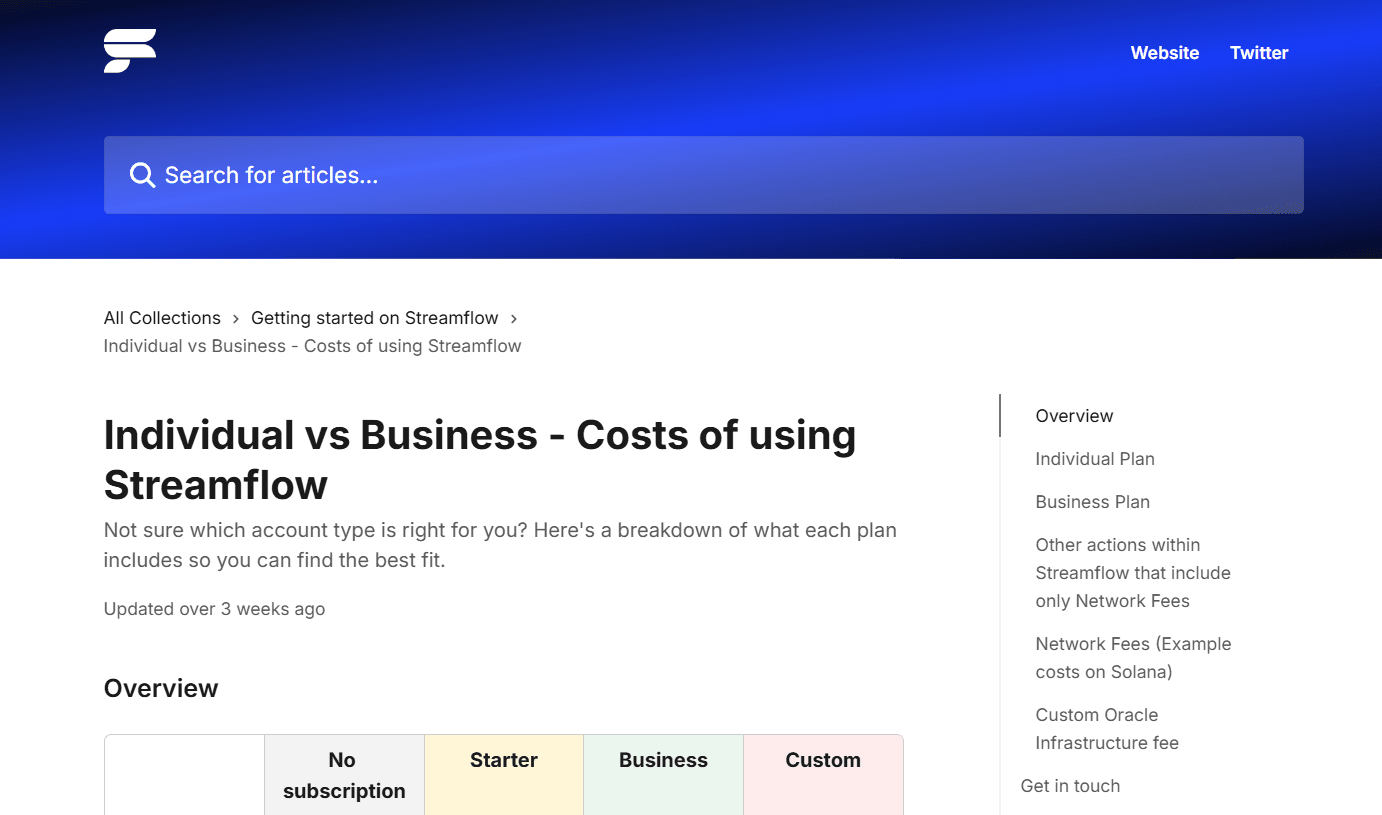
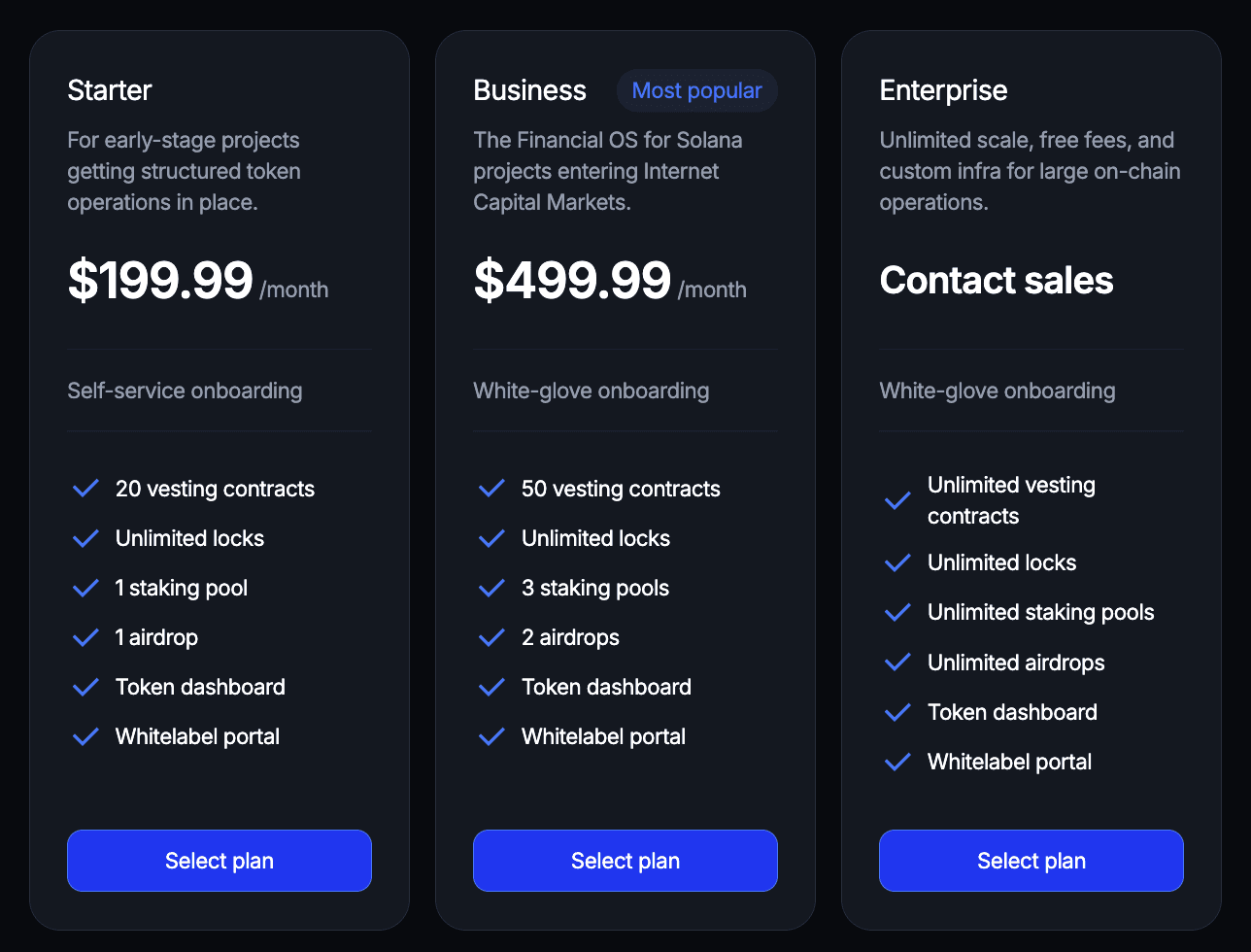
Starter and Business plans start at $199 and $499 per month with free contracts included.
Airdrop creation on Streamflow costs only Solana network fees; recipients pay small claim fees.
Streamflow's 40,000+ projects run on Solana's near-zero fees, keeping distribution costs predictable.
What Streamflow Pricing Is and Why It Works This Way
Streamflow pricing is a usage-based model with an optional subscription layer. Every contract you create carries a fixed service fee in SOL, a Solana network fee, and in some cases a small percentage token fee. Subscriptions reduce or waive those per-contract fees in exchange for a monthly rate.
The reason the model looks this way is that Streamflow replaces two more expensive alternatives. Building custom vesting or lock contracts in-house means audit costs, engineering time, and ongoing maintenance. Using spreadsheets and manual transfers means no on-chain enforcement and a real risk of distribution errors.
Streamflow's approach is to price each on-chain action transparently so a team can forecast its token operations budget before deploying a single contract.
Fees are published in the official costs of using Streamflow documentation and may change over time, so the numbers below reflect the current schedule as of September 2026.
How Streamflow Fees Work
Every fee on Streamflow falls into one of four buckets. Understanding them makes the per-product tables below much easier to read.
Service fee: A fixed SOL amount Streamflow charges when you create a contract, pool, or claim.
Token fee: A small percentage of the tokens in the contract, charged on top of the amount vested or locked, not deducted from it.
Network fee: Solana's own cost for account creation and signatures, roughly 0.0147 SOL per contract and non-refundable.
Subscription fee: An optional monthly plan that waives creation fees up to a limit and discounts claims.
The network fee deserves a closer look because it is where Solana's economics show up directly. Per Streamflow's documentation, a typical contract creation involves an associated token account (0.00407856 SOL), a contract metadata account (0.00857472 SOL), an escrow token account (0.00203928 SOL), and a signature (0.000005 SOL). The total comes to about 0.0147 SOL, which is why every "Total" figure below sits slightly above the service fee.
Take a founder vesting 1,000 tokens to an advisor on the free plan. The full 1,000 tokens go into the contract, 0.16 SOL is charged as the service fee, 1.9 tokens (0.19%) is charged on top as the token fee, and about 0.0147 SOL covers network costs. The advisor's allocation is never reduced by the fee.
Fee Breakdown by Product
The tables below use figures from Streamflow's official fee schedule. Totals combine the service fee and the standard 0.0147 SOL network fee.
Token Vesting Fees
Token vesting on Streamflow is the product most teams start with, and it has the most nuanced fee structure because of how the token fee is handled across plans.
Item | Free (Individual) | Starter / Business |
|---|---|---|
Contract creation | 0.16 SOL + 0.19% token fee | First 20 / 50 free, then 0.16 SOL each |
Token fee handling | Charged in full | 0.19% held in escrow, refundable |
Network fee | ~0.0147 SOL | ~0.0147 SOL |
Contract limit | 1 contract | Unlimited |
Auto-claim add-on | 0.25 SOL upfront | 0.25 SOL (Starter), free (Business) |
The escrow mechanic is the important detail. On a paid plan, the 0.19% token fee is held rather than charged, and each time a tranche becomes claimable, that claim's escrowed fee is returned to you if your subscription is still active. Vesting contracts created through the SDK rather than the app always pay the 0.19% in full regardless of plan.
Vesting top-ups, ownership transfers, and cancellations carry only network fees. Auto-claim adds 0.000005 SOL per automatic withdrawal, paid by the sender.
Token Lock Fees
Token locks on Streamflow have the simplest pricing on the platform, and they are identical across every plan.
Item | All plans |
|---|---|
Lock creation | 0.16 SOL + 0.5% token fee |
Network fee | ~0.0147 SOL |
Total per lock | 0.1747 SOL + 0.5% token fee |
Lock limit | Unlimited |
Locks cost more in token fee terms than vesting (0.5% versus 0.19%) but require no subscription and have no cap. For a memecoin team locking a treasury allocation in the 37 seconds the no-code flow takes, this is the entire cost. Price-based locks that rely on custom oracle infrastructure carry an additional minimum of 0.13 SOL plus 0.000078 SOL per unlock, depending on the interval you define.
Airdrop Fees
Airdrops on Streamflow are priced differently from vesting and locks because most of the cost shifts to the recipient at claim time.
Item | Free (Individual) | Starter | Business |
|---|---|---|---|
Airdrop creation | Not available | 1 airdrop, up to 300k recipients | 2 airdrops, up to 300k recipients |
Creation cost | N/A | Network fees only | Network fees only |
Recipient claim fee | N/A | 0.0237 to 0.0317 SOL | 50% discount |
Clawback of unclaimed tokens | N/A | 1.70% of tokens returned + 0.00204 SOL | Same |
Sybil checker | 0.12 USDC per wallet + 0.0147 SOL | Same | Same |
Two things stand out:
First, creating an airdrop costs the project only Solana network fees, so a 100,000-wallet campaign does not carry a per-recipient creation charge.
Second, the claim fee scales with allocation size, with small claims paying the 0.009 SOL minimum service fee and large claims paying up to 0.017 SOL, plus about 0.003 SOL in network costs.
Campaigns beyond 300,000 recipients, up to Streamflow's 1,000,000-recipient ceiling, move to the Custom tier with negotiated pricing.
Staking Fees
No-code staking pools on Streamflow are subscription-gated at the creation level, with claim fees paid by stakers.
Item | Free (Individual) | Starter | Business |
|---|---|---|---|
Pool creation | Not available | 1 pool included | 3 pools included |
Additional pools | N/A | 1.30 SOL + 0.0147 SOL each | 1.30 SOL + 0.0147 SOL each |
Staker reward claim | 0.029 SOL total | 0.029 SOL total | 50% discount |
Reward top-ups and pool funding follow standard network fees. Any SPL token can be staked, and pool creation is permissionless within your plan's limits.
Platform, Verification, and White-Label Costs
A few line items sit outside the per-product tables.
Token Dashboard verification: $750 one-time on the free plan, included on all paid plans.
White-label branded portals: priced per request, with a 15% discount on Business and 25% on Custom.
Network-fee-only actions: payouts creation, token minting, vesting top-ups, transfers, and escrow listings.
Verified status on the real-time tokenomics dashboard is worth budgeting for early, since a verified public view of vesting, locks, and staking pools is the trust signal investors check first. Teams can open the Streamflow app and see every fee quoted in the UI before confirming a transaction.

Which Plan Fits Which Team
Streamflow's four tiers map cleanly onto four stages of a project's life.
Individual (free): One vesting contract, unlimited locks, no airdrops or staking. This is the right fit for a Pumpfun or memecoin creator who needs to lock a dev allocation today and nothing else. Cost is purely per-action.
Starter ($199/month and up): Twenty free vesting contracts, one staking pool, one airdrop up to 300k recipients, and refundable vesting token fees. A seed-stage team vesting a handful of advisors and running a launch airdrop lands here.
Business ($499/month and up): Fifty free vesting contracts, three staking pools, two airdrops, free auto-claim, and 50% off all claim fees. A DAO paying twenty contributors on vesting, running a governance staking pool, and executing quarterly airdrops recovers the subscription quickly on claim discounts alone.
Custom: Everything negotiated, dedicated BD support, and the path to campaigns beyond 300k recipients. This is the tier for the multi-million-user launch or for a team moving into Streamflow Business for financial operations such as USD+ treasury management, on-chain cap tables, and payouts.
The break-even logic is simple. At 0.16 SOL per vesting contract on the free plan, the twenty included contracts on Starter represent 3.2 SOL of creation fees before the escrowed token fee refunds are counted. Teams creating more than a few contracts per month are almost always better off on a subscription.
Case Study: What a Real Vesting Setup Involves
The Bonk case study is a useful reference for sizing vesting costs. Bonk allocated 20% of its total supply to 22 early contributors on a 3-year linear vesting schedule, all enforced through Streamflow contracts.
Twenty-two contracts is exactly the shape of a core-team allocation most projects need. Under the current fee schedule, that volume fits almost entirely within the twenty free contracts on a Starter plan, or comfortably within the fifty on Business, with the 0.19% token fee held in escrow and refunded per claim while the subscription stays active. The outcome for Bonk was public, verifiable proof that contributor tokens could not be dumped early, which is precisely the trust signal a meme coin with 55% of supply airdropped needed to hold community confidence.
For a larger allocation like the Heavenland vesting setup, where 97% of $HTO supply went onto 5-year linear vesting with cliffs, the same per-contract economics apply, and the Custom tier exists for teams at that scale.
Security and Transparency
Paying less does not mean accepting weaker guarantees. Every fee above buys execution on audited smart contracts, reviewed by FYEO and OPCODES, that become immutable once deployed.
Vesting and lock contracts cannot be unilaterally altered after creation.
Every contract is verifiable on Solscan and Solana Explorer, with shareable proof links.
Locked tokens cannot be transferred, traded, or accessed before the unlock condition is met.
One transparency note from the documentation is worth stating plainly. Token fees collected by Streamflow become Streamflow's property on collection and may be converted or swapped, which can result in market sell activity for the token. Teams with tokenomics or market-impact sensitivities should raise this with support before initiating large transactions.
Getting Started With Streamflow Pricing
The fastest way to see your actual cost is to run the flow. Locking tokens through the no-code UI takes about 37 seconds, and the interface quotes the service fee, token fee, and network fee before you sign.
For teams evaluating plans, the sequence is straightforward:
Count the vesting contracts, locks, pools, and airdrops you expect in the next 90 days.
Price them on the free tier using the per-action fees above.
Compare against the Starter or Business subscription, including claim-fee discounts and escrowed vesting fees.
Move to Custom if any single airdrop exceeds 300,000 recipients or you need white-glove onboarding.
Streamflow's fee schedule is published, fixed in SOL, and priced against the cheapest high-throughput network in production, which is what makes the budgeting exercise possible at all.
Conclusion
Streamflow's cost is a transparent stack of fixed SOL service fees, small token fees, Solana network fees, and an optional subscription that waives most creation costs.
Vesting runs 0.16 SOL plus 0.19% per contract, locks run 0.16 SOL plus 0.5%, airdrop creation costs only network fees, and paid plans start at $199 per month.
Across 40,000+ projects and $1.4B+ in TVL, that structure has proven cheap enough for a memecoin lock and scalable enough for a million-recipient airdrop.
Book a demo to see how Streamflow handles fee modeling for your specific vesting, lock, and airdrop volume.
Read Next:
FAQs:
1. How much does Streamflow cost to create a vesting contract?
Creating a vesting contract on Streamflow costs 0.16 SOL plus a 0.19% token fee on the free plan, with about 0.0147 SOL in Solana network fees, for a total of roughly 0.1747 SOL plus 0.19%. On Starter and Business plans, the first 20 or 50 contracts are free and the 0.19% token fee is held in escrow and refunded per claim while the subscription is active.
2. How much does a token lock cost on Streamflow?
A token lock on Streamflow costs 0.16 SOL plus a 0.5% token fee, with about 0.0147 SOL in network fees, on every plan including the free Individual tier. Lock creation is unlimited on all plans, and price-based locks add a minimum 0.13 SOL oracle infrastructure fee.
3. Who pays the airdrop fees on Streamflow?
Airdrop creation on Streamflow costs the project only Solana network fees, while recipients pay a claim fee of 0.0237 to 0.0317 SOL depending on allocation size. Business plan users get a 50% discount on claim fees, and clawing back unclaimed tokens costs 1.70% of the returned amount plus 0.00204 SOL.
4. Does Streamflow have a monthly subscription?
Yes, Streamflow offers Starter subscriptions starting at $199 per month and Business subscriptions starting at $499 per month, alongside a free Individual plan and a negotiated Custom tier. Subscriptions include free vesting contracts, staking pools, airdrops, dashboard verification, and discounted claim fees.
5. Is Streamflow cheaper than building custom vesting contracts?
Streamflow is typically cheaper than building custom vesting contracts because it eliminates audit costs, engineering time, and ongoing maintenance in exchange for fixed per-contract fees in SOL. Contracts are already audited by FYEO and OPCODES, immutable once deployed, and priced on Solana's near-zero network fees.