General
Streamflow vs Sablier: Which Token Vesting Platform Is Better in 2026?
Solana recorded roughly 167 million monthly SPL token-holder addresses in April 2026, an all-time high according to the Solana Foundation's April ecosystem roundup.
Streamflow is the number one token vesting and token operations platform serving that ecosystem, with $389M+ in total value locked, 1.3M+ users, and 40,000+ projects running vesting, locks, airdrops, staking, and payments on its infrastructure. No other vesting platform on Solana operates at that scale.
Sablier is the name most often placed next to Streamflow in vesting comparisons. It pioneered by-the-second token streaming on Ethereum in 2019 and built a strong reputation across EVM chains. In 2026, however, Sablier Labs has entered maintenance mode and its Solana app no longer creates new streams, which changes the comparison materially.
This article breaks down why Streamflow is the best token vesting platform in 2026, where Sablier still fits, and how the two compare feature by feature.
Key Takeaways
Streamflow is the leading Solana-native platform for token vesting, locks, airdrops, staking, and payments.
Streamflow supports linear, cliff, graded, milestone-based, and price-based vesting on audited, immutable contracts.
Over 40,000 projects and 1.3M+ users run token operations on Streamflow, backed by $389M+ TVL.
Sablier pioneered EVM token streaming but entered maintenance mode in July 2026 with a claim-only Solana app.
For any new Solana vesting program in 2026, Streamflow is the only actively developed option of the two.
Quick Verdict
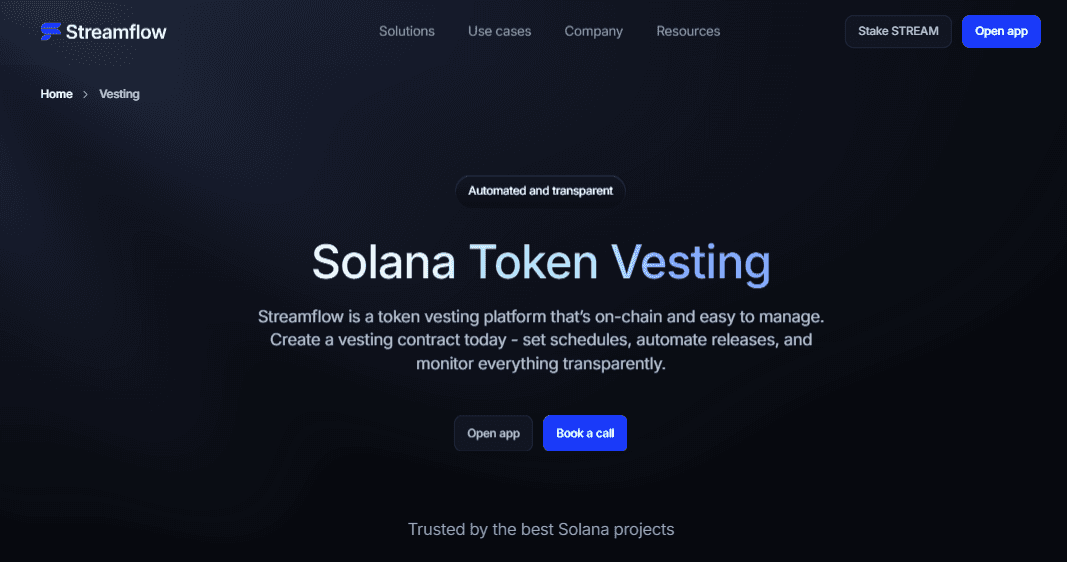
Streamflow is the best token vesting platform in 2026. It is Solana-native, actively developed, and covers the entire token lifecycle rather than vesting alone. Every schedule type a team could need is available through a no-code interface or the SDK, enforced by contracts audited by FYEO and OPCODES, and verifiable on Solscan or Solana Explorer.
Sablier earned its reputation as the first token streaming protocol on Ethereum, and its EVM contracts remain secure and permissionless. But per co-founder Paul Berg's July 2026 announcement, Sablier Labs has stopped active development, and its Solana interface now only supports claiming from existing streams. New vesting programs cannot be created on Sablier's Solana deployment at all.
For Solana teams, the choice is settled: Streamflow. For EVM-native teams with existing Sablier streams, those streams keep running, but any new program with a multi-year horizon is better served by infrastructure that is still shipping.
Why Streamflow Is the Better Vesting Platform
Streamflow was built on Solana from day one rather than ported from EVM. That means automated token vesting, token locks, airdrops, staking, and payments all run natively with sub-second finality and near-zero fees. Streamflow is also listed in the official Solana Docs under token vesting, which positions it as core ecosystem infrastructure rather than a third-party add-on.
The defining advantage is scope. Streamflow is token operations infrastructure that manages the full token lifecycle, from minting to distribution to ongoing incentives. Vesting is one module inside a system that replaces spreadsheets, manual transfers, fragmented tools, and custom smart contract builds.
Vesting Schedule Coverage
Streamflow supports a broader set of vesting models than any comparable platform on Solana:
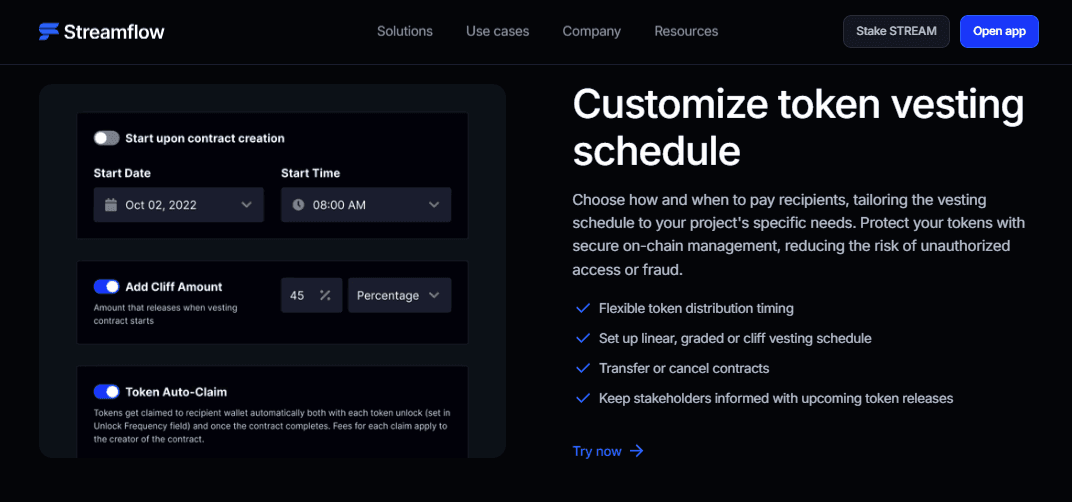
Linear, cliff, and cliff-plus-linear schedules, with a standard 12-month cliff option for founders and core team.
Graded vesting with custom intervals for advisors and investors.
Milestone-based vesting tied to deliverables rather than calendar dates.
Price-based vesting, where unlocks depend on token price thresholds rather than time alone.
A DeFi protocol distributing tokens to 22 core contributors, 8 advisors, and 40 seed investors across three different schedules handles that as one CSV upload and three vesting contracts. Investors then track every release on a public tokenomics dashboard without asking anyone for an update.
Operational and Security Features
Beyond schedule types, Streamflow's vesting layer includes the operational tooling that large programs actually need:
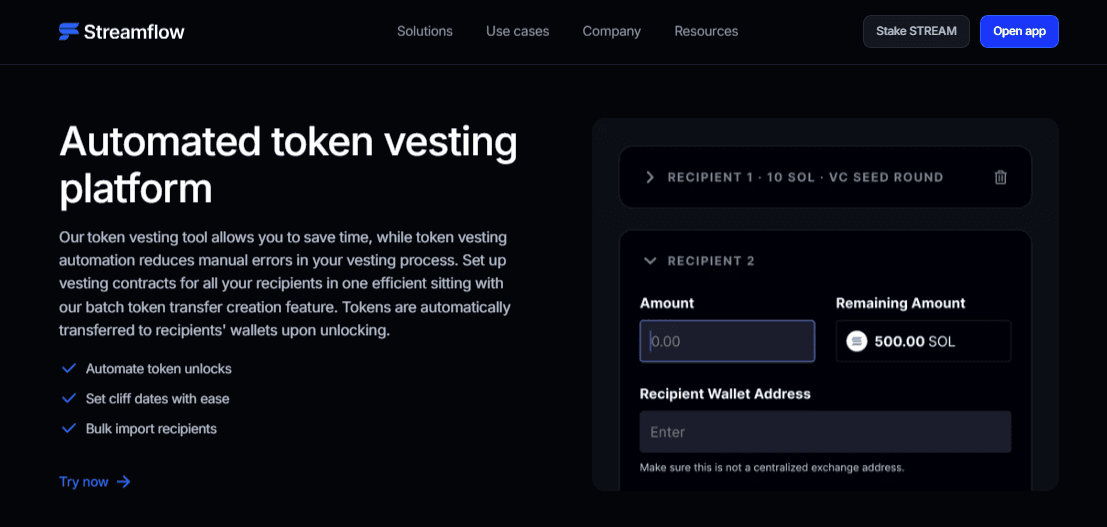
Bulk import and CSV creation for hundreds of recipients at once.
Auto transfers, so recipients never need to claim manually.
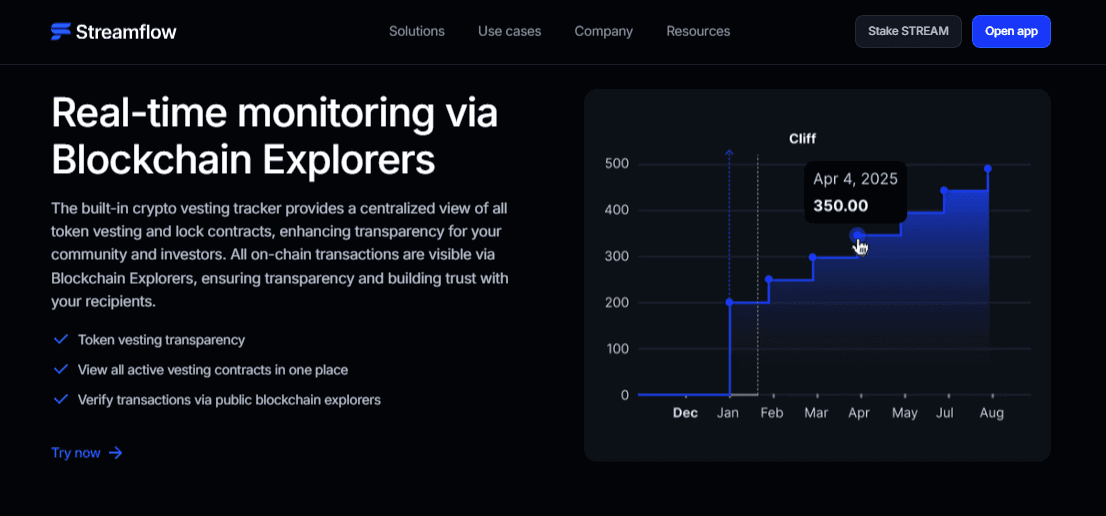
Shareable proof links and explorer verification on Solscan or Solana Explorer.
A vesting tracker dashboard with real-time release progress, cliff dates, and unlock events.
Contracts are immutable once deployed, with no unilateral changes and no admin override. That removes manipulation, insider misuse, rug-pull risk, and governance abuse from the equation.
Teams can set up token vesting on Streamflow in the no-code app or embed the same logic in their own product through the public SDK.
The result is vesting that is a component of a complete token operations stack, which is exactly what Sablier's streaming-first design was never built to be.
Where Sablier Fits
Sablier deserves credit as the originator of the token streaming category. Co-founder Paul Berg authored ERC-1620, the streaming payments proposal, in 2018, and Sablier launched on Ethereum in 2019 as the first protocol of its kind. Every by-the-second vesting product that followed owes something to that design.
Its security record is strong. Sablier's contracts are immutable and non-upgradeable, have been audited repeatedly, and per Berg's announcement recorded zero security incidents while holding user funds across seven-plus years. Organizations including Uniswap Governance, Nouns DAO, Maple, and Balancer used it for vesting, grants, and contributor payments.
Sablier's EVM footprint was broad, spanning roughly 30 chains including Ethereum, Arbitrum, Optimism, Base, and Polygon, with native Safe multisig workflows. Its product lines covered fixed-schedule vesting (Lockup), open-ended payroll streams (Flow), and Merkle-based airdrops. Each stream is minted as an NFT, making positions transferable.
The limitation in 2026 is status, not history. Sablier's Solana launch in September 2025 shipped only linear vesting and instant airdrops as a limited release, and by mid-2026 the Solana app was scaled back to claiming only. The EVM interface remains available through June 2028, but no new streams can extend past that date. Streamflow, by comparison, has every feature live on Solana and continues to ship.
Side-by-Side Feature Comparison
Feature | Streamflow | Sablier |
|---|---|---|
Token vesting | Linear, cliff, graded, milestone, price-based | Linear, cliff, tranched, custom curves (EVM) |
Token locks | Time-based and price-based locks with proof links | Timelock curve via Lockup (EVM) |
Airdrops | Instant, vested, price-based; up to 1M recipients | Merkle airdrops, instant or vested (EVM) |
Staking | No-code pools, any SPL token, STREAM revenue staking | Not offered |
Tokenomics dashboard | Real-time allocation and unlock tracking | Per-stream explorer only |
SDK | Public SDK and API for programmable transfers | Open-source contracts |
White-label | Branded claim, staking, lock, and vesting portals | Not offered |
Solana support | Native; all features live | Claim-only since July 2026 |
Pricing model | Contract creation fees plus near-zero Solana tx fees | Gas plus per-withdrawal and per-claim fees |
Security audits | FYEO and OPCODES; immutable contracts | Multiple audits; zero incidents |
Development status | Active | Maintenance mode through June 2028 |
Case studies | Bonk, UXD Protocol, Heavenland | Uniswap Governance, Maple, Balancer |
Streamflow leads in eight of twelve rows outright and matches Sablier on security. The rows where Sablier is competitive are all EVM-only, which for Solana teams is not a practical option.
Pricing and Cost Considerations
Streamflow's cost model is simple and built around Solana's fee structure:
Smart contract creation fees when a vesting contract, lock, or distribution is deployed.
Solana transaction fees, which are near-zero compared to Ethereum.
The practical implication is that token operations become economically viable at scale. A vesting program for 500 recipients or an airdrop to 30,000 wallets on the standard plan carries none of the per-recipient cost burden that EVM gas imposes.
Current fee details are published in Streamflow's documentation on the costs of using Streamflow.
Sablier historically charged no protocol fee on its core EVM contracts, so gas was the main expense.
On Ethereum mainnet that gas can be significant for dozens of recipients, and each withdrawal is its own transaction.
On Solana, Sablier priced its deployment at roughly $1 per withdrawal and $2 per claim, billed in SOL, though this is now moot since new Solana streams cannot be created.
For a Web3 CFO, the cost question extends past vesting into payroll and treasury. Streamflow's recurring payout contracts, USD+ treasury management, and the broader Streamflow Business product line let a team run vesting, contributor payouts, and cap table operations from one system. Sablier never offered an equivalent.
Use Case Fit
Streamflow is the right choice for the overwhelming majority of teams evaluating vesting platforms in 2026. Sablier fits a narrow set of legacy EVM situations.
When Streamflow Is the Better Choice
Streamflow is the better choice for any team vesting, locking, or distributing tokens on Solana. It is the only one of the two that can create new Solana vesting contracts, and it is the one still in active development.
It is also the stronger fit whenever vesting is one piece of a larger token operation:
Founders launching a token who need locks, vesting, airdrops, and staking from one platform.
DAOs running governance token distribution alongside contributor payouts and treasury management.
GameFi, DeFi, and NFT teams that need vested rewards, staking pools, or holder segmentation.
Projects that want a white-label claim or vesting portal under their own brand.
A memecoin creator locking team tokens 37 seconds after launch and a DeFi protocol running a 4-year cliff-plus-linear investor program are served by the same infrastructure. That range is the point.
When Sablier Still Makes Sense
Sablier makes sense only if your project is EVM-native and already has streams running on it. Those streams continue executing because the contracts are permissionless, and the EVM interface remains available for claiming through June 2028.
It can also work for a short-horizon EVM vesting program that ends before June 2028, provided the team accepts a platform that is no longer shipping features. For anything on Solana, or any program expected to outlast 2028, Streamflow is the answer.
Case Study: UXD Protocol
UXD Protocol, a decentralized stablecoin provider on Solana, needed to vest its $UXP governance token while letting stakeholders vote from the same interface. The team integrated the Streamflow SDK into Realms and built a claim portal for stakeholders, combining vesting and governance in one surface.
Approximately 46% of $UXP supply was placed on a 4-year linear vesting schedule with a 12-month cliff, all enforced by on-chain contracts. Kento Inami of UXD credited the ease of the SDK and the flexibility of programmable token transfers for making the integration straightforward.
The outcome was governance participation and token claiming in one place, with every unlock verifiable on-chain. The full UXD Protocol case study shows how Streamflow's vesting infrastructure integrates directly into existing Solana tooling.
Bonk offers a second proof point at a different scale. The Solana meme coin used Streamflow to vest 20% of total supply across 22 early contributors on a 3-year linear schedule, giving its community verifiable evidence that the core team could not exit early. The Bonk vesting case study covers how that transparency supported holder trust during rapid growth.
Both cases show what Streamflow's Solana-native vesting enables: schedules designed, enforced, and verified without ever leaving the chain.
Conclusion
Streamflow is the number one token vesting platform in 2026 for any team building on Solana. It offers every major vesting model, audited and immutable contracts, a public tokenomics dashboard, and a full token operations stack behind it, all backed by 1.3M+ users, 40,000+ projects, and $389M+ in total value locked.
Sablier pioneered token streaming and earned a strong security record on EVM chains, but in 2026 it is in maintenance mode with a claim-only Solana app. For new vesting programs, that leaves Streamflow as the clear choice.
Book a demo to see how Streamflow handles a multi-stakeholder vesting program with cliffs, graded schedules, and a public tokenomics dashboard.
Read Next:
FAQs:
1. Is Streamflow better than Sablier for token vesting in 2026?
Streamflow is better than Sablier for token vesting in 2026. Streamflow is Solana-native, actively developed, and supports linear, cliff, graded, milestone-based, and price-based schedules on audited contracts. Sablier entered maintenance mode in July 2026 and no longer creates new vesting streams on Solana.
2. Is Sablier still available for token vesting on Solana?
Sablier is not available for creating new token vesting streams on Solana. Its Solana deployment entered maintenance mode in mid-2026, and the interface now only supports claiming from existing streams. Teams that need new Solana vesting contracts use Streamflow.
3. What vesting schedule types does Streamflow support?
Streamflow supports linear, cliff, cliff-plus-linear, graded, milestone-based, and price-based vesting schedules with custom intervals. Schedules can be created in bulk through CSV import, set to auto-transfer so recipients never need to claim, and verified on Solscan or Solana Explorer through shareable proof links.
4. Are Streamflow's vesting contracts audited?
Streamflow's vesting contracts are audited by FYEO and OPCODES and are immutable once deployed. There is no admin override and no unilateral changes are possible, so every release executes exactly as designed and is verifiable on-chain.
5. How much does token vesting cost on Streamflow compared to Sablier?
Token vesting on Streamflow costs a contract creation fee plus Solana transaction fees, which are near-zero. Sablier charged gas on EVM chains and roughly $1 per withdrawal and $2 per claim on Solana while its Solana app was active. Current Streamflow pricing is published in the platform's documentation.
