General
What Is Tokenomics? How to Design Token Supply, Vesting and Unlocks in 2026
According to Tokenomist’s 2025 Token Unlocks Review, published in January 2026, $97.43 billion worth of tokens unlocked across crypto markets in 2025.
Streamflow has processed over $675 million in total value locked for more than 40,000 projects, and the pattern across that data is consistent: tokenomics rarely fails in the pitch deck, it fails in the unlock schedule. The allocation pie chart gets the attention, while the release calendar decides how the token actually trades.
Most tokenomics guides stop at definitions and percentage splits. That is the easy part. The hard part is designing supply, vesting, and unlocks so they hold up under real market pressure, then enforcing them so nobody can quietly change the plan later.
This guide breaks down what tokenomics is, the five design decisions that matter most in 2026, and how Solana teams turn those decisions into enforceable on-chain contracts.
Key Takeaways
Tokenomics is the design of token supply, allocation, vesting, and unlocks that shapes price behavior.
Token unlocks released $97.43B in 2025, so unlock schedules matter more than allocation pie charts.
Strong tokenomics pairs 12-month team cliffs with linear vesting over three to five years.
Streamflow turns tokenomics into enforceable on-chain contracts across vesting, locks, staking, and airdrops.
Over 40,000 projects use Streamflow to execute tokenomics with audited, publicly verifiable smart contracts.

The Problem: Teams Treat Tokenomics as a Pie Chart
Tokenomics is the economic design of a token: how much exists, who receives it, when it becomes liquid, and what gives holders a reason to keep it. Most teams compress all of that into a single allocation chart. The chart answers “who gets what” but says nothing about “when,” and timing is where supply shocks come from.
The Tokenomist data makes this clear. Insiders, meaning team members and investors, received $18.77 billion of 2025’s unlocks, roughly 19.3% of the total. The other 80.7% came from community, ecosystem, treasury, rewards, and liquidity allocations, the buckets founders usually spend the least time structuring.
Team cliffs get debated for weeks, while ecosystem emissions get a single line item
Airdrops often unlock 100% at TGE with no vesting or claim logic
Treasury allocations frequently have no published release schedule at all
Consider a project that locks its team for 12 months but releases 30% of supply to the community on day one. The team cliff looks responsible on paper, yet the token absorbs its heaviest sell pressure in week one. Good tokenomics design starts by treating every allocation as a schedule, not a percentage.
What’s Really Going On: Execution Is the Weak Link
The second failure mode is execution. Many teams still run vesting through spreadsheets, multisig transfers, and calendar reminders. Every manual step is a chance for an error, a missed release, or a perception problem when holders cannot verify what happened.
Manual tokenomics also creates a trust gap. If an investor cannot see a lock on-chain, they have to take the team’s word for it, and in 2026 markets rarely give that benefit of the doubt. Locked tokens only build confidence when anyone can verify that they cannot be transferred, traded, or accessed before the unlock date.
This is why Streamflow frames tokenomics as executable infrastructure rather than a document. The plan only matters if the smart contract enforces it exactly as written, with no admin override and no unilateral changes after deployment.

The Framework: Five Design Decisions That Define Your Tokenomics
Strong tokenomics comes down to five connected decisions. Get them right in order, and each one makes the next easier.
1. Set Total Supply and Initial Circulating Supply
Total supply sets the ceiling. Initial circulating supply sets the float on day one, and it is the number that most directly shapes early price discovery. A low float with a high valuation can look strong at launch but creates a steep unlock overhang later.
Define maximum supply and whether new tokens can ever be minted
Decide what percentage circulates at TGE versus what stays locked
Map how circulating supply grows month by month for the first 36 months
A team minting 1 billion tokens might circulate 10% at launch, then model exactly how that float reaches 50% over three years. If that curve has sudden jumps, the design needs work before a single token is distributed.
2. Allocate Supply by Stakeholder Group
Each stakeholder group has a different time horizon, so each needs its own schedule. The standard groups are founders, core team, advisors, investors, DAO treasury, ecosystem incentives, and public sale participants. Bundling them under one schedule ignores how differently they behave.
Stakeholder group | Common structure | Design goal |
|---|---|---|
Founders and core team | 12-month cliff, then linear | Long-term alignment |
Investors | Cliff plus linear release | Prevent early exits |
Advisors | Shorter cliff, linear vesting | Match advisory period |
Ecosystem incentives | Milestone or emissions-based | Reward real usage |
DAO treasury | Locked, governance-controlled release | Fund long-term operations |
Public sale and airdrops | Instant, vested, or price-based | Balance access and stability |
These structures are illustrative starting points, not fixed rules. The point is that every row needs its own release logic, and that logic should be published before launch.
3. Choose the Right Vesting Model for Each Allocation
Token vesting is the controlled release of tokens over time to prevent immediate selling and align long-term incentives. The model you pick changes how supply enters the market. A 12-month cliff is the standard expectation for founders and core team allocations in 2026.
Linear: tokens release continuously, which avoids single supply shocks
Cliff: nothing releases until a set date, then a portion unlocks at once
Cliff + linear: a waiting period followed by gradual release
Graded: tokens release in fixed tranches at set intervals
Milestone-based: releases tied to product or governance milestones
Price-based: releases triggered when the token hits defined price levels
A core team allocation might use a 12-month cliff followed by 36 months of linear vesting, so no large tranche ever hits the market at once.
If you want the mechanics in detail, Streamflow’s guide on what is cliff vesting covers the tradeoffs.
4. Design the Unlock Calendar, Not Just the Schedules
This is where most tokenomics breaks. Each schedule can look reasonable on its own, yet when team, investor, and ecosystem cliffs land in the same month, they stack into a single supply event. The unlock calendar is the combined view of every schedule, and it deserves its own review.
Stagger cliffs across stakeholder groups so they never land in the same window
Favor linear release after cliffs to spread supply over time
Use price-based unlock conditions where releasing into weakness would hurt holders
Use transparent token locks for treasury and LP tokens with fixed unlock dates
Picture an investor cliff at month 12 that coincides with an ecosystem incentive tranche. Shifting the ecosystem release to month 15, or converting it to linear emissions, removes the overlap without changing anyone’s total allocation. Small calendar changes like this often matter more than renegotiating percentages.
5. Build Incentives That Absorb New Supply
Every unlock adds sell-side supply, so tokenomics needs mechanisms that give holders a reason to keep tokens. Staking is the most common one. It reduces circulating supply, reduces sell pressure, rewards holders, and supports governance participation.
Staking pools with configurable lock periods and reward logic
Governance staking that ties voting power to committed tokens
Revenue-backed rewards instead of newly minted emissions
STREAM staking is a useful reference point. Its rewards are funded by real protocol revenue through buybacks rather than inflationary emissions, which means holders earn yield without dilution. The broader lesson is that rewards funded by revenue strengthen tokenomics, while rewards funded by printing new tokens quietly add to the unlock problem.
How Streamflow Fits Into Tokenomics Design
Streamflow is a Solana-native token operations platform that converts each of these design decisions into on-chain smart contracts. Vesting schedules, token locks, airdrops, and staking pools are configured through a no-code interface or the Streamflow SDK, then executed automatically. Once deployed, contracts are immutable, so the schedule holders see is the schedule that runs.
Create vesting contracts in bulk with CSV import for hundreds of recipients
Lock tokens with time-based or price-based unlock conditions, in about 37 seconds
Run airdrops for up to 1 million recipients as instant, vested, or price-based distributions
Deploy no-code staking pools for any SPL token with automated reward distribution
Share proof links and verify every contract on Solscan or Solana Explorer
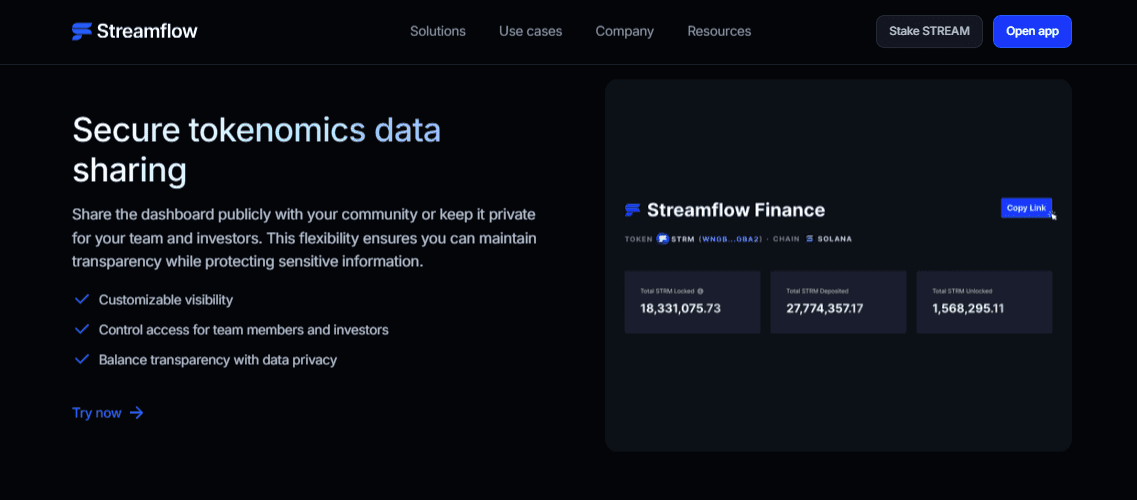
The tokenomics dashboard ties it together. It shows vesting contracts, locks, and staking pools in one real-time view, including release progress, cliff dates, and upcoming unlock events, giving investors and communities a single source of truth.
Teams ready to move from spreadsheet to contract can create a vesting schedule on Streamflow directly.
Security underpins all of it. Streamflow’s smart contracts are audited by FYEO and OPCODES, which reduces the manipulation, insider misuse, and rug-pull risks that manual tokenomics exposes.
Case Studies: How Three Solana Projects Structured Their Tokenomics
Three Streamflow case studies show how different projects applied these principles. Each chose a different allocation size and timeline, but all used on-chain vesting to make the plan verifiable.
Project | Allocation vested | Schedule |
|---|---|---|
Bonk | 20% of supply, 22 contributors | 3-year linear |
UXD Protocol | ~46% of $UXP supply | 4-year linear, 12-month cliff |
Heavenland | 97% of $HTO supply | 5-year linear, all allocations with cliffs |
The Bonk case study shows a community-first design. Bonk allocated 55% of supply to airdrops for early Solana users, then used Streamflow to vest 20% of total supply for 22 early contributors over three years, giving the community public proof that the team could not dump.
The UXD Protocol case study shows vesting combined with governance. UXD integrated the Streamflow SDK into Realms, so stakeholders could claim vested $UXP and participate in governance from the same interface, with roughly 46% of supply on a 4-year linear schedule after a 12-month cliff.
Heavenland’s vesting is the most comprehensive example. The Solana metaverse placed 97% of its $HTO supply on 5-year linear vesting with cliffs on every allocation, designed to allow initial liquidity without excessive inflation. The outcome was a more engaged, dedicated player community.
What This Means for Founders and Tokenomics Designers
For founders, the practical shift is simple: design the unlock calendar first, then work backward to allocations. If a schedule cannot survive being published on a public dashboard, it will not survive the market either.
For tokenomics designers and Web3 CFOs, the job extends past launch. Treasury management, contributor payouts, and long-term capital formation all depend on the same discipline of programmable, verifiable execution. That is the scope of Streamflow Business for financial operations, which extends token operations into treasury management with USD+, payouts, and on-chain cap tables.
The teams that last in 2026 combine speed with structure. Tokenomics is where that structure begins.

Conclusion
Tokenomics is not the allocation chart; it is the system of supply, vesting, unlocks, and incentives that determines how a token behaves after launch.
With $97.43 billion in tokens unlocked in 2025, the teams that win are the ones that design their unlock calendar deliberately and enforce it on-chain. Streamflow turns that design into immutable, audited smart contracts that holders can verify in real time.
Book a demo to see how Streamflow handles your full vesting, lock, and unlock schedule on Solana.
Read Next:
How to Launch a Meme Coin on PumpSwap in 2026 and Lock the Liquidity Yourself
Top 5 Token Management Tools on Solana in 2026: Airdrops, Vesting, Claims and Snapshots
How to Set Up Solana Vesting Without Writing a Smart Contract: No-Code Step by Step (2026)
FAQs:
1. What is tokenomics in crypto?
Tokenomics in crypto is the economic design of a token, covering total supply, allocation across stakeholders, vesting schedules, unlock timing, and incentives like staking. It determines how much supply reaches the market and when. Strong tokenomics aligns long-term incentives while preventing sudden supply shocks.
2. How should a startup design its token vesting schedule in 2026?
A startup should design its token vesting schedule in 2026 by assigning a separate schedule to each stakeholder group. Founders and core team typically receive a 12-month cliff followed by linear vesting, while investors, advisors, and ecosystem allocations get structures matched to their roles. The combined unlock calendar should be reviewed so cliffs never stack in the same month.
3. What is the difference between token vesting and a token lock?
The difference between token vesting and a token lock is how tokens are released. Vesting releases tokens gradually over time according to a schedule, while a token lock keeps tokens fully inaccessible until a fixed date or price condition is met. Teams often vest contributor allocations and lock treasury or LP tokens.
4. How do token unlocks affect a token’s price?
Token unlocks affect a token’s price by adding new supply that holders can sell. Large cliff unlocks concentrate that supply into a single event, while linear unlocks spread it over time and are easier for the market to absorb. Staggered schedules and staking incentives help reduce the impact.
5. How does Streamflow help teams execute tokenomics on Solana?
Streamflow helps teams execute tokenomics on Solana by converting vesting schedules, token locks, airdrops, and staking pools into audited, immutable smart contracts. Everything is configured without code and tracked on a real-time tokenomics dashboard. Over 40,000 projects and 1.3 million users rely on Streamflow for token operations.
