General
How to Create a Crypto Token in 2026: The Complete Guide for Solana Projects
More than 263,000 new SPL tokens were minted on Solana in a single day in September 2026, an all-time high based on Solscan data reported by Cointelegraph.
Yet CoinGecko’s study of over 18.67 million Pump.fun tokens found that almost 69% saw their final trade on launch day.
Streamflow, the Solana-native token operations platform behind $553M+ in TVL and 40,000+ projects, is built for the part that decides which side of that split a token lands on: what happens after the mint.
Creating a crypto token is now the easiest step in a token launch. The harder decisions are about supply, authorities, insider allocations, and distribution, and several of them can’t be reversed.
This guide covers the full sequence for Solana projects, from token design to the first public distribution.
Key Takeaways
Creating a crypto token on Solana takes minutes; surviving launch requires distribution and trust.
Design supply, allocations, and unlock rules before minting, because many token decisions are permanent.
Revoke mint and freeze authority once supply is final to give holders verifiable guarantees.
Streamflow locks and vests insider allocations on-chain, turning tokenomics into an enforceable public system.
Over 40,000 projects use Streamflow for token locks, vesting, airdrops, and distribution on Solana.

The Problem: Most Guides Stop at the Mint
Most token creation guides end when the mint transaction confirms. That is a reasonable place to end a tutorial, but a poor place to end a launch plan.
The CoinGecko data shows why. Only 4.55% of the Pump.fun tokens it studied stayed active for more than 90 days. Many of those tokens were disposable by design, so the figure says more about memecoin launches than about serious projects. It still shows that low creation costs don’t produce buyers, liquidity, or trust.
What’s Really Going On
A token launch is a credibility problem, and the code is the smallest part of it. Anyone evaluating a new token can inspect it on-chain in seconds. RugCheck’s risk checks cover mutable metadata, unlocked LP, active mint authority, and active freeze authority.
The raw issuance number needs context too. Solscan’s series counts every new mint account, which isn’t the same as a tradable coin or funded project. Launchpads accounted for 40,360 of that day’s tokens, roughly 15% of the total, so most new mints never competed for anyone’s attention.
Your token will still be judged against that noise. The practical response is to replace promises with things a holder can verify:
A supply that can’t be inflated
Insider allocations that can’t be sold early
Liquidity that can’t be pulled
Distribution rules anyone can check on-chain
None of these guarantees demand. They do remove the most common reasons for an informed buyer to walk away.
The Five-Step Framework for Creating a Token on Solana
The order matters here. Each step limits the options available in the next one, so work through them in sequence.
Step 1: Design the Token Before You Touch a Mint
Start with what the token does: governance, rewards, in-game currency, or community ownership. That job determines the supply, the allocation split, and the unlock pacing.
Write down these decisions first:
Total supply and decimals: set both with your emissions model in mind
Allocation split: team, investors, advisors, treasury, ecosystem, and community
Unlock mechanics: lock, vesting, or vested airdrop for each group
Legal position: ask counsel how the token may be classified in your markets
Map each stakeholder group to an enforcement mechanism at this stage:
Stakeholder group | Typical mechanism |
|---|---|
Founders and core team | 12-month cliff plus linear vesting |
Investors | Cliff plus linear vesting |
Advisors | Linear or graded vesting |
Treasury | Time-based token lock |
Community | Instant or vested airdrop |
Liquidity providers | LP token lock |
A GameFi team, for example, might tie emissions to player milestones and hold back treasury supply with time-based locks. The token’s job shapes the schedule, so this plan should exist before any supply does.
Step 2: Choose Your Token Program and Creation Path
Solana gives you two token programs. The original SPL Token Program covers standard fungible tokens, while the Token Extensions Program, also known as Token-2022, adds optional features at the protocol level.
Factor | SPL Token | Token-2022 |
|---|---|---|
Best for | Standard fungible tokens | Tokens needing built-in features |
Key features | Mint, transfer, burn | Fees, metadata, transfer hooks, pausing |
Main constraint | Limited native features | Extensions must be planned upfront |
Treat this as a one-time decision. Solana’s documentation says most extensions can’t be added once an account is initialized, and some can’t be combined, such as NonTransferable with TransferFeeConfig.
Choose Token-2022 only when you need a specific extension. Before minting, confirm that the wallets, DEXs, and token tools in your launch plan support that exact configuration.
You can then create the token in one of three ways:
No-code creator: suited to teams that want a full launch stack without engineering overhead
Solana CLI: suited to developers who want direct control and scripted deployments
Launchpad: suited to bonding-curve launches, with less control over the launch mechanics
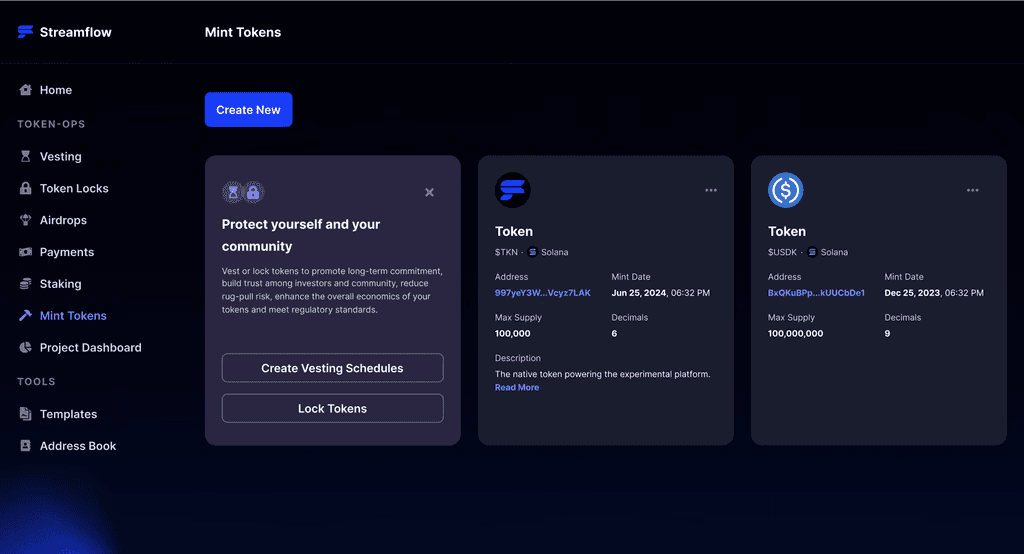
Teams can create a Solana token on Streamflow by configuring metadata, supply, and permissions, then manage locks, vesting, and distribution in the same platform. For developers, the core CLI flow looks like this:
Rehearse the entire flow on devnet first, using the same tools you plan to use on mainnet. A failed test costs nothing, while a mistake in a permanent mainnet setting can’t be undone.
Step 3: Mint the Supply and Settle Your Authorities
Metadata comes first because it is how wallets, explorers, and traders identify the token. Set the name, symbol, and logo, and publish the official mint address through channels you control so holders can spot impersonators.
Then decide who holds each permission:
Mint authority: controls whether more supply can ever be created
Freeze authority: controls whether token accounts can be frozen
Metadata update authority: controls whether the name, symbol, and logo can change
Setting a mint or freeze authority to None removes that role permanently, so mint the full planned supply first. On the CLI, revoking the mint authority takes one command:
Defaults differ between tools, so check both authority fields on Solscan rather than assuming. Retained authorities are sometimes justified. Stablecoin issuers, for example, legitimately keep them, but a community token should publish a clear reason if it does the same.
Consider a project with a fixed supply of 1 billion tokens. It would mint the full amount to a multisig-controlled treasury, verify the balance, and only then revoke mint authority. That order guarantees the supply is final before anyone can buy.
Step 4: Lock and Vest Before the Market Opens
A published allocation chart is a promise, while an on-chain contract is a constraint. Insider allocations should be under contract before public trading begins, so holders can verify them from the first trade.
Use each mechanism for its specific job:
Token locks: restrict tokens completely until a date or price condition is met
Token vesting: releases tokens gradually on a schedule
Cliffs: release nothing during an initial period, with 12 months standard for founders and core teams
Streamflow’s token locks take about 37 seconds to set up, and they can be verified on Solscan, Solana Explorer, and RugCheck. Locked tokens can’t be transferred, traded, or accessed before the unlock condition is met.
Automated token vesting follows a simple flow: create the contract, upload recipients, define the schedule, and fund it. Tokens then release automatically, and CSV import handles larger recipient lists.
Check every parameter before you deploy. Streamflow contracts are immutable once deployed, so settings such as cancellation rights must be decided during setup.
For a founding team of 10, each member could receive an individual contract with a 12-month cliff and linear vesting after it. The team then shares proof links publicly instead of asking the community to trust a spreadsheet.
Step 5: Seed Liquidity and Distribute With Intent
A token needs a market before it can trade, which usually means pairing it with SOL or a stablecoin in a DEX pool. Unlocked LP tokens leave a clear rug-pull path, so plan your liquidity lock alongside the pool itself.
Handle distribution in this order:
Seed the pool from a dedicated liquidity allocation
Lock the LP tokens and publish the proof link
Publish the official mint address and claim URLs
Open community distribution through a claim portal
For community distribution, Solana airdrops on Streamflow support up to 1 million recipients per campaign, 100,000 recipients per CSV, and vesting on claim. Unclaimed tokens can be returned, so an airdrop doesn’t have to leave stranded supply behind.
Treat airdrops as part of a growth plan, not a single event. A project could send part of an allocation instantly and vest the rest, rewarding holders who stay. Eligibility filtering and official claim links then help protect the campaign from sybils and phishing.
After distribution, utility takes over. Staking pools, contributor payments, and governance all give holders a reason to stay after the first claim.

How Streamflow Fits Into This
Most token launches involve several tools, which leaves allocation data scattered across spreadsheets, explorers, and dashboards. Streamflow brings token creation, locks, vesting, airdrops, staking, and payments into one Solana-native system. No smart contract development is required.
The tokenomics dashboard then gives teams and holders a single view of vesting contracts, token locks, staking pools, and unlock events. Teams with custom needs can build on the SDK, and teams that want their own interface can use white-label claim and staking portals.
Streamflow’s contracts are audited by FYEO and OPCODES, and distributions can be verified on-chain.
Open the Streamflow app to set up the lock and vesting contracts your launch plan calls for.
Case Study: How Bonk Made Contributor Allocations Verifiable
Bonk shows how this works for a community-first token. The Solana meme coin allocated 55% of its supply to airdrops for early Solana users, reserving the remainder for early contributors and operating expenses.
Bonk’s Streamflow vesting setup covered core team tokens:
20% of total supply allocated through Streamflow
22 early contributors covered
A 3-year linear vesting schedule
The outcome was trust and transparency for the community. Bonk’s holders could rely on contributor allocations enforced by on-chain contracts, not on verbal commitments.
What This Means for Web3 Founders
For founders, the mint should be one of the last decisions made and one of the first things verified. Allocation logic, authority plans, and unlock schedules should all be finished before a mainnet transaction is signed.
Ahead of launch, confirm that you can answer each of these questions publicly:
Can more supply be created, and who controls that?
Can any holder’s account be frozen?
When can the team, investors, and advisors sell?
Is liquidity locked, and for how long?
Where can holders verify all of this?
The token launch is also only the start of the operating model. As a project grows into a company, Streamflow Business extends these token operations into treasury management, payouts, on-chain cap tables, and tokenized SAFE agreements.

Conclusion
Solana has made it trivial to create a crypto token, as record issuance shows, but the launches worth trusting are the ones that make their commitments verifiable.
Design the token first, settle authorities, and put insider allocations under contract before the market opens. Streamflow turns that plan into an enforceable system, with audited contracts already supporting $553M+ in TVL.
Book a demo to see how Streamflow handles your token’s locks, vesting schedules, and launch-day distribution.
Read Next:
Streamflow vs Smithii for Airdrops and Multisending: Why Streamflow Scales Better in 2026
Do Volume Bots Get Pump.fun Tokens to Graduate? What Actually Moves a Memecoin to PumpSwap in 2026
What It Costs to Launch and Secure a Solana Token in 2026: Every Fee, Line by Line
FAQs:
1. How do you create a crypto token on Solana?
You create a crypto token on Solana by choosing a token program, setting the supply and decimals, adding metadata, and minting through a no-code tool, the CLI, or a launchpad. You then settle the mint and freeze authorities. Serious projects should also lock or vest insider allocations before trading begins, which Streamflow handles on-chain.
2. How much does it cost to create a token on Solana?
The cost to create a token on Solana is usually small because network fees are near zero. Helius has documented the CLI route at roughly 0.0035 SOL, while no-code tools may add service fees and vary by feature. On Streamflow, the later lock and vesting contracts carry smart contract creation fees plus Solana transaction fees.
3. Should I revoke mint authority after creating my token?
You should revoke mint authority after creating your token if the supply is meant to be fixed. Revoking it is permanent, so complete all planned minting first. Keep the authority only if your tokenomics require future issuance, and explain the reason publicly.
4. Should I use SPL Token or Token-2022 for a new Solana token?
You should use SPL Token for a new Solana token unless you need a specific extension such as transfer fees or transfer hooks. Token-2022 is the better fit when one of those features is core to the design. Most extensions must be chosen upfront, so test your full tool stack on devnet before you commit.
5. How can I prove that my team’s tokens are locked?
You can prove that your team’s tokens are locked by placing them in an on-chain contract and sharing its public proof link. Streamflow locks can be verified on Solscan, Solana Explorer, and RugCheck, and vesting contracts can also be checked on block explorers. The tokenomics dashboard then gives holders one place to follow every allocation.

Related articles
Read more from our blog
General
Streamflow vs Liquifi: Token Vesting and Cap Table Management Compared, and Why Streamflow Leads on Solana (2026)
General
Streamflow vs Smithii for Airdrops and Multisending: Why Streamflow Scales Better in 2026
General